Aug 22, 2019 | Advocacy, News
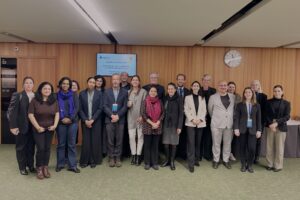
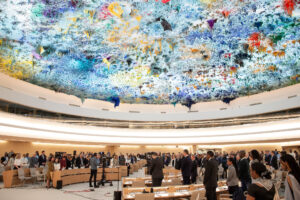
Today, the ICJ joined 10 other international and Venezuelan human rights organizations to call the United Nations Human Rights Council to establish a Commission of Inquiry (COI) on human rights in Venezuela in its upcoming session in September.
The ICJ considers that an independent COI is necessary given the Venezuelan authorities have been unable or unwilling to pursue effective domestic accountability and the judicial and prosecutorial mechanisms lack independence and impartiality.
In recent years, the ICJ has documented in several reports the lack of judicial independence, the lack of accountability for those allegedly responsible for gross human rights violations, the abuse and misuse of the military jurisdiction, and wide ranging breakdown in the functioning of the rule of law.
The United Nations High Commissioner for Human Rights in her 2019 report has similarly stressed that wide ranging human rights violations had occurred in Venezuela evidenced by the excessive use of force by security forces, attacks on freedom of expression, arbitrary detention and extrajudicial killings, dismantling of checks and balances, and deprivations constituting violations of the right to food and health. In addition, a panel of independent international experts mandated by the Secretary General of the Organization of American States (OAS), mentioned in 2018 “that reasonable grounds exist to believe that crimes against humanity have been committed in Venezuela”.
Commissions of Inquiry have been effectively established by the UN Human Rights Council to assess serious situations of human rights in several countries where there is a need to ensure proper human rights fact finding and ultimately accountability for widespread or systematic human rights violations. These include COIs for Syria, North Korea, Burundi, Yemen, Libya and Eritrea.
The ICJ and the other organizations have emphasized that the Commission of Inquiry that could be established for Venezuela “should be mandated to investigate reports of violations of international human rights law in Venezuela, including but not limited to violations associated with torture and inhuman treatment, arbitrary detention, discrimination, violations of freedom of expression, violations of the right to life and enforced disappearances, as well as violations of the rights to health and food. It should be tasked with establishing the facts and circumstances of violations committed since at least 2014, mapping out patterns of violations and identifying those responsible and, where possible, the chain of command, with a view to contributing to full accountability for all violations including those that constitute crimes under international law (…)”.
Download:
Venezuela-COI final-Advocacy-2019-ENG (full Q&A document prepared by all 11 organizations in PDF)

Aug 21, 2019
On the occasion of the second United Nations’ International Day of Remembrance of and Tribute to Victims of Terrorism, the ICJ has today published a compilation of international sources on human rights of victims of terrorism.
The compilation features a preface by the UN Special Rapporteur on the promotion and protection of human rights and fundamental freedoms while countering terrorism, Ms Fionnuala Ni Aolain.
It collects relevant UN General Assembly, Human Rights Council, and Security Council resolutions; findings and recommendations of the Special Rapporteur; and other UN and regional sources.
Human rights of victims of terrorism are set to receive new attention and focus at the global level.
Among important current developments are the following:
- The Human Rights Council’s most recent renewal, in March, of the mandate of the UN Special Rapporteur, highlighted and endorsed the ongoing efforts of current Special Rapporteur Fionnuala Ni Aolain to mainstream and highlight the human rights of victims of terrorism in relation to country visits and thematic work carried out by the mandate.
- In June in New York, a group of States led by Afghanistan and Spain launched a “Group of Friends of Victims of Terrorism” with the aim of bringing additional focus and activity at the United Nations to this topic.
- In July the General Assembly adopted for the first time a resolution on “Enhancement of international cooperation to assist victims of terrorism”.
- The UN Office of Counter-Terrorism is preparing to convene a global Congress of Victims of Terrorism in June 2020.
Many governments have long invoked the suffering of victims of terrorism in seeking to justify counter-terrorism measures that do not comply with human rights law, or indeed the rule of law more generally, while failing in practice to adopt and implement concrete measures at the national or global level to respect, protect and fulfil the actual human rights of victims of terrorism.
The ICJ accordingly welcomes the renewed focus and cooperation within the United Nations on concrete measures to ensure that the human rights of victims of terrorism are fully respected, protected and fulfilled.
Civil society, including groups that specifically represent victims as well as other organizations with a range of relevant experience and expertise, has an important role to play, not only in implementing but also in helping to shape those efforts.
The ICJ hopes the present publication will be found useful by all engaged in these processes, and looks forward to further engagement and progress towards the better realization of human rights of victims of terrorism in the years to come.
For more information, contact un(a)icj.org
Download
Universal-Compil Victims of Terrorism USLet-Publications-reports-thematic reports (full compilation in PDF)

Aug 21, 2019 | News
The ICJ in collaboration with the Zimbabwe Anti-Corruption Commission (ZACC) and the National Prosecuting Authority (NPA), today launched a broad base anti-corruption awareness campaign in Harare.
The campaign was introduced by the President of Zimbabwe H.E. Cde Emmerson D. Mnangagwa and is expect to effectively run for 15 months.
It will harness different forms of media to spread awareness on the negative impact corruption has on the rule of law, human rights and development.
The anti-corruption awareness campaign is part of a broader longstanding rule of law initiative by the ICJ in collaboration with with stakeholders in the justice sector, to strengthen the rule of law for the protection and promotion of human rights for all, including women and persons from marginalized or disadvantaged groups.
Corruption undermines the rule of law by impeding access to justice through diversions of public resources for private gain.
As such the ICJ, through the support of the EU, is working towards increased transparency and integrity in the justice delivery system in order to increase access to justice for all.
“Zimbabwe has no option but to fight corruption if it is to be a just, peaceful and successful developmental state,” said Arnold Tsunga, ICJ’s Africa Regional Director.
“The reconstituted ZACC has demonstrated a strong desire to pursue its mandate with renewed commitment from other stakeholders in the justice delivery chain,” he added.
The campaign is not undertaken in isolation. It builds on other initiatives to combat corruption under this programme, which include the establishment of an anti-corruption court, training of personnel for the court and various research initiatives.
The campaign seeks to support the national efforts against corruption, and sensitize the public on the negative effects of corruption in society.
It will promote awareness on how to report corrupt practices, how to avoid corrupt practices and the impact of corruption on the public interest.
The campaign acknowledges that different sections of the population engage with media in varying manners. As such it utilises a wide array of approaches designed to build the optimism of the people of Zimbabwe to take an active role in efforts to combat corruption at every level of society.
The campaign launch was attended by justice sector actors, civil society representatives, business representatives and the diplomatic.
Contact:
Arnold Tsunga, Director of the Africa Regional Programme, International Commission of Jurists C: +263 77 728 3248, E: arnold.tsunga(a)icj.org
Aug 20, 2019
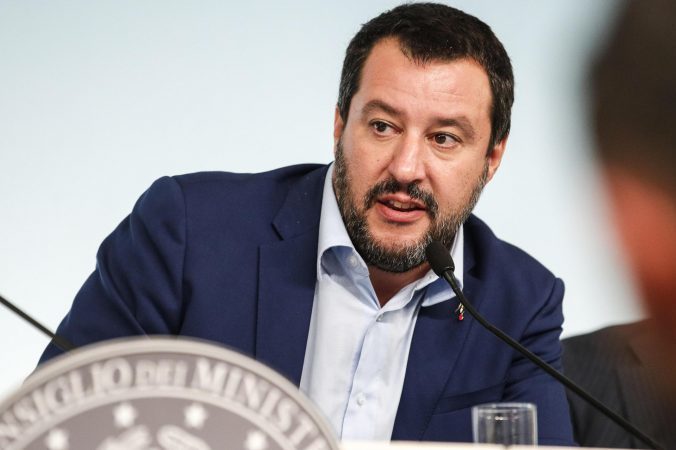
An opinion piece by Massimo Frigo, ICJ’s Senior Legal Adviser for Europe and Central Asia. This Op-ed was first published in the EU Observer.
Since he became Minister of Interior, Matteo Salvini has repeatedly vowed to close Italian harbours to migrants, including refugees, and NGOs, making it the central objective of his migration policy.
The latest attempt has been the issuance by the Government of a Law Decree called “Security Decree bis”. converted into law at the beginning of August by Parliament.
The Decree gives exceedingly wide power to the Minister of Interior “to restrict or prohibit the entry, transit or stop of any vessel in the territorial sea”.
The restriction or denial order may be issued for “reasons of public order and security or when the conditions arise under article 19.2.g of the UN Convention on the Law of the Sea.” Article 19.2 is about lack of respect of national immigration laws.
The same Decree affirms that the vessel’s captain must observe international law and the prohibition of entry, if ordered, by the Minister of Interior.
In case of breach of the prohibition of entry, the captain and the owner of the boat are sanctioned with an administrative fine between 150.000 and 1.000.000 EUR and the seizure of the boat.
As is evident from its express wording, the Decree itself recognizes that its terms are conditioned by the requirements international law. This limitation was highlighted as well by the President of the Republic, Sergio Mattarella, in his message accompanying the promulgation of the law that reinforced the duty of rescue upon any boat’s captain under the UN Convention on the Law of the Sea.
This was also a mandatory condition, since article 117 of the Italian Constitutions holds that the laws must respect “the constraints deriving from EU legislation and international obligations”.
The law strikes back
It is for this reason that, since the promulgation of the Law Decree and its approval by Parliament, judicial decisions have hampered the purported aim of the Decree to close the Italian harbours.
The Judge of Preliminary Investigations of Agrigento, who, on 2 July, ordered the release from detention of Captain Carola Rackete of the Sea Watch 3, did so because she considered that her entry in breach of the prohibition under the Security Decree bis could not be unlawful, since it was done during a rescue operation, that is an obligation under international law.
A similar reasoning was followed, by the Administrative Tribunal of the Lazio Region, which on 14 August issued an injunction to the Government to let the boat Open Arms to enter Italian territorial waters so as to allow immediate assistance to persons in need.
According to media accounts, the Juvenile Court of Palermo has similarly questioned the Government on the situation of the several children aboard the Open Arms defining the situation of the boat as that of a push-back by Italian authorities.
The Open Arms is still at large and hosts more than 130 people, including a number of children. The ICJ and several other organizations have called on Italy and Malta to allow for the disembarkment of the passengers of the Open Arms for the last days.
The attacks on the Rule of Law
Matteo Salvini, who, in the meantime, has withdrawn his support for the Government – while remaining in charge as Minister of Interior – and called for new elections in the next autumn, has relentlessly attacked the judges and the judiciary in general for issuing “political decisions” in opposition to the “will of the Italian people” and of not respecting the law.
He has often called for a reform of the judiciary whenever an unfavourable decision has been issued.
More recently, he openly challenged the order of the Administrative Tribunal of Lazio by attempting to issue a new decree of prohibition of access to Italian waters for the Open Arms.
This move was blocked by the refusal of countersigning the order by the Minister of Defence and the Minister of Transports and Infrastructures.
However, it did not stop Salvini from openly criticizing the ruling of the Tribunal and hinting that there is a “plan to come back and open Italian harbours to make Italy be again the reception centre of Europe.”
These attacks by Matteo Salvini have been by UN independent experts, including the UN Special Rapporteur on Judges and Lawyers and by the International Commission of Jurists (ICJ) that emphasized that fundamental principles regarding the independence of the judiciary forbid such inappropriate interference with judicial process by the executive.
What is really at stake?
So, what is at stake in the cases of Sea Watch 3, Open Arms, and more generally in the role of courts?
It is not only the immigration policy of Italy or the EU, or the protection of migrants, including refugees, in extremely vulnerable and often life-threatening conditions that are stake.
It is the respect and protection of the Rule of Law, in particular of the independence of the judiciary and of the separation of powers that are at stake.
The attacks to Italian judges and the judiciary by Minister Salvini concern every person because an independent judiciary is an essential guarantee for the respect, protection and fulfilment of the human rights of everyone, and once it is undermined it is undermined for everyone.
In the cases noted above, the judges have done nothing more than reaffirm basic legal rules and principles.
And, thankfully, this means that thousands of people that find themselves wretched in dangerous conditions may be protected from abuse and, in many cases, death, because they have rights under international law as any other human being.
And this is what is the duty of judges and the Rule of Law to uphold.
Aug 19, 2019 | Advocacy, Cases, Legal submissions
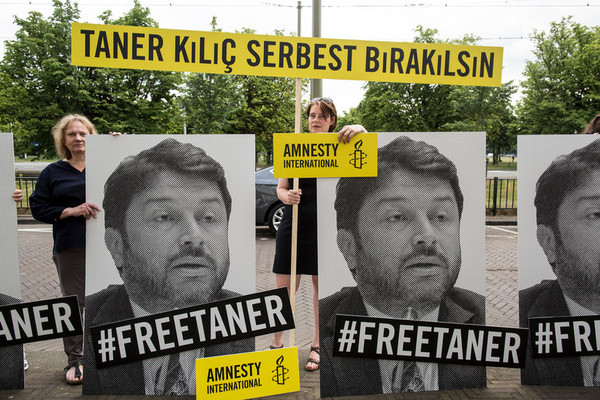
The International Commission of Jurists, the Turkey Human Rights Litigation Support Project and Human Rights Watch have jointly intervened before the European Court of Human Rights in the case of Taner Kiliç, former Chair of the Board of Amnesty International Turkey.
Taner Kiliç is a Turkish human rights defenders. He had been Chair of the Board of Amnesty International Turkey since 2014.
He was arrested on 6 June 2017 on reportedly unsubstantiated charges of “membership of a terrorist organisation” and was released on bail on 15 August 2018 after having spent 14 months in detention.
His case before the European Court of Human Rights challenges the lawfulness of his pre-trial and on remand detention, the violations of his right to judicial review of his detention, and of his freedom of expression and association, considering his arrest linked to his work as leader of a NGO.
As the interveners have written to the Court, this case epitomises some of the most fundamental human rights challenges in Turkey today.
These involve widely documented restrictions on freedom of expression, association, and assembly of human rights defenders (HRDs) and rapidly closing civil society space.
The interveners have submitted observations on:
- the factual context in respect of the situation facing HRDs in Turkey;
- international standards governing obligations towards HRDs of relevance to the Court’s interpretation of the European Convention on Human Rights, including the limits prescribed by Article 18;
- key principles necessary for a rule of law approach to the application of the criminal law, against the legal and practical pattern of excessive resort to criminal law against HRDs in Turkey today.
Turkey-ECtHR-icj&others-Kilic-Advocacy-legal submission-2019-ENG (download the third party intervention)
Photo credit: Amnesty International