Dec 6, 2013 | News
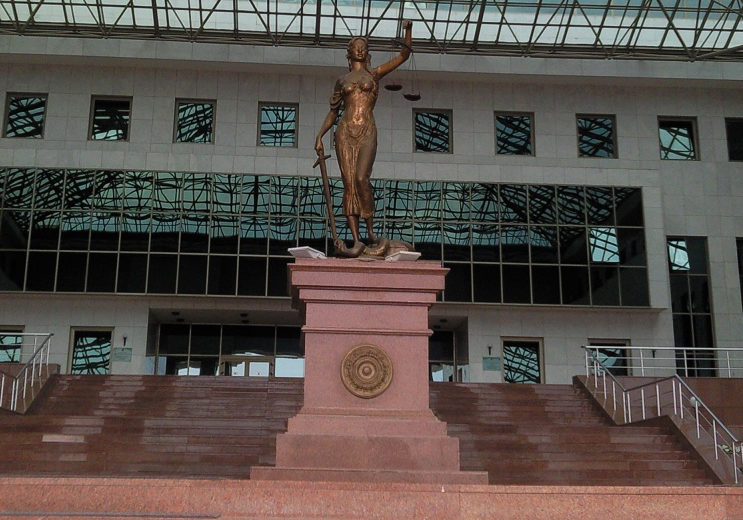
On 6 December, the ICJ concluded a trial observation mission to Kazakhstan on the case of the disbarment of lawyer Polina Zhukova.
Lawyers Lyubov Agushevich and Polina Zhukova were disbarred following disciplinary proceedings initiated by the Ministry of Justice regarding their defence of a client in court proceedings.
The alleged misconduct, which lead to the disbarment of the lawyers, included inter alia a statement of innocence of their client, submitting motions to the court, submitting requests for recusals, one lawyer “putting a question which she knew the answer to”, reading a page out of the case file, and filing a motion for an examination of the witnesses who attended the hearing.
These actions were interpreted by the presiding judge in the criminal case in which the lawyers represented the defendant as violations of professional ethics, and were later used as grounds for the termination of their licenses to practice law.
ICJ observers, Justice Ketil Lund, an ICJ Commissioner and a former Justice of the Supreme Court of Norway, and Zulfikor Zamonov, a lawyer from Tajikistan, observed the Supreme Court appeal hearing in the case on 5 December.
The Supreme Court upheld the motion of lawyer Zhukova to resume proceedings in her case and reconsider the issue of the lawfulness of her disbarment.
“The ICJ welcomes the decision to review the case against the lawyer and will continue following the case,” said Temur Shakirov, Legal Adviser of the ICJ Europe Programme.
Read also:
Disbarment proceedings against lawyers in Kazakhstan
Disciplinary action against lawyers in CIS countries: analysis of international law and standards
Contact:
Róisín Pillay, Director, ICJ Europe Programme, roisin.pillay(a)icj.org
Temur Shakirov, LegalAdviser, ICJ Europe Programme, temur.shakirov(a)icj.org
Dec 5, 2013
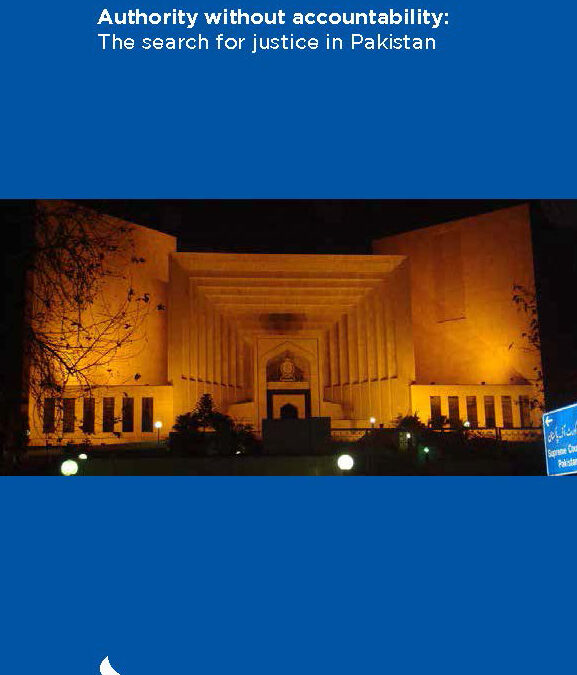
Supreme Court Chief Justice Iftikhar Muhammad Chaudhry finishes his eight-year term on 12 December 2013, leaving the legacy of a robust and assertive Court, as well as some well-founded criticisms of inconsistency in its approach to human rights, the ICJ says in a new report released today.
The ICJ’s 99-page report, Authority without accountability: the search for justice in Pakistan, presents a detailed assessment of the Court’s human rights jurisprudence during Chief Justice Chaudhry’s tenure.
It also provides recommendations to the Court to build on its work and improve its central role as a bulwark for the rights of the Pakistani people and the rule of law.
“The ICJ commends Chief Justice Chaudhry for redefining the Court as an independent institution and closing the door to military rule in Pakistan,” said Sam Zarifi, Asia Director for ICJ. “But there are also concerns about how the Court has exercised its judicial authority in protecting and promoting human rights.”
Under Chief Justice Chaudhry, the Supreme Court has increasingly used its authority to intervene directly in matters of public interest, invoking its “extraordinary jurisdiction’’ under Article 184(3) of the constitution.
The ICJ report shows that the Supreme Court has succeeded, in some cases, to bring accountability to a government and military that have long enjoyed impunity for human rights violations.
“However, the lack of guidelines about how the Court exercises this extraordinary power has led to criticisms about how it decides which cases to hear and, as importantly, which cases to ignore,’’ Zarifi added. “This lack of transparency corrodes the Court’s tremendous achievements and undermines the principles of rule of law that the Court seeks to uphold.”
The report documents some of the Supreme Court’s strides in strengthening the rights of victims to justice and remedy.
The Supreme Court has consistently taken a firm stance against unconstitutional usurpation of power by the military and has effectively held public officials accountable for corruption and abuse of power, it says.
In doing so, the Court has brought Pakistan closer to fulfilling some of its obligations under international human rights law.
“There is still a long way to go before civilian and military authorities in Pakistan are truly brought to justice for human rights violations,” said Zarifi. “But the Supreme Court has certainly made a visible dent in the culture of impunity, spanning decades in Pakistan.”
The ICJ study also sheds light on some inadvertent yet predictable consequences of the expanded use of Article 184(3), which if left unchecked, may weaken the rule of law and independence of the judiciary.
These include an overwhelming increase in case-load, leading to long delays faced by litigants; dispositions in cases that leave affected partied without any remedy or redress; influence on trial courts and interference with the presumption of innocence, blurring of institutional boundaries and undermining separation of powers, and the creation of a two-tier and arbitrary justice system.
“The Court should address these concerns as a matter of priority to ensure its hard-won independence is not undermined by allegations that the highest court of Pakistan is politically motivated,” said Zarifi.
“Under international standards, the judiciary must not only be independent and impartial, it must also be seen to be independent and impartial,” he added. “The absence of any actual or perceived bias is critical to ensure public confidence in the fair administration of justice.”
Some examples of the Supreme Court’s inconsistent use of its extraordinary jurisdiction to promote and protect human rights:
- The Court declared the Contempt of Court Act 2012 (a law that sought to curtail the judiciary’s contempt powers) void in less than two months after it was passed by Parliament. However, the Court has still not acted on a petition, made in 2011, calling for a review of the Actions (in Aid of Civil Power) Regulations, which facilitates enforced disappearances and arbitrary detention.
- In June 2012, the Chief Justice assumed jurisdiction on its own motion (known suo motu notice) of a case involving corruption allegations against his son, Arsalan Iftikhar. By contrast, in the same year the Court did not act when persons belonging to the minority Ahmadiyya community were attacked and their places of worship vandalized and destroyed.
The ICJ reiterates recommendations made in its 2011 Pakistan Mission Report:
- The Supreme Court should exercise its powers under Article 184(3) of the Constitution in a manner that complies with Pakistan’s obligation under international law to promote, protect and respect human rights, maintain rule of law and uphold separation of powers.
- The Court should adopt transparent yet flexible criteria to govern how cases are selected under Article 184(3), and in particular taken up under the Court’s suo motu jurisdiction, taking into account that suo moto procedures are an exception exercise of power.
Contact:
Sam Zarifi, ICJ Asia Pacific Regional Director (Bangkok), t: +66 807819002; email: sam.zarifi(a)icj.org
Reema Omer, ICJ International Legal Advisor for Pakistan (Lahore), t: +923214968434; email: reema.omer(a)icj.org
Pakistan-Authority without Accountability-Executive Summary-Publications-report-2013 (Download executive summary, in pdf)
Pakistan-Authority without Accountability-Publications-report-2013 (Download full report, in pdf)
Pakistan-Retiring Chief Justice-news-press release-2013-urdu (full text in pdf)
Dec 5, 2013 | Events, News
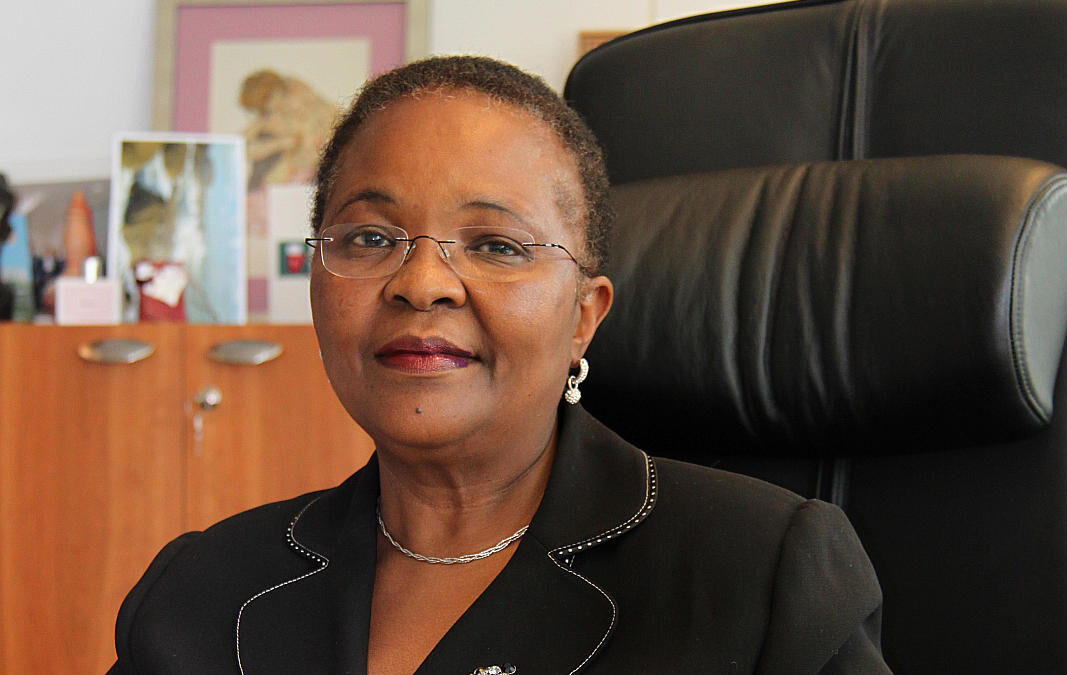
The 4th ICJ Geneva Forum of Judges and Lawyers opened today. This year’s forum promotes the role of women in the judiciary, focusing particularly on women judges and lawyers from Africa and the Middle East.Scheduled on 5-6 December, it forms part of a broader ICJ initiative on women judges, lawyers and human rights defenders as agents of change.
The Forum is convened annually by the ICJ’s Centre for Independence of Judges and Lawyers, bringing together legal practitioners from around the world to help safeguard the independence and impartiality of the judiciary and the legal profession.
The 2013 edition of the Forum is supported by the République and Canton de Genève, Australian Aid, and PeaceNexus Foundation.
ICJGeneva Forum 2013-Final Agenda-event-2013 (download in pdf)
ICJGeneva Forum 2013-Participants list-event-2013 (download in pdf)
Picture: ICJ Commissioner Sanji Monageng (Botswana) will chair the session on stories from the frontline.
Dec 3, 2013 | Agendas, Events
The ICJ was at the Club de la Presse in Geneva for a roundtable ahead of the Fourth ICJ Geneva Forum of Judges and Lawyers. The event was live streamed.
Moderated by Leah Hoctor, Senior Legal Adviser at ICJ, the event was a unique opportunity to share the real life experiences of two African women, who have overcome the challenges of poverty and discrimination to become two of Africa’s most senior and admired judges.
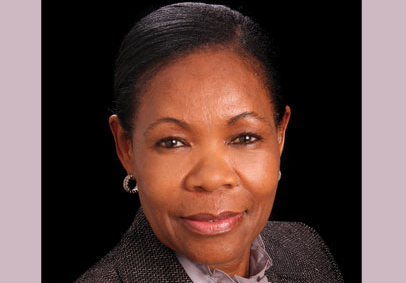
Justice Yvonne Mokgoro (photo) was the first black woman judge in South Africa and a former justice of its post-apartheid Constitutional Court.
Justice Lilian Tibatemwa-Ekirikabinza is an academic leader in Uganda. She was the first Ugandan woman to qualify for an award of a Ph.D. in Law.
The Press Club event came ahead of the Fourth ICJ Geneva Forum of Judges and Lawyers on 5-6 December.
The Forum is convened annually by the ICJ’s Centre for Independence of Judges and Lawyers, bringing together legal practitioners from around the world to help safeguard the independence and impartiality of the judiciary and the legal profession.
This year’s forum promotes the role of women in the judiciary, focusing particularly on women judges and lawyers from Africa and the Middle East.
It forms part of a broader ICJ initiative on women judges, lawyers and human rights defenders as agents of change.
Watch the event here:

Dec 3, 2013 | Новости, Статьи
Сегодня МКЮ рассмотрела слушание по делу Зинаиды Мухортовой, адвоката, задержанной до недавнего времени в психиатрическом учреждении, предположительно из за выполнения своих профессиональных обязанностей, но выпущенной 1 ноября.
На слушании 2 декабря Карагандинский областной суд подтвердил законность ее задержания, поддерживая ранее принятое решение Балхашского городского суда 20 августа 2013 года о предоставлении ходатайства прокуратуры о задержании адвоката.
«Вероятность ее повторного задержания для законного осуществления ее профессии поднялась после этого решения», – прокомментировала Альмаза Османова, наблюдатель МКЮ, присутствовавшая на слушании.
Заместитель начальника медицинского учреждения, в котором была задержана Зинаида Мухортова (фото), доктор Р.Р. Искаxaков присутствовал на слушании и настаивал на законности ее задержания.
МКЮ ранее сообщала об отказе доктора Искахакова освободить адвоката Мухортову до завершения всех судебных процессов.
Миссия МКЮ по наблюдению за судом состояла из двух наблюдателей: Альмазы Османовой, практикующего юриста из Кыргызстана и Каюма Юсуфова, практикующего юриста из Таджикистана.
МКЮ прежде уже делала заявления после задержания адвоката Мухортовой и последующего освобождения из психиатрического учреждения:
Казахстан: МКЮ приветствует освобождение адвоката, содержавшейся в психиатрическом учреждении
Казахстан: Содержание адвоката в психиатрической лечебнице должно быть прекращено
Контакты:
Роушин Пиллей, директор Региональной программы МКЮ по Европе, roisin.pillay(a)icj.org
Тимур Шакиров, правовой советник Региональной программы МКЮ по Европе, temur.shakirov(a)icj.org