Jun 12, 2013 | News
The Tshwane Principles on National Security and the Right to Information seek to protect the right to information and to ensure public access to information held by governments, without jeopardizing legitimate efforts to protect people from security threats.
Jun 12, 2013 | Agendas, Events
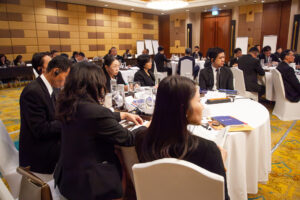
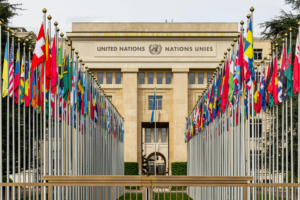
On Tuesday 11 June 2013, the ICJ convened a parallel event, organised with the Geneva Academy of International Humanitarian Law and Human Rights, during the Human Rights Council’s 23rd regular session held in Geneva.
The event, held in Room XXV of the Palais des Nations, discussed how human rights will be promoted by the Arms Trade Treaty (ATT), including ways to ensure compliance with the ATT and the relevance of the treaty for activities of the Human Rights Council and international human rights experts. The event was chaired by Alex Conte, Director of the ICJ’s International Law and Protection Programmes. Panelists were Simon Bagshaw, Senior Policy Adviser for the UN Office for the Coordination of Humanitarian Affairs; Professor Andrew Clapham, Director of the Geneva Academy of International Humanitarian Law and Human Rights; and Dr Stuart Casey-Maslen, Head of Research at the Geneva Academy of International Humanitarian Law and Human Rights.
Simon Bagshaw provided a background to the treaty from a humanitarian perspective, recognising that the ATT provides an opportunity to address some of the humanitarian impacts and costs of the arms trade. He also stressed the importance of specific elements within the treaty, such as the obligation to refrain from authorising the transfer of weapons where a substantial risk exists that this may result in serious violations of international human rights law or international humanitarian law.
Andrew Clapham and Stuart Casey-Maslen focussed on the human rights perspective. Professor Clapham promoted the use of mechanisms such as the Human Rights Council and its Universal Periodic Review to assist in implementation of the treaty. Dr Casey-Maslen discussed areas that may help ratification, implementation and monitoring of the ATT, including the role of civil society in that regard.
Several questions were raised during discussions concerning how the treaty would work in practice and its broader implications for non-State actors. Panellists confirmed that the ATT includes the facilitation of crimes as enumerated in the treaty and may also cover domestic crimes of terrorism. Since the ATT does not provide for the establishment of fact-finding missions, it was emphasised that civil society will need to act to monitor compliance with the ATT. Panellists also pointed out the important role of the treaty regarding the conduct of non-State actors. Although the treaty sets out obligations for States only, States parties will be responsible for providing licensing to arms manufacturers and private companies working within the weapons industry.
UN HRC-Arms Treaty side event flyer-event-2013 (event flyer in pdf)

Jun 12, 2013
The ICJ has submitted an alternative report to the Human Rights Committee for the evaluation of Indonesia’s implementation of the International Covenant on Civil and Political Rights (ICCPR).
In its submission, prepared as a report alternative to Indonesia’s initial report to the Human Rights Committee, the ICJ addresses issues concerning the right to an effective remedy; the right to life; and rights of persons belonging to minorities. This follows the ICJ’s submission of information to the Committee in December 2012 in the preparation of a list of issues for the examination of Indonesia. The current report calls on the Committee to make recommendations on articles 2, 6, 7 and 27 of the ICCPR.
The initial report of Indonesia will be considered by the Human Rights Committee during its 108th session held in Geneva on 8 to 26 July 2013, following which the Committee will adopt Concluding Observations with recommendations.
Indonesia-HRCttee108-ICJ-AlternativeReport-LegalSubmission-2013 (download full alternative report by the ICJ)
ICJ submission on the list of issues for the examination of Indonesia

Jun 10, 2013 | Agendas, Events
On Friday 7 June 2013, the ICJ convened a parallel event during the Human Rights Council’s 23rd regular session held in Geneva.
The event, held in Room IX of the Palais des Nations, addressed key issues concerning past and present challenges to the rule of law in Zimbabwe in the context of the upcoming elections and the need for the international community to remain vigilant about the necessity for free, fair and peaceful elections in the country. The event was chaired by Martin Okumu-Masiga, Deputy Director of the ICJ’s Africa Regional Programme. Panelists were MacDonald Lewanika, Director of Crisis Coalition; Okay Machisa, Director of the Zimbabwe Human Rights Association; and Irene Petras, Executive Director of Zimbabwe Lawyers for Human Rights.
Zimbabwe is scheduled to hold general elections before the end of 2013. Past elections in the country have been marred by violence and attacks on human rights defenders and the rule of law more generally. In the period leading to the 2013 elections, there have been several incidents of crackdown on political dissents and independent voices. The impunity enjoyed by past and current perpetrators electoral violence has continued to exacerbate fears for the integrity, peaceful conduct and fairness of the upcoming elections.
Zimbabwe-HR Council side event on elections in Zimbabwe-event-2013 (event flyer in pdf)
ICJ draws attention to risks of violence in the forthcoming general elections in Zimbabwe

Jun 10, 2013
The ICJ today called on the Human Rights Council to support the recommendations of the Special Rapporteur on the situation of human rights in the Occupied Palestinian Territories (OPT).
In a general debate under Item 7 (human rights situation in Palestine and other occupied Arab territories), the ICJ called for the immediate charging with precise criminal offences, or unconditional release, of Palestinians arbitrarily detained in Israel and the OPT. It characterised the construction, expansion and encouragement of settlements in the OPT as a de facto annexation of Palestinian land and an illegal exploitation of its natural resources. The ICJ also called for meaningful action to hold to account the perpetrators of human rights violations and abuses in the context of activities of business enterprises.
The statement was delivered during the Human Rights Council’s 23rd regular session (27 May to 14 June 2013).
Israel-OPT-HRC23-Item7GD-LegalSubmission-2013 (download full oral statement in PDF)