May 30, 2013
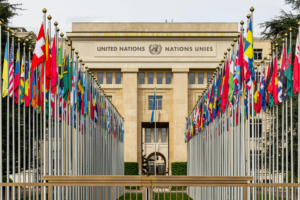
The ICJ today addressed the Human Rights Council, and the Special Rapporteur on the independence of judges and lawyers, concerning the need for protection of lawyers in Viet Nam.
In an interactive dialogue with the Special Rapporteur on the independence of judges and lawyers, Gabriela Knaul, the ICJ emphasised that legal aid (the subject of the Special Rapporteur’s report to the Council) is fruitless without proper protection of the legal profession. Referring to articles 16-18 of the UN Basic Principles on the Role of Lawyers, the ICJ drew attention to challenges faced by human rights lawyers in Viet Nam, particularly those who have been disbarred and not allowed to practice in their work representing victims of discrimination and land confiscation.
The ICJ urged the Government of Viet Nam to extend to the Special Rapporteur an invitation to undertake a mission to Viet Nam and to cooperate with her and allow her to effectively consider these and other obstacles to the effective functioning of the legal profession in the country.
The statement was delivered under Item 3 (promotion and protection of all human rights) of the agenda of the Human Rights Council’s 23rd regular session (27 May to 14 June 2013).
VietNam-HRC23-OralStatementIJL-LegalSubmission-2013 (download ICJ oral statement)
May 29, 2013
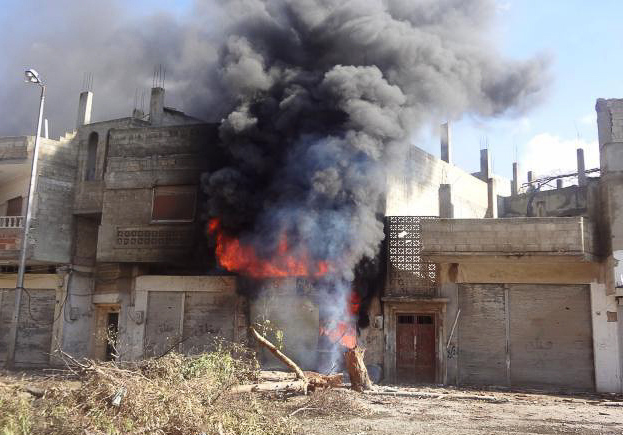
The ICJ today addressed the Human Rights Council during its urgent debate on the situation of human rights in the Syrian Arab Republic.
The ICJ again called for the Human Rights Council to request the UN Security Council to take effective measures at its disposal to end the ongoing conflict in Syria and to refer the situation to the International Criminal Court. Drawing attention to continued violence, gross violations of human rights and serious violations of international humanitarian law by government and anti-government forces, the ICJ reiterated its repeated calls for the international community to act and to address the humanitarian crisis.
The statement was delivered during an urgent debate on the situation in Syria held as part of the Human Rights Council’s 23rd regular session (27 May to 14 June 2013). The urgent debate concluded with the adoption of a resolution on the subject.
Syria-HRC23-UrgentDebate-OralStatement-LegalSubmission-2013 (download ICJ’s oral statement in full)
A_HRC_23_L1 (as revised and adopted) (download resolution)
Photo by Freedom House

May 29, 2013 | Agendas, Events
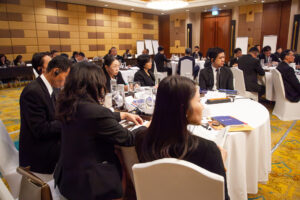
On Tuesday 28 May 2013, the ICJ co-sponsored a parallel event with TRIAL and the Missions of Botswana, Costa Rica, Estonia and Switzerland during the Human Rights Council’s 23rd regular session held in Geneva.
The event, held in Room XXV of the Palais des Nations, addressed key issues concerning accountability and human rights. The event was chaired by Professor Paola Gaeta from the Geneva Academy of International Humanitarian Law and Human Rights. Panelists were Tiina Intelmann, President of the Assembly of the States Parties to the ICC Statute; Mothusi Bruce Rabasha Palai, Ambassador of Botswana; Ian Seiderman, Director of the ICJ’s Law and Policy Office; and Gabriella Citroni, Senior Legal Adviser at TRIAL (Swiss association against impunity).
Panelists agreed that accountability is intimately linked to the enjoyment of human rights. It was stated that – under State responsibility – States are, or should be, held responsible for acts involving any violation of international law, including international human rights law and international humanitarian law. Accountability is thus not only about criminal justice, but also about ensuring reparations and guarantees of non-recurrence.
Recommendations made under the Universal Periodic Review (UPR) mechanism were seen as having been partly successful in bridging gaps, although there remains a lack of proper follow-up on the progress of implementation between UPR cycles. Panellists observed that States often fail to refer to standards enunciated by the High Commissioner for Human Rights and by the Special Procedures. Regarding the accountability of non-State actors for conduct involving human rights abuses and violations, the ‘Ruggie Principles’ were referred to as a representing good progress but still failing to be as comprehensive as they should be.
Concerning future steps by Human Rights Council mechanisms, panellists proposed that resolutions, statements and Special Procedures should more directly and frequently refer to accountability. The need for greater political pressure on the International Criminal Court was expressed, with the aim of supporting the domestic capacity of States parties to the Rome Statute. Concerning domestic capacity to strengthen accountability more generally, panellists and participants agreed on the need to improve linkages between the work of persons dealing with development and those working on accountability.
HR Council-Strengthening accountability-event-2013 (event flyer in pdf)
May 28, 2013 | Новости, Публикации, Статьи
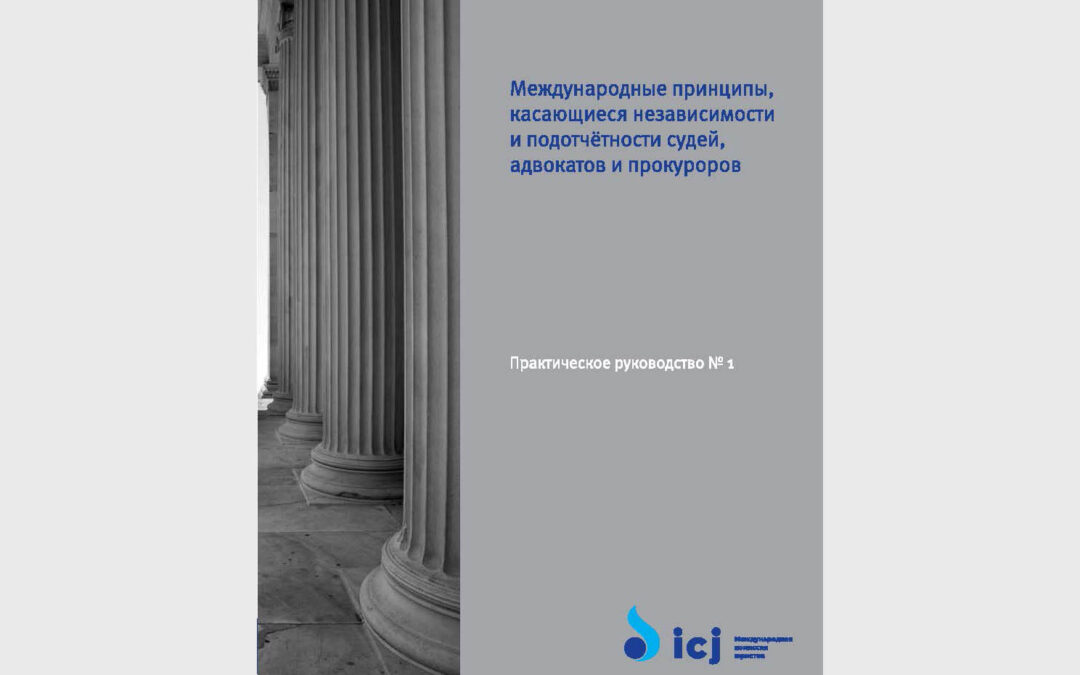
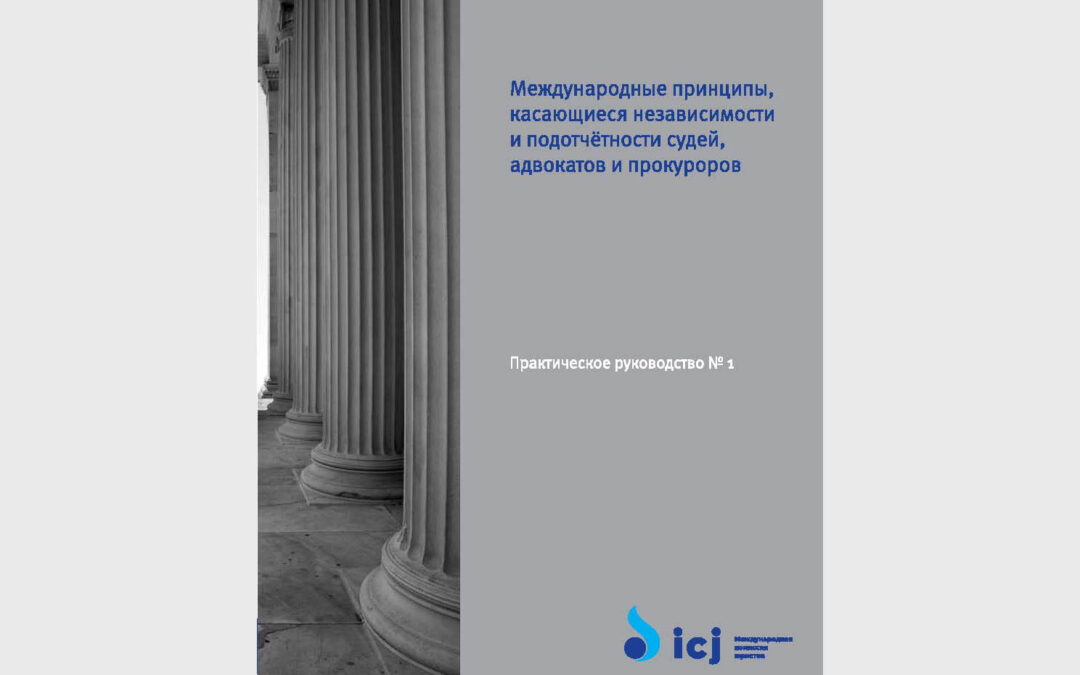
Международная комиссия юристов опубликовала перевод Практического руководства по Международным принципам, касающимся независимости и подотчетности судей, адвокатов и прокуроров.
Книга является первым комплексным анализом существующих стандартов и собранием универсальных и региональных инструментов на русском языке. В руководстве исследуется роль, которую играют сильная адвокатура, независимая судебная власть, а также беспристрастный и объективный орган уголовного преследования. Ссылки на международные решения, доклады, тексты договоров и другие международные стандарты позволят практикующим юристам и государственным органам использовать руководство в качестве справочного пособия.
International-Principles-on-the-Independence-and-Accountability-of-Judges-Lawyers-and-Procecutors-(No.1)-Practitioners’ Guide series-2013-Rus (полный текст на русском, PDF)
May 28, 2013 | News, Publications
The ICJ has now published a translation of its Practitioner’s Guide, International Principles on the Independence and Accountability of Judges, Lawyers and Prosecutors.
This is the first comprehensive analysis of the existing standards and compilation of universal and regional instruments published in Russian. The Guide outlines the roles to be played by a strong legal profession, an independent judiciary and an impartial and objective prosecuting authority. References to international decisions, reports, texts of treaties and other international standards allow the Guide to be used as a reference book by legal practitioners and policy makers.
International-Principles-on-the-Independence-and-Accountability-of-Judges-Lawyers-and-Procecutors-(No.1)-Practitioners’ Guide series-2013-Rus (full text in pdf)