Jul 13, 2020 | Advocacy, Non-legal submissions
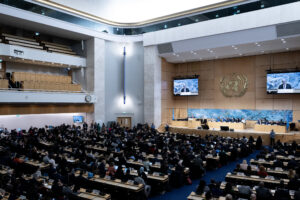
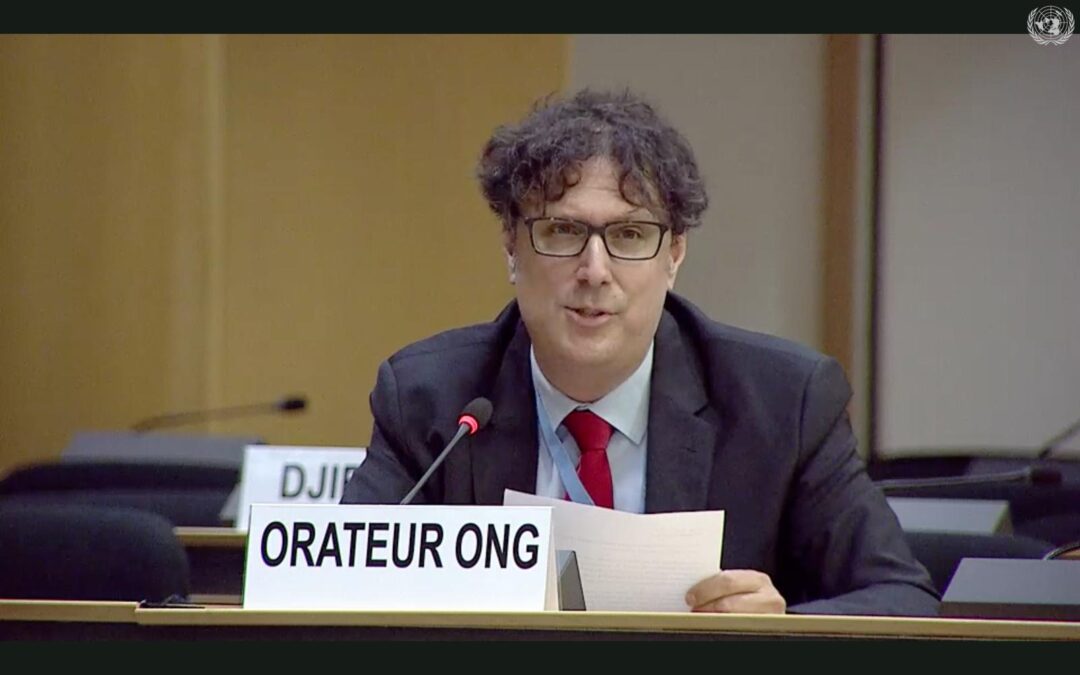
Speaking at the UN Human Rights Council the ICJ today emphasized the need for a human-rights-based approach to addressing corruption in justice systems, and urged more attention be given to the abuse of non-independent prosecution services by Executive governments.
The statement, delivered in an interactive dialogue with the Special Rapporteur on the independence of judges and lawyers, read as follows:
“Mr Special Rapporteur,
The International Commission of Jurists (ICJ) concurs with the affirmation in your report that justice systems must effectively counter corruption; that corruption in justice systems negatively impacts human rights; and that addressing such impacts is within the mandate of the Human Rights Council.[1]
At the same time, the UN Office on Drugs and Crime (UNODC) already actively provides resources and specialized technical expertise to States and prosecutors in implementing the Convention against Corruption. Keeping the Human Rights Council’s focus on the specific value added by a human-rights-based approach to such overlapping issues makes the best use of the Council and OHCHR’s limited resources and special competence and expertise.
For example, this report could have presented a detailed analysis of, and recommendations on, the right to remedy and reparation of victims of human rights violations caused by corruption of prosecutors, judges and lawyers. However, while the report briefly mentions victims (para 30), human rights defenders (para 31), and human rights training (para 58), and that human rights issues can impede international cooperation (para 49), but otherwise it mostly addresses technical advice for effective counter-corruption measures. The ICJ invites you to elaborate on the specific new elements a human-rights-based approach adds to the expert advice already provided by UNODC in this regard.
We also urge you to devote a future report to the manipulation of non-independent prosecution services by Executive governments to repress dissenting voices and human rights defenders, neutralize political opposition, shrink civil society space, and entrench impunity for human rights violations, which as our submission documented is no less urgent a global human rights issue than corruption, and is not a special focus of UN bodies other than the Council and OHCHR.
Thank you.”
[1] Indeed, twenty years ago the ICJ adopted a Policy Framework for Preventing and Eliminating Corruption and Ensuring the Impartiality of the Judicial System and its work against corruption in cooperation with judiciaries and prosecution services continues at the global and national levels.
Jul 11, 2020 | News
The Malaysian authorities must immediately put an end to their increasing attacks on freedom of expression, especially the media, international non-governmental organisations the ICJ, Amnesty International, CIVICUS: World Alliance for Citizen Participation said today.
Laws incompatible with international human rights law and standards, including the Sedition Act 1948 and Section 233 of the Communications and Multimedia Act (CMA) 1998, are being used to limit free speech and press freedom and should be repealed by the legislature.
In the latest move in the ongoing clampdown on criticism and other expression, authorities have targeted those involved in making the documentary “Locked Up in Malaysia’s Lockdown,” by news broadcaster Al Jazeera and its 101 East series – which reported on the authorities’ arrests of migrant workers during the COVID-19 pandemic. Al-Jazeera is being investigated for sedition and defamation, and has also been accused of breaching the Communications and Multimedia Act by the Malaysian authorities.
On 3 July 2020, Al Jazeera on its 101 East Stream published a documentary that investigated the arrests, detention, and ill-treatment of refugees and undocumented migrant workers during the outbreak of COVID-19 in Malaysia. The documentary highlighted raids conducted by authorities; the inhumane conditions of detention; and the situation of migrant workers who fear arrest. Those detained were found to be held in cramped facilities, while migrant workers at risk of detention suffered from a severe lack of adequate food. The documentary also highlighted the chilling effect the government crackdown has had on the migrant worker community, who fear for their lives and safety.
Rather than addressing the concerns raised in the documentary, the government has instead sought to question the reporters involved, and pursue migrant workers who spoke with Al Jazeera. By initiating a public campaign against migrants and refugees and publishing personal details of the migrant workers who were featured in the report, the authorities have also placed the lives and safety of those interviewed in jeopardy.
The government’s subsequent threats to revoke the visas of foreign workers appears intended to intimidate other migrant workers from speaking up about human rights violations, including mistreatment. These actions have contributed to a worrying rise in intolerance towards freedom of expression, including critical views.
Amnesty International, CIVICUS World Alliance for Citizen Participation, and the ICJ consider these actions as forms of harassment and intimidation of the media, migrant workers, and others exercising their right to freedom of expression, including criticism or dissent.
The use of the Sedition Act 1948, Section 233 of the Communications and Multimedia Act, and criminal investigations against the media set a dangerous precedent and are incompatible with international law and standards. These laws place restrictions on the exercise of freedom of expression that are overly broad, unnecessary and disproportionate, and inconsistent with rule of law and human rights principles.
We reiterate their our previous calls on the Government of Malaysia to abolish both laws, which have historically been used to silence voices of those challenging government policy.
Background
Since the COVID-19 pandemic emerged earlier this year, the Malaysian government has launched a crackdown on refugees, asylum-seekers and migrant workers, carrying out a series of raids on settlements in Kuala Lumpur and Selangor. Most notably, raids were carried out as Labour Day operations on 1 May 2020, but also continued afterwards.
In response to these raids, the Office of the UN High Commissioner on Human Rights (OHCHR) denounced the crackdowns on migrant workers and journalists on 21 May. Migrant workers fear for their safety and there have been reports of suicide amongst them.
Amid growing concerns about the crackdown, the government has increasingly sought to silence criticism.
On 7 July, refugee aid worker Heidy Quah was questioned by police for posting a statement on the raids and the treatment of migrant and refugee children on social media. Her lawyer confirmed that she is being investigated under the Penal Code for criminal defamation and the Communications and Multimedia Act for the ‘improper use of network facilities or network service’.
Since the Perikatan Nasional government assumed power, numerous investigations have been launched against individuals who have criticized government actions. Since February 2020, a journalist has been investigated by police for reporting on immigration raids; a member of parliament was investigated for criticising the May parliamentary session for not permitting debates; and a large number of ordinary Malaysians have been convicted for a variety of social media postings, including for criticising the enforcement of quarantine orders under the Movement Control Order (MCO).
In another recent attack on media freedom, on 2 July 2020, contempt of court charges were filed against Steven Gan, editor-in-chief of online news outlet Malaysiakini, over comments that were posted by readers that were allegedly critical of the judiciary. The Federal Court will next hear the case on 13 July. If convicted, Gan faces an unlimited prison sentence or fine.
Jul 10, 2020 | Events, News
Today, the ICJ and the Human Rights Joint Platform (IHOP) are hosting an online conference to take stock of the current situation of access to justice and the rule of law in Turkey and discuss compliance with international standards and the Turkish Constitution.
The online conference features international and European experts and will address the shortcomings in accessing justice in the country both in terms of the capacity of the justice system to ensure the respect and protection of human rights and of the independence and effectiveness of the justice system itself.
The conference will take stock of the state of access to justice in Turkey after four years of extraordinary and worrisome events for the Rule of Law and human rights in the country. During this period, Turkey has experienced a severe deterioration in the rule of law. The state of emergency, in force between 2016 and 2018, has led to the cleansing of the judiciary and restricted the capacity of lawyers and civil society to act, and increasingly dramatically the arrests and trials of some of their members under spurious charges of terrorism, offences against the State, insult to the nation or its President, and hate speech crimes.
Many of the measures undertaken under the state of emergency included mass dismissal of public servants, judges and prosecutors without ensuring due process guarantees and the degradation of the justice system, depriving the judiciary of essential guarantees to ensure its independence from the political authorities.
The conference will address how these developments impacted the capacity of people in Turkey, and in particular those belonging to marginalised groups, to access justice for their human rights, and what should be done to ensure that such access exists and is effective.
As a result of the conference, a draft statement on the state of access to justice in Turkey will be issued to provide Turkish authorities with recommendations on how to ensure effective and independent access to justice for human rights protection.
Jul 10, 2020 | Advocacy, Non-legal submissions
The ICJ and the World Organization against Torture (OMCT) today highlighted a range of human rights violations, including of freedom of association and assembly, in India’s repression of peaceful protests and the impact of COVID-19 measures in the country.
The joint statement “OMCT and ICJ welcome the Report of the Special Rapporteur on the rights to freedom of peaceful assembly and association and echo his concerns over the intensity and seriousness of the threats to the enjoyment of these rights, including the impact of current Covid-19 pandemic on the already fragile civic space.
We are particularly alarmed over the increasingly violent repression of dissent in India and the arbitrary detention and harassment of activists and human rights defenders by the state in relation to their participation in peaceful protests against the Citizenship Amendment Act 2019 (CAA), the National Population Register and the National Register of Citizens.
The repression of anti-CAA protests has been brutal, with the police reportedly using excessive force against demonstrators, including firing indiscriminately into crowds, using teargas and water cannons, beating bystanders and detaining and torturing protesters, including children. At least 31 persons were killed during these protests and scores were injured. No impartial and transparent investigations into the violence have been conducted to this day.
Reportedly fabricated charges of sedition, murder, and terrorism under repressive anti-terror and national security laws – such as the Unlawful Activities (Prevention) Act and the National Security Act – have been filed against activists and human rights defenders participating in the protests. Those arrested and detained include Gulfisha Fatima, Natasha Narwal, Devangana Kalita, Khalid Saifi, Meeran Haider, Shifa ur Rehman, Isharat Jahan, Dr. Kafeel Khan, Sharjeel Imam, Akhil Gogoi and Asif Iqbal. They are still in prison despite repeated calls for their release by national and international human rights groups and the United Nations.
Severe restrictions on freedom of peaceful assembly and association have been imposed in the framework of the Covid-19 emergency. These include blanket shutdown of internet services and the imposition in several areas of Section 144 of the Criminal Procedure Code, a colonial law banning public protests and gathering of more than five people. While appreciating India’s efforts to prevent the spread of Covid-19, we remind the government that restrictions must meet the requirements of legality, necessity and proportionality and shall not be abused to muffle dissent.
We call on the Government of India to take urgent steps to ensure that its people enjoy the rights to express dissent and to participate in peaceful protests without fear of being arrested, brutally beaten, tortured or killed. The right to life and from the prohibition of torture and other ill treatment as well as the rights to freedom of expression, association and assembly are protected under international law including the International Covenant on Civil and Political Rights to which India is a party.
We further call for a thorough, prompt, transparent and impartial investigation into allegations of unlawful use of force by police, and for the immediate release of all unjustly detained activists and HRDs.”
Jul 10, 2020 | Advocacy, Non-legal submissions
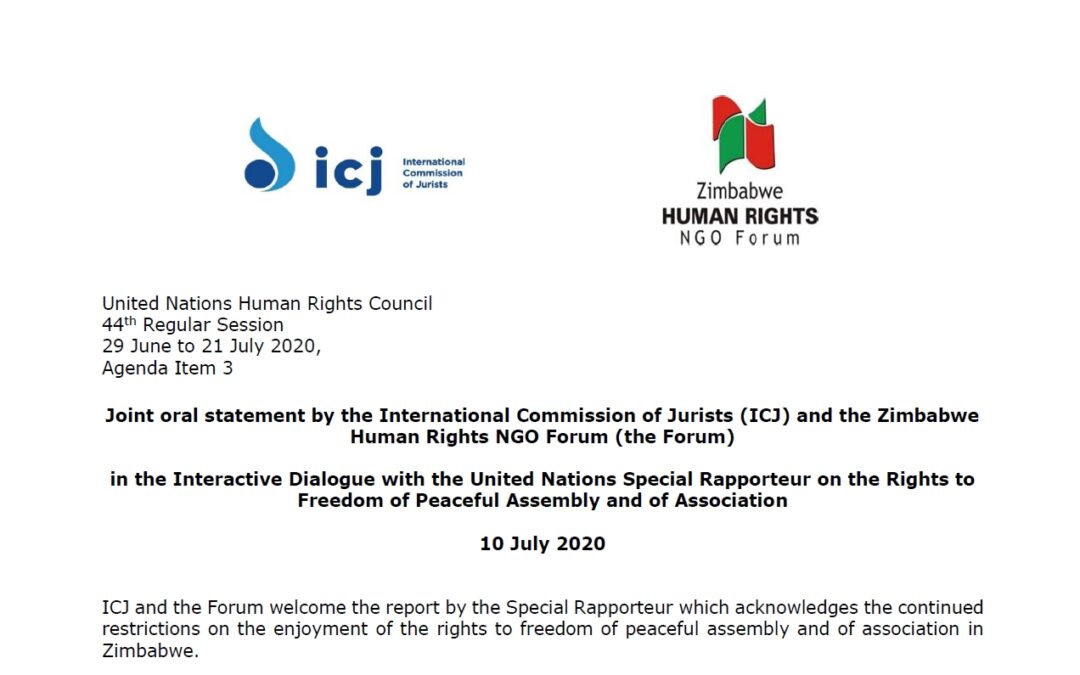
The ICJ and the Zimbabwe Human Rights NGO Forum highlighted today concerns on freedom of association and assembly in Zimbabwe, on the occasion of discussion by the Human Rights Council of a report of the relevant UN expert’s visit to the country.
The statement was prepared for delivery in an oral interactive dialogue with the UN Special Rapporteur on freedom of association and assembly on his reports to the Human Rights Council, including the report of his visit to Zimbabwe in September 2019.
The statement could not actually be read aloud due to the limited time for civil society statements in the dialogue.
The joint statement reads as follows:
“ICJ and the Forum welcome the report by the Special Rapporteur which acknowledges the continued restrictions on the enjoyment of the rights to freedom of peaceful assembly and of association in Zimbabwe.
The report mentions the use of excessive and lethal force by security forces; the use of military forces in managing protest; and the subsistence of repressive laws that curtail the enjoyment of the rights to Freedom of assembly and association.
ICJ and the Forum agree with the findings by the Special Rapporteur that the use of disproportionate and excessive force by the security has resulted in massive violations against protestors. In January 2019 following the “shutdown protests”, the Forum documented at least 1800 violations including 17 killings, 16 cases of rape and 81 victims were treated for gunshot wounds while ICJ documented at least 77 incidences of violation of fair trial rights of protestors.
The Maintenance of Peace and Order Act [Chapter 11:23] (MOPA) was enacted into law in November 2019 to repeal the Public Order and Security Act (POSA). MOPA reveal common similarities with POSA and maintains problematic provisions that do not guarantee the right to peaceful assembly.
ICJ and the Forum wish to draw the attention of the Special Rapporteur to the ongoing violations which have escalated in the context of the COVID-19 lockdown enforcement and the declining economic and social situation in Zimbabwe. While public health measures are crucial, these must be advanced in ways that do not unduly infringe on the rights to freedom of peaceful assembly and of association.
The government of Zimbabwe must be encouraged to comply with International human rights standards and guidelines such as the Guidelines for the Policing of Assemblies by Law Enforcement Officials in Africa; the United Nations Basic Principles on the Use of Force and firearms by law enforcement officials and the 10 principles for the Proper Management of Assemblies developed by the mandate in 2016.
ICJ and the Forum would to like to ask the SR what follow up he will do to monitor whether the Government of Zimbabwe complies with its international human rights obligations?”
The statement can be downloaded in PDF format here: UN-HRC44-statement-SRFoAA-2020