Sep 3, 2019 | Advocacy, News
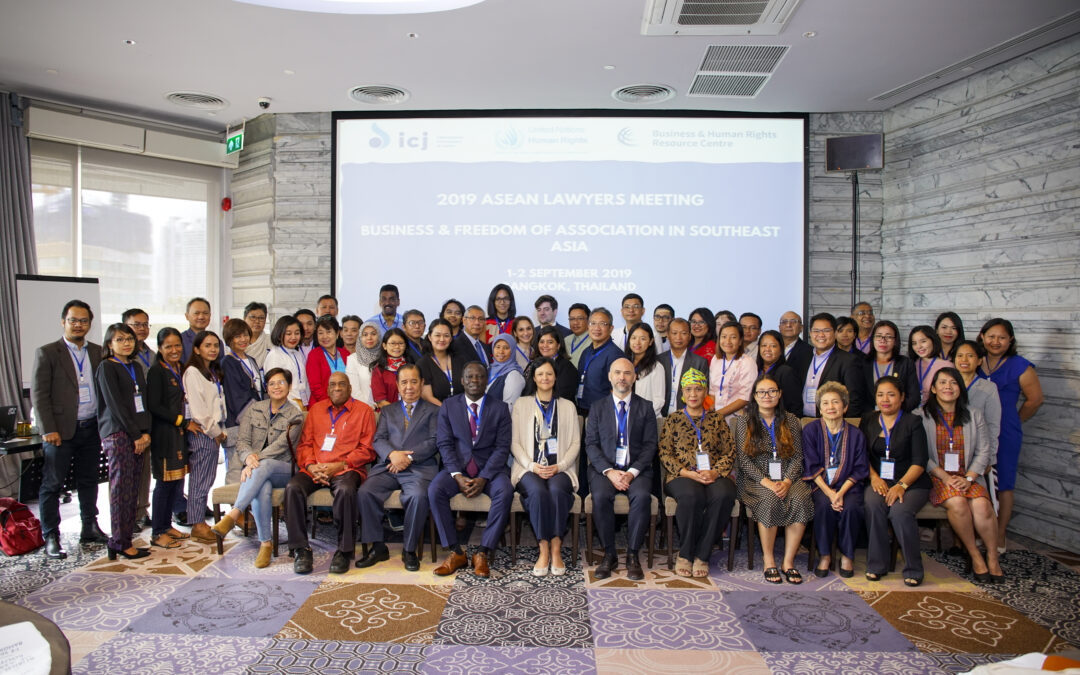
From 1 and 2 September 2019, the UN Special Rapporteur on freedom of association and assembly, Clément Nyaletsossi VOULE, and lawyers and trade union representatives met and discussed challenges faced in Southeast Asia on exercising the right to freedom of association of workers.
The event was organized by the ICJ together with Business & Human Rights Resource Centre (BHRRC), and supported by the Office of the United Nations High Commissioner for Human Rights (OHCHR).
At the meeting’s conclusion, the participants reached a consensus to work for the development regional guidelines on freedom of association of workers in the ASEAN and agreed to form a Working Group that would be tasked to develop these guidelines. The Working Group nominated by the participants is composed of trade union representatives at the national level, lawyers, among other experts.
In his keynote speech, the Special Rapporteur emphasized that freedom of association is a fundamental right for all workers without which they lack the power to fight discrimination and injustice in the workplace. He also explained the link between the rights to freedom of association and expression, “Freedom of association is closely related to freedom of expression as they both represent opening up of space for dialogue and an enabling environment where unions can participate freely.”
The participants at the meeting were practicing lawyers from Southeast Asia focusing on labor and employment and trade unions leaders and representatives. Other participants included representatives from human rights organizations addressing business and human rights and the right to freedom of association; the ASEAN Secretariat; the International Labor Organization (ILO), the ASEAN Trade Union Council (ATUC), and the International Trade Union Confederation (ITUC).
“Shrinking political and civic space combined with inequality and social marginalization are key challenges at the heart of business-related human rights violations in Southeast Asia,” said Katia Chirizzi, Deputy Regional Representative for UN Human Rights. “Governments must implement their obligations to respect, protect and promote human rights in relation to business activities. It is equally critical to ensure that businesses meet their responsibilities to respect human rights.”
During the meeting, the participants also discussed the role of women in labour organizing and the additional challenges women face when they exercise the right to freedom of association in the workplace. Betty Yolanda, Asia Regional Manager of the Business and Human Rights Resource Center (BHRRC) said: “Women workers face multiple forms of discrimination and challenges. They are fighting for their rights as workers in the company and at the same time they are also fighting the patriarchy.”
The participants identified common challenges confronted in the region where workers’ rights to freedom of association face legal and physical limitations. Migrant workers, women workers and workers in Special Economic Zones (SEZs) were identified as being particularly at risk in exercising their rights.
“It is crucial that we discuss these challenges openly and with all stakeholders, particularly issues that affect those who work in the informal sector, and other vulnerable communities such as migrant workers. Special investment frameworks, special economic zones and other government-led initiatives meant to attract foreign investment potentially create new opportunities to increase transparency and accountability. Unfortunately, they are more often used to justify lowering human rights standards, or impose new restrictions that act to limit workers and communities abilities to express their grievances or exercise their rights to association,” said Frederick Rawski, ICJ’s Regional Director for Asia and the Pacific.
Contact:
Boram Jang, International Legal Adviser, Asia & the Pacific Programme, e: boram.jang(a)icj.org
Aug 30, 2019 | Advocacy, Non-legal submissions
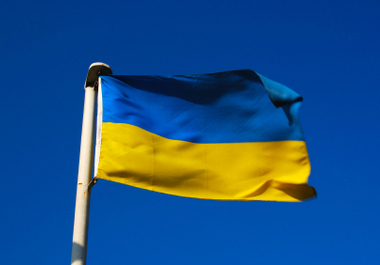
The ICJ has presented information to the UN Human Rights Committee in preparation for the Committee’s examination of the eighth periodic report of Ukraine under the International Covenant on Civil and Political Rights (ICCPR).
In this submission, the ICJ draws the Committee’s attention to the situation with the security and independence of the legal profession and Ukraine’s compliance with and implementation of its obligations under Articles 2, 6 and 14 of the ICCPR, as well as the UN Basic Principles on the Role of Lawyers.
The ICJ stresses that attacks on lawyers are likely to lead not only to violations the rights of the individual lawyers concerned, but also to violations of the rights of the clients they represent, including the right to a fair trial (Article 14 ICCPR), the right to liberty (Article 9 ICCPR), the right to freedom from torture or other ill-treatment (Article 7 ICCPR), and the right to an effective remedy (Article 2.3 ICCPR) as attacks on lawyers may, in turn, hinder the provision of effective legal representation.
Ukraine-List of Issues-Advocacy-non legal submission-2019-ENG (full submission, in PDF)
Aug 22, 2019 | Advocacy, News
Today, the ICJ joined 10 other international and Venezuelan human rights organizations to call the United Nations Human Rights Council to establish a Commission of Inquiry (COI) on human rights in Venezuela in its upcoming session in September.
The ICJ considers that an independent COI is necessary given the Venezuelan authorities have been unable or unwilling to pursue effective domestic accountability and the judicial and prosecutorial mechanisms lack independence and impartiality.
In recent years, the ICJ has documented in several reports the lack of judicial independence, the lack of accountability for those allegedly responsible for gross human rights violations, the abuse and misuse of the military jurisdiction, and wide ranging breakdown in the functioning of the rule of law.
The United Nations High Commissioner for Human Rights in her 2019 report has similarly stressed that wide ranging human rights violations had occurred in Venezuela evidenced by the excessive use of force by security forces, attacks on freedom of expression, arbitrary detention and extrajudicial killings, dismantling of checks and balances, and deprivations constituting violations of the right to food and health. In addition, a panel of independent international experts mandated by the Secretary General of the Organization of American States (OAS), mentioned in 2018 “that reasonable grounds exist to believe that crimes against humanity have been committed in Venezuela”.
Commissions of Inquiry have been effectively established by the UN Human Rights Council to assess serious situations of human rights in several countries where there is a need to ensure proper human rights fact finding and ultimately accountability for widespread or systematic human rights violations. These include COIs for Syria, North Korea, Burundi, Yemen, Libya and Eritrea.
The ICJ and the other organizations have emphasized that the Commission of Inquiry that could be established for Venezuela “should be mandated to investigate reports of violations of international human rights law in Venezuela, including but not limited to violations associated with torture and inhuman treatment, arbitrary detention, discrimination, violations of freedom of expression, violations of the right to life and enforced disappearances, as well as violations of the rights to health and food. It should be tasked with establishing the facts and circumstances of violations committed since at least 2014, mapping out patterns of violations and identifying those responsible and, where possible, the chain of command, with a view to contributing to full accountability for all violations including those that constitute crimes under international law (…)”.
Download:
Venezuela-COI final-Advocacy-2019-ENG (full Q&A document prepared by all 11 organizations in PDF)
Aug 19, 2019 | Advocacy, Cases, Legal submissions
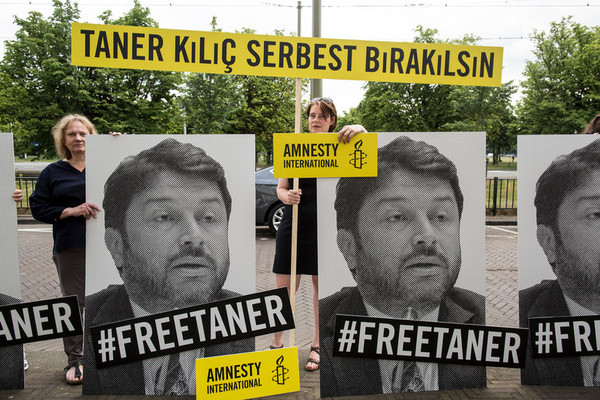
The International Commission of Jurists, the Turkey Human Rights Litigation Support Project and Human Rights Watch have jointly intervened before the European Court of Human Rights in the case of Taner Kiliç, former Chair of the Board of Amnesty International Turkey.
Taner Kiliç is a Turkish human rights defenders. He had been Chair of the Board of Amnesty International Turkey since 2014.
He was arrested on 6 June 2017 on reportedly unsubstantiated charges of “membership of a terrorist organisation” and was released on bail on 15 August 2018 after having spent 14 months in detention.
His case before the European Court of Human Rights challenges the lawfulness of his pre-trial and on remand detention, the violations of his right to judicial review of his detention, and of his freedom of expression and association, considering his arrest linked to his work as leader of a NGO.
As the interveners have written to the Court, this case epitomises some of the most fundamental human rights challenges in Turkey today.
These involve widely documented restrictions on freedom of expression, association, and assembly of human rights defenders (HRDs) and rapidly closing civil society space.
The interveners have submitted observations on:
- the factual context in respect of the situation facing HRDs in Turkey;
- international standards governing obligations towards HRDs of relevance to the Court’s interpretation of the European Convention on Human Rights, including the limits prescribed by Article 18;
- key principles necessary for a rule of law approach to the application of the criminal law, against the legal and practical pattern of excessive resort to criminal law against HRDs in Turkey today.
Turkey-ECtHR-icj&others-Kilic-Advocacy-legal submission-2019-ENG (download the third party intervention)
Photo credit: Amnesty International
Jul 19, 2019
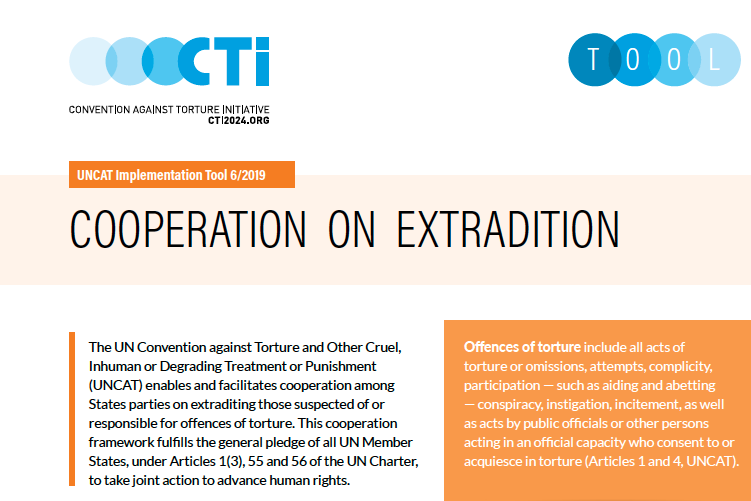
On 17 July 2019, the Convention Against Torture Initiative (CTI) released the 6th tool in their series of UNCAT implementation tools on “Cooperation on Extradition”. The ICJ developed the tool for the CTI.
This latest tool focuses on the extradition framework established in the UN Convention against Torture and Other Cruel, Inhuman or Degrading Treatment or Punishment (UNCAT), which enables and facilitates cooperation among States parties on extraditing those suspected of or responsible for offences of torture.
The tool sets out in an understandable format the basic elements of UNCAT’s extradition framework, explaining how it operates in practice, with the aim of bringing those suspected or convicted of torture to justice, thus ending impunity for torture and other ill-treatment. It provides 32 international, regional and national examples of how the framework can operate in practice.
You can read the tool here: Universal-CTI-Cooperation-Advocacy-ENG