Sep 20, 2018 | Advocacy, Non-legal submissions
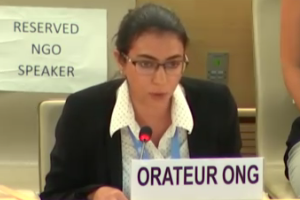
The ICJ today put the spotlight the lack of independence of the legal profession in Azerbaijan speaking at the UN Human Rights Council in Geneva.
The statement, made during the consideration of the Universal Periodic Review (UPR) of Azerbaijan, read as follows:
The International Commission of Jurists (ICJ) welcomes the acceptance by Azerbaijan of the recommendations by France (140.70), by Greece (141.12), Austria (141.13), Estonia (141.68), Slovenia (141.71), and Mexico (141.77), to respect the rights of lawyers.
The ICJ regrets, however, that Azerbaijan only noted and did not explicitly support the recommendations by Sweden (141.33), USA (141.39), Czechia (141.67) and Germany (141.76) and rejected the recommendation by the United Kingdom (141.60) to “End all interference in the work of lawyers through disbarment or other disciplinary measures on improper grounds such as expressing critical views.”
These recommendations call for the amendment of the Law on Advocates and Advocates’ Activities to ensure the effective independence of the Bar Association of Azerbaijan. They also call for the setting up of independent and transparent mechanisms for lawyers’ admission to practice, and disciplinary proceedings against lawyers, in conformity with the UN Basic Principles on the Role of Lawyers.
The ICJ notes that Azerbaijan’s support of most recommendations is predicated on the assumption that the situation of the independence of the legal profession in Azerbaijan is in line with international law.
This, however, is not the situation in the country.
The ICJ expresses concern at the persistent lack of independence of the Bar Association of Azerbaijan; indeed, it has actually played a role in undermining the work of lawyers defending human rights. The situation is exacerbated by recent hasty reforms that prohibit lawyers from appearing in any court hearing unless they are members of this non-independent Bar association, furthermore without a sufficient and meaningful transition period. This seriously curtails access to justice for human rights violations in the country.
Sep 18, 2018 | Plaidoyer
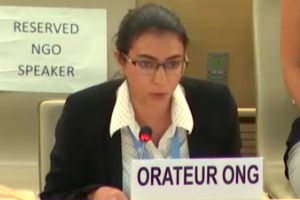
La CIJ a mis en lumière les graves menaces qui pèsent sur l’état de droit en Hongrie, en Pologne et en Turquie, lors de sa prise de parole au Conseil des droits de l’Homme à Genève.
La déclaration, faite pendant le débat général sur les situations nécessitant l’attention du Conseil, est la suivante:
«La Commission internationale de juristes (CIJ) voudrait attirer l’attention du Conseil sur les graves menaces qui pèsent sur l’état de droit en Hongrie, en Pologne et en Turquie.
En Pologne, le gouvernement a adopté une mesure législative pour imposer de manière arbitraire un «départ à la retraite» involontaire d’un tiers de ses juges à la Cour suprême, portant ainsi un coup fatal à l’indépendance du pouvoir judiciaire, déjà mis à mal par les réformes passées.
En Hongrie, de multiples réformes législatives ont affaibli l’indépendance des juges et puni les activités de certaines ONG de défense des droits de l’homme et restreint leur financement.
Enfin, en Turquie, la consolidation de mesures d’urgence en droit commun, des réformes constitutionnelles régressives, et le licenciements massif de juges et de procureurs a supprimé une protection essentielle pour le fonctionnement d’un pouvoir judiciaire indépendant.
La CIJ est en outre préoccupée par l’interdiction des manifestations des mères du samedi qui prévoit d’organiser des manifestations hebdomadaires à la mémoire des membres de leur famille disparus, en violation de leur droit à la liberté de réunion.
La CIJ est profondément préoccupée par l’escalade de telles menaces aux principes fondamentaux de l’état de droit en Europe, sans que des mesures spécifiques soient prises par le Conseil pour y remédier.
La CIJ exhorte le Conseil à prêter attention à ces développements, qui s’inscrivent dans le cadre d’une attaque mondiale plus vaste contre la primauté du droit [1] et à observer la situation des droits de l’homme dans ces pays.
[1] Voir la CIJ, «L’état de droit sous la menace mondiale» (déclaration lors du débat général sur le compte rendu oral du Haut Commissaire), 11 septembre 2018: https://www.icj.org/hrc39-gd2-hc/
Sep 18, 2018 | Advocacy, Non-legal submissions
The ICJ today put the spotlight on serious threats to the rule of law in Hungary, Poland and Turkey, speaking at the UN Human Rights Council in Geneva.The statement, made during general debate on situations that require the Council’s attention, read as follows:
“The International Commission of Jurists (ICJ) would like to bring to the Council’s attention the serious threats to the rule of law in Hungary, Poland and Turkey.
In Poland, the Government has adopted legislation to arbitrarily force into involuntary “retirement” one third of its Supreme Court Justices, delivering a fatal blow to the independence of the judiciary, already strained by past reforms.
In Hungary, multiple legal reforms have weakened judicial independence and effectively criminalized the activities of certain human rights NGOs and curtailed their financing.
Finally, in Turkey, consolidation of emergency measures in ordinary law, regressive constitutional reforms, and the mass dismissal of judges and prosecutors have removed essential protection for the independent functioning of the judiciary.
The ICJ is further concerned by the protest ban against the Saturday Mothers to hold weekly protests in memory of their disappeared family members, in breach of their right to freedom of assembly.
The ICJ is alarmed at the escalation of such threats to the very basic tenets of the rule of law in Europe, without specific action being taken by this Council to address them.
The ICJ urges the Council to give attention to these developments, which indeed form part of a broader global attack on the rule of law,[1] and to keep under observation the human rights situation in these countries.”
[1] See ICJ, “The Rule of Law under Global Threat” (statement in general debate on the oral update of the High Commissioner), 11 September 2018: https://www.icj.org/hrc39-gd2-hc/
Sep 18, 2018 | Advocacy, Non-legal submissions
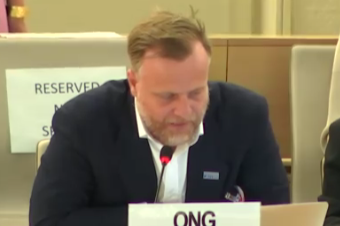
The ICJ today urged the UN Human Rights Council to establish a mechanism to preserve evidence of crimes under international law occurring in Myanmar, with a view to eventual prosecution of those responsible.
The statement, delivered during an interactive dialogue with the UN International Fact Finding Mission, read as follows:
“The International Commission of Jurists (ICJ) has monitored justice and human rights in Myanmar for more than five decades. The ICJ has an established presence in the country supporting justice actors to protect human rights through the rule of law.
With this experience, the ICJ views the Independent International Fact Finding Mission’s conclusions as painting an authoritative picture of the general situation in Myanmar, particularly in its highlighting of the pervasive damage of military impunity upon human rights, rule of law and the nascent democratic process.
The rule of law cannot be established, let alone flourish, without accountability for perpetrators of human rights violations and redress for victims and their families.
The Fact Finding Mission’s findings of crimes under international law, including crimes against humanity in Rakhine, Kachin and Shan states, and the identification of alleged perpetrators, necessitate immediate action.
The Government of Myanmar is unwilling and unable to effectively and genuinely provide justice for crimes, particularly when perpetrated by security forces. International action must not be deterred or delayed by the latest government inquiry, which is incapable of providing accountability or redress and may promote impunity by undermining credible international justice mechanisms.
The ICJ calls for a unified Council resolution at this session to establish an International Impartial and Independent Mechanism. This is urgently required to preserve evidence before its further deterioration, and to demonstrate a commitment to justice. Failing to act now risks further denying justice for victims and emboldening perpetrators.
Violations against Rohingya constitute an egregious yet emblematic example of systematic persecution of minority groups that has persisted in Myanmar for decades.
The ICJ would like to ask the Fact-Finding Mission: how can the Council best ensure accountability for the full range of crimes under international law committed against minorities throughout Myanmar and prevent their continuation and recurrence?”
For more information see:
Myanmar: why an IIIM and Security Council referral are needed despite the ICC ruling relating to Bangladesh
Myanmar: Government’s Commission of Inquiry cannot deliver justice or accountability
Sep 17, 2018 | Advocacy, Non-legal submissions
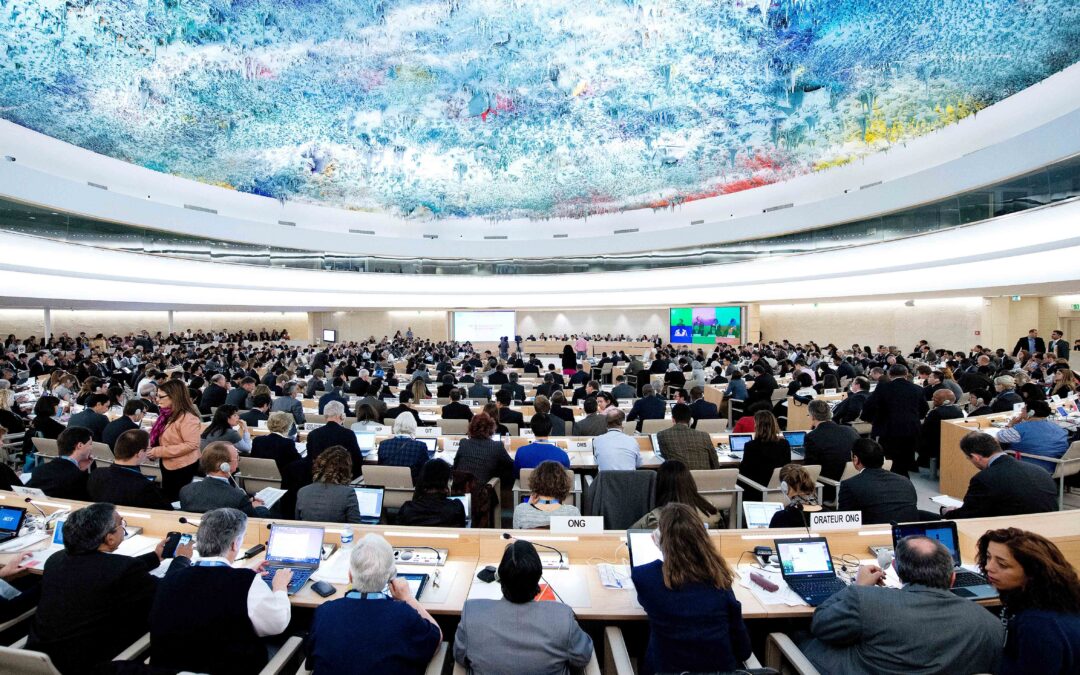
Today at the UN Human Rights Council, the ICJ emphasised the importance of effective investigations capable of leading to truth and justice, highlighting recent developments in Manipur, India as an example.
The statement read as follows:
“Justice processes in situations of conflict or transition require fighting impunity and re-establishing public trust.[1] An example is the new prospects for justice in relation to 1528 alleged extrajudicial killings cases in Manipur, India, which would make an important contribution to a transition out of the long-standing conflict.
In July 2016, in response to a petition filed on behalf of the victims, the Indian Supreme Court stated that “there is no concept of absolute immunity from trial…”,[2] opening the door to ending impunity. As of August 2018, the Central Bureau of Investigation has registered 29 complaints against security forces.[3] Recent reports suggest that the Government is also considering amending the Armed Forces Special Powers Act (AFSPA) to remove or restrict existing overbroad authorizations for use of lethal force.[4]
These are welcome developments. However, concerns remain, as the investigation status of the majority of the cases is unknown. Two UN Special Rapporteurs in July 2018 also affirmed that justice must be done in all cases.[5]
The ICJ calls on India to ensure independent, impartial and thorough investigations into all cases in Manipur, amend AFSPA, and to uphold the right to truth of victims and society about acts committed and the identity of perpetrators, in line with its international and national legal obligations, including as a party to the International Covenant on Civil and Political Rights.”
[1] Report of the Special Rapporteur on the promotion of truth, justice, reparation and guarantees of non-recurrence, A/HRC/39/53 (25 July, 2018), http://www.undocs.org/A/HRC/39/53.
[2] Para 163, Extra Judicial Execution Victim Families Association (EEVFAM) & Anr. v. Union of India & Anr. Writ Petition (Criminal) No. 129/2012.
[3] TNN, “Army Major named in FIR for killing 12-yr-old in fake Manipur encounter”, Times of India, August 3, 2018, https://timesofindia.indiatimes.com/city/imphal/army-major-named-in-fir-for-killing-12-yr-old-in-fake-manipur-encounter/articleshow/65252258.cms.
[4] “In AFSPA, Government Considering Crucial Changes”, NDTV, September 13, 2018, available at https://www.ndtv.com/india-news/in-afspa-government-considering-crucial-change-sources-1915706.
[5] Special Rapporteur on extrajudicial, summary or arbitrary executions and Special Rapporteur on the situation of human rights defenders, “India: UN experts call for urgent progress in investigation of hundreds of ‘fake encounter’ killings” (4 July 2018), https://www.ohchr.org/en/NewsEvents/Pages/DisplayNews.aspx?NewsID=23323&LangID=E .