Jun 11, 2014 | Advocacy, Non-legal submissions
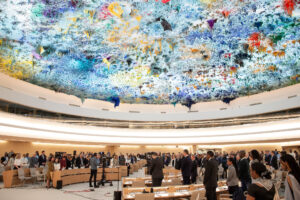
The ICJ, together with the International Lesbian and Gay Association (ILGA) and on behalf of ARC International, today delivered an oral statement to the Human Rights Council during an interactive dialogue with the UN Special Rapporteur on peaceful assembly and association.
The report of the Special Rapporteur addressed challenges faced by groups at risk, including lesbian, gay, bisexual, transgender and intersex persons.
The statement welcomed the report by the Special Rapporteur.
It referred to the Nigerian Same Sex Marriage (Prohibition) Act (which in fact criminalizes a much broader range of human rights-protected activities than its title would necessarily suggest), Uganda’s Anti-Homosexuality Act, and Ukraine’s draft law on “propaganda of homosexual relations”. All of these laws impede freedom of peaceful assembly of LGBTI persons. The Nigerian law also interferes with freedom of association, as it bans registration, funding and activities of “gay” organizations.
It also referred to Russia’s ban on “propaganda of non-traditional sexual relations”.
It emphasised the detrimental impact of such laws on the work of LGBTI human rights defenders and the activities of health care providers. It stressed that laws directly targeting the freedom of peaceful assembly or association of LGBTI individuals solely because of their sexual orientation or gender identity are inconsistent with international human rights law.
UN-HRC26-AssociationLGBTI-OralStatement-advocay-non legal submission-2014 (full text in pdf)
The report of the Special Rapporteur is available here.

Jun 10, 2014 | Advocacy, Non-legal submissions
The ICJ joined other non-governmental organisations in issuing a joint statement ahead of the 2014 annual treaty body chairpersons meeting, to be held on 24-27 June 2014.
The statement, made by NGOs that regularly contribute to the work of the treaty bodies, broadly welcomed the outcome of the UN General Assembly process to strengthen the treaty bodies. It, in particular, highlights a number of priority areas for consideration by treaty body chairpersons as critical to implementation of the General Assembly resolution and the ongoing process of strengthening the UN treaty bodies.
UNTBs-AnnualChairpersonsMeeting-JointStatement-Non-LegalSubmission-2014 (download full statement in PDF)
Jun 3, 2014 | Advocacy, Analysis briefs
The ICJ’s commentary analyses in detail the 7 November 2013 judgment of the Court of Justice of the EU (CJEU) in joined cases arising from three asylum claims asserting a well-founded fear of persecution based on same-sex sexual orientation.
Positively, in X, Y and Z v. Minister voor Immigratie en Asiel, the Court found that asylum applicants who have a same-sex sexual orientation and come from countries where consensual homosexual conduct is criminalized, form a particular social group for the purposes of EU refugee law.
Further, the Court’s recognition that sexual orientation is a characteristic so fundamental to one’s identity that one cannot be expected to renounce or conceal it, or to exercise greater restraint in its expression than heterosexuals, is welcome.
Likewise, the Court’s finding that the enforcement of a term of imprisonment that sanctions consensual homosexual acts must be regarded as a disproportionate or discriminatory punishment, and is thus persecutory, is a step forward, particularly given that in some EU countries this was hitherto not the case.
However, in some important respects this judgment represents a missed opportunity. The Court failed to clarify the inconsistency between secondary EU refugee law and the UNHCR’s authoritative interpretation of “a particular social group” in the Refugee Convention’s definition of a refugee.
Further, in choosing to maintain the narrow scope of the questions referred to it, the Court ended up with an unwarrantedly restrictive reading of EU refugee law, which ignores the numerous persecutory effects of criminalizing consensual same-sex sexual orientation or gender identity.
The Court missed a chance to state that these laws, even when they are not enforced in the sense that there exists a recent record of enforcement through the actual imposition of terms of imprisonment, have a persecutory effect, as they criminalize an essential characteristic of one’s identity.
Background
The ICJ decided to publish this commentary for a number of reasons.
First, the CJEU plays an important role in shaping international refugee law jurisprudence.
Further, asylum applications based on a well-founded fear of persecution for reason of real or imputed sexual orientation and/or gender identity or expression are unfortunately likely to increase, both within the EU and beyond.
Moreover, the CJEU’s judgment in this case is likely to have a bearing on the determination of asylum claims premised on membership of other particular social groups.
Lastly, the implementation by the EU and its Member States of the recently “recast” Common European Asylum System will likely give rise to several new referrals to the Court, whose interpretation of the recast instruments will also depend on its asylum case law precedents, including the CJEU’s judgment in this case.
CommentaryXYZ-Advocacy-2014

May 22, 2014 | Incidencia
En el presente informe la CIJ llama a la atención del Comité las debilidades del sistema legal y judicial del Estado colombiano y sus falencias en relación a su deber de protección de niños y niñas de comunidades locales y afrodescendientes en zonas de conflicto.
La CIJ solicita al Comité pedir información al Estado sobre las medidas y acciones desplegadas para la protección de los niños, niñas y adolescentes ante las actividades y operaciones de las empresas con actividad en la jurisdicción Colombiana, y para revisar el Plan de Acción Nacional o incluir en los distintos planes o programas sectoriales medidas concretas para proteger los derechos del Niño ante las actividades y operaciones de las empresas.
El informe hace referencia a la sentencia de la Corte Interamericana de Derechos Humanos en el caso de la Operación Génesis, en la cual se vulneraron derechos de comunidades afrodescendientes, incluidos niños.
La Corte, en base al Articulo 5 de la Convención Americana, se refiere a la Convención de derechos del Niño, y condena a Colombia por no adoptar las medidas necesarias para proteger a los niños y a las niñas de las comunidades afrodescendientes de la cuenca del río Cacarica ante las actividades de explotación forestal y la actividad de concesión de CODECHOCÓ, ha vulnerado su derecho a la vida, supervivencia y desarrollo (art. 6), derecho a la salud (art. 24) y el derecho a un nivel adecuado de vida (art. 27).
Asimismo se han vulnerado otros derechos de la Covención. Al respecto la CIJ solicita al Comité que pida información a Colombia sobre las medidas adoptadas o por adoptarse por el Gobierno Colombiano para hacer efectivo el fallo de la Corte Interamericana, especialmente su obligación de investigar para acabar con la impunidad y sancionar a las empresas que han vulnerado los derechos de los niños, así como en la adopción de las medidas de satisfacción, rehabilitación y restitución especificadas por la Corte, y en particular referidas a los niños.
La Comisión Internacional de Juristas (CIJ) ha reiterado en otras ocasiones las debilidades del sistema judicial colombiano y especialmente la impunidad de las fuerzas armadas en casos de graves violaciones de derechos humanos donde también hay un factor o motivación económica, y especialmente ante la presencia de compañías transnacionales.
En estos casos, la Comisión Internacional de Juristas ha pedido al Estado colombiano que reforme su Código penal e incorpore el principio de responsabilidad penal de las personas jurídicas en casos de graves violaciones de derechos humanos.
En el mismo informe, redactado con motivo del Examen Periódico Universal en 2013, la CIJ exhortó al Estado a mejorar la capacidad técnica de la Policía Judicial y la Fiscalía General de la Nación para investigar casos complejos con presencia de actores del sector privado.
A este respecto, la CIJ solicita al Comité que pida a Colombia información sobre las medidas tomadas para fortalecer su marco normativo y su capacidad de investigación y juzgamiento de casos donde se encuentran involucradas empresas.
Colombia-CRC68PSWG-LOI-LegalSubmission-2014 (PDF, español)
May 19, 2014 | Advocacy, News, Non-legal submissions
The UN Committee on Economic, Social and Cultural Rights has just finalized its review of El Salvador, one of the State parties under examination during the 52nd session of the Committee held between the 28 April and 23 May 2014.