Sep 3, 2018 | Communiqués de presse, Nouvelles
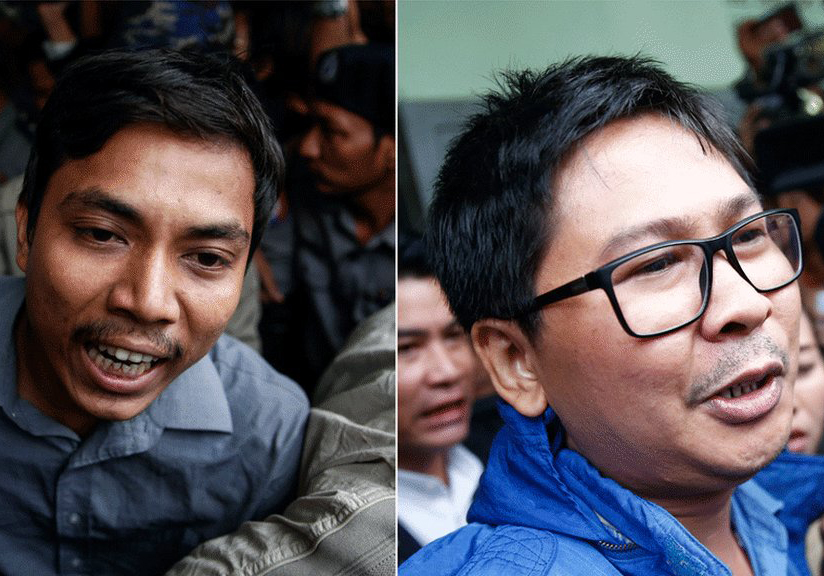
La décision du Tribunal de District de Yangon de condamner aujourd’hui les journalistes de Reuters, Wa Lone et Kyaw Soe Oo, à sept ans d’emprisonnement pour violation de la loi sur les secrets officiels porte gravement atteinte aux droits de l’Homme et à l’état de droit au Myanmar.
“La décision de la Cour punit dans les faits ces deux journalistes courageux pour avoir dénoncé des violations des droits de l’Homme, à la suite d’un procès manifestement inéquitable”, a déclaré Frederick Rawski, directeur de la CIJ pour l’Asie-Pacifique.
“La décision est une erreur judiciaire qui leur inflige des souffrances inutiles ainsi qu’à leurs familles, menace la liberté d’expression, porte atteinte à la réputation mondiale du Myanmar et sape ses institutions judiciaires en même temps”, a-t-il ajouté.
La CIJ a suivi l’affaire depuis la détention initiale des journalistes en décembre 2017.
Comme indiqué précédemment par la CIJ, la détention et le procès ont violé de nombreuses garanties fondamentales relatives à l’équité des procès.
Les procureurs avaient le devoir d’abandonner les accusations et le juge aurait dû rejeter l’affaire en raison de l’absence de preuves et de l’illégalité de la détention en raison de violations du droit à un procès équitable.
“L’affaire est emblématique de la manière dont le système judiciaire finit par renforcer l’impunité des militaires plutôt que de la remettre en cause”, a déclaré M. Rawski.
“Le résultat sape les affirmations du gouvernement selon lesquelles il peut rendre des comptes par lui-même sur les violations des droits de l’Homme, et ne fait rien pour que le système judiciaire agisse de manière indépendante et impartiale après des décennies de régime militaire”.
Les membres des forces de sécurité jouissent généralement de l’impunité pour la perpétration de violations des droits de l’Homme, notamment pour des crimes en droit international.
La CIJ a déjà rapporté que les victimes et leurs familles, ainsi que les journalistes, font souvent l’objet de représailles pour avoir diffusé des informations sur les violations des droits de l’Homme commises par l’armée.
Wa Lone et Kyaw Soe Oo ont été arrêtés en décembre 2017 et détenus au secret pendant près de deux semaines avant d’être accusés, en vertu de la loi sur les secrets officiels datant de l’époque coloniale, pour avoir prétendument été en possession de documents liés aux opérations des forces de sécurité dans le nord de l’État de Rakhine, lors “d’opérations de nettoyage”.
Les deux reporters avaient dénoncé des violations des droits de l’Homme dans l’État de Rakhine, notamment l’assassinat de Rohingyas par l’armée dans le village d’Inn Dinn.
Dans un rapport publié la semaine dernière (uniquement disponible en anglais), la mission d’enquête internationale indépendante des Nations Unies a constaté que les forces de sécurité avaient commis des crimes en droit international au cours de ces opérations, notamment des crimes contre l’humanité et peut-être un crime de génocide.
La détention et la mise en accusation de quiconque, y compris de journalistes, se basant uniquement sur la collecte et la publication de preuves pertinentes en matière de violations graves des droits de l’Homme constituent une violation du droit international et des normes relatives à la liberté d’expression, au droit de participer à la conduite des affaires publiques et au rôle des défenseurs des droits de l’Homme.
Les options légales disponibles pour les journalistes incluent de requérir à la décision d’aujourd’hui et demander une grâce présidentielle.

Sep 3, 2018 | News
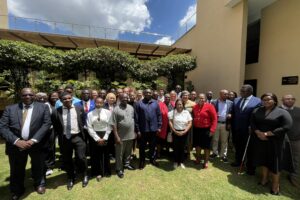
The ICJ held a workshop on reforming Myanmar’s 1982 citizenship law in Yangon from 1 to 2 September 2018.
The workshop convened a group of international and national legal experts, human rights defenders, political scientist, academics and researchers to jointly consider the way forward to identify creative legal and non-legal advocacy approaches for reforming Myanmar’s 1982 Citizenship Law.
The ICJ, UN organs and civil society organizations, through research and legal analysis, have consistently found this law to be discriminatory both in its content and application.
Unlike many other laws promulgated during the military junta era of General Ne Win, this law remains in force. Its tiered hierarchy of citizenship has effectively rendered many individuals as second- or third-class citizens, or in some instances stateless.
In August 2017, the government’s own Advisory Commission on Rakhine State, chaired by the late Kofi Annan, recommended a review of the Citizenship Law. The recommendation was accepted by the Government of Myanmar in principle, but in practice this commitment has not been followed up by any implementing measures.
The workshop’s participants included academics, researchers, human rights defenders, political scientist, legal and non-legal experts of different ethnic and religious backgrounds from a range of organizations from the U.K, Spain, Australia, Kachin, Chin, Mandalay, Rakhine, and Yangon.
The ICJ’s legal adviser, Sean Bain, introduced the workshop by noting that legal recognition of nationality is central to the enjoyment of many human rights.
Noting that protecting the right to nationality is an essential part of the rule of law in any democratic society, he highlighted that too often it is members of minority groups who experience a violation of their human rights due to discriminatory laws and their application with regards to citizenship.
The ICJ’s legal researcher Dr. Ja Seng Ing presented the overview and assessment of the Citizenship Law, including problematic provisions and key institutional actors with authority in Myanmar.
Amal de Chickera, a Sri Lankan Human Rights lawyer and Co-Director of Institute on Statelessness and Inclusion, delivered an introduction on the International law and comparative studies and the approaches and strategies for law reform from international perspectives.
José María Arraiza, Information, Counselling and Legal Assistance Specialist, Norwegian Refugee Council, spoke about a number of approaches and strategies for legal reform, including imperative role of collective identities, inclusive dialogue and evidence based advocacy strategies with comparative international experiences.
Michelle Yesudas, a Malaysian Human Rights lawyer, shared good practices and lesson learned from application of strategic litigation in citizenship related cases in Malaysian context to raise the awareness of the public and also discussed potential strategies for pushing the legislative reform and enforcement of the law in Myanmar.
The ICJ’s legal adviser Daw Hnin Win Aung, facilitated a panel discussion where the Senior legal scholars and researchers from Myanmar also provided their perspectives, based on their own independent research and writing on the legal and non-legal opportunities and challenges for law reform in Myanmar.
Advocate lawyer, Daw Zar Li Aye highlighted the legal consequences of mixed-nationality marriage in Myanmar, for instance, the authorities used physical appearance of the children as a determining factor when considering provision of citizenship / documentation in practice.
The participants considered a wide range of issues relating to statelessness and citizenship in Myanmar with comparative case studies, including the varying approaches for law reform across the region to improve understanding of the advocacy target groups on the issue and potentially inform public policy.
The participants also recognized the importance of multidisciplinary approaches, including strategic litigation in citizenship related cases, for developing advocacy strategies for law reform and to increase knowledge and understanding of the general public on the issue.
This event is part of the ICJ’s ongoing efforts to convene civil society actors including lawyers to discuss critical human rights issues in Myanmar with a view to advancing the protection of human rights in the country.
Sep 2, 2018 | News
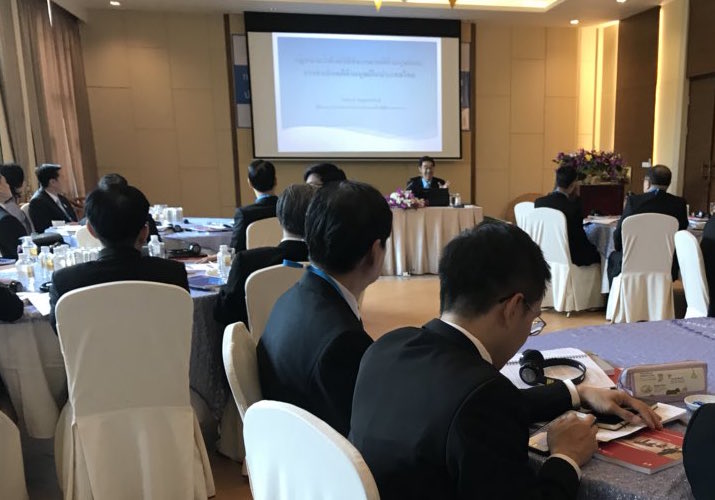
On 1 and 2 September, the ICJ held a “Workshop on the Independence of the Judiciary in the Context of the Inquisitorial Judicial System in Thailand” for members of the Thai judiciary in the north of the country.
Some 31 judges from 21 courts and the Administrative Office of the Court of Justice, Region V, attended the workshop, which was held in Chiang Mai.
The objective of the workshop was to discuss the role of judges and exercise of judicial power within the inquisitorial system, particularly in the context of adjudicating cases of human trafficking.
In an effort to combat human trafficking in Thailand, the Procedures for Human Trafficking Cases Act B.E. 2559 (2016) established inquisitorial system procedures for adjudication of cases of human trafficking.
With an increasing number of cases of human trafficking in Northern Thailand, judges in Northern Thailand are increasingly required to utilize inquisitorial processes in human trafficking cases.
Courts in Thailand generally adjudicate cases based on the adversarial judicial system.
In this context, the ICJ held the workshop in collaboration with the Administrative Office of the Court of Justice, Region V, in the North of Thailand, to share information and expand collaboration between Thai and international judges about inquisitorial processes.
Justice Aree Thecharuwichit, Chief Justice of the Office of the Chief Justice, Region V, Frederick Rawski, Regional Director of ICJ Asia and the Pacific, and Justice Radmila Dragicevic-Dicic, Vice-President of the ICJ, ICJ Commissioner, Acting President of the Belgrade Court of Appeals and Judge of the Supreme Court of Serbia delivered opening statements at the Workshop.
Justice Sittipong Tanyaponprach, Chief Judge of the Office of the Chief Justice, Region I, spoke about existing procedures in Thailand’s justice system to deal with human trafficking cases under the Procedures for Human Trafficking Cases Act 2016.
Justice Marcel Lemonde, Honorary President of Chamber in France’s Court of Appeal and an International Consultant in Judicial Matters, delivered an introduction to the inquisitorial system based on the French judicial system and spoke about existing challenges in inquisitorial processes.
Justice Radmila Dragicevic-Dicic, of the Supreme Court of Serbia and ICJ Vice-President spoke about judicial practice in cases involving human trafficking and shared her experience in adjudicating human trafficking cases in Serbia.
ICJ’s Senior Legal Adviser Kingsley Abbott moderated the workshop and provided an introduction to the ICJ’s resource materials on the independence of the judiciary and judicial accountability, including the ICJ’s Practitioners’ Guide No. 13 on Judicial Accountability.
The ICJ ended the Workshop with a statement reiterating its commitment towards working with Thailand’s judiciary to strengthen the rule of law and administration of justice in Thailand.
This Workshop is the second workshop held by the ICJ for Thailand’s judiciary in the North of Thailand.
Aug 30, 2018 | News
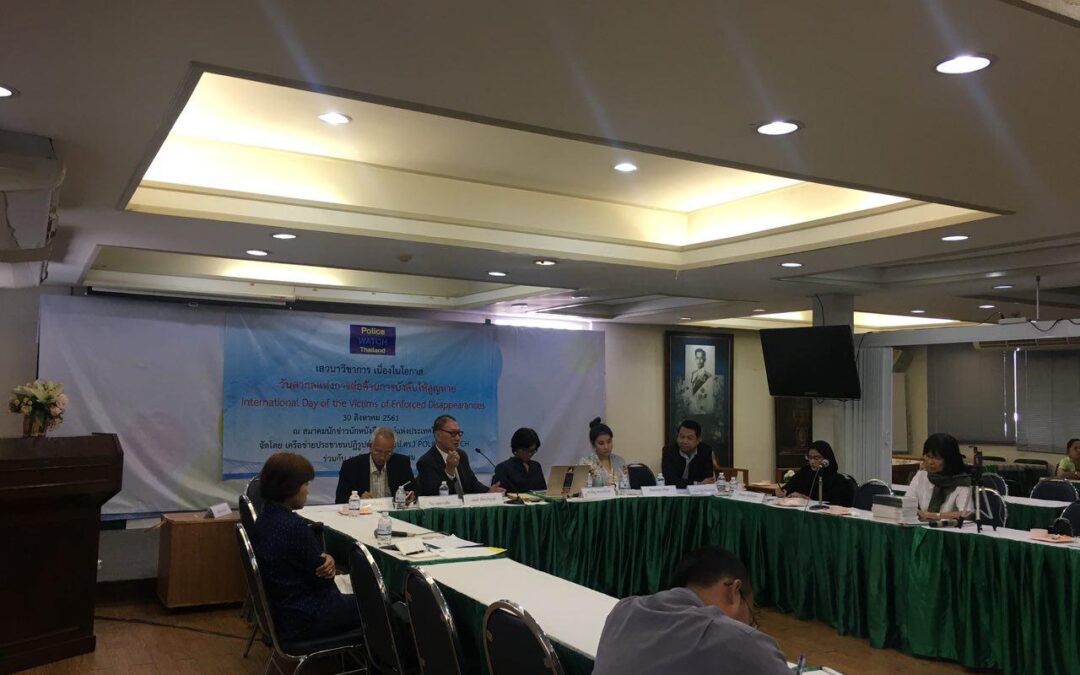
The ICJ participated in a panel discussion to commemorate International Day of the Victims of Enforced Disappearances, organized by Police Watch Thailand and Cross Cultural Foundation.
The discussion was held at the premises of the Thai Journalists’ Association.
The event began with opening remarks by Surapong Kongchantuk, Chairperson of the Cross Cultural Foundation, who called on the Thai Government to ratify the International Convention for the Protection of All Persons from Enforced Disappearance (ICPPED) and for the existing Draft Prevention and Suppression of Torture and Enforced Disappearance Act (‘Draft Act’) to come into force without undue delay.
He also emphasized that perpetrators of the crime of enforced disappearance needed to be brought to justice, and victims and relatives of victims of enforced disappearance must be provided with effective remedies and reparation.
A panel discussion followed the opening remarks, moderated by Pornpen Khongkachonkiet, Director of Cross Cultural Foundation. Panelists included Sanhawan Srisod, ICJ’s National Legal Adviser, Veera Somkomkid, from People Anti-Corruption Network, Pol.Col. Wirut Sirisawadibuth, Columnist and police reform activist, and Adul Kiewboribon, Chair of a committee of persons whose relatives disappeared during May 1992 protests against the government of General Suchinda Kraprayoon.
In her remarks, Sanhawan Srisod expressed concern at the absence of domestic legislation making torture and enforced disappearance specific crimes in Thai law and gaps in the existing Draft Act.
She also called for prompt, independent, impartial and effective investigations into the fate and whereabouts of disappeared persons consistent with international law and standards.
Human Rights Commissioner, and wife of disappeared lawyer and human rights defender Somchai Neelapaijit, Angkhana Neelapaijit, made closing remarks for the event.
The panel discussion followed a forum the ICJ co-hosted in March this year, commemorating the 14th year anniversary of the enforced disappearance of Somchai Neelapaijit, which also raised awareness about amendments to the Draft Act.
During the forum, the ICJ raised concerns about the independence of the ‘Committee managing complaints of torture and enforced disappearance cases’, which was established in May 2017, and expressed the need for further clarification on the legal framework – domestic and/or international – that will ground the Committee’s operation.
Background
The International Day of the Victims of Enforced Disappearances falls on 30 August every year.
Thailand is bound by international legal obligations under the International Covenant on Civil and Political Rights (ICCPR) and Convention against Torture and Other Cruel, Inhuman or Degrading Treatment or Punishment (CAT) – both of which it has acceded to – to investigate, prosecute, punish and provide remedies and reparation for the crimes of torture, other acts of ill-treatment, and enforced disappearance.
However, Thailand has not enacted domestic legislation recognizing enforced disappearance as a criminal offence. Thailand is also yet to ratify the ICPPED, despite signing the Convention in January 2012.
Thailand’s Ministry of Justice concluded a second round of public consultation on the Draft Act and is now reportedly in the process of evaluating the results of the consultation.
On 30 August 2017, 23 November 2017 and 12 March 2018, civil society organizations, including the ICJ, Amnesty International and Human Rights Watch, sent open letters to the Government, including to Thailand’s Minister of Justice, outlining amendments that would be necessary to bring the Draft Act in line with Thailand’s international human rights obligations.
In the absence of domestic legislation criminalizing torture and enforced disappearance, on 23 May 2017, a ‘Committee managing complaints for torture and enforced disappearance cases’ was established by the Prime Minister, pursuant to Prime Minister’s Office Order No. 131/2560 (2017).
The Committee, chaired by the Minister of Justice, consists of 15 officials drawn from different ministries,including the Ministry of Defence, the Royal Thai Police and the Internal Security Operations Command (ISOC).
Aug 27, 2018 | Nouvelles, Plaidoyer
Aujourd’hui, la CIJ a publié une note d’information juridique sous la forme d’un questions-réponses (uniquement disponible en anglais) dans laquelle elle énonce ce qui est requis pour pouvoir prouver un génocide, et en particulier, l’élément d’«intention génocidaire».
La note d’information de la CIJ sort au moment où la Mission internationale indépendante d’établissement des faits au Myanmar (FFM) appelle à enquêter les crimes commis au regard du droit international, y compris le génocide.
Le génocide est un crime particulièrement odieux dont la genèse en tant que crime de droit international réside dans la politique d’extermination du régime nazi pendant la Seconde Guerre mondiale.
En vertu du droit international coutumier et de la Convention pour la prévention et la répression du crime de génocide de 1948 («convention sur le génocide»), tous les États ont le devoir de prévenir et de punir le génocide.
Les agences des Nations Unies et des experts indépendants ont rapporté des informations crédibles et cohérentes selon lesquelles des crimes graves en vertu du droit national et international ont été commis contre les musulmans Rohingya au Myanmar, y compris les crimes contre l’humanité de déportation, viol et meurtre.
Un certain nombre d’experts et d’autorités ont également suggéré qu’un génocide avait été commis et ont demandé des enquêtes à ce sujet.
Aujourd’hui, la FFM a demandé l’ouverture d’une enquête sur un génocide dans le nord de l’État de Rakhine, ainsi que sur des crimes contre l’humanité et des crimes de guerre dans les États de Rakhine, Kachin et Shan.
Cette annonce fait suite à la déclaration du Haut-Commissaire des Nations Unies aux droits de l’Homme, Zeid Ra’ad al-Hussein, en décembre 2017, selon laquelle “des éléments de génocide pourraient exister”.
Et en mars 2018, le Rapporteur spécial des Nations Unies sur la situation des droits de l’Homme au Myanmar, Yanghee Lee, et le Conseiller spécial des Nations Unies pour la prévention du génocide, Adama Dieng, ont évoqué la possibilité que le traitement des Rohingyas par le Myanmar puisse constituer un génocide.
Les Rohingyas constituent la grande majorité des plus de 700’000 personnes déplacées à la suite d’opérations de sécurité commandées par l’armée du Myanmar dans le nord de l’État de Rakhine, à la suite d’attaques perpétrées le 25 août 2017 par l’Armée Arakan Rohingya (ARSA).
Le génocide est un crime complexe qui, dans de nombreux cas, peut être difficile à établir au-delà du doute raisonnable dans un procès.
L’un des domaines qui s’est révélé particulièrement difficile est la nécessité de prouver «une intention spéciale» ou une «intention génocidaire», qui est un élément constitutif et distinctif essentiel du crime de génocide.
La note d’information juridique devrait aider ceux qui examinent si un génocide a été commis contre la population Rohingya et, dans l’affirmative, si quelqu’un peut être tenu individuellement pénalement responsable.
La note d’information juridique répond aux questions suivantes:
1. Quelle est la définition du génocide?
2. Que signifie légalement une “intention génocidaire”?
3. Quelles sont les similitudes et les différences entre les crimes relevant du droit international en matière de persécution et de génocide?
4. Comment les différentes juridictions ont-elles abordé les intentions génocidaires de manière factuelle?
5. Dans quelle mesure l’élément d’intention des crimes sous-jacents contre l’humanité en matière de de déportation ou de transfert forcé à l’intention génocidaire est-il pertinent?
Contact
Kingsley Abbott, ICJ Senior Legal Adviser, t: +66 (0)94 470 1345 ; e: kingsley.abbott(a)icj.org
Download
Universal-Genocide Q & A FINAL-Advocacy-analysis brief-2018-ENG (PDF en anglais)