May 13, 2016 | Uncategorized
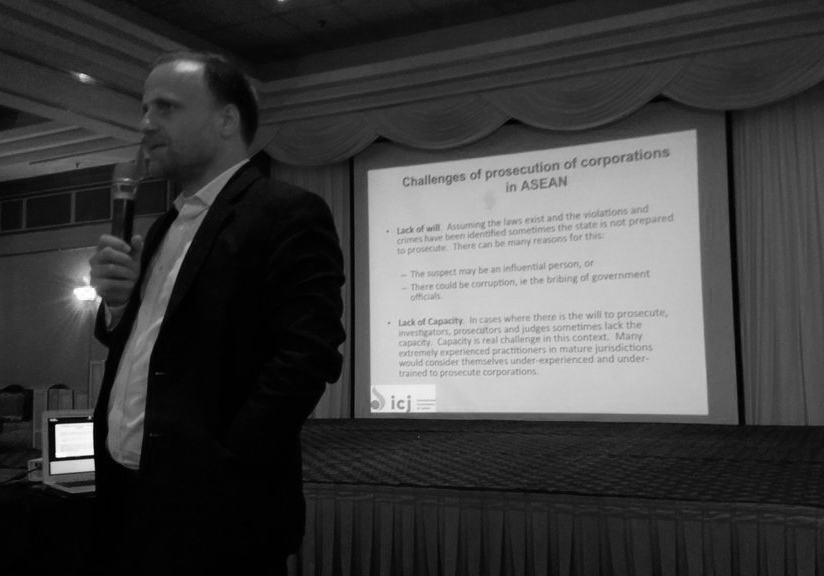
The workshop, held in Yangon on 12-13 May, brought together lawyers and activists from Cambodia, Laos, Myanmar, Thailand and the Philippines to share experience and best practice on access to remedy in the area of business and human rights.
“The ASEAN Economic Community and economic growth in Southeast Asia have not occurred with corresponding improvement in human rights,” said Carlos Lopez, ICJ Senior Legal Adviser on Business and Human Rights.
“The ICJ has identified supporting the right to a remedy as a key factor in ensuring that regional economic growth does not come at the expense of rights,” he added.
The Yangon workshop was designed to promote regional networking and sharing of experiences. In particular, participants discussed how to use strategic litigation to change a culture of impunity in South East Asia.
Strategic litigation can bring about significant changes in the law, practice or public awareness via taking carefully selected cases to court.
The clients involved in strategic litigation have been victims of human rights abuses that are suffered by many other people.
But strategic litigation does not happen entirely in the courts. Successful litigation will include social mobilization, awareness-raising, and skillful use of media.
Lawyers shared case studies revealing human rights abuses committed by business enterprises, fuelled by rapid, unregulated investment.
Unresolved and endemic disputes over land in Cambodia, Laos and Myanmar have given rise to human rights abuses and even conflict.
Illegal labour practices and the plight of migrant workers highlight the legal difficulty of prosecuting companies that operate in multiple jurisdictions.
Many of the abuses discussed concern the rights of communities, often the most marginalized.
Retaliation against communities and their lawyers for opposing development projects is common.
They fear legal action, intimidation and violence as a result of asserting human rights.
The workshop made clear that ASEAN states are not fulfilling their responsibility to protect human rights and are not providing adequate remedy for abuses by corporations.
“Despite diverse legal and political systems, the challenges facing these lawyers are strikingly similar,” said Daniel Aguirre, ICJ International Legal Adviser based in Yangon. “Protective laws are unimplemented in practice, individuals and communities lack effective access to remedy and they are often persecuted for asserting their human rights.”
Aside from outlining their important cases, participants at the workshop explained the strategies employed to affect change.
They discussed social mobilization and marches in the Philippines, the promotion of local culture and the use of media in Thailand, the engagement of civil society with lawyers in Cambodia and the struggle for land rights in Myanmar and Laos.
Participants took advantage of simultaneous translation to compare approaches.
Many participants pointed to a culture of impunity, where business activities often went unregulated, and corrupt authorities failed to implement and enforce laws.
Lawyers explained the difficulty of collecting evidence when so few locals were aware of the law and their human rights.
Moreover, crimes of a transnational nature present additional challenges, as people from different languages, cultures and legal systems must cooperate to enforce laws.
Underpinning all of these problems is the lack of independent judiciaries. “The lawyers all agreed that access to remedy is undermined by partial authorities that lack independence,” said Aguirre. “Even if they manage to get to trial, the courts are not always independent, impartial and competent.”
Contact:
Daniel Aguirre, ICJ International Legal Adviser, Yangon. daniel.aguirre(a)icj.org
Carlos Lopez, ICJ Senior Legal Adviser on Business and Human Rights, Geneva. carlos.lopez(a)icj.org

May 13, 2016 | News
The ICJ and other human rights organizations condemn the imminent executions of Kho Jabing in Singapore and at least 15 individuals which apparently includes, 4 Chinese nationals, 2 Nigerians, 2 Zimbabweans, 1 Senegalese, 1 Pakistani and 5 Indonesian nationals in Indonesia.
The organizations call on the authorities of the two countries to halt the impending executions.
On 12 May 2016, the family of Kho Jabing, a Malaysian national on death row in Singapore, received a letter from the Singapore Prisons informing them that he would be executed on 20 May 2016. Kho Jabing was convicted of murder in 2011.
Of particular concern is the fact that there was a lack of unanimity in sentencing Kho Jabing to death, which demonstrates that reasonable doubt exists as to whether he deserved the death penalty.
As regards the imminent executions that will be taking place in Indonesia, Indonesia would contravene her own international obligations under the International Covenant on Civil and Political Right by executing these individuals.
The Association of South East Asian Nations Member States (“ASEAN”), including Singapore and Indonesia, have continuously emphasized the importance of the rule of law and the protection of rights.
The death penalty therefore stands out as an aberration.
In December 2014, the United Nations General Assembly adopted its latest resolutions calling on all States to adopt a moratorium on the use of the death penalty, with a view towards abolition.
A record number of 117 Member States supported the Resolution.
Regrettably, Indonesia abstained and Singapore voted against the Resolution.
The ASEAN Member States must use the opportunity presented by this Resolution to align themselves with the global movement towards abolition.
Singapore has recently undergone its second Universal Periodic Review in January 2016.
The continued use of the death penalty was one of the key highlights of the review, with Singapore receiving over 30 recommendations related to the death penalty, including recommendations to abolish the death penalty.
In 2015, Indonesia, a United Nations Human Rights Council Member until 2017, executed 14 individuals convicted of drug-related offences amid strong international opposition.
The imminent executions would further damage Indonesia’s human rights record and erode her standing in the international community.
The death penalty has no place in the 21st Century.
Not only is there a real possibility of wrongful executions, it deprives inmates of their life and dignity, and creates new classes of victims.
We strongly urge the governments of Singapore and Indonesia to halt the upcoming executions, immediately impose a moratorium on the use of the death penalty and take meaningful steps towards its eventual abolition.
List of signatories:
Anti-Death Penalty Network Asia (ADPAN)
Center for Prisoner’s Rights Japan (CPR)
Community Action Network (CAN, Singapore)
Free Community Church (Singapore)
Function 8 (Singapore)
MADPET (Malaysians Against Death Penalty and Torture)
Maruah (Singapore)
International Commission of Jurists (ICJ)
Journey of Hope
Legal Aid Community (LBH Masyarakat, Indonesia)
Murder Victims’ Families for Human Rights (MVFHR)
Ocean
Pusat Studi Hukum dan Kebijakan Indonesia (The Indonesian Center for Law and Policy Studies)
Reprieve Australia
Sayoni (Singapore)
Singapore Anti-Death Penalty Campaign (SADPC)
Suara Rakyat Malaysia (SUARAM)
Taiwan Alliance to End the Death Penalty (TAEDP)
The Commission for the Disappeared and Victims of Violence (KontraS, Indonesia)
The Indonesian Center for Law and Policy Studies (PSHK, Indonesia)
The Institute for Criminal Justice Reform (ICJR, Indonesia)
The Institute for Policy Research and Advocacy of Indonesia (ELSAM)
The National Human Rights Society, Malaysia (HAKAM)
Think Centre Singapore
We Believe in Second Chances (WBSC, Singapore)
Contact:
Sam Zarifi, ICJ Asia-Pacific Director, t: +66-807-819-002; e: sam.zarifi(a)icj.org
May 12, 2016 | Новости, Статьи
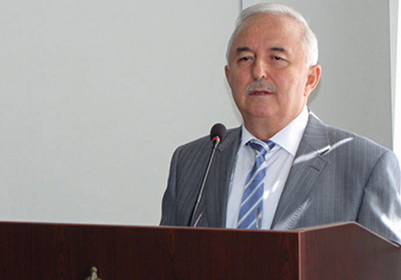
МКЮ обеспокоена сведениями об отставке федеральных судей в Чеченской Республике Российской Федерации, которая, по всей видимости, произошла под давлением исполняющего обязанности главы Чеченской Республики Рамзана Кадырова, заявившего, что добровольная отставка судей будет «самым правильным решением в их жизни».
МКЮ считает данные высказывания, прямым следствием которых, очевидно, и стала отставка федеральных судей, недопустимым вмешательством в функционирование и независимость судебных органов.
МКЮ призывает судебные органы Российской Федерации сделать всё возможное, чтобы обеспечить сохранение гарантированных сроков пребывания судей в должности, а также проверку любых заявлений о совершении судьями дисциплинарных проступков в рамках надлежащего дисциплинарного производства с соблюдением права на справедливое судебное разбирательство.
Кроме того, МКЮ призывает исполнительные органы воздержаться от любых комментариев, которые могут подорвать независимость судебных органов.
5 мая Рамзан Кадыров, исполняющий обязанности главы Чеченской Республики, посоветовал ряду судей добровольно подать в отставку.
Кадыров разместил пост в социальных сетях, в котором обратился к таким проблемам, как необъективные судебные решения, затягивание рассмотрения уголовных дел, решения по жилищным спорам, а также противоречивые решения.
Кадыров отметил, что, хотя все эти примеры единичны и малочисленны, они не способствуют росту доверия населения к судебной системе.
Кроме того, он рекомендовал Председателю Верховного Суда Чеченской Республики Магомеду Каратаеву и трём другим судьям, Тахиру Мурдалову, Супьяну Яндарову и Зайнди Хусаинову, подать в отставку, «если у них есть понятие чести и профессиональной этики».
Сообщается, что судьи Урус-Мартановского городского и Грозненского районного судов Супьян Яндаров и Зайнди Хусаинов в тот же день подали заявления об отставке.
Предположительно, Председатель Верховного Суда Чечни Магомед Каратаев и его заместитель Тахир Мурдалов также направили заявление об отставке.
Данные отставки, которые, очевидно, являются непосредственной реакцией на критику со стороны исполнительных органов власти, подрывают принцип разделения властей и независимости судебных органов в Российской Федерации.
В соответствии с международным правом, в том числе с правом на справедливое судебное разбирательство, которое защищается, помимо прочего, статьёй 6 Европейской Конвенции по правам человека и статьёй 14 Международного пакта о гражданских и политических правах, должна быть обеспечена независимость судебных органов.
Основные принципы ООН, касающиеся независимости судебных органов, предусматривают, что «все государственные и иные учреждения обязаны уважать и соблюдать независимость судебных органов», и устанавливают, что судебные органы не могут подвергаться «каким-либо ограничениям, неправомерному влиянию, … давлению, угрозам или вмешательству, прямому или косвенному, с чьей бы то ни было стороны и по каким бы то ни было причинам».
Несмотря на то, что у судей есть обязанность соблюдать судейскую этику и они должны привлекаться к ответственности за профессиональные проступки, представители исполнительных органов власти должны воздержаться от заявлений, которые ставят под угрозу независимость судебных органов.
В соответствии с Рекомендацией Совета Европы, «исполнительные и законодательные органы власти должны воздержаться от критики, которая может подорвать независимость судебных органов или общественное доверие к ним» (Рекомендация (2010) 12, параграф 18).
Давление на судей со стороны исполнительных органов власти с целью вынудить их подать в отставку может свести на нет гарантированные сроки пребывания судей в должности, которые защищаются национальным и международным правом и стандартами.
В соответствии с принципом 12 Основных принципов независимости судебных органов, «судьи, назначаемые или выборные, имеют гарантированный срок полномочий до обязательного выхода на пенсию или истечения срока полномочий, где таковой установлен».
По международным стандартам, заявления о совершении судьями дисциплинарных проступков должны рассматриваться самоуправляемыми органами судебной власти в рамках справедливого дисциплинарного производства.
В соответствии с Основными принципами ООН, единственным основанием для прекращения полномочия судей является их «неспособность выполнять свои обязанности или поведение, делающее их несоответствующими занимаемой должности».
Кроме того, заявления Рамзана Кадырова противоречат законодательству Российской Федерации, которое подробно регламентирует порядок привлечения судей к дисциплинарной ответственности в случае совершения дисциплинарных проступков.
RUSSIA-Chechen judges statement-News-web story-2016-RUS (полный текст на русском, PDF)
May 12, 2016 | News
The ICJ is concerned at the reported resignations of federal judges in the Chechen Republic of the Russian Federation following apparent pressure by the acting Head of the Republic Ramzan Kadyrov who had suggested that resignation would be the “most correct decision of their lives”.
The ICJ considers these statements, which appear to have led directly to the resignations of federal judges, to be inappropriate interference with the functioning and independence of the judiciary.
The ICJ calls on the Russian Federation judicial authorities to take all measures within their power to ensure that all judges’ security of tenure is preserved and that any allegations of misconduct are addressed through appropriate disciplinary proceedings that respect the right to a fair hearing.
The ICJ further calls on the executive authorities to refrain from any comments which may undermine the independence of the judiciary.
On 5 May, Ramzan Kadyrov, currently acting Head of the Chechen Republic, recommended that several named judges should step down.
In his post on social media, Kadyrov identified as problems unfair decisions of courts, procrastination in criminal cases, decisions regarding housing and inconsistent decisions.
He mentioned that although examples of such decisions were sporadic, they did not help build trust in the judiciary.
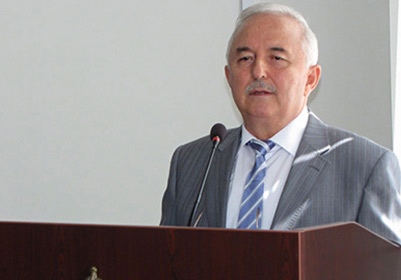
He then recommended that the President of the Supreme Court of the Chechen Republic, Magomed Karatayev (photo) and three other judges, Takhir Murdalov, Sulyan Yandarov and Zayndi Khusainov, should resign “if they had a notion of honour and professional ethics”.
It was reported that two judges of the Urus-Martan City Court and Grozny District Court, Sulyan Yandarov and Zayndi Khusainov, submitted their resignations on the same day.
The President of the Supreme Court of Chechnya, Magomed Karatayev, and his deputy Takhir Murdalov, are reported to have already filed a request for resignation.
The resignations, apparently in direct response to criticism by the executive, undermine the separation of powers and the independence of the judiciary in the Russian Federation.
Under international law, including the right to a fair trial protected, inter alia, by Article 6 of the European Convention on Human Rights and Article 14 of the International Covenant on Civil and Political Rights, the independence of the judiciary must be guaranteed.
The UN Basic Principles on Independence of the Judiciary enshrines “the duty of all governmental and other institutions to respect and observe the independence of the judiciary” and provides the judiciary shall not be subject to “any restrictions, improper influences…pressures, threats or interferences, direct or indirect from any quarter or for any reason.”
While judges have an obligation to adhere to judicial ethics and should be held accountable for professional misconduct, the representatives of the executive must refrain from statements which jeopardize the independence of the judiciary.
The Council of Europe’s Recommendation on judges specifies that “the executive and legislative powers should avoid criticism that would undermine the independence of or public confidence in the judiciary.”
Public pressure from the executive on judges to resign can nullify the security of tenure of judges protected under national and international law and standards.
According to Principle 12 of the Basic Principles on the Independence of the Judiciary, “[j]udges, whether appointed or elected, shall have guaranteed tenure until a mandatory retirement age or the expiry of their term of office, where such exists.”
Under international standards, allegations of misconduct against judges should be dealt with by the self-governing institutions of the judiciary, through fair disciplinary procedures.
Under the Basic Principles, the only basis for removal of judges is “incapacity or behaviour that renders them unfit to discharge their duties.
The comments by Ramzan Kadyrov also run contrary to the legislation of the Russian Federation, which spells out in detail the procedure for disciplinary measures against judges in case of alleged professional misconduct.
RUSSIA-Chechen judges statement-News-web story-2016-RUS (full text in Russian, PDF)
May 11, 2016 | Artículos, Noticias
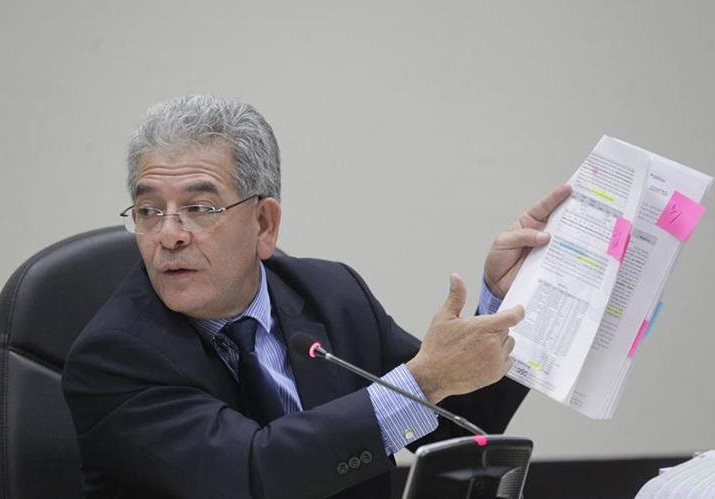
En los días pasados, el juez Miguel Ángel Gálvez ha sido víctima de amenazas que pretenden intimidarlo en su función de administración de la justicia.
La CIJ expresa su repudio ante cualquier tipo de presión en contra de operadores de justicia independientes y honestos.
Estas presiones no solamente amenazan la integridad física del juez Gálvez, sino también el trabajo valioso que realiza administrando justicia en casos de alto impacto.
Según los Principios Básicos de las Naciones Unidas Relativos a la Independencia de la Judicatura, no se permitirán intromisiones indebidas o injustificadas en los procesos judiciales.
Es esencial que los jueces puedan resolver los casos que conozcan con imparcialidad y sin restricción alguna.
La CIJ demanda que el Estado investigue estos actos intimidatorios y tome medidas efectivas de protección, para garantizar la seguridad física del juez Miguel Ángel Gálvez.
Ramón Cadena, Director de la CIJ para Centroamérica expresó: “Urgimos a las autoridades del Estado y en particular al Organismo Judicial a tomar medidas adecuadas para evitar que las y los jueces independientes resulten afectados por este tipo de intimidaciones y que se respete la integridad física y la independencia del juez Miguel Ángel Galvez.”