Mar 29, 2016 | News
The ICJ expresses its grave concern at the 28 March 2016 conviction and sentencing of 17 Angolan activists to terms of imprisonment ranging from two years to more than eight years, for the peaceful exercise of their human rights of freedom of association and freedom of expression.
Following an unfair trial, they were found guilty of “preparatory actions of rebellion and association of evildoers” [malfeitores], based on having read and discussed reading material on nonviolent means for resisting dictatorship or being associated with others who did so.
The ICJ joins numerous civil society organizations in condemning the failure by the authorities in Angola to conduct the trial in a manner consistent with its obligations under international human rights law.
“Judicial persecution of opponents of the government in Angola must be stopped forthwith” said Arnold Tsunga, ICJ’s Africa Director.
“A worrisome trend and pattern is emerging where the authorities in Angola are increasingly using the law and legal system as an instrument of repression targeting critics of the government as well as human rights defenders,” he added.
The ICJ calls on the Angolan authorities to invalidate the conviction and sentences, and to take concrete measures to strengthen the rule of law by ensuring the independence of the judiciary and legal profession as well as fully implementing international human rights standards in the national legal system.
Contact
Arnold Tsunga, ICJ’s Africa Director, t: +27731318411 or +263777283249 ; e: arnold.tsunga@icj.org
Background
Fifteen of the Accused were arrested in June 2015 and later joined by another two accused.
They were initially charged with rebellion and a conspiracy to mount a coup against the President for studying and discussing reading material on nonviolent means for resisting dictatorship.
The prosecution later dropped the second charge but added a charge of “criminal association” or “association with evildoers”.
The defense maintains that the state did not manage to prove anything beyond the fact that the accused discussed politics, which is allowed under the Angolan constitution.
No independent observers were allowed to attend the trial, raising serious concerns about the right to fair trial.
The African Charter on Human and Peoples’ Rights and the International Covenant on Civil and Political Rights, treaties to which Angola is a party, recognize freedom of expression and freedom of association as human rights, and prohibit governments from arbitrarily or otherwise illegitimately interfering with them.
Domingos da Cruz was sentenced to 8 years and six months; Luaty Beirão to 5 years and 6 months; Nuno Dala, Sedrick de Carvalho, Nito Alves, Inocêncio de Brito, Laurinda Gouveia, Fernando António Tomás “Nicola”, Afonso Matias “Mbanza Hamza”, Osvaldo Caholo, Arante Kivuvu, Albano Evaristo Bingo -Bingo, Nelson Dibango, Hitler Jessy Chivonde e José Gomes Hata were all sentenced to 4 years and 6 months); while Rosa Conde e Jeremias Benedito got 2 years and 3 months in jail.
Mar 28, 2016 | News
The ICJ today calls for the reversal of the Supreme Disciplinary Board’s decisions to force into retirement 47 judges following two separate, mass proceedings known as the “July 2013 Statement Case” and the “Judges for Egypt Case”, which concern over 60 judges.
Today’s final decision in the “July 2013 Statement Case” forcibly removed 32 judges from their offices.
It comes after all of the 15 judges referred to disciplinary proceedings in the “Judges for Egypt” were forcibly removed from their offices last Monday.
In a third case on 7 March 2016, the Disciplinary Board removed from office Zakaria Abdel Aziz, a former President of the Judges Club (Egypt’s representative body of judges) and a leading advocate of judicial independence.
“The intensity of Egypt’s attacks against individual judges is reaching a frightening level,” said Said Benarbia.
“By removing judges from the office following mass, arbitrary and unfair disciplinary proceedings, the authorities are purging from the judiciary the very voices that have promoted its independence, and sending a chilling message to others who might challenge the ongoing crackdown on fundamental rights and freedoms in Egypt,” he added.
The ICJ had previously raised concerns about fairness of these proceedings as well as the nature of the charges against the concerned judges.
In the “July 2013 Statement Case” and the “Judges for Egypt Case,” the Disciplinary Board found that the judges had been involved in politics and were therefore “unfit” to carry out their functions.
Article 73 of Egypt’s Judicial Authority Law prohibits judges from engaging in “political activity”.
This prohibition was interpreted by the Disciplinary Board to include “discussing or commenting on legislative and governmental decisions as long as it does not pertain to a case that he [the judge] is looking into as part of his judicial function”.
The ICJ considers that the interpretation by the Disciplinary Board could result in arbitrary limitations to the judges’ right to freedom of expression, assembly and association, well beyond any restrictions that could possibly be justified as necessary to preserve the dignity of their office and the impartiality and independence of the judiciary.
Furthermore, these disciplinary proceedings have failed to meet international standards of fairness, the ICJ says.
The Geneva-based organization previously highlighted procedural flaws in the proceedings against the judges such as failure to be notified properly, to be represented before the Board and to be provided with adequate time and facility to prepare a defense.
“The Egyptian authorities must reinstate all judges that have been removed from their office as a result of unfair and arbitrary proceedings”, said Benarbia.
“Furthermore, they must amend the Judicial Authority Law to ensure that disciplinary offences are clearly and precisely defined within the law; that the exercise of the rights to freedom of expression, association and assembly in a manner consistent with the dignity of the office and the impartiality and independence of the judiciary does not constitute a disciplinary offence; and that the disciplinary procedure is fair and does not undermine the independence and impartiality of the judiciary,” he added.
Contact:
Nader Diab, Associate Legal Adviser of the ICJ Middle East and North Africa Programme, t: +216 51727023; e: nader.diab(a)icj.org
Background
The UN Basic Principles on the Independence of the Judiciary, which were adopted by the UN in 1985 and elaborate on states’ obligations under international law, include the following provisions:
- In accordance with the Universal Declaration of Human Rights, members of the judiciary are like other citizens entitled to freedom of expression, belief, association and assembly; provided, however, that in exercising such rights, judges shall always conduct themselves in such a manner as to preserve the dignity of their office and the impartiality and independence of the judiciary.
- Judges shall be free to form and join associations of judges or other organizations to represent their interests, to promote their professional training and to protect their judicial independence. (…)
- A charge or complaint made against a judge in his/her judicial and professional capacity shall be processed expeditiously and fairly under an appropriate procedure. The judge shall have the right to a fair hearing. The examination of the matter at its initial stage shall be kept confidential, unless otherwise requested by the judge.
- Judges shall be subject to suspension or removal only for reasons of incapacity or behaviour that renders them unfit to discharge their duties.
- All disciplinary, suspension or removal proceedings shall be determined in accordance with established standards of judicial conduct.
- Decisions in disciplinary, suspension or removal proceedings should be subject to an independent review. This principle may not apply to the decisions of the highest court and those of the legislature in impeachment or similar proceedings.
Egypt- removal of judges-press release-2016-ARA (full text, Arabic, in PDF)

Mar 28, 2016 | Noticias
Indicios de crímenes de lesa humanidad por parte del Ejército de Guatemala en los años 80’s: nota No. 4 de Monitoreo y análisis de hallazgos de la justicia de transición de la CIJ para Centroamérica (enero 2016).
El caso CREOMPAZ inició a partir del hallazgo de 558 osamentas en el lugar donde operó la Zona Militar No. 21, ubicada en el municipio de Cobán, departamento de Alta Verapaz.
El Ejército de Guatemala decidió establecer el Comando Regional de Entrenamiento de Operaciones de Mantenimiento de Paz (CREOMPAZ), precisamente en el lugar en donde operó la Zona Militar No. 21.
El Ejército también inició en dicho centro, el entrenamiento del personal militar que el Estado de Guatemala aporta a la Organización de las Naciones Unidas para las Operaciones de Mantenimiento de Paz.
En su imputación, el Ministerio Público indica que los hechos ocurridos en la zona 21 datan de entre 1981 y 1988.
La Jueza del Juzgado de Primera Instancia Penal de Mayor Riesgo A resaltó que las exhumanciones fueron practicadas por la Fundación de Antropología Forense de Guatemala (FAFG), en virtud de un convenio de cooperación que esta entidad tiene con el Ministerio Público y con el Instituto Nacional de Ciencias Forenses. Estos temas vertidos en su argumentación, le permitieron a la juzgadora desvirtuar uno de los argumentos más remarcados por la defensa de los militares, quienes manifestaron en audiencias y ante los medios de comunicación, que la actuación de la FAFG era ilegal y estaba parcializada; por otro lado, con una breve exposición de argumentos, la jueza dejó claro que los procedimientos implementados por el MP para la investigación son legales y que se realizaron con el debido control jurisdiccional.
Un argumento central en el análisis de la juzgadora es el relacionado con la evidencia presentada por el MP, como por ejemplo álbumes fotográficos de las osamentas, en las cuales se observan cuerpos que aparecen enterrados boca abajo, con vendas en los ojos, manos atadas a la espalda, y lazos sintéticos atando los tobillos.
En palabras de la jueza, estos elementos permiten inferir que las personas encontradas en estas fosas, fueron víctimas de actos de violencia.
Finalmente, la juzgadora otorgó importancia a la existencia de dos declaraciones en calidad de anticipo de prueba por parte de testigos protegidos por el Ministerio Público; identificados en el proceso como Testigo A y Testigo B.
Vale notar en este proceso el trabajo bien fundamentado en el Derecho Internacional de los Derechos Humanos, realizado por la Jueza del Juzgado de Primera Instancia Penal de Mayor Riesgo A, quien analizó en forma metódica los puntos que resumimos a continuación:
a) tomó en cuenta las fuentes del derecho de forma integral, citando la costumbre, la jurisprudencia y la doctrina e hizo una relación del reconocimiento de las fuentes de derecho internacional como parte del derecho interno, a partir de la Constitución Política de la República de Guatemala;
b) la juzgadora reiteró que la desaparición forzada es un crimen de relevancia internacional, incluido en la categoría de crímenes de lesa humanidad;
c) para fortalecer sus argumentos jurídicos, la jueza citó jurisprudencia emanada del Sistema Interamericano de Derechos Humanos;
d) además, indicó que los delitos que están implicados en este caso constituyen crímenes que ofenden profundamente a la humanidad y que por esta razón han sido catalogados como normas “jus cogens”, que significa de “imperativo cumplimiento”, que son una categoría de normas que al ser violadas, es deber de la humanidad en su conjunto realizar investigaciones exhaustivas, que concluyan con la determinación de responsabilidad de las personas que participaron en la comisión de éstos ilícitos.
Al concluir su análisis sobre la evidencia, la jueza pasó a considerar la posibilidad de la participación de los sindicados en los crímenes que se investigan y para ello citó la teoría de Responsabilidad del Superior Jerárquico que deviene de la aplicación del principio de responsabilidad en el mando o mando responsable.
Los sindicados en este caso ocupaban altos mandos en el Ejército de Guatemala y por su función debían tener conocimiento suficiente para saber que sus subordinados estaban a punto de cometer algunos ilícitos penales, lo estaban cometiendo o lo habían cometido y no tomaron, oportunamente, las medidas necesarias y razonables para prevenir los crímenes, hacerlos cesar o para castigar a sus autores.
Basándose en legislación nacional y doctrina internacional, concluyó oportuno ligar a proceso a los sindicados y resolvió prisión preventiva en contra de 11 de los 14 sindicados, quienes ocuparon altos cargos militares en el ejército; para este grupo la jueza confirió un plazo de tres meses para que el Ministerio Público presente su acto conclusivo (resultados finales de la investigación).
Sobre 3 de los sindicados, decretó falta de mérito (no quedaron ligados a proceso penal), fundamentada en inconsistencias de la imputación. Se indicó que sobre éstos últimos, el Ministerio Público puede enmendar la imputación y presentarla nuevamente.
La CIJ realiza observación de este proceso penal con el apoyo del Programa de Acompañamiento a la Justicia de Transición -PAJUST- del Programa de las Naciones Unidas para el Desarrollo PNUD.
Mar 28, 2016 | News
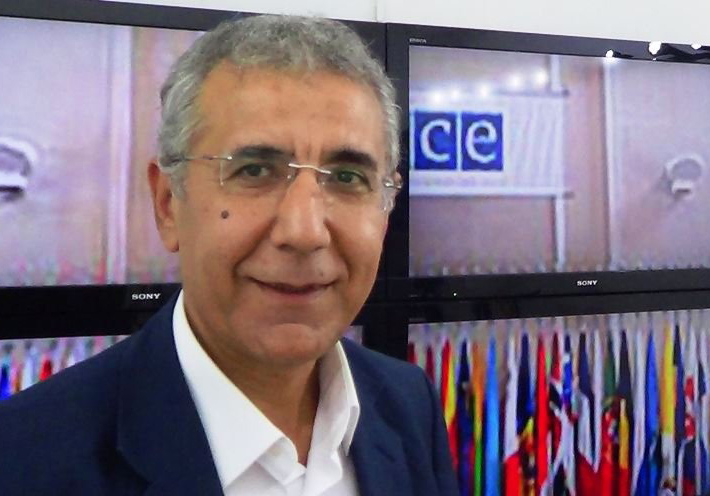
The ICJ welcomes the release of human rights lawyer Intigam Aliyev today after the Supreme Court reduced and suspended his sentence and ordered his immediate release.
Intigam Aliyev, a prominent human rights lawyer and the head of the NGO Legal Education Society, had been convicted on 22 April 2015 of tax avoidance, illegal entrepreneurship and abuse of power and sentenced to seven and a half years of imprisonment by a Baku Court.
A number of credible human rights organizations and international observers who have closely followed the case have stated that they consider the charges he was tried on to have been politically motivated, and that the real reason for his prosecution and conviction was repression by the Government of critical voices in civil society.
In a closed hearing, the Supreme Court reduced his sentence to five years of imprisonment and suspended its execution, after a request to this effect was made by Azerbaijan’s Prosecutor General, Zakir Garalov.
This unusual initiative follows the rejection, on 24 February, by the same Supreme Court of Intigam Aliyev’s complaint against his sentence.
“While the release of Intigam Aliyev is a positive step, the ICJ remains concerned that this decision appears to leave the underlying conviction in place despite credible reports that the charges were politically motivated,” said Massimo Frigo, ICJ Legal Adviser.
“If, as these allegations would suggest, Intigam Aliyev was targeted for his work as a lawyer, this would clearly violate international standards on the independence of lawyers”, said Temur Shakirov, another ICJ Legal Adviser.
Contact
Temur Shakirov, Legal Adviser, Europe Programme, temur.shakirov(a)icj.org
Massimo Frigo, Legal Adviser, Europe Programme, masimo.frigo(a)icj.org
Mar 24, 2016 | News
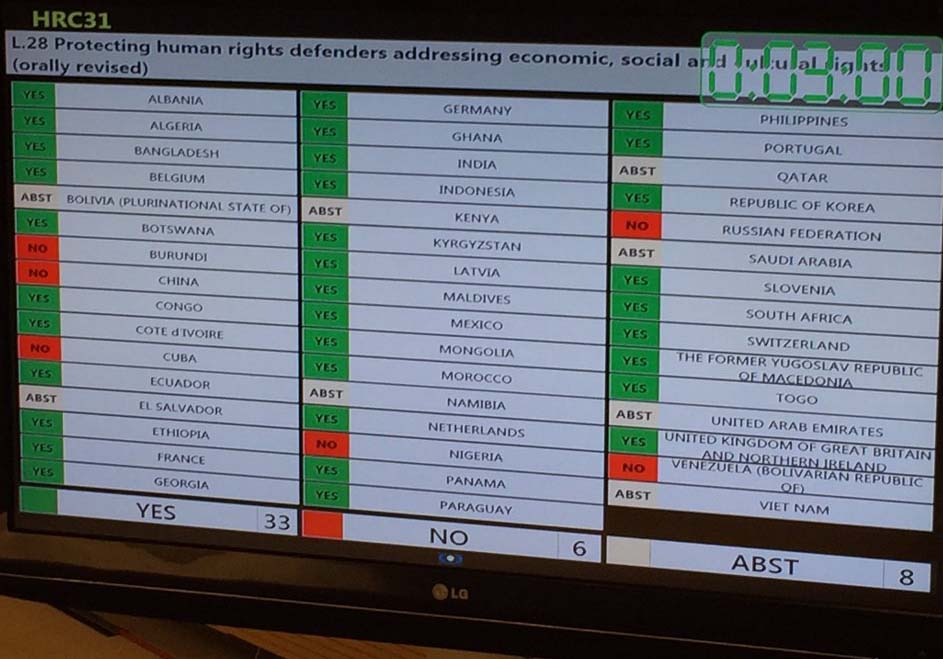
The ICJ welcomes today’s adoption by the UN Human Rights Council of a resolution on human rights defenders addressing economic, social and cultural rights.Negotiation of the resolution was led by Norway, who presented the draft to the Council with co-sponsorship with a large number of states from around the world.
A series of hostile amendments tabled by the Russian Federation, China, Cuba, Egypt and Pakistan, which would have weakened the resolution, were defeated, and the resolution was ultimately adopted by a large majority.
The ICJ had earlier joined advocacy efforts to support the resolution text as presented, and welcomes the strong message the resolution as adopted sends affirming the importance of defenders’ work on economic, social and cultural rights, as well as the need for states to respect, protect and fulfil the human rights of such defenders, including through a range of legislative, policy, and practical measures.
The draft resolution is available in an unofficial version here: 2016 draft resolution HRDs as orally revised.
The voting on the resolution is available here: Result of the vote HRDs