Aug 6, 2015 | News
Malaysian authorities must stop using vague and poorly defined laws to arrest and harass people for participating or organizing peaceful demonstrations, the ICJ said today.
The ICJ called for the repeal of Section 124B of the Penal Code, or its amendment in line with international standards.
At least 37 people have been swept up in arrests in recent days, many on 1 August at a rally organized in Kuala Lumpur by Demi Malaysia (For Malaysia) – a youth group comprised of activists from civil society groups, political parties and student organizations.
“As an immediate matter, the Malaysian government must ensure that no charges are brought against some 37 people who were arrested and detained this week for organizing a peaceful public demonstration,” said Emerlynne Gil, ICJ’s Senior International Legal Adviser on Southeast Asia. “As the government faces a wave of public criticism, it seems to be resorting to new legal mechanisms to block peaceful assembly and free expression—but these are guaranteed human rights and a crucial component of parliamentary democracy.”
At least 30 people were detained in the past few days under Section 143 of the Penal Code, which addresses “unlawful assemblies”.
Another seven people were arrested and held under Section 124B of the Penal Code, which states:
“Whoever, by any means, directly or indirectly, commits an activity detrimental to parliamentary democracy shall be punished with imprisonment for a term which may extend to twenty years.”
The seven individuals arrested under Section 124B were Adam Adli, Shukri Abdul Razab, Mandeep Singh, Safwan Anang, Hishammudin Rais, Vince Tan, and Fahmi Zainol. They were arrested before the public assembly occurred and are alleged to be involved in organizing the event.
“The use of Section 124B against people organizing a peaceful protest is particularly alarming, as the law’s language is impermissibly vague and broad, and the punishment of 20 years imprisonment is disproportionately harsh,” said Gil. “The Malaysian government must immediately move to substantially amend or repeal this problematic law, and meanwhile ensure that it is not used to charge any peaceful protesters.”
Gil further said: “An activity detrimental to parliamentary democracy’ is defined under Section 130A of the Penal Code to mean actions that are violent or unconstitutional, conditions clearly not present with this group of people arrested”.
“Section 124B has never been used before and the Malaysian government should ensure that this is never used in the future,” she added.
All 37 individuals arrested were released on police bail, except for Adam Adli, Shukri Abdul Razab, and Mandeep Singh, who were released after their lawyers successfully obtained an order from the High Court to review the order to remand them.
“Malaysia’s current political situation will likely see more public demonstrations critical of the government; it is the government’s responsibility to allow these peaceful protests to take place and to defend the rights of the protesters, not to trample on their rights,” Gil said. “Malaysia has the positive obligation under international human rights law not only to protect peaceful assemblies, but also to facilitate the exercise of the right to freedom of peaceful assembly.”
The right to freedom of peaceful assembly is guaranteed in key international human rights instruments.
The UN Human Rights Council underscored its commitment to promote and protect the right to freedom of peaceful assembly and association by adopting several resolutions on this issue, the most recent of which is Resolution 24/5, which was adopted in October 2013.
In Resolution 24/5, the UN Human Rights Council reminded States of their obligation to respect and fully protect the rights of all individuals, including human rights defenders, to assemble peacefully.
Background
On 1 August 2015, youth group Demi Malaysia (For Malaysia) organized a rally in Kuala Lumpur to call for the resignation of Malaysian Prime Minister Najib Razak for having failed to provide adequate responses on how 1Malaysia Development Berhad (1MDB), a strategic government fund, will be able to repay its debts that have amounted to billions of ringgit. Recently, Prime Minister Najib Razak has been facing allegations that he misappropriated RM 2.6 billion (USD 700 million) of 1MDB funds.
Adam Adli, Shukri Abdul Razab and Mandeep Singh were arrested and detained under s.124B of the Penal Code a day before the rally, while four others, Safwan Anang, Hishammudin Rais, Vince Tan and Fahmi Zainol were arrested and detained under the same provision on 1 August before the rally begun.
Contact
Emerlynne Gil, ICJ Senior International Legal Adviser, (Bangkok); t: +668 409 23575; e: emerlynne.gil(a)icj.org.
Photo: Zikri Kamarulzaman / Malaysiakini

Aug 3, 2015 | News
The ICJ is urging the Pakistani Government to immediately release, and drop all charges against, dozens of people arrested on 26 and 30 July in the context of a peaceful protest against forced evictions in Islamabad.
“This is yet another illustration of the Government using Pakistan’s counter-terrorism laws against peaceful protesters to clamp down on dissent,” said Sam Zarifi, ICJ’s Director for Asia and the Pacific.
“Peaceful protest is not an act of terrorism but a fundamental human right recognized by the Constitution as well as international human rights treaties that Pakistan is a party to,” he added.
The protest, forcibly dispersed by the police, was organized against the demolition of houses and the forceful eviction of over 8000 people residing in a slum in the city.
The Government alleges the slum is illegal and all residents are encroachers; the inhabitants claim that under Pakistani law, all informal settlements must either be formalized or the inhabitants must be provided alternate housing.
At least 66 individuals arrested were booked under Section 7 of the Anti-Terrorism Act, 1997 (ATA) for “obstructing the authorities”, “demonstrating force with a view to terrorizing citizens” and “creating mischief”.
Following a court order, they have been placed in police remand (custody of the police) for interrogation, where they may be at imminent risk of torture and other ill-treatment.
An anti-terrorism court released four of the detainees today. The rest, however, remain in police custody, and according to reports received by ICJ, many of them are being denied access to families and friends.
“The risk of abuse is inherent in the Anti-Terrorism Act, which defines terrorism in vague and overbroad terms. The Government must urgently amend the ATA to ensure it meets the internationally recognized tests of necessity, legality and proportionality,” Zarifi said.
Pakistan has a long history of using the ATA against political activists and human rights defenders.
In 2014, a dozen political activists, including Baba Jan, a prominent human rights defender from Hunza, were sentenced to life imprisonment by an anti-terrorism court for protesting against the government’s failure to assist victims of a landslide.
Before that, six power loom workers from Faisalabad were arrested in the context of a protest demanding minimum wage. In 2011, they were sentenced to 81 years in prison each under the ATA.
The International Covenant on Economic, Social and Cultural Rights, which Pakistan ratified in 2008, obligates States to recognize the right to an adequate standard of living, which includes housing.
The Human Rights Commission of Pakistan too has reminded the Government of its duty to provide shelter to the people of Pakistan and make arrangements to provide alternate housing to inhabitants of informal settlements.
“Forcibly evicting people from their homes without providing them any alternate housing can in itself be a human rights violation. Arresting peaceful protesters and denying their right to a fair trial even further adds to the culpability of the authorities,” Zarifi added.
Contact:
Sam Zarifi, ICJ Asia Pacific Regional Director (Bangkok), t: +66 807819002; email: sam.zarifi(a)icj.org
Reema Omer, ICJ International Legal Advisor, South Asia (London), t: +447889565691; email: reema.omer(a)icj.org
Additional Information:
Under Article 11(1) of the International Covenant on Economic, Social and Cultural Rights (ICESCR), which Pakistan ratified in 2008, States Parties recognize the right of everyone to an adequate standard of living, including adequate food, clothing and housing, and to the continuous improvement of living conditions.
States Parties are to take appropriate steps to ensure the realization of this right, recognizing to this effect the essential importance of international co-operation based on free consent.
The right to peaceful assembly is guaranteed under international human rights law, including Article 21 of the International Covenant on Civil and Political Rights (ICCPR), which Pakistan ratified in 2010 and is legally obligated to implement.
The UN Declaration on Human Rights Defenders also reiterates that everyone has the right to participate in peaceful activities against violations of human rights and fundamental freedoms, and obligates the State to take necessary measures to ensure the protection by the competent authorities of peaceful protestors against “any violence, threats, retaliation, de facto or de jure adverse discrimination, pressure or any other arbitrary action as a consequence of his or her legitimate exercise of the rights”.
Photo by Geo News

Aug 2, 2015 | News
From 31 July to 2 August 2015 the ICJ supported a training and induction workshop for the Zimbabwe National Prosecuting Authority (NPA) in Harare, with over 200 participants.
The public prosecutors came from the Eastern Division comprising of Midlands, Manicaland and Masvingo provinces.
The objective of the training and induction workshop was to appraise the prosecutors of the changes brought about by the Constitution, international and regional standards in the conducting of prosecutorial duties, their independence and accountability.
The presentations also focused on the Criminal Procedure and Evidence Act as the main guiding framework for public prosecutors which has been significantly altered with the assumption of a new Constitution in respect of fair trial rights.
The NPA and the public prosecutors required a platform to collectively familiarize themselves with the changes and conducting of their duties guided by national, international and regional standards.
For purposes of infusing best regional and international practices, presentations included international principles and standards for prosecutors under United Nations Basic Principles on the Role of Prosecutors; the Principles and Guidelines on the Right to Fair Trial and Legal Assistance in Africa; the relationship of the NPA and other arms such as the Judicial Service Commission and the Police.
An array of resources persons were invited and included Justice Chinembiri Bhunu, from the Judicial Service Commission, Virginia Mabiza, Permanent Secretary Ministry of Justice Legal and Parliamentary Affairs, Andrew Chigovera, former Attorney General of Zimbabwe, former Commissioner on the African Commission on Human and Peoples Rights and Dr. Tarisai Mutangi, law lecturer Midlands State University.
As a new establishment under the Constitution, the NPA explored the available and needed continuous professional development for prosecutors to fully equip them for their mandate.
The Principal of the Judicial College of Zimbabwe (a partner of the ICJ), Mr. Shana, presented on the opportunities for continuous professional development for prosecutors for acquaintance with new legal developments.
The training follows additional support that ICJ made to the National Prosecuting Authority (NPA) under a European Union (EU) funded agreement to develop a strategic plan for the NPA in respect of which a strategic planning workshop was held from 6 to 8 July 2015,
Contact:
Arnold Tsunga, ICJ Regional Director for Africa, t: +27 73 131 8411, e: arnold.tsunga(a)icj.org
Jul 31, 2015 | News
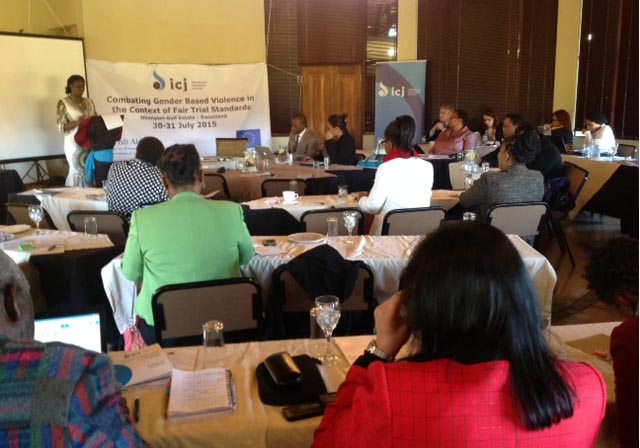
The ICJ held a colloquium on this issue on 30-31 July. Judges, magistrates, lawyers, members of academia, and civil society leaders from SADC, ECOWAS and the East African Community attended the event.
The Acting Chief Justice of the Kingdom of Swaziland, MCB Maphalala and the Secretary General of ICJ, Wilder Tayler, officially opened the colloquium.
The participants discussed the concept of gender-based violence; the efforts to combat impunity in sexual offences and gender based violence at the national, regional and international level and made recommendations to eliminate the scourge.
One of the key objectives of the workshop was to contribute to the process of enacting sexual offences and domestic violence legislation in Swaziland.
The Sexual Offences and Domestic Violence Bill of Swaziland is before the house of assembly, which has asked stakeholders to submit their views, on what should be included in the law.
The judges, lawyers and civil society leaders had robust and honest discussions touching on effective innovative strategies to combat sexual and gender based violence.
Some of the recommendations included the training of judicial officers to be gender sensitive, changing societal attitudes and prejudices, raising awareness amongst parliamentarians, creative interpretation and application of regional and international standards when adjudicating cases of sexual offences and gender based violence as well as observance of fair trial standards at the national, regional and international level.
The colloquium was made possible with funding from IrishAid.

Jul 30, 2015 | News
The ICJ strongly condemned the execution of Yakub Memon, who was hanged in Nagpur Central Jail, India this morning.
“Yakub Memon’s execution is a distressing and regressive move, keeping India in the minority of countries which continue to carry out executions,” said Sam Zarifi, ICJ Asia Pacific Regional Director. “While Yakub Memon was convicted of terrible crimes, executing him was not the solution. India should immediately put in place a moratorium on the death penalty.”
A court set up under the Terrorist and Disruptive Activities (Prevention) Act (TADA) convicted and sentenced Yakub Memon to death for a range of offences, including conspiracy to commit terrorist acts, in connection with the deadly terrorist attacks in Mumbai in 1993.
These attacks killed more than 250 people and injured more than 700. The main accused in this case, including Yakub Memon’s brother Tiger Memon, have still not been apprehended or tried.
“In executing Yakub Memon, the Indian government has only fulfilled a desire for retribution and added to the disturbing trend of executions in the name of fighting terrorism in South Asia”, Zarifi added. “The death penalty has not been shown to have any deterrent effect on crime or terrorism anywhere in the world.”
The Indian Supreme Court had confirmed Yakub Memon’s conviction and sentence on appeal from the court set up under the TADA in March 2013.
The Indian government repealed the TADA in 1995, after sustained national and international criticism for its incompatibility with human rights law, particularly the right to fair trial.
Yakub Memon was tried under provisions of the TADA as it was the law in force in 1993, when the terrorist attacks in Mumbai occurred.
The Indian president rejected a first mercy petition on his case in April 2014.
He subsequently filed a review petition challenging his sentence before the Indian Supreme Court, which was rejected on 9 April 2015.
On 21 July 2015, the Indian Supreme Court dismissed his curative petition for the commutation of his death sentence.
A court had authorized his execution before his curative petition was dismissed.
Yakub Memon then approached the Indian Supreme Court challenging, both, the manner in which his curative petition was heard and dismissed, and the validity of the order authorizing his execution. However, the Supreme Court dismissed both these arguments yesterday.
Over the past week, Yakub Memon filed fresh mercy petitions to commute his death sentence before the Governor of the State of Maharashtra and the President of India. Both were rejected yesterday.
Yakub Memon’s lawyers challenged the rejection of the mercy petition, and asked the Indian Supreme Court to stay the execution as per the guidelines issued in the 2014 case of Shatrughan Chauhan v Union of India, for “safeguarding the interests of the death row convicts”.
These included ensuring a minimum period of 14 days “between the receipt of communication of the rejection of the mercy petition and the scheduled date of execution”.
But the Court – in a hearing early this morning – rejected this final plea.
Background:
This is India’s third execution in the past five years. India resumed executions in 2012, after a gap of eight years. Since November 2012, two other people have been executed, Ajmal Kasab and Afzal Guru.
They also were both charged and convicted for their role in terrorist attacks.
The ICJ expresses its solidarity with the victims of the 1993 attack, and their families.
India is a party to the International Covenant on Civil and Political Rights, which guarantees the right to a fair trial as well as the right to life and freedom from cruel, inhuman, or degrading treatment or punishment.
The UN Human Rights Committee, the supervisory authority for the ICCPR, has emphasized: “In cases of trials leading to the imposition of the death penalty scrupulous respect of the guarantees of fair trial is particularly important. The imposition of a sentence of death upon conclusion of a trial, in which the provisions of article 14 of the Covenant have not been respected, constitutes a violation of the right to life.”
In December 2014, the UN General Assembly adopted a resolution, for the fifth time since 2007, emphasizing that the use of the death penalty undermines human dignity and calling on those countries that maintain the death penalty to establish a moratorium on its use with a view towards its abolition. Some 117 UN Member States, a wide majority, voted in favor of a worldwide moratorium on executions as a step towards abolition of the death penalty.
The ICJ opposes capital punishment in all cases without exception. In line with the present international trend, the ICJ calls on India to impose an official moratorium on the death penalty, with a view to abolishing the death penalty.
Contact:
Sam Zarifi, ICJ Asia Pacific Regional Director (Bangkok), t: +66 807819002; email: sam.zarifi(a)icj.org