Philippines: Supreme Court decision may stifle freedom of expression

Philippines: Supreme Court decision may stifle freedom of expression

The Philippines Supreme Court’s decision to uphold provisions in the Cybercrime Prevention Act that penalize online libel may stifle freedom of expression, the ICJ warned today.

Yesterday, the Philippine Supreme Court upheld as constitutional the provisions in the Cybercrime Prevention Act penalizing and increasing the penalty for libel committed online.

“By enacting this law, the Philippines government will inhibit people who try to express themselves through the Internet and electronic media,” said Emerlynne Gil, ICJ Legal Advisor on Southeast Asia. “The Supreme Court decision unfortunately means that the Philippines has now joined those countries in the ASEAN region that are vainly trying to turn back the tide of greater and freer expression online.”

The Cybercrime Prevention Act (Republic Act No. 10175) was adopted in September 2012, but its application was suspended in October 2012 by a temporary restraining order issued by the Supreme Court.

Several groups, such as the National Union of Journalists of the Philippines, the Internet and Society Program of the UP College of Law, and the National Press Club, filed petitions before the Supreme Court alleging that the law on its face violates the right to freedom of expression as guaranteed under the Philippine Constitution.

The ICJ considers the Cybercrime Prevention Act as incompatible not only with the Philippine Constitution, but also with Philippines’ international obligations under the International Covenant on Civil and Political Rights (ICCPR), which guarantees the rights to freedom of expression, including the right to receive and impart information.

“The criminalization of libel or defamation is an affront to freedom of expression,” Gil said. “It’s now up to the Philippine Congress to amend the Cybercrime Prevention Act and decriminalize libel and defamation so as to ensure respect for freedom of expression consistent with its international obligations.”

The Court upheld both Sections 4(4) and 6 of the law, which respectively provide that libel committed through a computer system or similar means is illegal and that responsible persons will incur the penalty one degree higher than what is provided under the Revised Penal Code.

Hence, a person found guilty of committing online libel may be subject to imprisonment from six to nine years.

The ICJ has previously expressed opposition to the law, pointing out that its provisions on online libel compound the existing problematic provisions on defamation in the Philippine’s Revised Penal Code and provide for even greater penalties for libel.

The decision of the Supreme Court made a distinction on who may be punished of committing online libel.

It specified that only the original author of the allegedly libelous statement and not the recipient or those who disseminated, such as an internet service provider, may be held criminally responsible for online libel under the law.

The UN Human Rights Committee, the international monitoring body of the ICCPR, has said that States should decriminalize libel or defamation.

It underlined that in order to comply with their obligations under ICCPR, States may only penalize the most serious defamation cases and even in these cases, “imprisonment is never an appropriate penalty.” The Philippines has been a party to the ICCPR since 1986.

The ICJ welcomed the Court’s striking down as unconstitutional section 19 of the Act, which gives the Department of Justice power to restrict or block access, without prior judicial determination, to computer data found to be in violation of the law.

This is in line with the international standard that no law shall confer unfettered discretion to those charged with its execution the restriction of freedom of expression.

Contact:

Emerlynne Gil, ICJ International Legal Adviser for Southeast Asia, t +66 2 619 8477; email: emerlynne.gil(a)icj.org (For English, Filipino, and Cebuano)

Craig Knowles, ICJ Media Consultant, t +66 81 9077653; email: craig.knowles(a)icj.org

Italy : Constitutional Court’s rendition ruling undermines the fight against impunity

Italy : Constitutional Court’s rendition ruling undermines the fight against impunity

The ICJ today expressed concern at a ruling of the Italian Constitutional Court which denies full accountability of Italian officials in the case of the 2003 unlawful rendition, enforced disappearance and torture of Osama Mustafa Hassan Nasr, also known as Abu Omar.  

In a ruling making no mention of the international human rights law obligations of Italy, the Court agreed with the contention of the Italian Government that it may protect from disclosure and use in court what it considers to be “secrets of state” even if to do so would prevent the revelation of the truth about serious crimes and human rights violations and the holding of those responsible to account.

The Court ruled that, under the Italian Constitution and the law on secrets of state, it is the sole prerogative of the President of the Council of Ministers, exercising “a wide discretionary power”, to establish the width of application of the secret of state doctrine.

The Court affirmed that such decisions cannot be questioned by ordinary courts.

A number of Italian and United States intelligence agents, including the former Director of the Italian Military Secret Service, Nicolò Pollari, had been found guilty of criminal offences in connection with the rendition.

The Constitutional Court’s ruling is likely to effectively annul the convictions of the top Italian secret agents involved in the rendition.

“This ruling constitutes a serious blow to the fight against impunity for some of the most serious crimes under international law”, said Massimo Frigo, Legal Adviser for the Europe Programme. “It disregards fundamental pillars of international human rights law, including the right to truth and the duty to investigate, prosecute and ensure accountability for gross violations of human rights”.

“The doctrine of “secret of state” must never be used as a means to cover up responsibility for crimes under international law or gross violations of human rights,” Frigo added. “The United States, which is primarily responsible, deplorably has abdicated its responsibility to meaningfully investigate and hold officials to account for gross human rights violations in its rendition and secret detention programme. Italy, by contrast, had been the only country in which the courts had imposed convictions for the US-led renditions. After this judgment, there is a real risk that the Italian complicity in this crime will never be fully ascertained and accounted for.”

The ICJ is concerned at reports that time limits for the conclusion of criminal proceedings in this case could expire in two months, despite the fact that, under international standards, limitation periods should not be imposed in respect of serious of crimes such as torture and enforced disappearance.

The expiry may foreclose any further investigation or criminal trial on Italian involvement in this rendition, which should occur irrespective the obstacles caused by the secret of state doctrine.

The ICJ is particularly concerned that successive Italian governments since 2007 have either proposed or refused to withdraw government applications before the Constitutional Court affirming that the executive prerogative on secret of state takes precedence over the fight against impunity.

The ICJ considers that the law and practice regarding the “secret of state” must be reformed to be into compliance with Italy’s duty to investigate crimes under international law and gross human rights violations.

While States may protected a limited amount of information when strictly necessary for legitimate national security purposes, they may not do so with respect to information concerning gross violations of human rights.

Background

Hassan Mustafa Osama Nasr, also known as Abu Omar, was been kidnapped in 2003 in the streets of Milan by CIA operatives and subject to rendition to Egypt where he had been subject to enforced disappearance, arbitrary detention and torture.

The case of Abu Omar was one of at least 136 known cases in the rendition and secret detention carried out since 2001 by the United States, with the participation of some 54 other States, which typically involved multiple human rights violations, including torture and ill-treatment, enforced disappearance, and arbitrary detention.

The Constitutional Court judgment effectively reversed the ruling of the Court of Cassation that ordered the reopening of the trial against the former Director of the Italian Military Secret Service, Nicolò Pollari, his deputy, Marci Mancini, and other Italian military secret services operatives for their alleged complicity in the operation.

The Court of Cassation had held that the doctrine of “secret of state”, which barred their conviction, would not apply to them, because the Italian secret services have no authority to conduct such illegal operations and they had therefore effectively acted in private capacity.

Following that judgment, the Court of Appeal convicted, among others, for complicity in the kidnapping Nicolò Pollari to ten years of imprisonment and Marco Mancini to nine years.

The Court of Cassation upheld in absentia the convictions and sentences of 23 US agents involved for the offence of kidnapping.

On 5 April 2013, the President of the Italian Republic, Giorgio Napolitano, granted a pardon for US Colonel Joseph L. Romano III, who had been convicted by Italian courts of the offence of complicity with the US in kidnapping for his role in the rendition of the Milan cleric Abu Omar in 2003.

Contact:

Massimo Frigo, Legal Adviser, ICJ Europe Programme, massimo.frigo(a)icj.org

Malaysia: ICJ continues to monitor Anwar Ibrahim’s ‘Sodomy II’ trial

Malaysia: ICJ continues to monitor Anwar Ibrahim’s ‘Sodomy II’ trial

The ICJ continued its observation of the trial of Malaysian opposition leader Anwar Ibrahim on sodomy charges under the colonial-era Section 377B of the Penal Code, which criminalizes consensual same-sex sexual relations.

ICJ Commissioner Justice Elizabeth Evatt AC, the first woman judge to be appointed to an Australian Federal Court and a former member of the United Nations Human Rights Committee, observed a hearing on the appeal of Anwar Ibrahim at the Court of Appeal in Putrajaya yesterday.

“The ICJ will continue to monitor this case and evaluate the fairness of the proceedings in light of relevant international standards,” said Emerlynne Gil, ICJ international legal advisor for Southeast Asia. “The ICJ will also assess whether the prosecution under Section 377 is being used in this case to suppress political dissent, contrary to the right to freedom of expression.”

The hearing is an appeal against the High Court’s decision on 9 January 2012, which acquitted Anwar Ibrahim of sodomy.

“The ICJ has previously condemned Malaysia’s continuing use of colonial-era criminal charges of ‘sodomy’ to cover even consensual sexual relations between adults,” Gil said. “The ICJ believes that Article 377B of the Malaysian Penal Code is inconsistent with respect for the right to privacy under international standards.”

The Court of Appeal heard and eventually dismissed an interlocutory application filed by the lawyers of Anwar Ibrahim seeking to recall for testimony Jude Blacious s/o Pereira, the investigating officer and key witness in the sodomy case.

Pereira was recently found unfit to be a practicing lawyer in another case in a High Court decision of 10 January 2014.

In that decision, the High Court relied on a 2009 Human Rights Commission of Malaysia’s (SUHAKAM) report, which determined Pereira to be an unreliable witness in a public inquiry established to investigate the arrest and detention of 5 legal aid lawyers.

The Court of Appeal dismissed the application on the grounds that Anwar Ibrahim had failed to satisfy the court that additional evidence in the appellate stage was necessary in dispensing justice and that it fell in the category of “most exceptional” cases, particularly as the SUHAKAM report had already been available since 2009.

The Court of Appeal postponed the hearing on the appeal itself to allow Anwar Ibrahim’s lawyers to file a notice of appeal with the Federal Court on the dismissal of the interlocutory order.

Anwar Ibrahim’s counsel immediately filed a notice of appeal to the Federal Court on the dismissed interlocutory application.

The case management for the sodomy appeal has been fixed on 28 February 2014.

The appeal proper was initially scheduled on 17 and 18 September 2013 but has faced continuous delays due to a series of interlocutory matters.


Myanmar’s court officials discuss judicial independence and integrity with international experts

Myanmar’s court officials discuss judicial independence and integrity with international experts

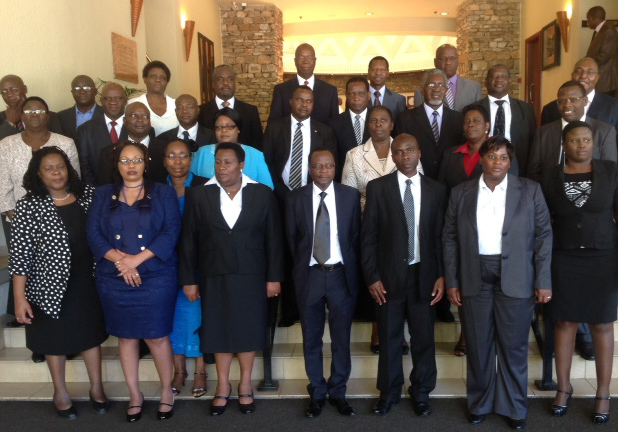
The seminar was on “The Role of Judicial Independence and Integrity in Improving the Effectiveness of the Rule of Law”, with the participation of the ICJ.

The event, hosted by the Office of the Supreme Court of the Union (OSCU) in collaboration with the United Nations Development Programme (UNDP) and the ICJ, took place in Nay Pyi Taw on February 10th and 11th 2014.

It was attended by more than 40 judges and senior court administrators from all states and regions in Myanmar.

Discussions at the seminar focused on the ways in which Myanmar’s judicial system can continue to develop its functional independence and deliver justice for all.

In opening the seminar, the Honourable Chief Justice of the Union, U Htun Htun Oo, remarked that judicial independence and integrity are essential to building a reliable judicial system in which the people of Myanmar can trust, and which can uphold the rule of law.

During the seminar, Justice Kalyan Shrestha of Nepal, and ICJ Vice President Justice Michèle Rivet of Canada shared their experiences of the challenges of preserving judicial independence as a key pillar of a democratic society.

In her opening remarks, Ms. Renata Lok-Dessallien, UN Resident Coordinator, also noted that in addition to the importance of a fair legal framework, a trained judiciary and well-functioning court system, “the other half of the equation is from the bottom up: it is people’s perceptions of the professionalism, integrity and fairness of the system.”

Sam Zarifi, ICJ’s regional director for Asia and the Pacific added that “access to an independent and impartial tribunal is a human right”.

Both UNDP and ICJ expressed their willingness to continue working with Myanmar’s judiciary on the issues of judicial independence, and justice for all for the long-term.

Photo: ICJ Vice President Justice Michèle Rivet, Justice Kalyan Shrestha and Chief Justice U Htun Htun Oo


Cambodia: the ICJ condemns decision to deny bail to garment workers and activists

Cambodia: the ICJ condemns decision to deny bail to garment workers and activists

The ICJ condemned the Cambodian Court of Appeal’s decision to deny bail to 21 workers and activists who were arrested in connection with protests by garment factory workers. 

They have been held in detention since their arrests on 2 and 3 January 2014.

The court upheld an earlier decision of the Phnom Penh Municipal Court.

Garment factory workers were protesting to seek a higher minimum wage.

“International law is clear that pre-trial detention may only be ordered in exceptional circumstances and avoided if suitable alternatives are possible,” said Sam Zarifi, ICJ’s Regional Director for Asia and the Pacific.  “The ongoing detention of these protesters, and the failure of the government to provide accountability for the death of five unarmed protesters on 3 January, demonstrates the government’s efforts to stop protesters exercising their rights to assemble freely and express their opinions.”

“Not only is this a very disappointing outcome for the 21 detainees and their families, but it also sets a worrying precedent in what is still a developing area of the law in Cambodia,” he added.

Article 9 of the International Covenant on Civil and Political Rights (ICCPR), to which Cambodia is a party, guarantees the right to liberty.

It states, “It shall not be the general rule that persons awaiting trial shall be detained in custody, but release may be subject to guarantees to appear for trial.”  Such guarantees include bail.

Articles 19 and 21 of the ICCPR guarantee the rights to freedom of opinion and assembly.

Contact:

Sam Zarifi, ICJ Asia-Pacific Regional Director, (Bangkok), t:+66 807819002, e-mail: sam.zarifi(a)icj.org

Craig Knowles, ICJ Media & Communications, (Bangkok), t:+66 819077653, e-mail: craig.knowles(a)icj.org


Translate »