Nov 19, 2013
Despite progress for many women in Botswana, access to justice remains a challenge, a new ICJ report says.
Launched today, Women’s Access to Justice in Botswana: Identifying the Obstacles and Need for Change, assesses some of the challenges faced by women in Botswana when seeking justice and legal protection for human rights abuses and other wrongful conduct.
It underlines that a range of practical barriers and legal impediments continue to combine to undermine the ability of women to seek legal redress for such abuses.
“Although Botswana has implemented a number of important measures to advance gender equality, for many women justice remains an abstract ideal rather than a practical reality,” said Leah Hoctor ICJ Senior Legal Advisor on Women’s Human Rights. “Over the coming years further concerted action is needed.”
The report outlines a series of effective and meaningful steps that Botswana can take to ensure laws and procedures support and advance women’s ability to assert their rights.
“This report provides a wide range of stakeholders, including government actors, the judiciary, civil society representatives and the legal profession with important guidance as to the action now necessary,” said Arnold Tsunga, Director of the ICJ’s Africa Programme.
Contact:
Leah Hoctor: leah.hoctor(a)icj.org
Arnold Tsunga: arnold.tsunga(a)icj.org
ICJ Women’s Access to Botswana-publications-2013 (download in pdf)

Nov 7, 2013
Many women in Kazakhstan face a range of serious legal and procedural challenges and obstacles when seeking justice for discrimination and gender-based violence, a new ICJ report says.
Launched today, the report Women’s Access to Justice in Kazakhstan: Identifying the Obstacles and Need for Change assesses some of these challenges and the deficits of legal protection, and access to remedy for violations, in situations of discrimination and sexual and domestic violence.
The report also underlines that significant flaws and gaps in Kazakhstan’s legal and procedural framework dealing with discrimination and violence against women undermine the ability of women to seek legal redress.
“Advancing gender equality and preventing violence and discrimination against women requires sustained engagement and long-term commitment, it is not a static process,” said Leah Hoctor, Senior Legal Adviser for ICJ’s Women’s Human Rights Programme. “Kazakhstan should take serious measures to address the issues identified in this report so as to ensure its laws and procedures address women’s needs and protect their rights in practice.”
The report details the way in which international human rights law obliges Kazakhstan to take effective and meaningful steps to ensure its legal framework adequately deals with discrimination and violence against women.
“This report provides both government actors, civil society representatives and the legal profession with important guidance as to the content of Kazakhstan’s international obligations to advance women’s access to justice,” said Temur Shakirov, Legal Adviser for ICJ’s Europe Programme.
Contacts:
Leah Hoctor: leah.hoctor(a)icj.org
Temur Shakirov: temur.shakirov(a)icj.org
Kazakhstan-Women’s Access to Justice-Publications-Report-2013 (full text in pdf)
Kazakhstan-Women’s Access to Justice-press release-2013-RUS (full text in pdf)
Kazakhstan-Women’s Access to Justice-Publications-Report-2013-RUS (full text in pdf)
Oct 29, 2013
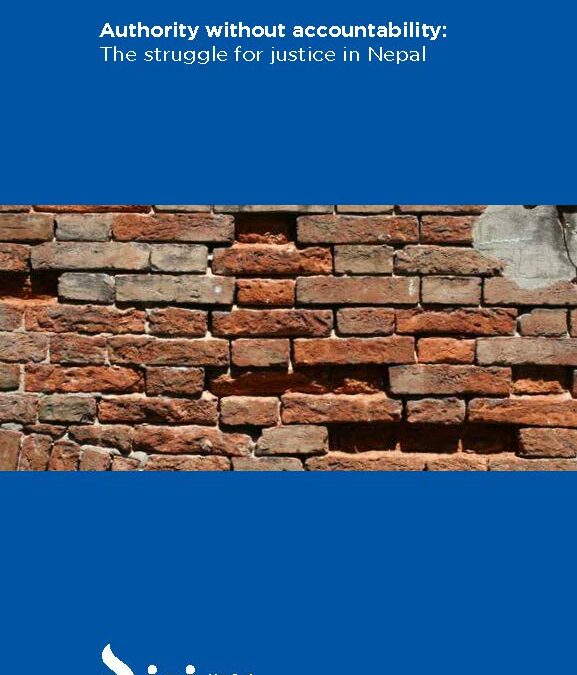
The report explains how the historic system of statutory immunities in Nepal, compounded by the lack of political will, has prevented victims of human rights violations from obtaining effective remedy and reparation for their injuries.
The ICJ released its new 117-page report Authority without Accountability: The struggle for justice in Nepal today in Kathmandu.
During Nepal’s decade-long civil war, serious human rights abuses were committed by government security forces as well as the armed Maoist insurgents, with an estimated 17,000 persons killed, many unlawfully, and over 1,300 subject to enforced disappearance.
Despite an explicit commitment to provide for effective justice in the peace agreement between the Maoists and the government, to date, no one has been prosecuted or convicted for any conflict-related human rights violations.
Three successive governments between 2008 and 2012 have withdrawn more than 1055 criminal cases in the district courts, with many cases involving allegations of unlawful killings, torture and ill-treatment, including rape and other sexual violence.
“The political identity of the government has changed but the culture of impunity remains the same,” said Sheila Varadan, ICJ South Asia legal advisor. “Political parties continue to exploit the well-established system of political privilege and embedded impunity for personal interest and political gain.”
Numerous public officials continue to enjoy impunity for alleged violations of human rights in Nepal. For instance, Colonel Raju Basnet, suspected of being involved in the systematic enforced disappearance and torture in 2003, was promoted to Brigadier General in October 2012.
Inspector General of Police Kuber Singh Rana, who was allegedly involved in the extra-judicial killing of five students, has been promoted twice and is now the most senior police officer in the country and in charge of implementing urgent reforms that focus on accountability.
Bal Krishna Dhungel, leader of the Unified Communist Party of Nepal-Maoist (UCPN-M), was convicted of murder and sentenced to life imprisonment in 2011, but continues to be an active politician and will contest in the November 2013 parliamentary election.
Agni Sapkota, another UCPN-M Central Committee member, allegedly involved in the unlawful killing of Arjun Bahadur Lama, was appointed as Minister of Information and Communication in May 2011, despite a March 2008 Supreme Court order directing police to investigate the allegations against him.
The ICJ notes that none of the major political parties have made any tangible commitments to address accountability for human rights meaningfully, including in political manifestos in the lead up to the Constituent Assembly election in November.
“The major political parties seem unwilling to address the systemic impunity prevalent in Nepal, both for past violations and present conduct,” Varadan added.
“If there is to be lasting peace and political stability in Nepal, the people of Nepal must be afforded their right under international law to an effective remedy and reparations for violations of human rights,” Sheila Varadan said. “The Nepali people have consistently demanded justice. It’s time the politicians and military listened and delivered.”
The ICJ calls on the major political parties in Nepal to publicly pledge that, if elected, they will commit to implement the following:
(1) Ensure the new constitution does not permit any State official to grant an official pardon, withdraw a case or grant an amnesty to anyone suspected or convicted of an offence constituting a gross human rights violation or crime under international law;
(2) Enact legislation to ensure that any parliamentarian or State official against whom there are credible allegations of responsibility for gross violations of human rights or crimes under international law are suspended from service in public office, including armed forces personnel representing Nepal in international peace-keeping operations, at least pending the outcome of an independent and impartial investigation and fair trial;
(3) Limit the application of Section 5.2.7. of the Comprehensive Peace Agreement to ensure that only those cases brought during the course of the conflict and up to – and not after – the signing of the Peace Agreement are eligible for withdrawal, while also ensuring that cases involving credibly allegations of gross human rights violations are not withdrawn;
(4) Implement the decisions of the Supreme Court issuing instructions to the Attorney General and all relevant law enforcement personnel to proactively and vigorously pursue all cases alleging serious violations of international human rights law;
(5) Review the Public Security Act, 2046 (1989), the Police Act, 2012 (1955), the Armed Police Act, 2058 (2001), and the Army Act 2006, in order to remove any immunity afforded to State officials for gross violations of human rights.
Contact:
Ben Schonveld (Kathmandu), ICJ South Asia Director, t: +977 9804596661; email: ben.schonveld(a)icj.org
Sheila Varadan (Kathmandu), ICJ South Asia Legal Advisor, m: +977 9803654599 ; email: sheila.varadan(a)icj.org
Sam Zarifi (Bangkok), ICJ Asia Pacific Regional Director, m: +66 807819002 ; email: sam.zarifi(a)icj.org
Nepal-SUMMARY-Authority without Accountability-Publication-report summary-2012 (full text in pdf)
Nepal-FULL-Authority without accountability-publications-report-2012 (full text in pdf)
Oct 13, 2013
This newsletter informs you on recent activities and ongoing situations related to the ICJ’s work on the independence of the legal profession.
EDITORIAL
Myanmar needs an effective legal system, and so do its foreign investors
An opinion piece by Sam Zarifi, ICJ’s Asia-Pacific Regional Director and Benjamin Zawacki, ICJ Senior Legal Adviser for Southeast Asia.
The controversy surrounding Aung San Suu Kyi and a joint-venture copper mine project in Myanmar should give prospective foreign investors pause. It should also prompt the international community to help the country establish a legal regime on which both investors and the people of Myanmar can rely for protection of their rights.
A Government-backed investigation into the mine project, chaired by Suu Kyi, concluded that security forces used chemicals against villagers protesting against it. It also recommended additional impact assessments, and either increased compensation or the return of farmland allegedly taken via fraud and coercion.
But, crucially, it concluded that the project should continue. Villagers vehemently disagreed and vowed to pursue a lawsuit.
Myanmar’s Government has a duty to protect workers, consumers, landholders and indigenous people against rights violations. Despite recent steps, however, there are not enough lawyers, judges and others adequately trained to monitor economic activity and provide accountability for violations of laws governing corporate action.
Corporations have a strong interest in supporting the development of robust accountability mechanisms in Myanmar. Many now considering investing participate in a global corporate citizenship initiative known as the UN Global Compact, which asks its members to take action prior to investing, such as human rights and environmental impact assessments, and to monitor business activity once under way. Yet all the compact’s “commitments” are non-binding. And even strict adherence would not serve as a defence for companies accused of committing human rights and environmental violations.
Increasingly, transnational corporations may be held legally responsible for abuses in the country where they occurred, and also in their home country. Western companies are the most vulnerable, but the copper mine case shows Asian enterprises are not immune: the mine’s other joint-venture partner is the Chinese Wan Bao mining company, a subsidiary of weapons manufacturer Norinco. The copper mine controversy also shows that the line between “government” and “company” in Myanmar can be blurry; large joint ventures often include the military-owned Union of Myanmar Economic Holdings Company. Indeed, the army is deeply involved in many companies and has a long record of human rights and humanitarian law violations.
In one landmark case, villagers sued Unocal in a US court for complicity in security forces’ human rights violations during the construction of the Yadana gas pipeline. The case was settled in 2004 before a final decision on liability was reached. What made it significant – and still relevant – is that the US law used is not limited to US corporations. The Unocal case was allowed to progress in the US because the courts found that the judicial system in Myanmar was not independent of the military government of the time and therefore could not provide a proper venue for a lawsuit.
Today, despite ongoing legal reform, there is a long way to go to rebut this finding. The copper mine case presents an opportunity for the judiciary to demonstrate whether it can render just decisions. Investment in Myanmar, if done lawfully and with reliable legal remedies, can be a strong force for good. The international community should support Myanmar’s reformers in making this happen.
(This article first appeared in the South China Morning Post print edition on 28 March 2013 as “Effective justice in Myanmar protects foreign investors, too”.)
ACTIVITIES
Southern Africa: Induction seminar for new judges
29-30 August: The ICJ, in conjunction with the Southern Africa Chief Justices’ Forum and the Africa Judges’ and Jurists’ Forum, organized an induction seminar for new judges in Johannesburg. Participants included judges from South Africa, Botswana, Mozambique, Namibia, Lesotho, Swaziland, Mauritius, Seychelles, Kenya, Tanzania, Uganda and Zambia. The seminar’s sessions covered a wide range of topics including judicial independence and accountability, deontology and professional skills.
Kyrgyz Republic: Government must take urgent measures to end attacks on lawyers
21 August: The ICJ called on the Government of the Kyrgyz Republic to take urgent measures to prevent repeated attacks on lawyers, following reliable reports of an assault on two lawyers in a court in the south of the country, the latest in a series of such incidents. The ICJ expressed concern that the Government has consistently failed to take measures to prevent these attacks, or to promptly and effectively investigate them and bring perpetrators to justice.
Africa: ICJ Colloquium on Women and the Judiciary
12-13 August: Women judges from across Africa participated in the first ICJ Colloquium on Women and the Judiciary held in Arusha, Tanzania, in collaboration with the Tanzania Women Judges Association and the Judiciary of Tanzania. Themes included amongst others the importance and role of women within the judiciary and independence and impartiality issues affecting women judges. The Colloquium marked the beginning of an ICJ multi-year initiative on women judges, lawyers and human rights defenders as agents of change.
Bangladesh: Release human rights defender Adilur Rahman Khan
12 August: The ICJ called for the immediate release of Adilur Rahman Khan, a prominent Supreme Court lawyer and human rights defender and Secretary of Odhikar, a Bangladeshi human rights organization that has documented human rights violations allegedly carried out by the Bangladeshi security forces. The ICJ considers he is being charged for the lawful exercise of the right to freedom of expression and has therefore called on authorities to immediately and unconditionally drop all charges.
Honduras: ICJ condemns the murder of Judge Mireya Mendoza Peña
27 July: The ICJ strongly condemned the murder of Judge Mireya Mendoza Peña on 23 July in El Progreso, Departamento del Yoro in Honduras. Attacks against judges and legal professionals do not just constitute grave crimes in and of themselves, but also undermine the rule of law and the administration of justice in Honduras. The ICJ called on the authorities to conduct a prompt, effective and impartial investigation into the murder, and to take the necessary measures to protect legal professionals against intimidation and attacks.
Vietnam: ICJ calls for the release of human rights lawyer Le Quoc Quan
9 July: The ICJ called for the immediate release of Le Quoc Quan, after the People’s Court of Hanoi announced the postponement of his trial, without setting a new date. The ICJ considers his continued detention to amount to a violation of Vietnam’s penal law and the State’s international human rights obligations.
United Arab Emirates: 68 convicted in unfair trial
2 July: The ICJ called on UAE authorities to take urgent measures to ensure the setting aside of the convictions of 68 individuals in the “UAE-94” case, and to immediately and unconditionally release those detained, as well as withdraw any remaining charges against each of the 94 accused. Their trial did not comport with international law and standards governing fair trials. The detainees also reported being subjected to torture and other ill-treatment. These allegations were not investigated and, instead, information obtained as a result of torture and ill-treatment was heavily relied on in court as “evidence”. Two ICJ observers, together with other international observers and media, were denied access to the first and second hearings, in contravention of international standards on the right to a public hearing. Their report can be found here.
Ukraine: ICJ welcomes decision to reinstate disbarred lawyer
27 June 2013: The ICJ welcomed the decision by the High Qualification-Disciplinary Commission to reinstate Larisa Gerasko, who was previously disbarred because of her involvement in seeking to register a local lawyers’ association.
Russia: lawyers threatened with death in Dagestan need urgent protection
7 June: The ICJ expressed grave concern at death threats received by lawyers Sapiyat Magomedova and Musa Suslanov, especially taking into account the recent murder of a lawyer in Dagestan which allegedly involved the security forces. The ICJ called on Russian authorities to promptly, independently and thoroughly investigate these threats and to bring the perpetrators to justice in fair trials.
Central America: Conference on impunity and independence of the judiciary
4-5 June: The ICJ organized an international conference on impunity and independence of the judiciary in Guatemala, bringing together judges from Central America. The conference was followed by a public debate on the role of judges in confronting the phenomenon of impunity.
Asia Pacific: Judicial Dialogue on HIV, human rights and the law
2-4 June: UNAIDS, UNDP and the ICJ co-hosted a Judicial Dialogue, which brought together some thirty judges from the highest national courts from sixteen countries in Asia and the Pacific. At this first conference of its kind in the region, participants discussed specific actions that can be taken to create a more supportive legal and social environment for people living with and vulnerable to HIV.
Guatemala: ICJ condemns decision by the Constitutional Court
21 May: The ICJ condemned the decision by the Constitutional Court of Guatemala, partially annulling the judgment and the trial in the case of Efrain Rios Montt. The ruling constitutes a serious setback in the search for justice for gross human rights violations committed during the internal armed conflict in Guatemala.
Bulgaria: trial observation in the case of the dismissal of Judge Miroslava Todorova
16 May: The ICJ in collaboration with Rechters voor Rechters (Judges for Judges) observed an appeal hearing in the Supreme Administrative Court in Sofia, in the case of the dismissal of Judge Todorova. Judge Todorova, who served on the Sofia City Court, is known for her critical commentary on the problems in the Bulgarian judiciary.
Russia: ICJ comments on draft law on judicial discipline
13 May: The ICJ published a recommendation on a draft law introducing amendments to the judicial disciplinary system in the Russian Federation. While acknowledging a number of positive changes, the ICJ regrets that the opportunity was not seized to introduce more comprehensive reform legislation addressing the weaknesses in the disciplinary system that allow for abuse.
Tunisia: death threats against Justice Kalthoum Kennou
3 May: The ICJ strongly condemned the serious death threats against Justice Kalthoum Kennou, judge on the Court of Cassation, President of the Tunisian Association of Magistrates, and ICJ Commissioner. Furthermore, the ICJ condemned all acts of intimidation against the judiciary and human rights defenders in Tunisia and called on the authorities to initiate the necessary investigations and inquiries to find, prosecute and punish the perpetrators.
Morocco: fully independent judiciary must be established
16 April: The ICJ, with FIDH and EMHRN, called on Moroccan authorities to comprehensively reform the judiciary in order to bring it in line with international standards. Pursuant to a high-level mission in the country, the organizations formulated twenty specific recommendations in a memorandum addressed to authorities, pertaining to ending executive control over the Higher Judicial Council, reforming the statute of magistrates, ensuring the independence of prosecutors and removing the jurisdiction of military courts over civilians.
Russia: seminar on the reform of the judicial disciplinary system
15 April: The ICJ held a roundtable seminar at the High Arbitration Court in Moscow, with judges of the Russian Federation’s highest courts, on disciplinary action against judges, following the 2012 ICJ report on the matter. The roundtable considered the Russian system in light of comparative experiences in other jurisdictions, as well as the ICJ’s findings and proposals for reform.
Vietnam: ICJ condemns court decision to imprison four fish farmers
8 April: The ICJ condemned the decision by Vietnam’s Hai Phong court to sentence Doan Van Vuon and three of his male relatives to imprisonment sentences ranging from two to five years for attempted murder, after proceedings that blatantly disregarded the right to a fair trial.
Cambodia: the Cambodian Bar Association must uphold lawyers’ freedom of expression
5 April: The ICJ urged the Cambodian Bar Association to make clear that its new Code of Ethics does not restrict the freedom of lawyers to express their opinions, in light of the ambiguity of the Code’s provisions regarding media statements made by lawyers. The ICJ has since welcomed the clarification provided by the Bar Association that the provision at hand does not make it mandatory for lawyers to consult with it prior to speaking to media.
Kazakhstan: ICJ condemns assaults on lawyers in Supreme Court
2 April: The ICJ expressed serious concern at the physical assault on Tatiana Tomina and Ulugbek Usmanov at a Supreme Court hearing in Bishkek. The ICJ called on the authorities to take effective measures to protect the physical security of lawyers and other parties in court proceedings, and to ensure accountability for those responsible for the attack.
CONTACTS AT CIJL:
Matt Pollard, ICJ Senior Legal Adviser, t +41 22 979 3812, matt.pollard(a)icj.org
Ilaria Vena, ICJ Associate Legal Adviser, t +41 22 979 3827, ilaria.vena(a)icj.org
Laurens Hueting, ICJ Associate Legal Adviser, t +41 22 979 3848, laurens.hueting(a)icj.org
Oct 3, 2013
A new study on access to justice and remedies for violations of economic, social and cultural rights, launched today by the ICJ highlights various obstacles that prevent Salvadorians from accessing justice effectively.
They include economic, normative, procedural and other legal obstacles.
The study Acceso a la Justicia – Recursos contra la violaciones de los derechos sociales en El Salvador launched at a public conference organized in collaboration with the Fundación de Estudios para la Aplicación del Derecho and the Instituto de Derechos Humanos de la Universidad Centroamericana (UCA), is the outcome of a research and consultation process that started in 2012 and involved various official and civil society actors.
It takes stock of the remedies available to victims of violations of economic, social and cultural rights such as labour rights and the rights to housing and health and assesses their accessibility and effectiveness.
The report makes recommendations to address the obstacles identified.
The study illustrates that providing access to courts and legal remedies is a fundamental element of any strategy to realize economic, social and cultural rights and to combat poverty and social inequalities.
As Jessica Vasquez, ICJ’s Legal Adviser on Economic, Social and Cultural Rights (ESCR) in Central America, stated: “a right that cannot be claimed by those who allege that it is threatened or violated is not a right. Economic, social and cultural rights, just like civil and political rights, require not only effective public policies but also a regular monitoring in order to assess whether progress is achieved or not, as well as remedies and reparation in cases of confirmed violations.”
El Salvador is one of the first countries to have ratified the Optional Protocol to the International Covenant on Economic, Social and Cultural Rights and thus to have accepted the jurisdiction of a UN body to hear complaints of rights violations in El Salvador, where the alleged victims are unable to obtain justice domestically.
“The ICJ study aims to contribute to the discussions on access to justice and legal remedies for these rights that are made especially timely and opportune by El Salvador’s ratification of this new treaty,” said Sandra Ratjen, ICJ’s Senior Legal Adviser on Economic, Social and Cultural Rights (ESCR).
The launch of the study at the Universidad Centroamericana is part of a week of ESCR-related activities carried out by an international mission involving the ICJ Office for Central America, the ICJ programme on ESCR as well as ICJ Commissioners Philippe Texier and Rodrigo Uprimny.
The ICJ delegation will meet various relevant actors, including public authorities, civil society organizations and lawyers.
Contacts
Ramon Cadena, ICJ Office Central America at +502 5511 9976
Sandra Ratjen, ICJ Programme on ESCR at + 41 79 9640596
Jessica Vásquez, ICJ Office Central America at +502 4219 0411
Javier Melgar, ICJ Consultant El Salvador at +503 7986 5185
El Salvador-Acceso à la Justicia launch-News-press release-2013-spa (full text in pdf, Spanish)
Salvador-Acceso a la Justicia-Publications-Report-2013-spa (full text in pdf, Spanish)