Nov 5, 2015
The ICJ has released a paper reflecting discussions on the implementation of international law and standards on sexual and gender based violence within the context of fair trial standards.
The discussions took place at an ICJ organized regional colloquium event, which took place in Swaziland in July 2015, attended by judges, lawyers, academics and other human rights defenders from Sub-Saharan Africa.
The theme of sexual and gender based violence in the context of fair trial standards focus attention on one of the prevalent challenges faced by women human rights defenders when seeking to use law and justice systems, and the ways in which laws and justice institutions may hamper or undermine their work as defenders.
Sexual and gender based violence is a persistent and universal problem that occurs globally across all geographical regions and social strata.
Yet, despite its pervasiveness gender based violence does not get the attention called for by the extent of the problem.
Participants identified a number of issues in the way the problem of sexual and gender based violence has been addressed and in how domestic legislation designed to combat the problem has been implemented.
Participants made a number of recommendations around the following areas:
- Balancing the rights of victims and accused at trial;
- Protecting the rights of children and other vulnerable victims at trial;
- Implementing international standards on sexual and gender based violence;
- National legislation on sexual and gender based violence;
- Cross-sector collaboration;
- Changing cultural attitudes; and
- Applying a gender balanced perspective.
Africa-Sexual and gender based violence-Publication-Thematic report-2015-ENG (full report in PDF)
May 15, 2015
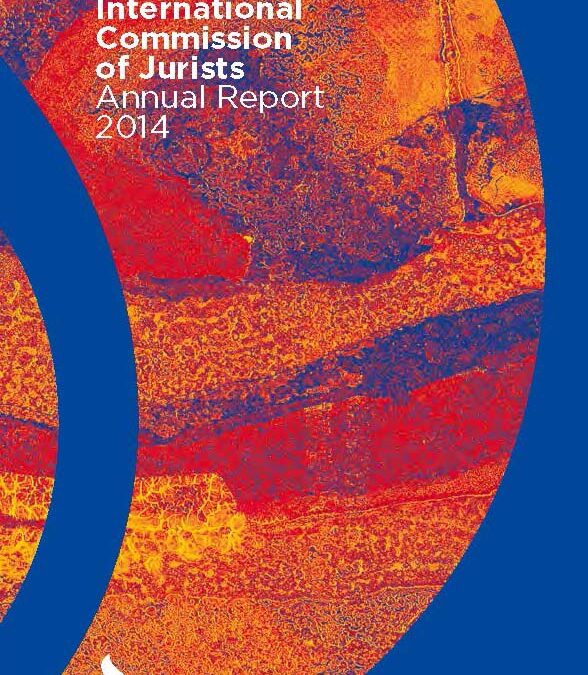
The ICJ has issued its Annual Report 2014, which offers a concise summary of the work carried out by the ICJ over the last year.
In 2014, the world witnessed a new threat to its peace and security with the growing menace of publicity-seeking extremist groups, committing acts of unspeakable barbarity, inflicting wanton cruelty on innocent individuals around the globe.
In addition to the threat to human rights that these groups pose in and of themselves are the threats to human rights that arise from states counter-terrorism efforts that confine the space in which fundamental freedoms are accessible to its citizens.
The ICJ does not believe that counter-terrorism efforts give states carte blanche to disregard their human rights obligations.
Throughout 2014, the ICJ proactively advocated for the accountability of officials responsible for torture, enforced disappearances and other human rights violations that occurred in the course of the CIA’s rendition and secret detention programmes.
In May 2014, Thailand underwent its twelfth military coup since 1932, which has resulted in the implementation of a wide range of measures in clear contravention of Thailand’s international human rights obligations.
The ICJ has worked diligently to remind Thailand of its international responsibilities and to highlight these violations to the international community.
The rule of law cannot exist without an impartial and effective judiciary. In 2014, the ICJ shone a spotlight on the lack of judicial independence in Venezuela through a series of publications, press releases and public events.
The ICJ was also compelled to condemn the judicial persecution of prominent Swazi human rights defender Thulani Maseko, after he was charged and sentenced to two years imprisonment following the publication of an article criticizing judicial conduct.
In 2015, the ICJ intends to develop its work with the institutions of the EU and strengthen its voice in Europe, following the establishment of the ICJ-European Institutions Brussels office.
In Europe and Central Asia, the ICJ will continue its dedicated work on migration and will look to geographically expand its programme of activities further.
In Asia, the ICJ will continue its work with the judiciary in Myanmar and efforts to counter the increasing use of military courts for civilians across the region.
In Africa, the ICJ will be starting a new project in Swaziland and continuing its work to strengthen regional networks of human rights defenders and lawyers.
In Central and South America, the ICJ will continue to strive for justice for victims of enforced disappearances.
In the Middle East, the ICJ continues to expand its field presence and to work for the implementation of strong regional human rights standards.
Download:
Universal-ICJ Annual Report-Publications-Annual Report-2015-ENG (full ICJ Annual report 2014 in PDF, high resolution, best quality)
Universal-ICJ Annual Report low res-Publications-Annual Report-2015-ENG (full ICJ Annual report 2014 in PDF, low resolution, lighter, but lesser quality)

Apr 8, 2015
The ICJ calls on member States of the League of Arab States (LAS) to refrain from ratifying the Statute of the Arab Court of Human Rights unless and until it is comprehensively amended.
In a report published today, the ICJ highlights numerous failings in the drafting process and the provisions of the Statute that fall short of international standards.
The Statute, approved by the Ministerial Council of the LAS on 7 September 2014, does not permit individuals or groups, including victims of human rights violations, to file a complaint directly with the Court. Only States parties, and NGOs that are both accredited in a State party and are specifically permitted to do so by that State, can bring cases before the Court.
“By denying the right of victims to have direct recourse to the Court, the Statute defeats the very purpose and objective of establishing the Arab Court of Human Rights,” said Said Benarbia, Director of the ICJ’s Middle East and North African Programme. “Amendments to the Statute’s access provisions should be introduced to ensure direct access at a minimum for individuals who allege they have been a victim of a violation of a right within the jurisdiction of the Court.”
Further reforms needed include proper guarantees for the independence and impartiality of the Court and its judges, a requirement for the Court to interpret the Arab Charter of Human Rights consistently with States’ other international law obligations, and for the Court to have broad discretion to decide whether cases are admissible, without the undue restrictions of a strict requirement to exhaust local remedies.
In addition, if the Court is to be effective, it must be able to order interim or provisional measures; to order measures capable of protecting victims, witnesses and other participants in Court proceedings from reprisals; the host State must be required to provide the necessary guarantees for the Court and its staff; and there must be mechanisms to ensure that the Court’s judgments are actually implemented in practice.
“Member States of the LAS must refrain from ratifying the Statute in its current form and should instead launch a transparent and inclusive process to amend the Statute in full accordance with international standards,” Benarbia added. “All stakeholders, including victims of human rights violations and their representatives, civil society organizations, judges, academics and Bar Associations, should be given the opportunity to participate in all stages of the process of establishing the Arab Court, including the reform of the Statute.”
Said Benarbia was speaking at a joint conference of the ICJ and Legal Agenda in Tunis, from 8 to 9 April 2015, bringing experts on international and regional mechanisms and courts, together with judges, lawyers and civil society organizations from LAS member states, to examine the Statute of the Arab Court in light of international standards and experiences.
Contact:
Said Benarbia, ICJ Director of the Middle East and North Africa Programme, e: said.benarbia@icj.org
MENA-Arab Court of Human Rights-Publications-Report-2015-ENG (full report in PDF, English version)
MENA-Arab court of Human Rights-Publications-reports-2015-ARA (full report in PDF, Arabic version)
MENA-Arab Court Report-News-Pressrelease-2015-ARA (full Arabic version of press release in PDF)
MENA-Arab Court Tunis Declaration-Advocacy-2015-ENG (full text in PDF)
MENA-Arab Court Tunis Declaration-Advocacy-2015-ARA (full text in PDF, Arabic)
MENA-Arab Court Speech Monageng-Advocacy-2015-ENG (full text in PDF)
MENA-Arab Court Memo Monageng-Advocacy-2015-ENG (full text in PDF)
MENA-Conference Agenda-News-Event-2015-ENG (full agenda in PDF, English)
MENA-Conference Agenda-News-Event-2015-ARA (full agenda in PDF, Arabic)

Mar 15, 2015
El 13 y 14 de marzo, en Lima y Ayacucho (Perú), la CIJ y el Equipo Peruano de Antropología Forense (EPAF) realizaron dos seminarios sobre los crímenes de desaparición forzada y de ejecución extrajudicial.
Con ocasión a estos Seminarios la CIJ hizo el lanzamiento de su nueva Guía para profesionales No. 9 Desaparición forzada y ejecución extrajudicial: Investigación y sanción.
Ambos Seminarios abordaron, desde la perspectiva del Derecho internacional y de experiencias comparadas, diferentes aspectos de la investigación y sanción de los crímenes de desaparición forzada y de ejecución extrajudicial, con especial énfasis en el papel de la antropología forenses y demás disciplinas científicas en la investigación de estos crímenes y en la búsqueda e identificación de las víctimas y localización y restitución de sus cuerpos.
En Lima, el Seminario contó con la participación de César Landa (Comisionado peruano de la CIJ), Wilder Tayler (Secretario General de la CIJ), Gisela Ortiz (Directora de operaciones del EPAF) Diana Ramírez (Instituto Nacional de Medicina Legal y Ciencias Forenses de Colombia), Oscar Loyola (EPAF), Gloria Cano (APRODEH), Carlos Rivera (Instituto de Defensa Legal), Ronald Gamarra (Abogado de la CIJ) y Federico Andreu (Representante para Suramérica de la CIJ). El Seminario de Ayacucho contó con la participación de José Pablo Baraybar (Director del EPAF), Gisela Ortiz, Diana Ramírez, José Suasnavar (Fundación de Antropología Forense de Guatemala), Ronald Gamarra y Federico Andreu.
A ambos eventos asistieron, entre otros, magistrados, jueces, fiscales, representantes del Instituto de Medicina Legal de Perú y de la Defensoría del Pueblo, miembros de las organizaciones no gubernamentales de derechos humanos y de asociaciones de víctimas, autoridades locales, representantes de la comunidad diplomática y periodistas.
Universal-Desaparición forzada y ejecución extrajudicial PG9-Publications-Practitioners’ guide series-2015-SPA (informe en Español)
Universal-Enforced Disappearance and Extrajudicial Execution PGNo9-Publications-Practitioners’ guide series-2015-ENG (full report in PDF, English)

Jan 7, 2015
El presente comentario jurídico se refiere al artículo 378 del Código Penal guatemalteco, cuyo epígrafe le denomina “delitos contra los deberes de humanidad”.
En este texto se lee: “Quien violare o infringiere deberes humanitarios, leyes o convenios con respecto a prisioneros o rehenes de guerra, heridos durante acciones bélicas, o que cometiere cualquier acto inhumano contra población civil, o contra hospitales o lugares destinados a heridos será sancionado con prisión de veinte a treinta años”.
De la lectura de este artículo, podría interpretarse de forma literal que tipifica los crímenes de guerra.
Sin embargo, la redacción es un poco desafortunada por ambigua, para determinar si el mismo artículo incluye también el tipo penal de delitos contra la humanidad o de lesa humanidad.
Por lo que en la presente investigación se buscarán los fundamentos jurídicos, históricos y jurisprudenciales que permitan dilucidar si los delitos de lesa humanidad se encuentran regulados en el artículo 378 del Código Penal guatemalteco; y, en consecuencia, mediante este comentario jurídico, se determinará el alcance jurídico de dicho artículo, a la luz del Derecho Internacional y de los principios y costumbre internacional.
Este documento fue producto de una serie de talleres y conversatorios implementados por la Comisión Internacional de Juristas para Centroamérica, con jueces y magistrados del Organismo Judicial, fiscales del Ministerio Público de Guatemala y abogadas y abogados defensores de derechos humanos.
Esta edición se realizó con la ayuda financiera del Programa de Acompañamiento a la Justicia de Transición (PAJUST) del Programa de las Naciones Unidas para el Desarrollo (PNUD) y de Medico International (MI).
Guatemala-Comentario Juridico articulo 378 CP-Publications-Reports-2014-SPA (descargar en PDF)