Jan 1, 2002
Las reacciones frente a los hechos del 11 de septiembre del 2001 en Nueva York, así como las dinámicas emprendidas en nombre de la lucha antiterrorista, son más que preocupantes.
La adopción, en varios países, de medidas en nombre de la lucha antiterrorista, los desarrollos y proyectos de las legislaciones nacionales, la reactivación de la iniciativa por una Convención internacional general sobre el terrorismo internacional, el proyecto de un mandato europeo de detención, etc… son fuentes de preocupación toda vez que varios de ellos ponen en tensión, y en ciertos casos transgreden, los derechos humanos y principios del derecho internacional.
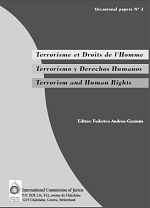
El libro “Terrorismo y derechos humanos, no 1” está disponible, más abajo, en formato PDF.
INDICE DE CONTENIDO
INTRODUCCIÓN
A. EL TERRORISMO INTERNACIONAL
1. El Tratado de Ginebra de 1937
2. La Comisión de Derecho Internacional
3. El Estatuto de Roma de la Corte Penal Internacional y los Tribunales Ad hoc
4. Los Comités Especiales de las Naciones Unidas sobre el terrorismo
5. El Centro de Prevención del Crimen Internacional de las Naciones Unidas
6. La Asamblea General de las Naciones Unidas
7. Actos de terrorismo específicos
8. El Derecho Internacional Humanitario
9. El Derecho Internacional Consuetudinario
B. LA CONVENCIÓN INTERNACIONAL GENERAL SOBRE EL TERRORISMO INTERNACIONAL
1. La Definición del crimen de terrorismo internacional
2. El proyecto de Convención y el Derecho Internacional Humanitario
3. El principio de non refoulement
4. Salvaguarda contra la impunidad
C. DERECHOS HUMANOS Y REPRESIÓN DEL TERRORISMO
I. Algunos problemas relacionados con la represión del terrorismo
- Las definiciones del delito de “terrorismo”
- El Estado de excepción
- Las medidas de privación de la libertad
- Habéas Corpus
- El derecho a un tribunal independiente e imparcial
- Las garantías judiciales
- Devolución, extradición y expulsión
II. Criterios fundamentales que se deben respetar en la lucha contra el terrorismo
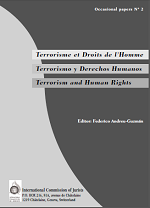
terrorism and human rights-occasional paper 2-2002-spa (full text in Spanish, PDF)
Jan 1, 2002
Terrorism, especially in the current international context, is generally viewed from a highly ideological and political, even emotional and manipulative, perspective.
Jan 1, 2002
Les réactions aux événements du 11 septembre 2001 à New York ainsi que les dynamiques amorcées au nom de la lutte antiterroriste sont plus que préoccupantes.
L’adoption de mesures au nom de la lutte antiterroriste dans plusieurs pays, les avancées et projets de législations nationales, le re-lancement de l’initiative pour une convention internationale générale sur le terrorisme international, le projet d’un mandat d’arrêt européen, etc. sont sources de préoccupation, car plusieurs d’entre elles mettent en tension et, dans certains cas, transgressent des droits de l’Homme et des principes du droit international.
INTRODUCTION
A. LE TERRORISME INTERNATIONAL
- Le Traité de Genève de 1937
- La Commission du droit international
- Le Statut de Rome de la Cour pénale internationale et les Tribunaux Ad hoc
- Les Comités spéciaux des Nations Unies sur le terrorisme
- Le Centre de prévention de la criminalité internationale des Nations Unies
- L’Assemblée générale des Nations Unies
- Des actes terroristes spécifiques
- Le Droit international humanitaire
- Le Droit international coutumier
B. LA CONVENTION INTERNATIONALE GÉNÉRALE SUR LE TERRORISME INTERNATIONAL
- La définition du crime de terrorisme international
- Le projet de Convention et le Droit international humanitaire
- Le principe de non refoulement
- Sauvegarde contre l’impunité
C. DROITS DE L’HOMME ET RÉPRESSION DU TERRORISME
I. Certains problèmes liés à la répression du terrorisme
- Les définitions de crime de “terrorisme”
- L’état d’urgence
- Les mesures de privation de liberté
- L’Habeas corpus
- Le droit à un tribunal indépendant et impartial
- Les garanties judiciaires
- Refoulement, extradition et expulsion
II. Quelques critères fondamentaux à respecter dans la lutte contre le terrorisme
terrorism and human rights-occasional paper 2-2002-fra (Texte complet en PDF)

Sep 1, 2001
The purpose of the Review is to focus attention on the problems in regard to which lawyers can make their contribution to society in their respective areas of influence and to provide them with the necessary information and data.
This edition is entitled “Impunity, Crimes Against Humanity and Forced Disappearance” and features:
- Foreword by Louise Doswald-Beck
- Articles:
-Recent Argentine jurisprudence in the matter of crimes against humanity, by Rodolfo Mattarollo
-Augusto Pinochet Ugarte before the court of Chilean justice, by Alejandro Artucio
-Background to the elaboration of the draft International Convention on the Protection of All Persons from Forced Disappearance, by Wilder Tayler
-The draft International Convention on the Protection of all Persons from Forced Disappearance, by Federico Andreu-Guzmán
-Draft International Convention on the Protection of All Persons from Forced Disappearance
-Legal brief amicus curias presented by the ICJ before the Inter-American Court of Human Rights in the case of Efraín Bámaca Velásquez vs. Guatemala
-Legal brief on the incompatibility of Chilean decree law no. 2191 of 1978 with international law
ICJ Review-62-63-2001-eng (full text in English, PDF)
ICJ Review-62-63-2001-spa (full text in Spanish, PDF)

Sep 1, 2001
Impunidad, crimen de lesa humanidad y desaparición forzada.
ICJ Review-62-63-2001-spa (full text in Spanish, PDF)