Mar 1, 2019 | News
On 28 February and 1 March, the ICJ met with senior officials of the Myanmar Police Force (MPF) and the Union Attorney General’s Office (UAGO) in Nay Pyi Taw.
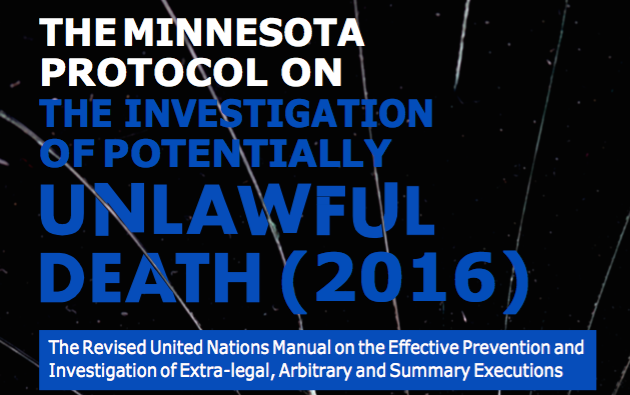
The purpose of these talks was to promote the conduct of effective investigations into potentially unlawful deaths and enforced disappearance in accordance with international human rights law and standards, particularly the Minnesota Protocol on the Investigation of Potentially Unlawful Deaths (“Minnesota Protocol”).
Under customary international law, the right to life, and the right to be free from torture and other ill treatment, is not to be restricted even during an armed conflict or declared public emergency. All States are obliged to investigate, prosecute and punish acts that constitute violations of the right to life, and to provide effective remedies and reparations to victims.
Published by the United Nations Office of the High Commissioner for Human Rights, the Minnesota Protocol provides guidance to authorities on investigating acts amounting to human rights violations, including when State actors may have been involved. Drawing upon international law and standards, including in relation to the rights of victims and their families, the Protocol includes detailed guidelines on crime scene investigation, interviews, exhumations and autopsies.
Since December 2017, the ICJ has co-hosted four regional workshops in Thailand focused on this topic. Attendees have included lawyers, academics and State authorities from Thailand, Cambodia, Nepal, India and Myanmar.
Frederick Rawski, Director for Asia and the Pacific, Sean Bain, Legal Adviser, and Ja Seng Ing, Legal Researcher, composed the ICJ delegation in Myanmar’s capital.
Frederick Rawski proposed opportunities to continue these discussions on international standards into investigative procedures and processes. The ICJ Team also provided updates about related activities undertaken regionally and in Myanmar.
The ICJ has worked with the UAGO since 2014 to provide assistance on prosecutorial independence and human rights in the context of Myanmar’s broader democratic and legal reforms. This was the third meeting with the MPF over the last twelve months to discuss the conduct of investigations inline with international human rights law and standards.
Members of UAGO and MPF received copies of the Minnesota Protocol and indicated these would be shared with officials involved in the conduct of investigations or in setting the standards for them under national law in Myanmar.
Feb 28, 2019 | Events, News
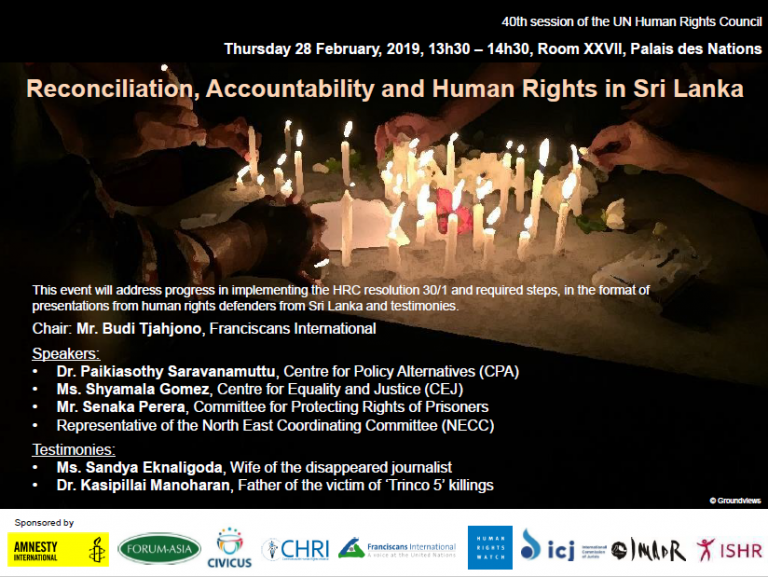
This event will address progress in implementing Human Rights Council resolution 30/1 and required steps, in the format of presentations from human rights defenders from Sri Lanka and testimonies.
Date: Thursday, 28 February 2019
Time: 13.30 – 14.30
Venue: Room XXVII, Palais des Nations
Chair: Mr. Budi Tjahjono, Franciscans International
Speakers:
- Dr. Paikiasothy Saravanamuttu, Centre for Policy Alternatives (CPA)
- Ms. Shyamala Gomez, Centre for Equality and Justice (CEJ)
- Mr. Senaka Perera, Committee for Protecting Rights of Prisoners
- Representative of the North East Coordinating Committee (NECC)
Testimonies:
- Ms. Sandya Eknaligoda, Wife of the disappeared journalist
- Dr. Kasipillai Manoharan, Father of the victim of ‘Trinco 5’ killings
Sponsors:
- Asian Forum for Human Rights and Development (FORUM-ASIA)
- Amnesty International
- CIVICUS
- Commonwealth Human Rights Initiative (CHRI)
- Franciscans International
- Human Rights Watch (HRW)
- International Commission of Jurists (ICJ)
- International Movement Against all forms of Discrimination and Racism (IMADR)
- International Service for Human Rights (ISHR)
Feb 28, 2019 | Advocacy, News
The ICJ made a submission to Mr. Léo Heller, the United Nations Special Rapporteur (Special Rapporteur) on the human rights to water and sanitation, in response to a call for submission in advance of the Special Rapporteur’s 2019 Human Rights Council Report on the human rights to water and sanitation in spheres of life beyond the households, in particular in public spaces.
The ICJ’s submission focuses on the status and the impact of inadequate access to water and sanitation on lesbian, gay, bisexual, transgender and queer individuals (LGBTQ), and more specifically on transgender persons and non-binary persons, in India.
ICJ’s submission draws on its ongoing work on the human rights of LGBTQ persons in India, where from 2017 to date, the ICJ has studied LGBTQ persons’ access to and enjoyment of economic, social, and cultural rights, focusing on access to adequate housing, decent work, and public spaces and services including water and sanitation. The goal is to reveal, address, and reduce discriminatory treatment against LBGTQ persons in accessing economic, social and cultural rights as a result of discriminatory laws and practice through advocacy with the Indian State and with the United Nations.
Read the full submission here.
Feb 26, 2019
The ICJ has joined with other NGOs in a letter urging States to ensure that the UN Human Rights Council adopts a resolution that provides for a time-bound plan for the Government of Sri Lanka to implement its obligations and commitments for reconciliation, accountability and human rights in the country.
The letter reads as follows:
“February 25, 2019
Your Excellency,
Sri Lanka: Need for time-bound plan for implementation of commitments to the Human Rights Council
We write to seek your support in ensuring that the United Nations Human Rights Council (HRC or Council) adopts a resolution at this 40th session to maintain scrutiny of Sri Lanka’s progress towards implementation of its commitments, including, at minimum, regular reporting to the Council and a time-bound plan, developed in collaboration with the Office of the High Commissioner for Human Rights, to implement its pledges.
In October 2015, the Council adopted resolution 30/1 by consensus in which Sri Lanka, through its co-sponsorship, committed to 25 key undertakings across a range of human rights issues. A core commitment was to set up four transitional justice mechanisms to promote “reconciliation, accountability and human rights” in the country. These included an accountability mechanism involving international judges, prosecutors, investigators, and defense lawyers; a truth and reconciliation mechanism; an office of missing persons; and an office for reparations.
While some positive steps have been taken by the government to date, both the current and former High Commissioners in their reports have expressed concern at the slow rate of progress.
The UN High Commissioner for human rights, Michelle Bachelet, noted in her September 2018 update that Sri Lanka has “moved too slowly towards meaningful implementation of the transitional justice agenda.” She reiterated concern at the “lack of sufficient progress, particularly towards truth seeking and accountability” during the recent intersessional dialogue with HRC members and observers on February 4, 2019, noting that this created “significant obstacles to reconciliation.”
Her predecessor, Zeid al Ra’ad Hussein, in his opening remarks to the Council on September 11, 2017, had called on the government to realize that its obligations are not a mere “box-ticking exercise to placate the Council but as an essential undertaking to address the rights of all its people.”
Yet, it appears that the Sri Lankan government continues with exactly that endeavor.
Thus far only the Office of Missing Persons has been set up, but progress was delayed. The commissioners were appointed only in February 2018 and making the office operational was marred with logistical difficulties. The commissioners have held both public and private consultations with the families of victims and are observing the ongoing excavation and exhumation of a mass grave in Mannar. However, in its interim report in September 2018, the Office of Missing Persons called for “active cooperation” of various relevant state institutions, which has not been entirely forthcoming. Families of the forcibly disappeared are still awaiting answers.
While President Maithripala Sirisena said that all military-occupied civilian land in the predominantly ethnic Tamil north would be released by December 2018, progress has stalled, hindered in part by broad military claims of national security and the lack of a transparent process. Nor has the government fulfilled its pledge to repeal the abusive Prevention of Terrorism Act (PTA). While the cabinet has apparently adopted draft legislation to set up a National Truth Commission, it has yet to be made public for civil society consultations. Sri Lankan civil society groups have expressed reservations about the proposed Office for Reparations Bill, calling for a fully independent mechanism.
There has been no discernible progress on establishing an accountability mechanism involving international judges, prosecutors, and investigators. Instead, Sri Lankan political leaders have repeatedly said that there will be no foreign judges, and that “war heroes” will be protected from prosecution. Importantly, a report issued by the government-appointed Consultation Task Force, which conducted extensive nationwide consultations on the transitional justice mechanisms, has not been given the attention it deserves. The Task Force report contains detailed recommendations, drawn from all affected communities including the security services, and provides an important blueprint for the way forward in addressing abuses by both the Liberation Tigers of Tamil Eelam and government forces.
Numerous UN experts and special mandates have since 2015 highlighted the marginalization and misrepresentation faced by minority communities, as well as a trust-deficit between these communities and the government, due in significant part to a culture of impunity. This was exposed during the recent political and constitutional crisis in Sri Lanka that laid bare the volatility of the political environment and the imperative need for continued international engagement to support the government in protecting human rights and promoting reform, reconciliation and accountability.
The Human Rights Council has played a vital role in identifying the many steps needed to reconcile with the past, ensure justice and accountability, and implement necessary reforms. Its scrutiny has proved an important catalyst for the progress made to date.
At the upcoming HRC session, the High Commissioner will present a substantive report on the progress towards implementation of the resolution – and the many challenges remaining. It is crucial that the Council remain fully engaged with the process until the commitments Sri Lanka made to the HRC and its own people through its co-sponsorship of resolution 30/1 are met in full.
To maintain confidence in the process, states should engage meaningfully with the High Commissioner’s report, and ensure the Council adopts a resolution that, at minimum:
- welcomes the High Commissioner’s report (once available) and calls on the government of Sri Lanka to implement its recommendations;
- reaffirms resolution 30/1 and underlines the importance of the commitments therein being met in full;
- maintains reporting by the High Commissioner on the status of Sri Lanka’s progress towards implementation of its commitments, with opportunities for regular interim reporting through oral updates and interactive dialogues;
- expresses concern at the slow rate of progress and requests the government of Sri Lanka to collaborate with the OHCHR to develop a time-bound implementation plan for consideration by the Council in an interactive dialogue.
Given the insufficient progress to date, and rising frustrations that any accountability process seems stalled, a mere technical “rollover” resolution will be insufficient unless it includes provision for a clear timetable and framework for Sri Lanka to fulfill its commitments.
States should also make clear that stronger measures are needed to assist in monitoring, implementing and fulfilling these commitments, such as an OHCHR field presence, Special Procedure and evidence-gathering, justice and accountability mechanisms.
Anything less would fall substantially short of the expectations of victims and their families, and risk undermining faith in the process long before the promises of reconciliation, justice and reform have been translated into reality. Sri Lanka’s long-term peace and stability hinges upon the international community’s willingness to support the government in addressing the past so that it may look to the future.
Sincerely,
Amnesty International
Asian Forum for Human Rights and Development (FORUM-ASIA)
Commonwealth Human Rights Initiative
Franciscans International
Human Rights Watch
International Commission of Jurists
International Movement Against All Forms of Discrimination and Racism (IMADR)
International Service for Human Rights
Sri Lanka Advocacy”
The ICJ also submitted a written statement on Sri Lanka, to the Human Rights Council session.
Feb 15, 2019 | News
The International Court of Justice will hold public oral hearings in India v. Pakistan (Jadhav case) from 18 to 21 February 2019. Before they commence, the International Commission of Jurists (ICJ) has published a briefing paper to clarify the key issues and relevant laws raised in the case in a Question and Answer format.
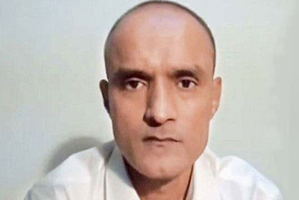
The case concerns Pakistan’s failure to allow for consular access to an Indian national, Kulbhushan Sudhir Jadhav, detained and convicted by a Pakistani military court on charges of “espionage and sabotage activities against Pakistan.”
India has alleged that denial of consular access breaches Pakistan’s obligations under Article 36(1) of the Vienna Convention on Consular Relations (VCCR), to which both States are parties.
Pakistan has argued, among other things, that the VCCR is not applicable to spies or “terrorists” due to the inherent nature of the offences of espionage and terrorism, and that a bilateral agreement on consular access, signed by India and Pakistan in 2008, overrides the obligations under the VCCR.
ICJ’s Q&A discusses the relevant facts and international standards related to the case, including: India’s allegations against Pakistan; Pakistan’s response to the allegations; the applicable laws; and the relief the International Court of Justice can order in such cases.
Contact:
Frederick Rawski (Bangkok), ICJ Asia Pacific Regional Director, e: frederick.rawski(a)icj.org
Reema Omer (London), ICJ International Legal Adviser, South Asia t: +447889565691; e: reema.omer(a)icj.org
Additional information
While the case at issue is limited to denial of consular access under the VCCR, it engages other critical fair trial concerns that arise in military trials in Pakistan.
The International Commission of Jurists has documented how Pakistani military courts are not independent and the proceedings before them fall far short of national and international fair trial standards. Judges of military courts are part of the executive branch of the State and continue to be subjected to military command; the right to appeal to civilian courts is not available; the right to a public hearing is not guaranteed; and a duly reasoned, written judgment, including the essential findings, evidence and legal reasoning, is denied.
The case also underscores one of inherent problems of the death penalty: that fair trial violations that lead to the execution of a person are inherently irreparable.
Download the Q&A:
Pakistan-Jadhav case Q&A-Advocacy-Analysis brief-2019-ENG