Sep 17, 2018 | Advocacy, Non-legal submissions
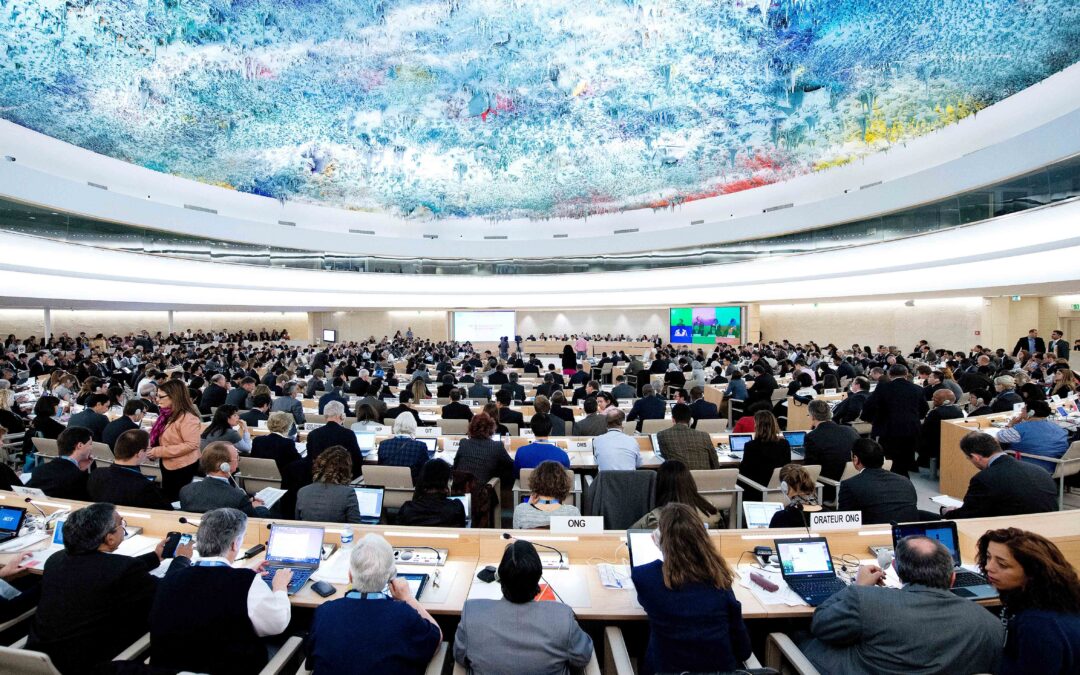
Today at the UN Human Rights Council, the ICJ emphasised the importance of effective investigations capable of leading to truth and justice, highlighting recent developments in Manipur, India as an example.
The statement read as follows:
“Justice processes in situations of conflict or transition require fighting impunity and re-establishing public trust.[1] An example is the new prospects for justice in relation to 1528 alleged extrajudicial killings cases in Manipur, India, which would make an important contribution to a transition out of the long-standing conflict.
In July 2016, in response to a petition filed on behalf of the victims, the Indian Supreme Court stated that “there is no concept of absolute immunity from trial…”,[2] opening the door to ending impunity. As of August 2018, the Central Bureau of Investigation has registered 29 complaints against security forces.[3] Recent reports suggest that the Government is also considering amending the Armed Forces Special Powers Act (AFSPA) to remove or restrict existing overbroad authorizations for use of lethal force.[4]
These are welcome developments. However, concerns remain, as the investigation status of the majority of the cases is unknown. Two UN Special Rapporteurs in July 2018 also affirmed that justice must be done in all cases.[5]
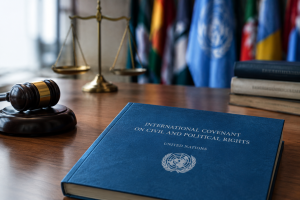
The ICJ calls on India to ensure independent, impartial and thorough investigations into all cases in Manipur, amend AFSPA, and to uphold the right to truth of victims and society about acts committed and the identity of perpetrators, in line with its international and national legal obligations, including as a party to the International Covenant on Civil and Political Rights.”
[1] Report of the Special Rapporteur on the promotion of truth, justice, reparation and guarantees of non-recurrence, A/HRC/39/53 (25 July, 2018), http://www.undocs.org/A/HRC/39/53.
[2] Para 163, Extra Judicial Execution Victim Families Association (EEVFAM) & Anr. v. Union of India & Anr. Writ Petition (Criminal) No. 129/2012.
[3] TNN, “Army Major named in FIR for killing 12-yr-old in fake Manipur encounter”, Times of India, August 3, 2018, https://timesofindia.indiatimes.com/city/imphal/army-major-named-in-fir-for-killing-12-yr-old-in-fake-manipur-encounter/articleshow/65252258.cms.
[4] “In AFSPA, Government Considering Crucial Changes”, NDTV, September 13, 2018, available at https://www.ndtv.com/india-news/in-afspa-government-considering-crucial-change-sources-1915706.
[5] Special Rapporteur on extrajudicial, summary or arbitrary executions and Special Rapporteur on the situation of human rights defenders, “India: UN experts call for urgent progress in investigation of hundreds of ‘fake encounter’ killings” (4 July 2018), https://www.ohchr.org/en/NewsEvents/Pages/DisplayNews.aspx?NewsID=23323&LangID=E .
Sep 13, 2018
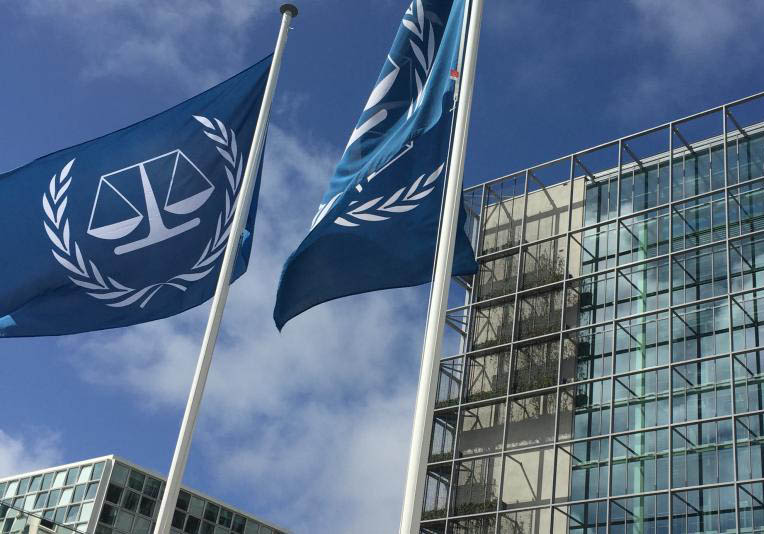
The ICJ today issued a briefing note following the Independent International Fact-Finding Mission on Myanmar and the ICC ruling relating to Bangladesh.
Fact-Finding Mission identifies crimes, calls for ICC referral and IIIM
On 27 August 2018, the Independent International Fact-Finding Mission on Myanmar (FFM) released a report finding that members of Myanmar’s military should be investigated and prosecuted for crimes against humanity and war crimes in Rakhine, Kachin and Shan States, and for genocide in the north of Rakhine State.
The FFM identified that many of the same kinds of crimes committed against the Rohingya in Rakhine State, were also being committed by the same or linked military authorities against other minorities in Kachin and Shan states.
While the FFM focused on the situations in Kachin, Rakhine and Shan States since 2011, it noted “serious allegations have also arisen in other contexts, meriting further investigation.”
The FFM concluded by recommending among other things that:
- the UN Security Council should refer the situation to the International Criminal Court (ICC) or create an ad hoc international criminal tribunal; an
- until the Security Council acts, the General Assembly or the Human Rights Council should create an independent evidence gathering mechanism, similar to the IIIM for Syria.
ICC ruling on jurisdiction re: Bangladesh
On 6 September 2018, an ICC Pre-Trial Chamber ruled that the Court could exercise jurisdiction over the alleged deportation (as a crime against humanity) of the Rohingyas from Myanmar into Bangladesh, since one element of the crime (crossing a border) took place in Bangladesh, which is a State party to the Rome Statute.
The Chamber noted that the same rationale could apply to other crimes within the jurisdiction of the Court “if it were established that at least an element of another crime … or part of such a crime is committed on the territory of a State Party,” citing persecution and other inhumane acts as possible examples in this case. The crime of genocide was not directly addressed.
The ruling did not address other crimes allegedly committed against the Rohingya, or crimes against other minorities elsewhere within Myanmar, including in Shan and Kachin States.
The proceeding is still at an early, pre-investigation, phase. If at the conclusion of a preliminary examination the Prosecutor assesses that there is a reasonable basis to proceed with an investigation, she must first seek authorization from the Pre-Trial Chamber.
The preliminary examination phase has been known to take from less than a week (Libya) to more than 14 years (Colombia).
Need for an IIIM or similar independent evidence gathering mechanism
An independent evidence gathering mechanism, with functions similar to those of the IIIM for Syria, should be created by the Human Rights Council as a matter of urgency.
- The passage of time increases the chances that critical evidence will deteriorate or be lost entirely, reducing the possibility of effective prosecution.
- An IIIM mechanism would ensure that evidence is collected, preserved and analyzed to a standard and methodology facilitating its use in national, regional or international courts.
- The delay and uncertainty associated with referring the question of creation of a mechanism to the General Assembly mean the Council should establish the mechanism at this session.
The ICC ruling relating to Bangladesh does not reduce the need for an IIIM:
- The limited scope of the ruling relating to Bangladesh creates a high risk that the existing ICC proceeding will not cover all crimes under international law against the Rohingya, or other crimes against other minorities elsewhere in Myanmar, including Kachin and Shan states.
- At best, the ICC will only be able to prosecute a fraction of the crimes identified by the FFM, and an even smaller fraction of the perpetrators, leaving an impunity gap. An IIIM will preserve evidence to enable that gap to be filled now, or later, by national courts or other tribunals.
- The work of an independent evidence gathering mechanism would be complementary to and cooperate with any ICC investigation and prosecution (or that of an ad hoc tribunal).
Referral of Myanmar to the ICC
States should continue to call for Security Council referral to the ICC despite the jurisdictional ruling relating to Bangladesh.
- With a Chapter VII referral, the ICC would assume jurisdiction over all crimes listed in the Rome Statute that may have been committed after the Rome Statute entered into force on 1 July 2002 either in the territory of Myanmar or elsewhere by a Myanmar national.
Contact:
Kingsley Abbott, Senior Legal Adviser (Global Accountability), kingsley.abbott(a)icj.org
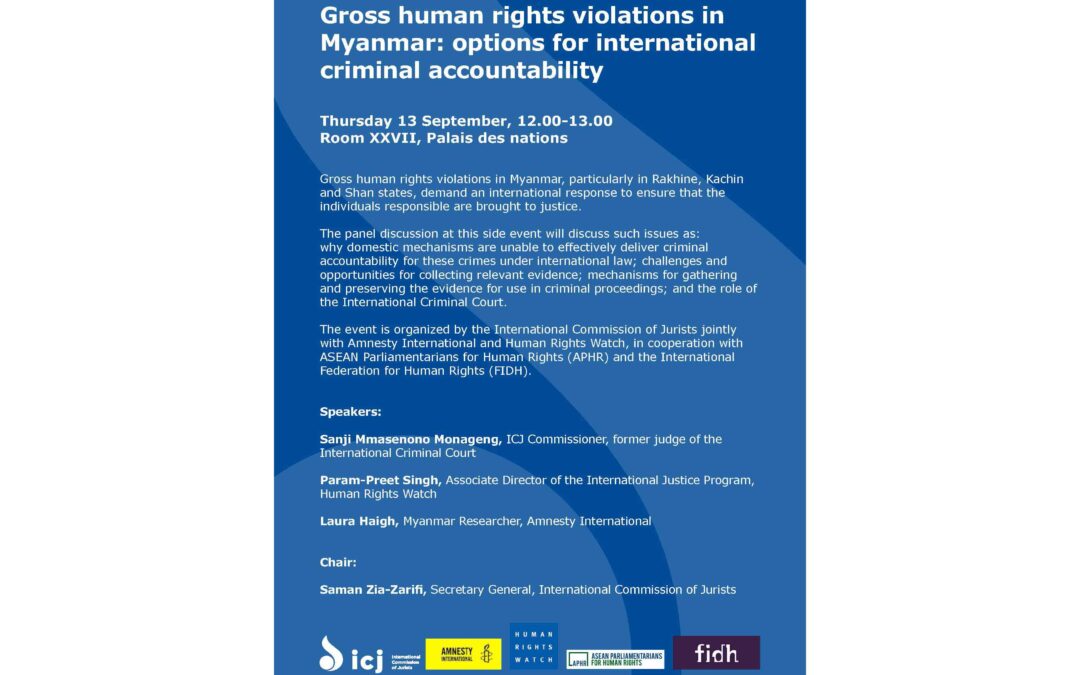
Sep 10, 2018 | Events, News
The ICJ will host the side event “Gross human rights violations in Myanmar: options for international criminal accountability” at the Human Rights Council on Thursday 13 September 2018 from 12:00 – 13.00 in Room XXVII of the Palais des Nations.
It is organized by the ICJ, Amnesty International and Human Rights Watch in cooperation with ASEAN Parliamentarians for Human Rights (APHR), the International Federation for Human Rights (FIDH) and Physicians for Human Rights (PHR).
The issues of documenting violations, possible evidence-gathering mechanisms and the role of the International Criminal Court will be discussed.
Speakers:
- Justice Sanji Mmasenono Monageng, Commissioner of the ICJ and former judge of the International Criminal Court
- Param-Preet Singh, Associate Director of the International Justice Program, Human Rights Watch
- Laura Haigh, Myanmar Researchers, Amnesty International
Moderator:
Saman Zia-Zarifi, Secretary General, International Commission of Jurists
Myanmar side event 13 Sept flyer (flyer of the event in PDF)

Sep 7, 2018
On 30 May 2018 the Government of Myanmar announced its latest “International Commission of Enquiry” (ICOE) to investigate human rights violations in Rakhine State.
Its creation follows at least eight other special government inquiries and boards conducted since 2012 in Rakhine State alone.
In a five-page legal briefing, the International Commission of Jurists (ICJ) assesses the inquiry in reference to standards on the conduct of investigations.
The ICJ finds that the ICOE cannot reasonably be seen as having any chance of being independent, impartial, or making an effective contribution to justice or accountability for the crimes under international law. To the contrary, giving any recognition to it is likely to undermine and delay effective international measures for justice and accountability.
On 28 August the spokesperson for the Office of the President stated that:
“We have formed the Independent Commission of Enquiry to response [sic] to false allegations made by the UN Agencies and other international communities.”
Indeed, the Chairperson of the ICOE stated at a press conference, that:
“[T]here will be no blaming of anybody, no finger-pointing of anybody… saying you’re accountable.”
Such prejudicial statements confirm the conclusion of the United Nations Independent International Fact-Finding Mission (IIFFM), that:
“The Government’s recently-created Commission of Inquiry will not and cannot provide a real avenue for accountability, even with some international involvement. The impetus for accountability must come from the international community.”
Crimes against humanity and war crimes have been committed in Myanmar, and an investigation of evidence of the crime of genocide is warranted, according to the summary report of the UN IIFFM, published on 27 August 2018.
Throughout Myanmar the rule of law is severely undermined by a lack of accountability for perpetrators of rights violations; lack of access to remedies and reparation for victims; and persistent challenges to the independence of the justice system.
In current circumstances it is impossible to rely on any national courts, prosecution services, or commissions of inquiry in Myanmar to deliver justice or accountability of security forces in relation to human rights violations constituting crimes under international law.
The UN Security Council should refer the situation to the International Criminal Court or a similarly constituted international tribunal without delay.
The UN Human Rights Council should promptly establish a robust International Impartial and Independent Mechanism (IIIM) or similar mechanism, to collect and analyse evidence for future prosecutions; action should be taken by the Council at its September 2018 session – waiting for or deferring to the UN General Assembly to act would risk further delaying or denying justice for victims, including because key criminal evidence could be irretrievably lost, destroyed, or deteriorate in the meantime.
Contact
Frederick Rawski, Asia and the Pacific Director, frederick.rawski(a)icj.org
Legal briefing
Myanmar-COI cannot deliver justice or accountability-Advocacy-Analysis brief-2018-ENG (full text, PDF)
Myanmar-COI cannot deliver justice or accountability-Advocacy-Analysis brief-2018-BUR (full text in Burmese, PDF)

Sep 6, 2018 | News
The ICJ welcomed the Supreme Court’s judgment in Navtej Singh Johar et al v. Union of India and others, which effectively ends the threat to a large segment of the Indian population that they will be held criminally liable for exercising their human rights.
The Court has issued a long-overdue ruling that the criminalization of consensual same-sex relationships under Section 377 violates the Indian Constitution, and is in breach of India’s obligations under international law. This long-awaited judgment testifies to the work of activists and lawyers in India, who have shown the potential of the law to affirm human rights and equality.
“This judgment will not only have an impact in India. Its influence should extend across the world. The ICJ hopes that it will provide an impetus for other countries, especially those of the Commonwealth of Nations, to revoke similar provisions that criminalize consensual sexual relations,” ICJ Asia Pacific Director Frederick Rawski stated.
The Court underscored that provisions of Section 377 contravened international law and standards on equality, privacy, non-discrimination and dignity guaranteed in international human rights treaties to which India is a party. These include the International Covenant Civil and Political Rights and International Covenant on Economic Social and Cultural Rights.
The Court also noted that the Yogyakarta Principles, which address sexual orientation and gender identity in international law, reinforce these protections. This is a vital jurisprudential recognition that LGBTI persons are entitled to full equality, and protection of their rights under India’s Constitutional and international human rights law.
In the judgement, which reverses the December 2013 Koushal decision, the Court held that discrimination based on sexual orientation is a violation of fundamental rights to autonomy, privacy, equality, dignity, and non-discrimination. It underscored that decriminalization of homosexuality is only the first step and that LGBTI persons are entitled to equal citizenship in all its manifestations. The Court also recommended that wide publicity be given to judgment to ensure de-stigmatization of identity through sensitization training on barriers to access to justice faced by LGBTI persons.
“Even a landmark decision by the Indian Supreme Court cannot alone end the discrimination against people based on their sexual orientation or gender identity. It is time for the Indian Parliament to conduct wide-ranging review of existing legal framework, repeal discriminatory laws, and address other gaps in the law that prevent LGBT persons from fully exercising their rights,” Rawski added.
Background
For background, see the ICJ’s July 2018 Briefing Paper on Navtej Singh Johar et al. v. Union of India and Others, and its February 2017 report, “Unnatural Offences”: Obstacles to Justice in India Based on Sexual Orientation and Gender Identity.
Contact
Maitreyi Gupta (Delhi), ICJ International Legal Advisor for India
e: maitreyi.gupta(a)icj.org, t: +91 7756028369