Feb 14, 2018 | News
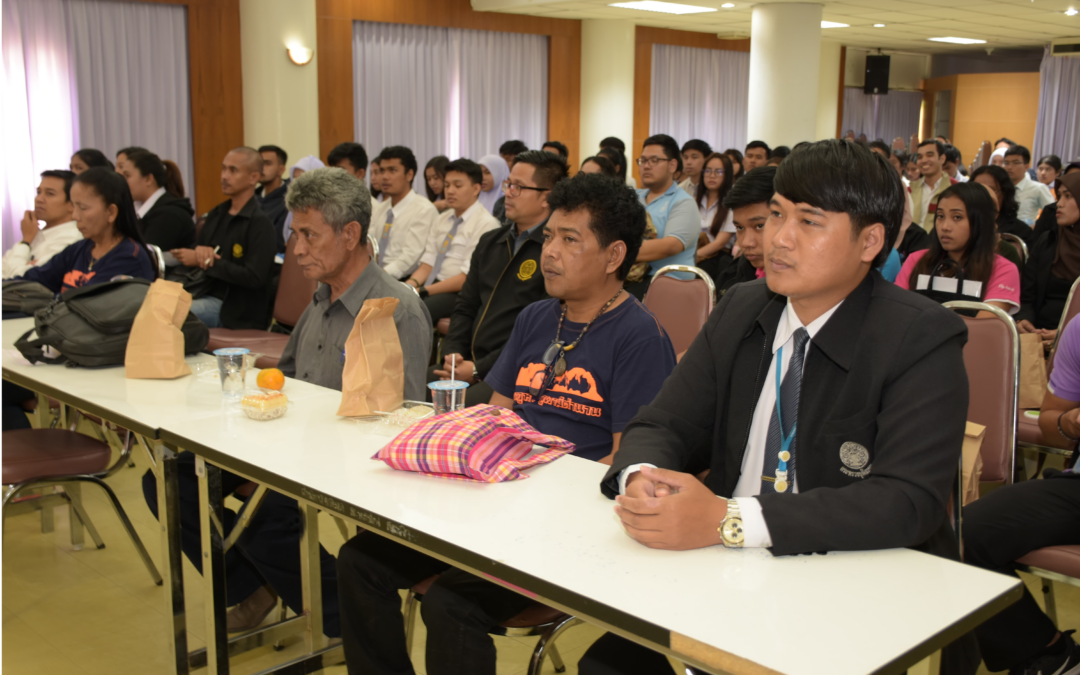
Today, the ICJ addressed an academic seminar on the topic of “Public interest and the anti-strategic lawsuit against public participation (SLAPP)”.
It was organized by Thaksin University’s Faculty of Law, in collaboration with the Embassy of Canada in Bangkok, the Thai Ministry of Justice’s Justice Office, and the Community Resources Centre Foundation (CRC).
Participants in the seminar, which was held at Thaksin University, included more than 50 undergraduate students and lecturers from Thaksin University, around 20 villagers from affected communities, and approximately 20 justice officers from the Justice Office of Songkhla Province, Ministry of Justice.
Sanhawan Srisod, ICJ National Legal Adviser, delivered an introduction to basic international human rights law on the rights to freedom of expression, association, and peaceful assembly, and Thailand’s international legal obligations in relation to these rights.
Other speakers at the Workshop were Ms. Jantima Thanasawangkul, Special Prosecutor, Department of Legal Aid and Civil Rights Protection, Office of the Attorney General; Ms. Sor.Rattanamanee Polkla, Lawyer, Community Resources Centre Foundation; and Mr. Tawan Puakpong, Justice Office of Songkhla Province, Ministry of Justice.
Feb 13, 2018 | News
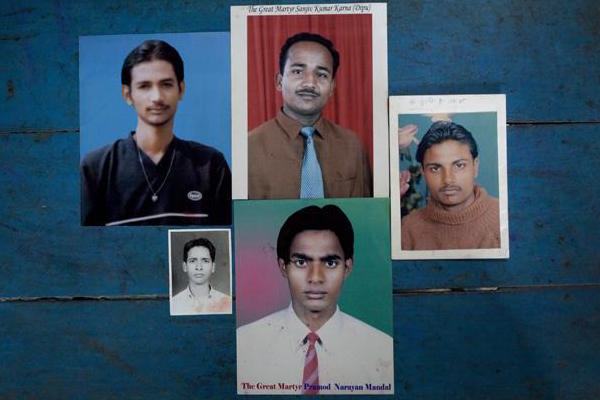
The one-year extensions of Nepal’s two transitional justice mechanisms without necessary legal and institutional reforms ordered by the Supreme Court and the UN are insufficient to comply with international standards, the ICJ, Amnesty International and Human Rights Watch said today.
The three organizations warned that the mere extension of the terms of the Truth and Reconciliation Commission (TRC) and the Commission on the Investigation of Enforced Disappeared Persons (CIEDP) is likely to prolong the justice process without meaningfully improving the chances that victims will have their demands for justice, truth, and accountability met.
“The net worth of these two bodies has now been tested by the victims in Nepal who are deeply dismayed and disappointed at not having been served truth and justice—even after years of delay,” said Biraj Patnaik, Amnesty International’s South Asia Director.
On February 5, 2018, the Government of Nepal extended, for the second time, the mandates of the TRC and CIEDP by one year without taking any measures to ensure their credibility and human rights compliance, and to increase the capacity of the Commissions as demanded by victims, civil society groups, and the National Human Rights Commission of Nepal (NHRC).
On the same day, the NHRC called on the government to amend the Enforced Disappearances Enquiry, Truth and Reconciliation Commission Act, 2014, in line with international standards and the judgements of the Supreme Court of Nepal.
The TRC and CIEDP have fallen short of international standards, both in constitution and operation, despite repeated orders by the Supreme Court of Nepal.
Among other flaws, the current legal framework allows for the possibility of amnesties and effective impunity for gross human rights violations amounting to grave crimes under international law, and the broad authority to facilitate reconciliation, including without the informed consent of the victims and their families.
In addition, a non-consultative, uncoordinated and opaque approach to their work has also created distrust with all major stakeholders, including conflict victims and members of civil society.
Where the Commissions have made efforts to work effectively, they face problems due to a lack of sufficient human and financial resources.
“Families and victims of Nepal’s decade-long civil war have waited far too long for answers, and cynical government attempts such as extending the mandate without broader reform as directed by the highest court is a further slap in the face,” said Meenakshi Ganguly, South Asia director at Human Rights Watch.
“The two commissions have gathered a lot of documentation, but the authorities seem more committed to protecting perpetrators than ensuring justice in the process.”
Despite flaws in the law, and questions of legitimacy and capacity, victims and their families have given the benefit of the doubt to these bodies, and submitted thousands of complaints.
As of February 2018, the TRC has received 60,298 complaints of human rights violations, and the CIEDP has received 3,093 complaints of enforced disappearance.
Though the Commissions have stated that they have initiated investigations into some of these cases, there are serious concerns about the quality of these investigations, and to date, not a single case has been recommended for prosecution.
“Now a member of the UN Human Rights Council, the international community has high expectations of the government of Nepal,” said Frederick Rawski, Asia Director of the International Commission of Jurists.
“It needs to commit to ensure that these institutions function independently and free from political interference, and in accordance with international standards that prohibit impunity for gross human rights violations. Merely extending their mandates without addressing the underlying problems is not adequate.”
Contacts
Frederick Rawski, ICJ Asia Pacific Regional Director, t: +66 64 478 1121, e: frederick.rawski@icj.org
Meenakshi, Ganguly, South Asia Director, Human Rights Watch, e: gangulm@hrw.org
Omar Waraich, Deputy Director, Amnesty International South Asia, t: +94 72 737 5467; e: omar.waraich@amnesty.org
Background
The TRC and CIEDP were established on 10 February 2015 through the Enforced Disappearances Enquiry, Truth and Reconciliation Commission Act, 2014.
The two-year mandates of the TRC and CIEDP expired on February 9, 2017.
The government extended the mandates for one year.
On 20 January 2018, the President approved an Ordinance extending the mandate of the two Commissions.
On the basis of the Ordinance, the Council of Ministers, on 5 February 2018, extended the mandates of these bodies for an additional year.
Feb 12, 2018 | News
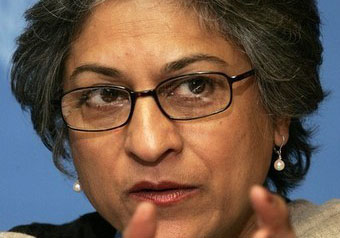
The ICJ mourns the loss of its former Commissioner, Executive Committee Member and Honorary Member, Asma Jahangir, who was at the frontline of the struggle for the rule of law and human rights in Pakistan and around the world.
Ms. Jahangir died of cardiac arrest on Sunday, 11 February, in Lahore, Pakistan. She was 66.
“The ICJ benefited immeasurably from Asma Jahangir’s contribution and leadership. She was a giant of the human rights movement, dedicated to defending the rule of law and fighting for the rights of everyone – including her fiercest detractors,” said Sam Zarifi, ICJ’s Secretary General.
Asma Jahangir was elected to the ICJ in 1998, and went on to serve on the organization’s Executive Committee until the end of her term.
She continued to work closely with the ICJ as an Honorary Member.
Asma Jahangir started her journey as a human rights defender as a petitioner is a case challenging the military dictatorship of Yahya Khan. She was only 19 at the time.
She continued throughout her life to be an outspoken critic of military rule and abuses in Pakistan and at the forefront of the struggle for human rights and the rule of law in the country.
In 1987 she co-founded the Human Rights Commission of Pakistan, which remains one of the oldest and most preeminent human rights organizations in the region.
Asma Jahangir was a senior advocate of the Supreme Court with a legal career spanning nearly forty years.
In 1987, along with other women lawyers, she established the first legal aid cell in the country for free legal representation to women, children, bonded laborers and religious minorities.
She also made lasting contribution to the human rights globally, and served as a UN Special Rapporteur for three different mandates: Extrajudicial, summary or arbitrary executions (1998 to 2004); freedom of religion or belief (2004 to 2010); and the situation of human rights in Iran (2016 – 2018).
In the course of her work as a human rights activist, she was repeatedly threatened, put under house arrest and even imprisoned. However, these attacks did not deter her from her commitment to human rights.
“Asma Jahangir’s brave, powerful voice for human rights and dignity has fallen silent much too soon. We will miss her and strive to live up to her example,” said Zarifi.
Last year, Asma Jahangir participated in ICJ’s Women profiles video series:
Asma Jahangir profile
Feb 11, 2018 | News
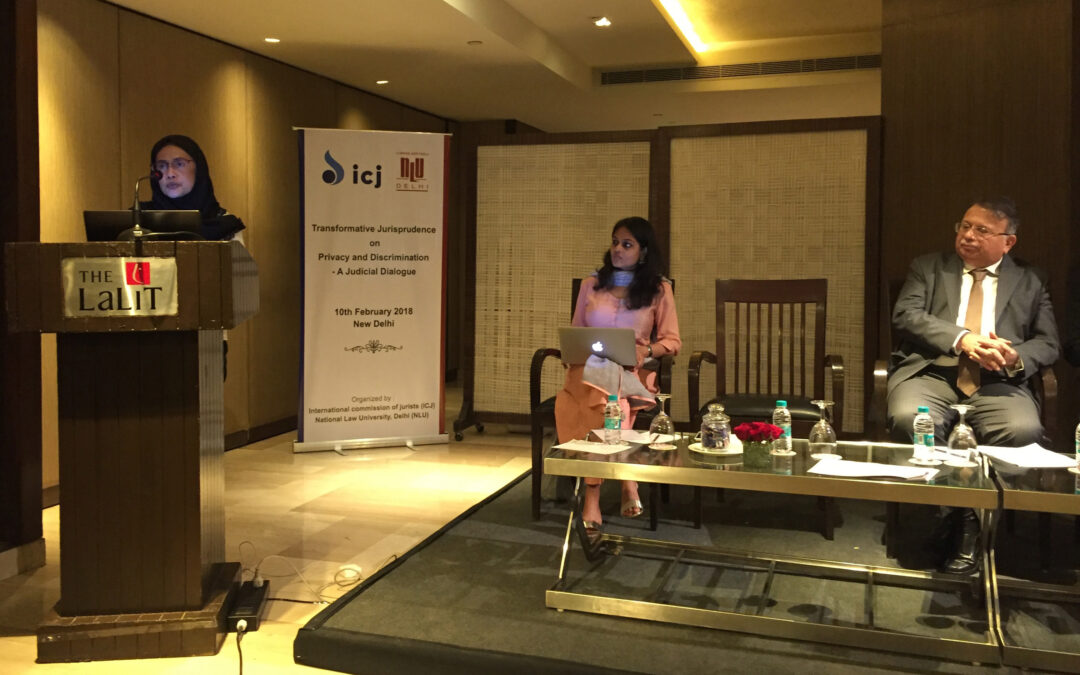
On 10 February 2018, the ICJ, in partnership with the National Law University, Delhi (NLU), organized a judicial dialogue on transformative jurisprudence on privacy and discrimination.
Participants included judges from the Supreme Court of India, the High Court of Delhi, and the District Courts of Delhi; ICJ Commissioners: Justice Ajit Prakash Shah, from India, who made the event possible through his support, Justice Kalyan Shrestha, from Nepal, Justice Adolfo Azcuna, from the Philippines; a Commissioner of Thailand’s National Human Rights Commission; and lawyers and activists from India. The judicial dialogue examined the relationship between the right to privacy, the principle of non-discrimination, and the right to equality before the law, in the context of one’s sexual orientation and/or gender identity, as well as in light of the jurisprudence of the Indian Courts.
It pursued the ICJ’s larger goal of addressing the need for sustained, ongoing engagement with the Indian judiciary on LGBTI rights, to facilitate better access to justice for the LGBTI community, with the help of a sensitized judiciary.
The discussions lent support to domestic advocacy efforts directed at other State and non-State actors to get them to better address and reduce discriminatory treatment and homophobic and transphobic attitudes towards LGBTI communities by challenging discriminatory laws and practices.
The dialogue underscored the different facets of the dynamic right of privacy in relation to the human rights of disenfranchised communities, and discussed sexual orientation and gender identity as essential attributes of one’s identity deserving of and entitled to protection.
The conversation touched upon emergent challenges in the privacy debate, in light of technological advances, critiquing the Indian Government’s unique identification project whereby the Government’s programme of issuing a 12-digit unique identity number to all Indian residents based on their biometric and demographic data, and which will be needed to access government and private sector services, is currently being contested in the Supreme Court on account of privacy concerns.
The speakers emphasized the importance of the right to be forgotten and the right to limit one’s audience as essential to a right to privacy, given the increasing importance of the internet.
The speakers also highlighted the need for the judiciary to uphold fundamental rights enumerated in the constitution instead of pandering to populist beliefs and mores
There was unanimous agreement among the judges and the extended legal community that Section 377, Indian Penal Code, which criminalizes “voluntary carnal intercourse against the order of nature” needs to be struck down, to facilitate progress in developing a rights framework for sexual minorities.
There was criticism of other discriminatory laws, including draft legislation, such as the current Indian Transgender Persons (Protection of Rights) Bill, 2016 for its denial of an individual’s right to self-identify one’s gender.
The speakers reiterated the need for a comprehensive effort from the Indian judiciary, and other State actors with a focus on judicial training and sensitization, as well as police reform, to ensure that India is able to fulfill its international and constitutional obligations to respect, protect, and fulfill the rights of the LGBTI community.
A common theme was the importance of comparative and international law in the development of Indian jurisprudence.
The speakers discussed the ‘Yogyakarta Principles on the Application of International Law in Relation to Issues of Sexual Orientation and Gender Identity’ at length, and the growing prominence of these Principles in Indian jurisprudence, as reflected in the Puttuswamy and National Legal Services Authority v. Union of India judgments, both of which quoted the Yogyakarta Principles extensively.
The dialogue focused on the role of the judiciary, the need for sensitization regarding the human rights violations of the LGBTI community among the judiciary in India and South and South East Asia and, in that context, the importance of judicial dialogues.
ICJ Commissioner Justice Shrestha emphasized that South Asian judges have typically played a more important role than the legislature in advancing human rights.
He discussed the importance of judicial creativity in providing remedies, and emphasized that training programs must include best practices and that judicial training programs must be imparted regularly.
The dialogue stressed the importance of judicial trainings highlighting the role that Justice Cameron and Justice Kirby, both former ICJ Commissioners, have played in raising awareness about the relationship between human rights and issues of sexuality, HIV/AIDS and gender identity in India.
It reiterated the importance of judges being in touch with people’s lived realities, and thus the importance of encouraging judiciary’s interaction with the LGBTI community.
For more information: maitreyi.gupta(a)icj.org
Feb 8, 2018
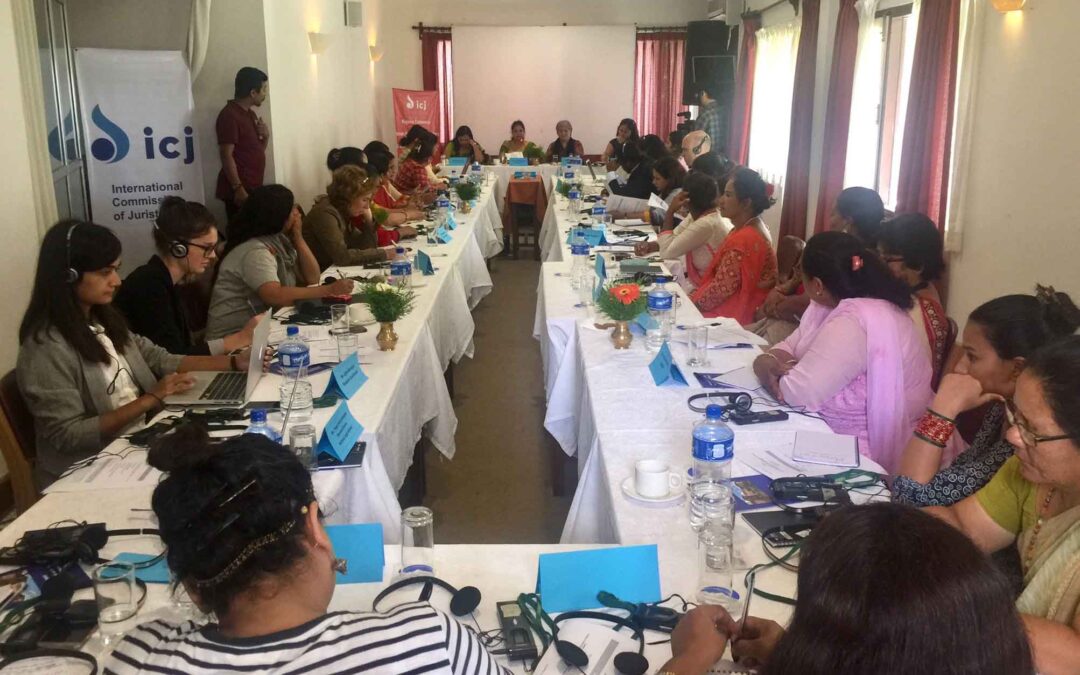
Today, the ICJ released a new briefing paper concerning its Regional Conference on Women Human Rights Defenders as Political Actors (28-29 August 2017), which brought together women human rights defenders (WHRDs) from all over Nepal who were elected in May 2017.
The conference focused on how newly-elected WHRDs could continue to advance human rights in their new roles as elected officials, with specific attention paid to encouraging equal participation of women in public affairs and furthering their advocacy for human rights.
The attached briefing paper lays out the key points of the conference and offers a set of future actions aimed at supporting WHRDs in their role as political actors pursuing a human rights agenda.
Nepal-WHRD-Advocacy-Analysis brief-2018-ENG (Briefing Paper in PDF)