Nov 20, 2017
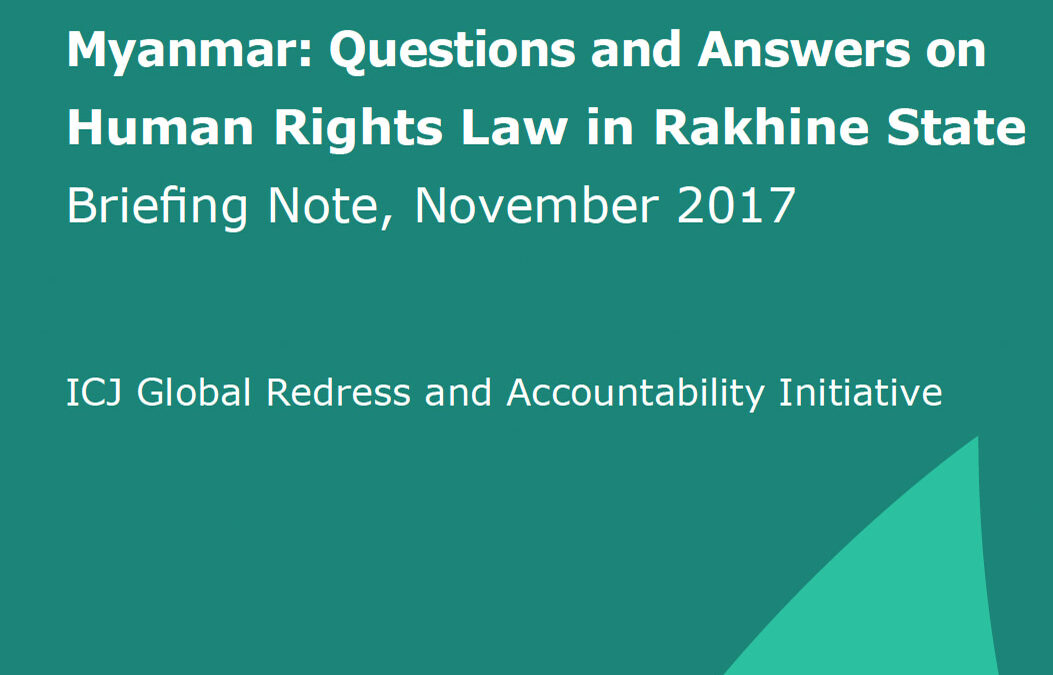
Responses to the devastating human rights crisis in Rakhine State must be driven by respect for the rule of law, protection of human rights of all people without discrimination, and greater accountability and justice, the ICJ states in a briefing note published today in a Questions & Answers format.
More than 600,000 people, the vast majority of whom are Rohingya Muslims, have been displaced as a result of security operations commanded by the Myanmar military (Tatmadaw), following attacks on police posts by the Arakan Rohingya Salvation Army on 25 August.
“Credible allegations of crimes against humanity, including widespread and systematic killings, rape, and forced evictions demand a robust and immediate response from the Myanmar government, with full assistance from the international community,” said Sam Zarifi, ICJ’s Secretary General.
“The Myanmar government has so far not responded in a manner commensurate with the gravity of the situation or its obligations under international law, and the country’s military continues to enjoy de facto and de jure impunity for its actions,” he added.
Entitled Questions & Answers on Human Rights Law in Rakhine State, the 23-page (31 in Burmese) note details how members of Myanmar’s military, the Tatmadaw are largely shielded from prosecutions for human rights violations owing to provisions of constitutional and national law that codify the Tatmadaw’s dominance.
In law and in practice the Tatmadaw remains the most powerful institution in the country, largely outside the control of the civilian government.
“Constitutional arrangements in Myanmar are incompatible with the rule of law principle that security forces must be accountable to civilian authorities,” Zarifi said.
“The Tatmadaw must be held accountable for its conduct in Rakhine state, as well as its well-documented violations against other ethnic groups in the country,” he added.
The ICJ found no legal basis for the “area clearance operations” associated with widespread reports of arson, murder, rape and forcible transfer.
A lawful response to ARSA’s attacks would consist of independent and impartial investigations and public criminal prosecutions in accordance with national laws and fair trial rights standards – protections commonly violated throughout the country, the ICJ says.
“Recognizing the limitations on civilian authority over security operations, the NLD-led government remains bound to do everything in its power to respect and to protect human rights,” Zarifi added.
Measures available to the NLD include reforming laws that enable impunity for gross human rights violations, particularly the 1959 Defence Services Act and the 1995 Maintenance of Police Discipline Law, allowing full humanitarian access to protect the right to life; and supporting dignified, safe and voluntary return of displaced persons to their places or origin without discrimination.
The 2008 Constitution and provisions of national laws enable impunity for human rights violations, including by shielding security forces from public criminal prosecutions.
Myanmar lacks a mechanism to independently and impartially investigate allegations of serious human rights violations, the ICJ notes.
“The United Nations, as well as ASEAN and Myanmar’s other neighbors, such as China and India, should be clear that they expect, and will assist, a proper response to the Rakhine crisis in line with international law and respect for the rights of all people there, in particular, the Rohingya community,” Zarifi said.
Government cooperation with the UN-mandated Fact Finding Mission would also assist to independently establish facts and provide a factual basis to consider proper policy responses to human rights violations and humanitarian crises in Rakhine State and also in Shan and Kachin States, which remain embroiled in a state of conflict replete with human rights violations.
“Cooperation with the Fact Finding Mission would signal that the NLD is serious about its stated commitment to investigate allegations of human rights violations and to cooperate with the international community in doing so,” Zarifi said.
“Allowing this Mission to carry out its mandate would complement the work of the government’s Rakhine Advisory Commission,” he added.
The ICJ said that Myanmar’s neighbors and other States in the region must ensure that Rohingya refugees under their jurisdiction are offered full protection under international human rights and refugee law.
Any return of refugees to Myanmar must be dignified and voluntary to their places of origin without discrimination.
All refugee-receiving countries have an obligation to provide protection, including, in particular, against refoulement.
Contact
Sam Zarifi, ICJ Secretary General (Geneva)t: +41 22 979 38 25 ; e: sam.zarifi(a)icj.org
Background
The ICJ has observed that statements and reports on the crisis have sometimes conflated the use of legal and non-legal terms to assess and describe the situation.
The ICJ briefing note clarifies some of the applicable national and international law and standards.
The ICJ’s independent legal research and analysis covers areas of law, including rules governing the conduct of security operations, protection of affected communities, justice and accountability for domestic offences and crimes under international law, and responsibilities and obligations relating to displaced persons.
Myanmar-QA Rakhine-Advocacy-Briefing Paper-2017-ENG (full report in English, pdf)
Myanmar-QA Rakhine-Advocacy-Briefing Paper-2017-BUR (full report in Burmese, pdf)
Nov 17, 2017 | News
Pakistan’s third Universal Periodic Review (UPR) has drawn global attention to a number of serious human rights failures in the country, said the ICJ today.
On 16 November, the UPR Working Group of the Human Rights Council adopted a draft UPR outcome report for Pakistan. Pakistan received a total of 289 recommendations – a substantial increase from its previous UPR in 2012, when Pakistan received 167 recommendations. As many as 111 State delegations took the floor to make statements, and 14 States submitted their questions in advance.
“That well over a hundred delegations participated in the review indicates the global community’s interest in Pakistan’s human rights situation,” said Frederick Rawski, ICJ’s Asia Director.
Key recommendations urge Pakistan to:
- Reinstate a moratorium on executions with the view to abolishing the death penalty;
- Repeal or amend “blasphemy laws” to bring them in line with international human rights law;
- Ratify the International Convention for the Protection of All Persons from Enforced Disappearance and a number of other human rights treaties;
- Ensure effective protection of the rights of religious minorities, human rights defenders, journalists and other vulnerable groups;
- Strengthen the National Commission for Human Rights;
- Ensure prompt, impartial and effective investigations of human rights violations and bring perpetrators to justice;
- Set 18 as the minimum legal age for marriage; and
- Ensure effective implementation of laws on violence against women.
“The States’ recommendations echo the concerns of dozens of civil society organizations and even the National Commission of Human Rights – who all agree that the Government must take urgent measures to address the downward spiral of rights in the country”, Rawski said.
Pakistan will now examine the recommendations and respond to the Human Rights Council at latest by the Council’s next session in March 2018.
Pakistan’s review comes at a time of serious concern about the rights situation in the country.
The Government lifted the informal moratorium on the death penalty and carried out nearly 500 executions in less than three years – among the highest execution rates in the world; Parliament enacted laws allowing military courts to try civilians for certain terrorism-related offences in secret trials; and the authorities started a new wave of crackdowns on NGOs, journalists and human rights defenders, including subjecting them to enforced disappearance.
Persecution of religious minority communities also continues despite the Government’s claims that religious minorities “enjoy equal rights as equal citizens of Pakistan”. Last month, three Ahmadi men were sentenced to death for blasphemy for allegedly scratching anti-Ahmadi pamphlets that had the “Mohr-e-Nabbuwat” (seal of the Prophet Muhammad) printed on them. And earlier this week, the Islamabad High Court directed the Government to respond to a petition demanding a separate database for Ahmadis in the civil service to ensure they are not “posted in offices involving sensitive matters”.
“As a member of the Human Rights Council, Pakistan is expected to uphold the highest standards in the promotion and protection of human rights, something it has clearly failed to do,” added Rawski.
“Pakistan should make use of this process by accepting the recommendations made during the review and adopting a concrete, action-based national human rights plan to ensure their effective implementation.”
Contact
Frederick Rawski, ICJ Asia Pacific Regional Director, t: +66 64 478 1121, e: frederick.rawski@icj.org
Reema Omer, ICJ International Legal Adviser for Pakistan (London), t: +447889565691; e: reema.omer(a)icj.org
Pakistan-UPR-PressRelease-2017-eng (download the press release)
Additional information
UN Member States reviewed Pakistan’s human rights record for the third time on Monday, 13 November, through the UPR process.
The UPR is a unique mechanism of the UN Human Rights Council aimed at improving the human rights situation of each of the 193 UN Member States. Under this mechanism, the human rights record of all UN Member States is peer-reviewed every four to five years by the UPR Working Group, consisting of the 47 UN Member States of the Human Rights Council; however, any UN Member State can take part in the discussions and the dialogue during the UPR of the reviewed States. States then make recommendations to the country under review, which has the option of accepting or noting the recommendations.
Nov 16, 2017 | News
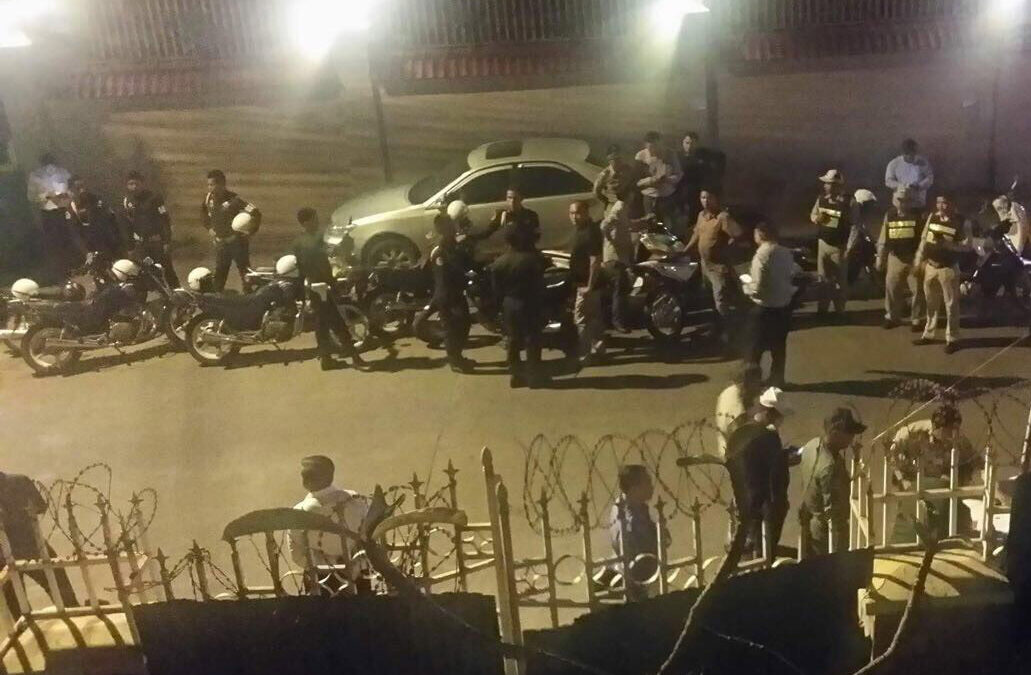
Today’s decision of the Supreme Court to dissolve the main opposition political party, the Cambodia National Rescue Party (CNRP), has significantly heightened the human rights and rule of law crisis within the country, the ICJ said.
The Supreme Court has also banned 118 of CNRP politicians from political activity for five years.
“By dissolving the main opposition party and banning 118 CNRP politicians from political activity for five years, the Supreme Court is irreparably interfering with the rights of potentially millions of Cambodians to freely choose their political representatives and vote for them in the upcoming elections,” said Kingsley Abbott, the ICJ’s Senior International Legal Adviser for Southeast Asia.
“The fact that the Law on Political Parties was amended to enable the Supreme Court to dissolve political parties shortly before it dissolved the CNRP strongly suggests the entire ‘legal process’ was nothing more than political theatre, inconsistent with human rights and the rule of law.”
A full bench of nine judges of the Supreme Court, including the President, unanimously decided to dissolve the CNRP pursuant to powers contained within Article 44 (new) of the Law on Political Parties (LPP), which was controversially amended twice this year, in February and July 2017.
The lawyers representing the CNRP were not present at Court after electing to boycott the proceedings in protest at their legitimacy.
Furthermore, the President of the Supreme Court, Justice Dith Munty, who read out the decision, is reportedly a member of the ruling Cambodian People’s Party (CPP) and sits on both its Standing and Permanent Committees, raising serious doubts about the independence and impartiality of the Court.
“It makes a mockery of fair justice to have someone in a leadership position within one political party sit in judgment on the conduct of that party’s main opposition. There can be no starker example of an inherent conflict of interest,” Abbott said.
“At an absolute minimum, the President should have recused himself from any role in relation to the case, as should have any other judge sitting on the bench if they hold a similar position within the CPP,” he added.
These concerns are consistent with the ICJ’s findings in a report it released last month, in which it found that the “single largest problem facing the Cambodian justice system is the lack of independent and impartial judges and prosecutors.”
“The problem is two-fold: an endemic system of political interference in high-profile cases and an equally entrenched system of corruption in all others.”
On 23 October 2017, the 26th anniversary of the 1991 Paris Peace Conference on Cambodia, the ICJ and 54 other organizations wrote an open letter to the Secretary-General of the United Nations and the Conference’s co-chairs calling on them to reconvene the members of the Conference, along with other concerned stakeholders, for an emergency summit to discuss the human rights crisis within the country.
“The dissolution of the CNRP sends a strong signal to the international community and all Cambodians that a red-line has been crossed, which makes reconvening the Paris Peace Conference to address the human rights and rule of law crisis within the country all the more urgent,” said Kingsley Abbott.
Contact
Kingsley Abbott, Senior International Legal Adviser for Southeast Asia, ICJ, t: +66 94 470 1345 ; e: kingsley.abbott@icj.org
Background
It has been reported that, on 4 and 5 October 2017, the Cambodia Youth Party and the Funcinpec Party, respectively, filed complaints with the Ministry of Interior (MOI) alleging that the CNRP had violated Articles 6 (new) and 7 (new) of the Law on Political Parties, and asked the MOI to file a complaint with the Supreme Court to dissolve the CNRP.
On 6 October 2017, the MOI filed a complaint with the Supreme Court pursuant to Article 38 (new) of the LPP to dissolve the CNRP.
Article 25 of the International Covenant on Civil and Political Rights (ICCPR), to which Cambodia is a State Party, guarantees the rights of all persons, without any unreasonable restrictions, “to take part in the conduct of public affairs, directly or through freely chosen representatives; and to vote and to be elected at genuine periodic elections which shall be by universal and equal suffrage and shall be held by secret ballot, guaranteeing the free expression of the will of the electors.”
Article 14 of the ICCPR affirms the principle that tribunals judging rights and obligations in legal proceedings be independent and impartial.
Detailed international standards on requirements for a court to be independent have been set out in the UN Basic Principles on the Independence of the Judiciary (1985), and requirements for judicial impartiality have been set out in the Bangalore Principles of Judicial Conduct and Commentary (2002/2007), which includes the standard that “All partisan political activity and association should cease upon the assumption of judicial office” (para 75 of the Commentary).
Nov 10, 2017 | News
As Pakistan is set to undergo its third Universal Periodic Review (UPR) on 13 November, the ICJ has urged Pakistani authorities to meaningfully engage with the process to improve the human rights situation in the country.
“Pakistan’s past engagement with the UPR has been characterized by denial and defensive posturing,” said Frederick Rawski, ICJ’s Asia Director.
“As a recently-elected member of the UN Human Rights Council, it is more important than ever for the Pakistan to show that it takes its human rights obligations seriously by engaging with the upcoming UPR in its true spirit,” he added.
During its second UPR in 2012, Pakistan received 167 recommendations, of which it rejected seven, noted 34, and accepted 126.
The seven recommendations rejected by Pakistan relate to some of the most serious human rights violations in the country, including recommendations to adopt an official moratorium on the death penalty with a view to abolishing capital punishment in law and practice, repeal blasphemy laws, and decriminalize adultery and non-marital consensual sex.
Even accepted recommendations have been largely ignored in the four years since the previous UPR, the ICJ notes.
Enforced disappearances are still not recognized as a distinct, autonomous crime; perpetrators of gross human rights violations continue to escape justice; there has been complete inaction to prevent abuse of so-called blasphemy laws; and freedom of expression is often restricted on vague grounds such as “national security” and “immorality”.
“Pakistan’s human rights situation has in many ways deteriorated since 2012,” Rawski added.
“Yet – as reflected by Pakistan’s national report for the upcoming UPR – the authorities apparently remain in a state of denial about the dire human rights implications of these new measures,” he said.
These measures include the lifting the informal moratorium on the death penalty and carrying out nearly 500 executions in less than three years – among the highest in the world; passing laws allowing military courts to try civilians for certain terrorism-related offences; and a new wave of crackdowns on NGOs, journalists and human rights defenders, including retaliating against NGOs for presenting “a very bleak picture” of the country’s human rights situation to the UN.
“UN member states on Monday should urge Pakistan to end the dangerous downward spiral on rights by ending repression, respecting fundamental freedoms, and holding perpetrators of violations responsible,” Rawski said.
Contact
Frederick Rawski, ICJ Asia Pacific Regional Director, t: +66 64 478 1121, e: frederick.rawski(a)icj.org
Reema Omer, ICJ International Legal Adviser for Pakistan (London), t: +447889565691; e: reema.omer(a)icj.org
Additional information
The UPR is a unique mechanism of the UN Human Rights Council aimed at improving the human rights situation of each of the 193 UN Member States. Under this mechanism, the human rights record of all UN Member States is peer-reviewed every four to five years by the UPR Working Group, consisting of the 47 UN Member States of the Human Rights Council; however, any UN Member State can take part in the discussions and the dialogue during the UPR of the reviewed States. States then make recommendations to the country under review, which has the option of accepting or noting the recommendations.
Nov 8, 2017
Today, the ICJ and 15 other organizations wrote to the Prime Minister of Viet Nam requesting the immediate and unconditional release of human rights defender, Mr Nguyễn Bắc Truyển, who has been detained incommunicado and arbitrarily since the end of July 2017.
Vietnam-Nguyen Bac Truyens-Advocacy-Open letters-2017-ENG (full letter in English, pdf)