Aug 29, 2017 | News, Publications, Reports, Thematic reports
South Asian states can only address the tens of thousands of cases of enforced disappearances by recognizing enforced disappearance as a serious crime in domestic law, said the ICJ today.
On the eve of the International Day of the Victims of Enforced Disappearances, the ICJ 58-page report No more ‘missing persons’: the criminalization of enforced disappearance in South Asia analyzes States’ obligations to ensure that enforced disappearance constitutes a distinct, autonomous crime under national law.
It also provides an overview of the practice of enforced disappearance, focusing specifically on the status of the criminalization of the practice, in five South Asian countries: India, Pakistan, Bangladesh, Sri Lanka and Nepal.
For each State, the report briefly examines the national context in which enforced disappearances are reported, the existing legal framework, the role of the courts; and the international commitments and responses to recommendations concerning criminalization.
“It is alarming that despite the region having some of the highest numbers of reported cases of disappearances in the world, enforced disappearance is not presently a distinct crime in any South Asian country,” said Frederick Rawski, ICJ’s Asia Director.
“This shows the lack of political will to hold perpetrators to account and complete apathy towards victims and their right to truth, justice and reparation,” he added.
In Nepal and Sri Lanka, draft legislation to criminalize enforced disappearance is under consideration.
Though the initiatives are welcome, the draft bills in both countries are flawed and require substantial improvements to meet international standards.
In the absence of a clear national legal framework specifically criminalizing enforced disappearance, unacknowledged detentions by law enforcement agencies are often treated by national authorities as “missing persons” cases.
On the rare occasions where criminal complaints are registered against alleged perpetrators, complainants are forced to categorize the crime as “abduction”, “kidnapping” or “unlawful confinement”.
These categories do not recognize the complexity and the particularly serious nature of enforced disappearance, and often do not provide for penalties commensurate to the gravity of the crime.
They also fail to recognize as victims relatives of the “disappeared” person and others suffering harm as a result of the enforced disappearance, as required under international law.
“Like torture and extrajudicial execution, enforced disappearance is a gross human rights violation and a crime under international law,” said Rawski.
“South Asian States must recognize that they have an obligation to criminalize the practice with penalties commensurate with the seriousness of the crime–filing “missing” person” complaints in cases of disappearance is not enough, and in fact, it trivializes the gravity of the crime,” he added.
Other barriers to bringing perpetrators to account are also similar across South Asian countries: military and intelligence agencies have extensive and unaccountable powers, including for arrest and detention, often in the name of “national security”; members of law enforcement and security forces enjoy broad legal immunities, shielding them from prosecution; and military courts have jurisdiction over crimes committed by members of the military, even where these crimes are human rights violations, and proceedings before such courts are compromised by their lack of independence and impartiality.
Victims’ groups, lawyers, and activists who work on enforced disappearance also face security risks including attacks, harassment, surveillance, and intimidation.
A comprehensive set of reforms, both in law and policy, is required to end the entrenched impunity for enforced disappearances in the region – criminalizing the practice would be a significant first step, said the ICJ.
Contacts:
Frederick Rawski (Bangkok), ICJ Asia Pacific Regional Director, e: frederick.rawski(a)icj.org
Reema Omer, ICJ International Legal Advisor (South Asia) t: +923214968434; e: reema.omer(a)icj.org
Thyagi Ruwanpathirana, ICJ National Legal Advisor (Sri Lanka), e: thyagi.ruwanpathirana(a)icj.org
Background
Under international law, an enforced disappearance is the arrest, abduction or detention by State agents, or by people acting with the authorization, support or acquiescence of the State, followed by a refusal to acknowledge the detention or by concealing the fate or whereabouts of the “disappeared” person which places the person outside the protection of the law.
The UN General Assembly has repeatedly described enforced disappearance as “an offence to human dignity”.
South Asia-Enforced Disappearance-Publications-Reports-Thematic Reports-2017-ENG (full report in PDF)
Aug 29, 2017 | News
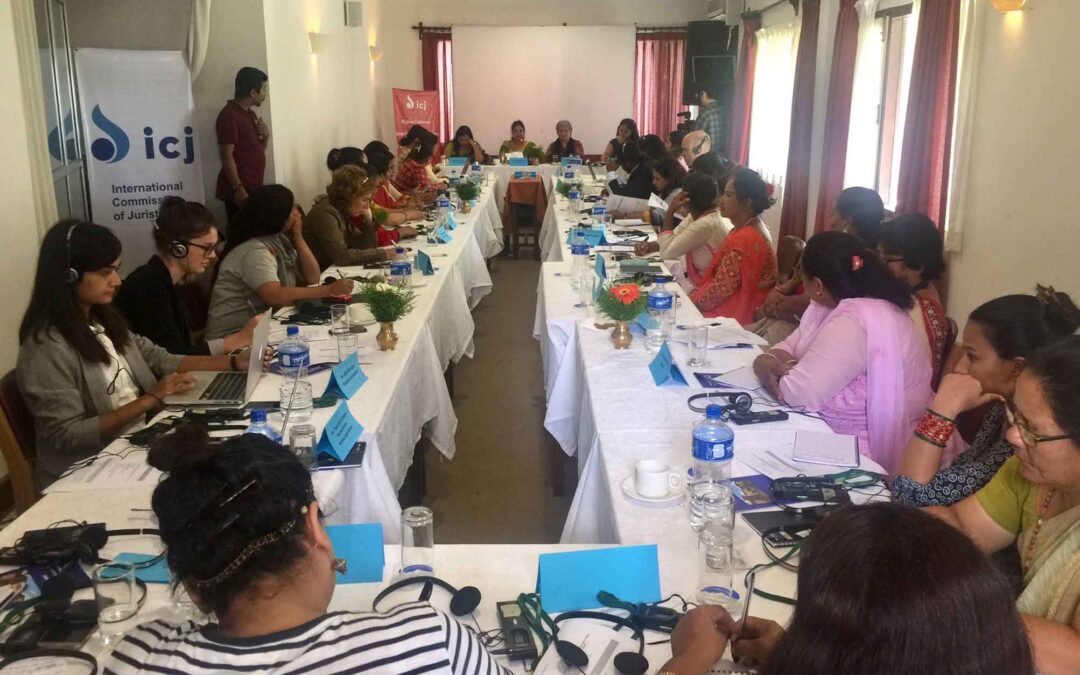
Today, the ICJ concluded its Regional Conference on Women Human Rights Defenders as Political Actors, which gathered in Kathmandu women human rights defenders (WHRDs) from all over Nepal who were recently elected during the local elections in May 2017.
They were joined by Bushra Gohar, a former Member of Parliament in Pakistan, Ahmed Naaif of the Maldivian Democracy Network, and Sherene Xavier, a filmmaker and WHRD from Sri Lanka.
The discussions focused on how the newly-elected WHRDs can continue to advance human rights in their new roles as elected officials.
Under Nepal’s Local Level Election Act 2017, political parties are required to field female candidates for half of the executive posts (mayor/deputy mayor) and at least 40% for membership at the local community councils.
In May 2017, during the first local election held in the country in almost 20 years, approximately 20,000 women stood for elections, including WHRDs.
Most of the women candidates, however, were fielded by the political parties for the deputy mayor posts. At least 92% of the candidates fielded for the mayoral posts were men.
The discussions during the two-day conference (28-29 August 2017) focused on how these affirmative measures should be utilized by women human rights defenders in Nepal to advance equal participation of women in public affairs and further their advocacy for human rights.
There was some caution expressed by some of the women that these measures may reinforce the already disadvantaged place women hold in public life and may also be viewed as tokenism.
Participants in the conference discussed as well how as WHRDs, they would need to deal with human rights abuses allegedly committed by their political parties against women.
The need for WHRDs in politics to have their own support system was also emphasized during the conference.
The participants of the conference ran under the banner of various political parties in Nepal.
The National Alliance of Women Human Rights Defenders of Nepal collaborated with ICJ in organizing the conference.
The conference was opened with a keynote speech from Justice Sapana Pradhan Malla of the Supreme Court of Nepal, who spoke about the challenging path women politicians face.
Former Chief Justice Kalyan Shrestha, Commissioner of the ICJ, chaired the opening ceremonies.

Aug 24, 2017 | News
Today, the Indian Supreme Court delivered a landmark judgment declaring the right to privacy an intrinsic part of the right to life and liberty under Article 21 of India’s Constitution.
The ICJ welcomed a momentous and courageous judgment, where the Supreme Court took an expansive view of the right to privacy, and held that, at its core, privacy includes “the preservation of personal intimacies, the sanctity of family life, marriage, procreation, the home and sexual orientation…”
As such, this judgment is an important step towards scrapping laws criminalizing same-sex activity in the country, the ICJ said.
“The judgment is a testament to the inspiring work of human rights activists and lawyers in India, who have shown the potential of the law to affirm human rights and equality,” said Frederick Rawski, ICJ’s Asia Director.
“The ruling could have far-reaching implications for a number of cases -including with respect to the criminalization of consensual same-sex relations – where laws, policy and practices have been challenged on the basis that they violate the right to privacy,” he added.
The judgment clarified that the right to privacy is not spatially bound and exists beyond four walls as it “attaches to the person” and is not “lost or surrendered merely because the individual is in a public place.”
Significantly, in explaining the ambit of the right to privacy, the Supreme Court held that sexual orientation is “an essential component of identity” and “equal protection demands protection of the identity of every individual without discrimination.”
The Court also highlighted that laws criminalizing same-sex activity have a “chilling effect on the exercise of the right”, posing “a grave danger to the unhindered fulfillment of one’s sexual orientation, as an element of privacy and dignity.”
Section 377 of the Indian Penal Code criminalizes voluntary “carnal intercourse against the order of nature with any man, woman or animal” and prescribes a range of penalties including life imprisonment.
In Naz Foundation v. Govt. of NCT of Delhi, the Delhi High Court in 2009 read down the application of section 377, holding, among other things, that insofar as it criminalizes consensual sexual acts, it violates Articles 21 (right to life and liberty), 14 (equal protection of the law) and 15 of the Constitution (freedom from discrimination) of the Indian Constitution.
However, in Suresh Kumar Koushal in December 2013, the Supreme Court reversed the 2009 Delhi High Court ruling, effectively recriminalizing homosexuality.
The petitioners challenged the ruling in Koushal, and in February 2016, the Indian Supreme Court referred a “curative petition” to a five-judge bench of the Supreme Court for consideration.
In today’s judgment, the Supreme Court questioned the rationale in Koushal, and expressed disagreement with the manner in which Koushal dealt with the “privacy–dignity based claims of LGBT persons.”
It also found the reasoning in Koushal flawed and unsustainable for being discriminatory towards LGBT persons by calling them “a miniscule fraction of the country’s population” and making that the basis for denying their right to privacy.
However, the Court held that since a challenge to section 377 is pending before a larger bench, its constitutional validity would be decided in the appropriate proceedings.
“The Supreme Court’s judgment is indeed historic, but the real test of its impact will be whether the right to privacy it affirms is given effect in its true spirit in individual cases, so as to ensure that laws, policies and practices meet India’s obligations under the Constitution as well as international standards,” added Rawski.
Contact:
Frederick Rawski (Bangkok), ICJ Asia Pacific Regional Director, e: frederick.rawski(a)icj.org
Ajita Banerjie, ICJ Consultant in Delhi, t: +918447784157; e: ajita.banerjie(a)icj.org
India-Privacy & section 377-News-web stories-2017-ENG (full story in PDF)

Aug 24, 2017 | News
On the one-year anniversary of the enactment of a law establishing the Office on Missing Persons (OMP), the ICJ called on the Sri Lankan Government to swiftly operationalize the Office.
The ICJ also urged the Government to set up other transitional justice mechanisms it committed to in the context of a key 2015 UN Human Rights Council resolution, without further delay.
On 23 August 2016, the OMP Act received the Speaker’s assent and became law. Even after one year, however, the Office has not been operationalized.
Organizations have reportedly made the claim that the President has unconstitutionally allocated the subject of the OMP to himself.
The Government’s failure to follow Constitutional provisions when setting up an important office such as the OMP, which has a permanent mandate to search and trace the whereabouts of “missing persons”, leaves the office exposed to future uncertainty- a move that affected communities can ill afford after a long and unjustifiable delay in setting up the OMP, the ICJ notes.
“The delay has already resulted in affected communities losing hope and faith in the Government’s transitional justice agenda, as is evident by continuous protests in the North,” said Frederick Rawski, ICJ’s Asia and Pacific Director.
The ICJ noted that in September 2015, the Government of Sri Lanka made a promise to the people of Sri Lanka and the international community, to initiate a process of reconciliation which “involves addressing the broad areas of truth seeking, justice, reparations and non-recurrence and for non-recurrence to become truly meaningful, the necessity of reaching a political settlement that addresses the grievances of the Tamil people”.
In the context of UN Human Rights Council resolution 30/1, adopted 1 October 2015, the Government of Sri Lanka made a commitment to establish four main transitional justice mechanisms, a Commission for Truth, Justice, Reconciliation and Non-recurrence, an Office on Missing Persons, an Office for Reparations and a Judicial Mechanism with a Special Counsel, amongst numerous other reforms.
Almost two years since these promises were made, only one mechanism, the OMP, has been established by law.
In March 2017, the need for implementation of these commitments related to reconciliation, accountability and human rights were reaffirmed, and a comprehensive report, followed by a discussion on the implementation of Council resolution 30/1, is due at the Human Rights Council’s 40th session in March 2019.
The Consultation Task Force on Reconciliation Mechanisms (CTF), a panel of 11 independent eminent persons appointed by Prime Minister Ranil Wickremesinghe, publicly released its final report on 3 January 2017.
The report already outlines structures and recommendations for the promised mechanisms based on country-wide consultations.
The ICJ called on the government of Sri Lanka to implement Task Force recommendations to deliver justice for victims of human rights abuse.
“The Government of Sri Lanka should make public its plans and drafts for the proposed mechanisms based on consultations, as well as a timeline for when it hopes to establish them, in order to stop further erosion of faith by the affected communities,” Rawski added.
In February, President Sirisena affirmed that he will prioritize Constitutional Reform over Transitional Justice-related reforms adding that there is a need to foster support for Transitional Justice amongst all communities.
The linkages between the two reform processes are many and one process cannot be seen independent of the other.
There is, however, very little progress on either front or a broad-based campaign to garner support for transitional justice, the ICJ said.
Two years into its tenure, the Government of Sri Lanka must take stock of its commitments and forge ahead with its reform agenda before the increasingly negative perception of the Government compromises the change it pledged and incumbency fatigue sets in, the ICJ added.
“The Government must act, and act now, to stop the disconnect between the hopes of affected communities and the lack of substantive progress of the transitional justice agenda from growing further, and deliver on its commitments before the opportunity for progressive reform is lost for good,” Rawski added.
Contact:
Frederick Rawski, ICJ’s Asia Pacific Regional Director (Bangkok), e: frederick.rawski(a)icj.org
Thyagi Ruwanpathirana, ICJ’s National Legal Advisor (Sri Lanka), e: thyagi.ruwanpathirana(a)icj.org
Aug 15, 2017 | Advocacy
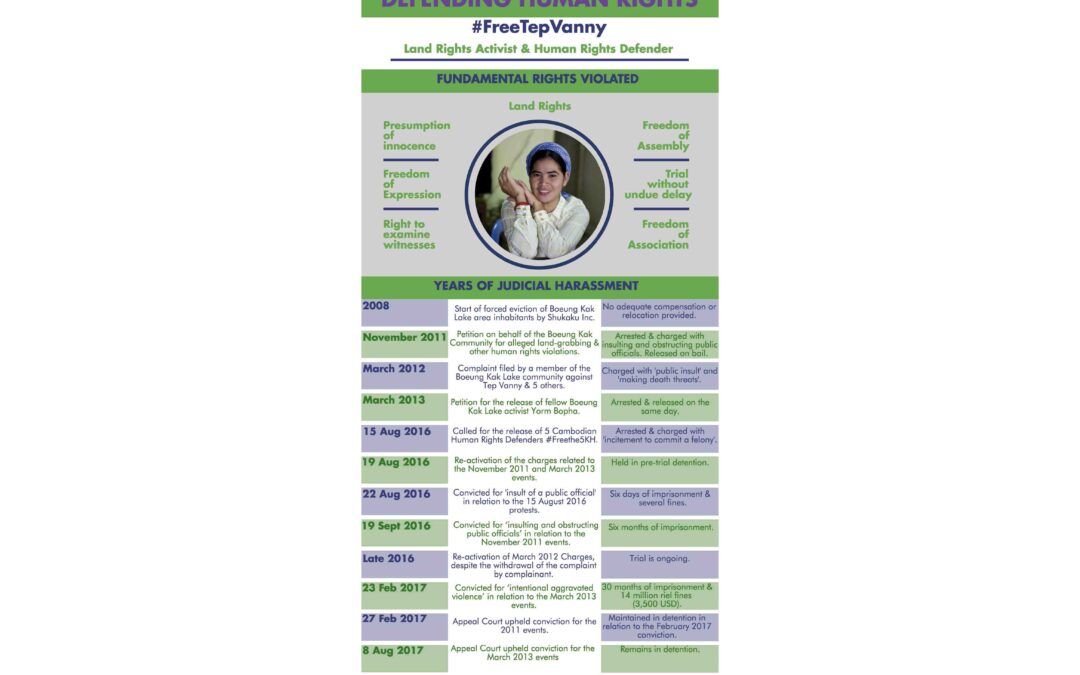
Tep Vanny, one of Cambodia’s most prominent land activists and human rights defenders, will have spent one year in prison on 15 August for defending her community and exercising her human rights.
The ICJ and other human rights organizations condemn her arbitrary imprisonment and call for her convictions to be overturned, for all ongoing politically motivated and unsubstantiated charges against her to be dropped, and for her immediate release from prison.
Tep Vanny has fought tirelessly to protect the rights of members of the Boeung Kak Lake community, following their forced eviction from their homes in Phnom Penh.
More recently, she played a leading role in the so-called ‘Black Monday” campaign, challenging the arbitrary pre-trial detention of five human rights defenders, Lim Mony, Ny Sokha, Yi Soksan, Nay Vanda, and Ny Chakrya (the “Freethe5KH” detainees).
On 22 August 2016, following her arrest at a protest calling for the release of the five, she was convicted of ‘insulting of a public official’, and sentenced to six days in prison.
However, instead of releasing her based on time served, the authorities reactivated dormant charges dating back to a 2013 protest and kept her in detention.
“It is clear that the authorities are using the courts to lock me up, silence my freedom of expression and break my spirit,” said Tep Vanny. “They want to stop me from advocating and seeking a solution for the remaining people from Boeung Kak Lake as well as other campaigns to demand justice in our society.”
On 19 September 2016, Tep Vanny was sentenced, along with three other Boeung Kak Lake community activists, to six months imprisonment for “insulting and obstructing public officials” in a reactivated case related to a 2011 peaceful protest calling for a resolution to the Boeung Kak Lake land dispute, despite the absence of credible inculpatory evidence.
This conviction has since been upheld by the Court of Appeal on 27 February 2017.
On 23 February 2017, following proceedings which fell short of fair trial standards, Tep Vanny was convicted of “intentional violence with aggravating circumstances”, sentenced to a further 30 months in prison and fined more than 14 million riel (about US $3,500 – or twice the annual minimum wage in Cambodia) for having peacefully participated in protests calling for the release of her fellow activist Yorm Bopha, back in 2013.
While the #FreeThe5KH human rights defenders were released on bail on 29 June 2017, after having spent 427 days in arbitrary detention, Tep Vanny remains in prison.
She is currently on trial in a third reactivated case, facing charges of “public insult” and “death threats” brought by another member of the Boeung Kak Lake community, despite the complaint having been dropped by the community member.
On 8 August 2017, the Court of Appeal upheld her February 2017 conviction.
Cambodia-Joint Statement Tep Vanny-Advocacy-2017-ENG (full statement in English, PDF)
Cambodia-Joint Statement Tep Vanny-Advocacy-2017-KHM (full statement in Khmer, PDF)
Cambodia-Infographic TV Case Overview-Advocacy-2017-KHM (Infographic in Khmer, PDF)