Oct 12, 2023
On 11 October 2023, the International Commission of Jurists (ICJ) made a submission to the UN Human Rights Council’s Working Group on the Universal Periodic Review (UPR) in advance of its review of Vietnam’s human rights record in April – May next year.
In its submission, the ICJ draws the attention of the Human Rights Council’s Working Group on the UPR to a number of serious human rights concerns in Viet Nam in connection with:
- Freedom of expression;
- The death penalty; and
- The independence of the judiciary and the right to a fair trial.
In addition, in its submission the ICJ calls upon the Working Group and the Human Rights Council to make the following recommendations to the Vietnamese authorities:
On freedom of expression
- The legislature should repeal or substantially amend legal provisions that unduly restrict the right to freedom of expression – including articles 117 and 331 of the Penal Code, Law on Cybersecurity, Decree 53, and Decree 72 – to bring them in line with international human rights law; and the proposed enactment of a new Decree 72 should be shelved;
- The prosecuting authorities and the judiciary should immediately cease ongoing criminal investigations, drop all existing charges and revoke or otherwise rescind criminal penalties imposed against individuals for alleged violations of domestic provisions, particularly with respect to domestic criminal provisions that are inconsistent with general principles of criminal law and Viet Nam’s obligations under international human rights law, including those guaranteeing the rights to freedom of expression and information;
- The government should refrain from restricting or blocking online content unless the blocking decision has been undertaken following a full analysis that applies international standards concerning legality, legitimate purpose, necessity, proportionality and non-discrimination, and has been authorized pursuant to an order by an independent and impartial judicial authority, in accordance with due process with the express guarantee of the right to appeal.
On the death penalty
- Halt all impending executions of individuals and commute their sentences; impose an immediate moratorium on the use of the death penalty with a view to abolishing capital punishment;
- Ensure that there is sufficient transparency with respect to the death penalty, including through making sure that essential information relevant to a specific planned execution be promptly provided to death row prisoners and their families, and making publicly available information regarding death sentences, notifications and executions.
On the independence of the judiciary and fair trial
- Take immediate steps to safeguard, in law and in practice, the full independence and impartiality of the judiciary from any form of political pressure and influence, and ensure transparent and impartial processes for appointments to the judiciary;
- Ensure that the right to a fair trial be fully respected at the investigation and trial stages in compliance with international law and standards, including through guaranteeing the right to legal assistance pending trial, the right to adequate time and facilities for the preparation of a defence, the right to a public hearing, the presumption of innocence, the right to defence, and the right to equality of arms;
- In relation to cases where there have been allegations of ill-treatment, initiate prompt, impartial and effective investigations into all credible allegations of torture or other cruel, inhuman or degrading treatment and, when warranted by the evidence, bring the perpetrators to justice; provide victims with access to an effective remedy and reparation; and
- Cease the use of arbitrary criminal investigations against lawyers aimed at impairing their legitimate work as human rights lawyers and their right to freedom of expression. In addition, consistent with the ICCPR and UN Basic Principles on the Role of Lawyers, take all necessary measures to ensure the free exercise of the legal profession, in all circumstances, so that lawyers may exercise their legitimate professional rights and discharge their duties towards their clients and the courts without fear of reprisals and free from all undue restrictions, including harassment through abusive legal proceedings.
The submission can be downloaded here.
Oct 11, 2023 | Advocacy, News
The International Commission of Jurists (ICJ) called the Human Rights Council’s (HRC) attention to the entrenched pattern of human rights violations in Cambodia, and called on the HRC to adopt a resolution to extend the Special Rapporteur’s mandate and ensure it has adequate resources and support.
Oral statement of the International Commission of Jurists (ICJ) during the Interactive Dialogue with the Special Rapporteur on the situation of human rights in Cambodia
“Madam Vice President,
The International Commission of Jurists (ICJ) concurs with the Special Rapporteur’s assessment that Cambodia has largely failed to implement the 20 human rights-related benchmarks proposed in his previous report to this Council.
In the lead-up to the national elections, there was a rapid escalation of the human rights and rule of law crisis in Cambodia. Human rights defenders and political opponents were convicted based on non-human rights compliant laws for exercising their right to freedom of expression, both online and offline, with new draconian laws on cybercrime and cybersecurity being drafted and considered.
The authorities have arbitrarily revoked licenses and blocked online access to independent media outlets without due process. The government at the highest level has employed rhetoric, reproduced online, to threaten and incite violence against political opponents with impunity, with credible reports of actual physical violence as an apparent consequence.
This systematic disregard for Cambodia’s international human rights obligations has been further exacerbated by the absence of an independent and impartial judiciary. The convictions of human rights defenders and political opponents were frequently accompanied by massive fair trial violations, including the effective application of a presumption of guilt.
It is imperative that the Council responds decisively to reverse this entrenched pattern of human rights violations in Cambodia by adopting a resolution to extend the Special Rapporteur’s mandate and ensuring it has adequate resources and support.
Thank you.”
Contact
Sandra Epal Ratjen, ICJ UN Representative and Senior Legal Adviser, e: sandra.epal@icj.org
Daron Tan, ICJ Associate International Legal Adviser, e: daron.tan@icj.org
Oct 10, 2023 | News
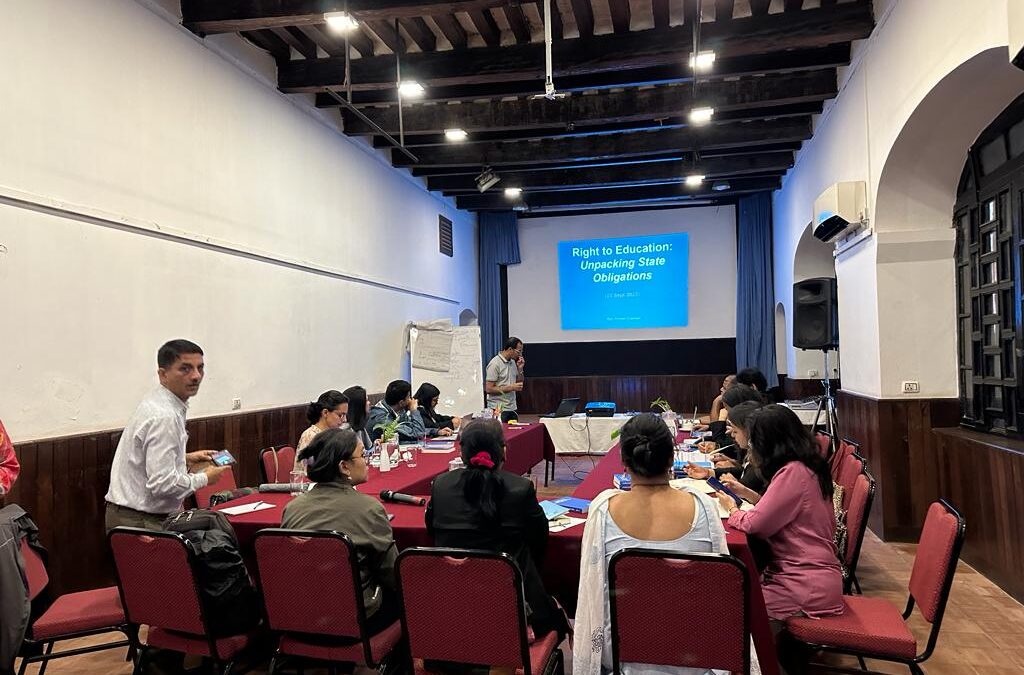
The International Commission of Jurists (ICJ), in partnership with the Economic, Social and Cultural National Network/Justice & Rights Institute Nepal (JuRI-Nepal), the Public Interest Litigation LawyersGroup (Nepalgunj), and the Privatisation in Education and Human Rights Consortium (PEHRC), has launched a mentorship program geared towards training young lawyers on international law and standards applicable to private actor involvement in education.
The 22 lawyers who will benefit from the programme are from Bagmati and Lumbini Province. To kick off the program, workshops were held on 23 September in Kathmandu and 28 September in Nepalgunj.
“We are delighted to initiate this mentorship program and are hopeful that it will be helpful to prepare a new set of human rights lawyers capable of and dedicated to advancing the realization of the right to education in Nepal in the context of burgeoning privatization,” said Karuna Parajuli, ICJ National Legal Adviser.
“The State has the primary role in guaranteeing access to education for all persons without discrimination of any kind. We hope that knowledge of their specific duties around will assist Nepali lawyers to identify issues and support their clients in enjoying their rights to education and ensuring effective and adequate regulation of private actors in education, added Parajuli.
Opening the workshop in Nepalgunj Judge Harka Bahadur Gurung emphasized the importance of these issues in the Nepali context:
“The current educational system in Nepal has segregated children as those going to high-fee private schools and others going to public schools with no basic infrastructure. Your litigation initiative should focus to remove this division and enable each student equal access to free and quality education”.
“The Constitution of Nepal guarantees education as a human right which is fully enforceable before Nepali Courts. This provides a strong avenue to initiate strategic litigation, which remains underutilized”, said ICJ’s Senior International Legal Adviser Mandira Sharma. “We encourage the mentees in this programme and Nepali lawyers more broadly to work towards crafting innovative advocacy strategies directed at fully realizing right to education in Nepal”, she concluded.
Contact
Dr Mandira Sharma, ICJ Senior International Legal Adviser, t: +9779851048475, e: mandira.sharma@icj.org
Karuna Parajuli, ICJ Legal Adviser, Nepal, t: +9779808431222, e: karuna.parajuli@icj.org
Further information
International law and standards on the right to education are spelled out in various treaties binding on Nepal such as the International Covenant on Economic, Social and Cultural Rights and the Convention on the Rights of the Child. Further detail on States’ obligations to restrict, regulate and monitor private actor involvement in education are further details in a range of standards including the general comments of UN Treaty Body Mechanisms and the Abidjan Principles on the human rights obligations of States to provide public education and to regulate private involvement in education.
Following the workshops, participants worked in groups to formulate an action plan for their mentorship period. They have been paired up with mentors (that include a senior advocate, senior litigating lawyers, and an ESCR expert). The mentorship program will run from October 2023 to March 2024.
The mentorship program is organized with the support of the Privatization in Education and Human Rights Consortium (PEHRC), an informal network of national, regional, and global organizations and individuals collaborating to analyse and respond to the challenges posed by the rapid growth of private actors in education from a human rights perspective and propose alternatives.
The main objectives of the mentorship program are to train young lawyers on how to utilize strategic litigation for claiming the right to education; expand their knowledge of international law (including Abidjan Principles) and share good practices on the right to education in other parts of the world.
Resources
https://www.icj.org/nepal-strategic-litigation-is-an-important-tool-to-ensure-compliance-with-international-human-rights-standards/
https://www.icj.org/late-as-usual-delayed-delivery-of-textbooks-infringes-the-right-to-education-of-nepali-students/
https://www.icj.org/nepal-icj-lawyers-workshop-discusses-strategic-litigation-to-enforce-the-right-to-education/
Oct 2, 2023
The International Commission of Jurists (ICJ) and Access Now sent a joint letter and an accompanying legal analysis to Cambodia’s Ministry of Post and Telecommunications and Ministry of Justice, calling for the withdrawal or substantial amendment of its Draft Law on Cybersecurity to bring its provisions in line with international human rights standards.
The draft law, if adopted, would likely undermine the rights to privacy and freedom of expression, while also risking personal security and exposing people to increased cyber threats.
“The Draft Law would require government licenses of cybersecurity services – an excessive provision that would hamper the ability of people and businesses in Cambodia from being able to secure themselves against intrusion into their networks and safeguard their data,” said Golda Benjamin, Asia Pacific Campaigner at Access Now. “Cambodia wants this draft law to deal with malicious cyber activities but in its current form, it will only create a new problem of having a cybersecurity landscape that imposes unreasonable administrative burdens to organizations, including small and medium enterprises and civil society.”
In the legal analysis attached to the joint letter, Access Now and ICJ point out that the vaguely worded and sweeping provisions in the Draft Law may be abused to allow government cybersecurity inspectors overbroad access to private data. It fails to provide for safeguards, but instead would grant a newly created body of cybersecurity inspectors immense power to investigate, observe, monitor, prevent and respond to cybersecurity threats and incidents. The Draft Law also fails to make provision to ensure that cybersecurity inspectors are properly qualified.
“These proposed arrangements are a recipe for executive abuse, especially given that the bill fails to provide for any independent or effective oversight or remedial mechanism to serve as check on governmental conduct and safeguard against any potential overreach,” said Ian Seiderman, Legal and Policy Director at the ICJ. “If this legislation is put forward for adoption, it needs to amended to correct these deficiencies and comply with Cambodia’s international legal obligations and rule of law principles.”
Access Now and ICJ urge Cambodia to strengthen their cybersecurity landscape to deal with malicious cyber activities and ensure that any law, policy, or practice to implement this goal complies with the country’s international human rights obligations. Effective cybersecurity requires a human-centric and human rights respecting approach.
Download
Read the joint letter here, and the joint legal analysis of the Draft Law on Cybersecurity here.
Contact
Daron Tan, ICJ Associate International Legal Adviser, e: daron.tan@icj.org
Sep 29, 2023 | News
The ICJ is concerned that the newly proposed Online Safety legislation, if adopted in its present form, would serve to crush free expression and further contract an already shrinking civic space in Sri Lanka.
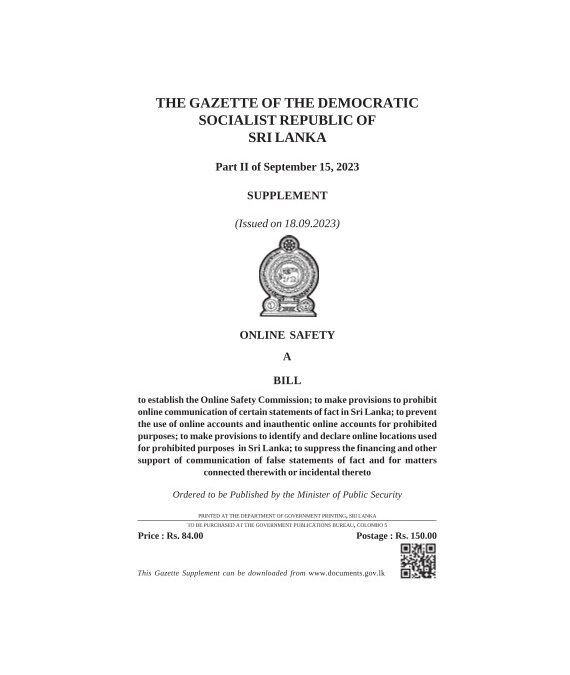
On 18 September 2023, the Ministry of Public Security gazetted a bill titled “Online Safety” intended to dramatically regulate the content of online communication, including by the general public.
The ICJ considers that several provisions of the bill would serve to undermine the exercise of human rights and fundamental freedoms in the country, including freedom of information and expression. Of particular concern are provisions related to the setting up, appointment and functions of an Online Safety Commission and other experts, the vague and overbroad wording of conduct designated as punishable offences and unnecessary and disproportionate punitive sanctions.
“While the spread of online hate-speech and disinformation need to be tackled, this bill is deeply flawed in its design and would be open to abuse by the Sri Lankan government, which has persistenty failed to uphold freedom of expression,” said Ian Seiderman, ICJ’s Legal and Policy Director. “It risks being used to suppress important public debate regarding the conduct of the government and matters of public policy,” he added.
The Bill would establish an “Online Safety Commission” that would act to: “prohibit online communication of certain statements of fact; prevent the use of online accounts and inauthentic online accounts for prohibited purposes; make provisions to identify and declare online locations used for prohibited purposes in Sri Lanka and to suppress the financing and other support of communication of false statements,” as well as other unspecified matters.
The Bar Association of Sri Lanka has called for the immediate withdrawal of the bill and for the adoption of a process of meaningful consultations with all relevant stakeholders prior to gazetting bills which ‘have a serious impact on the community at large.’
“The current draft fails to adhere to the principles of legitimacy, necessity and proportionality required for any State activity that restrict rights. It must be withdrawn or amended to be brought in line with Sri Lanka’s international human rights obligations guaranteeing freedom of expression, opinion, and information.” Seiderman added.
The ICJ considers that the Bill should not be evaluated in a vacuum, but instead must be read in conjunction with existing and proposed legislation that threaten human rights. Such laws include the extremely misused ICCPR Act of 2005, the Prevention of Terorrism Act (PTA), the Bureau of Rehabilitation Act, and the proposed Anti-Terrorism law which seeks to replace the PTA. This body of legislation, taken together, fosters a chilling effect on the exercise of fundamental freedoms restricting civil society while unduly expanding the reach of the security state.
Article 14 (1) (a) of the Sri Lankan Constitution gurantees the freedom of speech and expression. Article 19 of the International Covernant on Civil and Political Rights, to which Sri Lanka is a party, affirms the right to freedom of expression and opinion.
In July 2018, the UN Human Rights Council adopted by consensus a resolution affirming that “the same rights that people have offline must also be protected online, in particular freedom of expression, which is applicable regardless of frontiers and through any media of one’s choice, in accordance with articles 19 of the Universal Declaration of Human Rights and the International Covenant on Civil and Political Rights.”
Contact: Ian Seiderman, Legal & Policy Director, e: ian.seiderman@icj.org
See annexed below a summary analysis of some problematic aspects of the Online Safety Bill.
Sri Lanka: Selected flaws in the Online Safety Bill
- Wide ranging and overly broad powers of the Online Safety Commission and appointed Experts
The bill provides for the establishment of a five-member ‘Online Safety Commission’ that is to be appointed on the sole discretion of the President (clause 5). This is in contrast to other notionally independent commissions in Sri Lanka, the appointments to which require the consent of the Constitutional Council by way of nomination or ratification. This bill would give the president unfettered discretion where both appointment and removal is concerned.
The Commission would also be vested with a wide range of powers, some of which encroach into the functions of the judiciary. It essentially acts as sole arbiter of matter of fact and is entitled to issue notices or directives against any person, internet service provider (ISP) or internet intermediaries who/which is alleged to have communicated a prohibited or false statement. The bill does not specify the process through which the Commission would arrive at this decision.
Moreover, the Commission is granted authority to block websites and instruct ISPs to restrict access to specific online locations. This may result in undue government overreach and censorship and impermissible limitations on the exercise of the right to information protected by Article 14A of the Constitution and international law.
Further clause 37 allows for the Minister to appoint ‘Experts’ to assist police officers in investigations. The experts are private individuals who can accompany police officers during search procedures, but are also given the power upon authority granted by a police officer above the rank of a sub-inspector to require a person to hand over any documents or device, provide traffic data or be orally examined (clause 37 (6)). Such excessive powers in the hands of unaccountable private individuals provide avenues for abuse.
The bill does not provide provide for judicial review of the Commission’s decisions or procedures. Instead clause 49 seeks to protect the Commission, its staff, or any expert appointed under clause 37 from being brought to court for any act or omission done in good faith.
- Vague and overbroad offences
A particularly problematic aspect of the bill are provisions of vague and overbroad definitions of offences.
Article 19(3) of the ICCPR provides that the right to freedom of expression and opinion may be subject to certain restrictions, but that these restrictions must be provided by law and necessary for one of a limited numbers of legitimate purposes, namely to protect the rights and reputations of others, national security, public order or public health or morals. The measure of limitation must be proportionate, using the least restrictive means possible to achieve the purpose. The requirement that any restrictive measure be provided by law means that they must comply with the principle of legality, by which the law must be stated with precision as to allow persons to be able to conform their conduct in compliance.
Similarly, Article 15 (2) of the Sri Lankan Constitution provides for possibility of restriction of the right “as may be prescribed by law in the interests of racial and religious harmony or in relation to parliamentary privilege, contempt of court, defamation or incitement to an offence.”
The prohibitions listed in this draft legislation go beyond the restrictions allowed for under the ICCPR and the Sri Lankan Constitution, as clause 12 states that “any person who poses a threat to national security, public health or public order or promotes feelings of ill-will and hostility between different classes of people, by communicating a false statement, commits an offence.”
In addition, several acts that would constitute offence are only vaguely defined, if at all. This includes communicating a false statement “with the deliberate intention of wounding the religious feelings of any other person” (clause 16) or “outraging the religious feelings of any class of persons, insults or attempts to insult the religion or the religious beliefs of that class” (clause 17). These clauses are overbroad in that they would encompass expression that is protected under human rights law. Clause 14 makes it an offence to ‘wantonly giving provocation by false statement to cause riot’. This language is open to abuse by the authorities, as evidenced by practices arising from other legislation, including the ICCPR Act and the PTA.
Repeated mention of ‘religion’ in these provisions is a cause for concern as they come in a context where there is ongoing strife relating to contested religious sites between majority and minority religious communities, thus creating risk of selected application to silence expression by persons from minority religious communities.
- Disproportionate Punishment
The draft bill prescribes unjustifiably hefty punishments of fines and a period of imprisonment ranging from one, two, three or five years for overbroad and ill-defined offences. It also states that “in the event of a second or subsequent conviction, such term of imprisonment or fine or both such imprisonment and fine may be doubled.”
Clause 25 of the bill, which refers to ‘failure to comply with the directives of the Commission’ would make it an offence to fails to comply with such directive within a period of 24 hours and makes the person liable to imprisonment for a term not exceeding five years or to a fine not exceeding one million rupees.