Dec 3, 2015 | News
The Indian government should support a comprehensive law guaranteeing equal rights and non-discrimination to transgender persons, consistent with India’s international human rights obligations, the ICJ said today.
This law must be developed and passed after adequate consultation with the transgender community in India, the Geneva-based organization added.
“The transgender community in India has faced stigma, discrimination and violence for years,” said Sam Zarifi, ICJ’s Asia-Pacific Director. “It is time for the Indian Parliament to pass comprehensive anti-discrimination legislation as an essential first step towards guaranteeing the transgender community’s internationally recognized, and constitutionally protected, human rights.”
Earlier this year, the Rajya Sabha (Upper House of the Indian Parliament) passed the Rights of Transgender Persons Bill, 2014, a private member’s Bill, that is, a bill introduced by a Member of Parliament rather than the Government.
The Bill guaranteed a wide range of rights to transgender individuals, including the right to be free from discrimination, the right to life and personal liberty, the right to protection from abuse, violence and exploitation, as well as equality in educational opportunities, employment, social security, and health care.
The Lok Sabha (Lower house of the Indian Parliament) will discuss a revised version of this Bill in the current session. The Government’s Ministry of Social Justice and Empowerment is reportedly developing its own draft.
“Any transgender rights legislation must fully comply with India’s international human rights obligations,” Zarifi added. “An essential element of this is that the Indian government must ensure that the transgender community participates in, and is meaningfully consulted on, the new law’s provisions.”
India has ratified several international instruments, including the International Covenant on Civil and Political Rights, the International Covenant on Economic, Social and Cultural Rights and the Convention on the Elimination of all forms of Discrimination against Women. They prohibit discrimination and guarantee full equality for everyone, including transgender people.
Successive pronouncements by international bodies, including the UN, have affirmed that these rights apply to transgender persons.
The Yogyakarta Principles – which reflect the specific application of international human rights law in the context of sexual orientation and gender identity – recognize transgender people’s human rights, including the right to equality before the law, equal protection of the law and the principle of non-discrimination, as well as the right to self-defined sexual orientation and gender identity, the right to expression, to privacy, to health, to housing, to education, and the right to participate in policies affecting one’s welfare.
India’s transgender rights Bill should respect, protect and fulfill this range of rights. It should also ensure that the definition of who constitutes a transgender person, as well as the process of determining this, is consistent with international standards, the ICJ said.
In 2014, in the case of National Legal Services Authority v Union of India (NALSA), the Indian Supreme Court recognized transgender persons’ right to self-identification and to the legal recognition of their gender identity. However, a year after the Supreme Court’s judgment, its directions are yet to be effectively implemented, making the passage of a comprehensive bill on transgender persons’ human rights all the more crucial. At the same time, the legislative process culminating in the adoption of the legislation needs to be adequately consultative.
“A comprehensive transgender rights bill is long overdue in India,” Zarifi said. “It is crucial that the Indian government take advantage of the current political momentum to reaffirm the rights of transgender persons, and pass a strong and progressive law.”
Contact:
Sanhita Ambast, ICJ International Legal Adviser (Delhi), t: +91 9810962193; e: Sanhita.ambast(a)icj.org
Background
A report by India’s Ministry of Social Justice and Empowerment – Report of the Expert Committee on the Issues relating to Transgender Persons –has acknowledged the range and impact of discrimination faced by the transgender community in India.
It makes note of the stigma, discrimination and violence they face from their families, communities, and state institutions, including the police. It also highlights the difficulties faced by them in accessing services like housing and education.
In the NALSA case, the Supreme Court found that discrimination faced by the transgender community in India violated the rights to equality, non-discrimination, free speech and expression, and life in the Indian constitution. The Court gave specific directions to address this discrimination.
It also noted that the absence of “suitable legislation protecting the rights of the members of the transgender community” has resulted in their facing discrimination in various areas. A clarification petition, filed by the government, regarding this case is currently pending at the Supreme Court.
Following the Supreme Court’s 2013 NALSA judgment, several states have put in place progressive policies to address the discrimination faced by transgender groups.
However, the implementation of this judgment is far from adequate, and a lot more needs to be done.
A 2011 Report of the United Nations High Commissioner for Human Rights has recommended that states “Enact comprehensive anti-discrimination legislation that includes discrimination on grounds of sexual orientation and gender identity among prohibited grounds and recognizes intersecting forms of discrimination”.
It also asked states to “Facilitate legal recognition of the preferred gender of transgender persons”.
In its 2015 report, the United Nations High Commissioner for Human Rights recommended that anti-discrimination legislation should “include[s] sexual orientation and gender identity among prohibited grounds, and also protect[s] intersex persons from discrimination” and that “LGBT and intersex persons and organizations [should be] consulted with regard to legislation and policies that have an impact on their rights”.
Dec 2, 2015 | News
The ICJ today denounced the execution of four individuals convicted for their involvement in terrorism in secret trials by military courts.
Four civilians, namely Maulvi Abdus Salam, Hazrat Ali, Mujeebur Rehman and Sabeel alias Yahya, were hanged in Kohat early morning today after being sentenced to death by military courts earlier this year.
In a press statement issued on 13 August, the media wing of the armed forces announced they were convicted for their involvement in “terrorist activities”, including harboring, funding and transporting “suicide bombers” who attacked the Army Public School in December last year.
According to the statement, they are all “active members” of the “Toheedwal Jihad Group”.
The ICJ considers that the executions are unlawful, in breach of Pakistani law and its international legal obligations.
“The failure of the government and military authorities to make public information about the time and place of their trials, the charges and evidence against them, as well as the judgments of military courts have confirmed fears of human rights groups and the legal community that military trials in Pakistan are secret, opaque and constitute a violation of the right to a fair trial,” said Sam Zarifi, ICJ’s Asia Director.
The ICJ emphasizes that under international standards, civilians may not be tried before military tribunal.
As highlighted by the ICJ in a briefing paper released in April, proceedings before Pakistani military courts fall well short of national and international standards requiring fair trials before independent and impartial courts: judges are part of the executive branch of the State and continue to be subjected to military command; the right to appeal to civilian courts is not available; the right to a public hearing is not guaranteed; and a duly reasoned, written judgment, including the essential findings, evidence and legal reasoning, is denied. In addition, the procedures of military courts, the selection of cases to be referred to them, the location and timing of trial, and detailed about the alleged offences are kept secret.
“The ICJ supports the pursuit of justice for all victims of terrorism in Pakistan, including the horrific attack on the Army Public School last year”, added Zarifi. “However, justice will not be done by subverting the foundational pillars of justice: the right to a fair trial and independence of the judiciary.”
The UN Human Rights Committee, the supervisory authority for the ICCPR, has emphasized that in trials leading to the imposition of the death penalty, “scrupulous respect of the guarantees of fair trial is particularly important” and “imposition of a sentence of death upon conclusion of a trial, in which the provisions of article 14 of the Covenant have not been respected, constitutes a violation of the right to life.”
Pakistan has hanged more than 300 people since it lifted a six-year moratorium on the death penalty in December 2014. Initially lifted only for terrorism-related offences, the Government resumed executions in all cases in March 2015. Less than ten per cent of the total executions relate to terrorism-related offences.
“These executions only fulfill a desire for retribution and add to the disturbing trend of hanging people in the name of fighting terrorism in Pakistan and the region,” said Zarifi. “The death penalty has not been shown to have any deterrent effect on crime or terrorism anywhere in the world.”
The ICJ opposes capital punishment in all cases without exception. The death penalty constitutes a violation of the right to life and the right not to be subjected to cruel, inhuman or degrading punishment.
In December 2014, the UN General Assembly adopted a resolution, for the fifth time since 2007, emphasizing that the use of the death penalty undermines human dignity and calling on those countries that maintain the death penalty to establish a moratorium on its use with a view towards its abolition.
Some 117 UN Member States, a wide majority, voted in favor of a worldwide moratorium on executions as a step towards abolition of the death penalty.
In line with the present international trend, the ICJ reiterates its call on Pakistan to impose an official moratorium on executions, with a view to abolishing the death penalty.
Contact
Sam Zarifi, ICJ Asia Pacific Regional Director (Bangkok), t: +66 807819002; email: sam.zarifi(a)icj.org
Reema Omer, ICJ International Legal Adviser for Pakistan (London), t: +447889565691; email: reema.omer(a)icj.org
Additional Information
On 6 January 2015, less than a month after a terrorist attack on an army public school in Peshawar that killed nearly 150 people, most of them children, Parliament voted to amend the Constitution of Pakistan, 1973, and the Army Act, 1952, to allow military courts to try civilians for offences related to terrorism.
Since January 2015, 56 cases have been referred to military courts, out of which 31 have been decided. Military courts have found the accused persons guilty in all cases. 27 convicts have been given the death penalty and four have been sentenced to life imprisonment.
Around 20 cases are still pending before the various military courts.
Nov 26, 2015
Myanmar’s Parliament must abolish or extensively amend its criminal defamation laws to ensure the protection of the right to freedom of opinion and expression, said the ICJ today.
Criminal defamation laws in Myanmar impose harsh sanctions, such as imprisonment, to punish free expression.
The prospect of arrests, detentions, criminal trials and prison time could chill the exercise of free expression of opinions and exchange of information.
The ICJ, the United Nations Human Rights Committee (which monitors and supervises States’ compliance with their international human rights obligations), the UN Special Rapporteur on freedom of opinion and expression and other international human rights authorities and an increasing number of governments consider that criminal defamation laws should be abolished, as they are incompatible with the right to freedom of expression and opinion.
Myanmar’s 2008 Constitution provides for the protection of freedom of expression but sets out broad and ambiguous restrictions that limit the enjoyment of these rights.
In addition, the judiciary of Myanmar currently struggles to adjudicate such criminal defamation cases with impartiality and competence.
The result is that enforcement of the defamation laws can result in violations of a number of international laws and standards protecting human rights, and also could have an overall chilling effect on the freedom of opinion and expression in the country.
Just last month, three people faced criminal defamation charges and were detained pending trial for posting material on Facebook that allegedly defame either the Myanmar army or a political leader.
- Kachin activist Patrick Kum Jaa Lee was arrested in Yangon for allegedly posting a Facebook post showing someone stepping on a photo of an army Commander-in-Chief Senior General;
- Chaw Sandi Tun was arrested for a Facebook post pointing out that an army official was wearing clothes of a similar colour to those of then opposition leader Aung San Suu Kyi; and
- Maung Saungkha was arrested for allegedly posting a poem on Facebook he had written about having a tattoo of the President on his penis. His next hearing at Shwepyithar Township has been scheduled for tomorrow.
The ICJ is monitoring some of these trials to assess their compliance with international laws and standards. In one such trial, involving Patrick Kum Jaa Lee, the accused has been denied bail for the fifth time this week despite his ailing health.
The laws used to charge and detain the accused are the Electronic Transaction Law, specifically under provision 34(d), the Myanmar Telecommunications Law, specifically under provision 66(d), and Article 500 of the Penal Code.
Download the full paper here:
Myanmar-Criminal Defamation Laws-Advocacy-Position paper-2015-ENG (in PDF)
Myanmar-Criminal Defamation Laws-Advocacy-Position paper-2015-BUR (Burmese version, in PDF)
Nov 25, 2015 | News
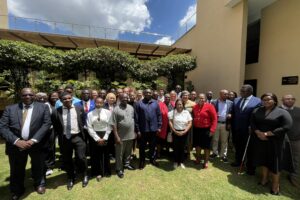
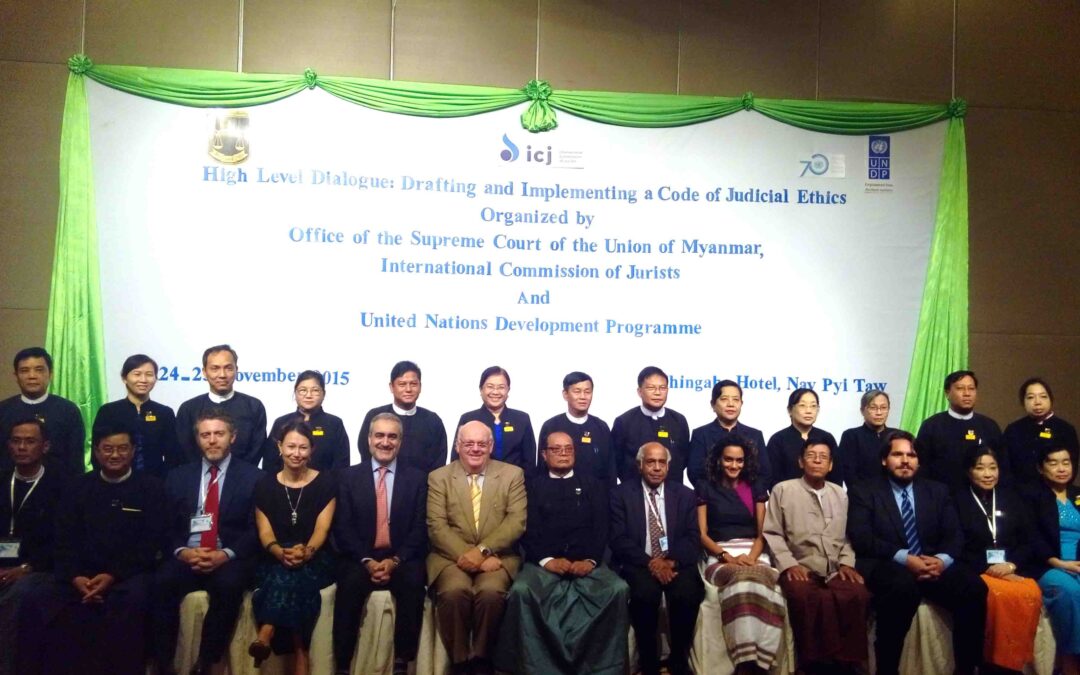
The ICJ, the UNDP and the Office of the Supreme Court of the Union (OSCU) held a High Level Dialogue on “Drafting and Implementing a Code of Judicial Ethics” in Nay Pyi Taw on 24-25 November 2015.
This followed on a commitment by the OSCU to create a new code and to work together with the ICJ and UNDP to ensure it is informed by and implemented in accordance with international best practice.
The Judicial Ethics Review Committee, Regional High Court Judges and other senior court administrators participated in the Dialogue.
The participants and their international counterparts from the ICJ and UNDP discussed the content of the Draft Code of Ethics, international standards on Judicial Codes of Ethics and accountability mechanisms.
In opening the Dialogue, the Honourable Supreme Court Justice of the Union, U Mya Thien explained that the new code reflecting international standards would enhance public trust and promote accountability in the Judiciary.
In his opening remarks, Sam Zarifi, the ICJ’s Regional Director for Asia and the pacific noted the historic occasion in which the world was watching transition in Myanmar.
During the Dialogue, former ICJ Commissioner and UN Special Rapporteur on the Independence of Judges and Lawyers, Dato Param Cumaraswamy, and Justice Murray Kellum of Australia shared their wealth of experience developing codes of ethics and accountability mechanims at the national and international levels.
Both explained that public perception of the Judiciary is key in a transition to the rule of law and human rights.
All participants agreed the Myanmar’s judiciary is not yet independent and that its current judicial code of ethics requires updating.
It was acknowledged that new code of ethics would develop the independence of the judiciary in Myanmar.
Sam Zarifi explained that, “in order for the Supreme Court to assert judicial independence it must demonstrate that it can hold itself accountable to a code of ethics.”
Both the UNDP and the ICJ congratulated the OSCU for following its Strategic Plan for 2015-2018 and engaging in a dialogue designed to further this process.
Both expressed willingness to continue working with Myanmar’s judiciary on the issues of judicial independence, the rule of law and human rights.
Nov 24, 2015 | News
The government and all political parties, along with the country’s neighbors and international supporters, must act immediately to end the increasingly violent political crisis in the southern Terai region said the ICJ today.
The associated border blockade that has imposed severe shortages of necessary commodities throughout the country must also be ended, the ICJ added.
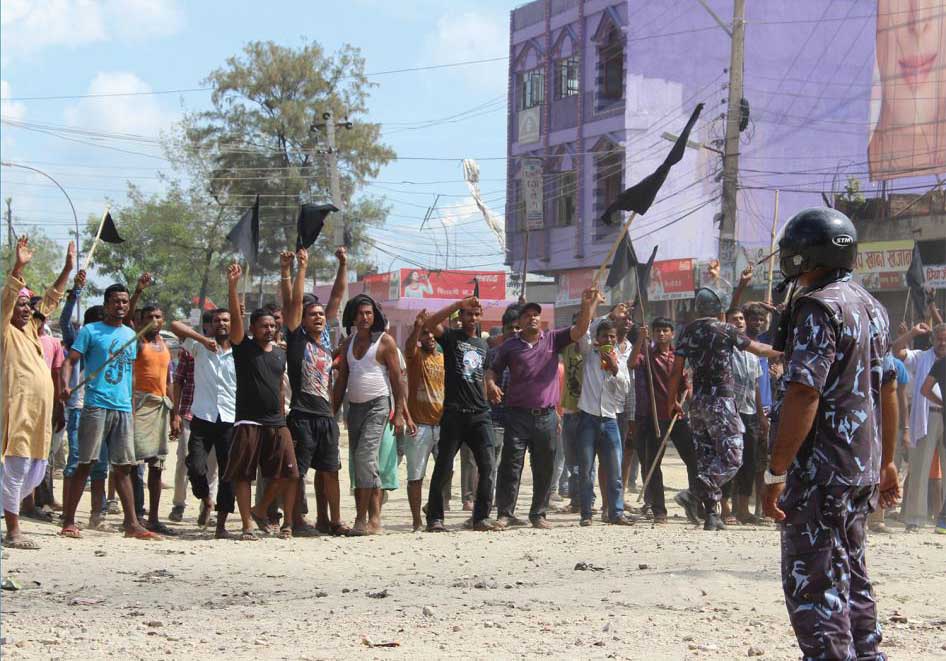
Over the weekend, three individuals were killed and at least another 28 individuals, including 15 police officers, were injured during clashes following an apparent impasse in talks among political parties trying to end the crisis over the newly adopted Constitution.
“Nepali authorities should promptly investigate and bring to justice the perpetrators – be they security forces or protesters – of any unlawful killings and other acts of violence committed during the ongoing protests in the Terai, and ensure that security forces refrain from the use of excessive force against civilians,” said Sam Zarifi, ICJ’s Asia-Pacific Director.
“At the same time, the Nepal government must address the severe shortage of commodities and the impact it has had on economic and social rights by prioritizing the most urgent needs while working to resolve the constitutional crisis,” he added.
The border blockade initiated nearly three months ago has had a deeply detrimental impact on the economic and social rights of the population countrywide, including the rights to food, water and sanitation, health and adequate housing, by causing severe shortages of essential commodities such as fuel, cooking gas and medical supplies throughout the country.
Madhesi groups have been demonstrating against Nepal’s new Constitution in the Terai since August 2015, protesting discriminatory aspects of the new Constitution that they argue would entrench marginalization, and have been staging a de facto blockade at the main border posts along the Nepal-India border since the Constitution was adopted on 20 September 2015.
India has been accused of imposing or collaborating in the blockade, an allegation which the Indian government has denied.
The ICJ has previously highlighted the lack of proper consultation in the drafting and adoption of the Constitution as well as the substantive human rights defects in its text, particularly the discriminatory provisions on the rights of women and some ethnic groups.
More than 45 persons, including 8 police personnel, have been killed during violent confrontations that have erupted between protesters and security forces since the demonstrations began, with allegations of excessive use of force by Nepali security forces as well as violent attacks by protesters against police personnel.
One Indian national was apparently killed by Nepali security forces at the Birgunj border last month.
“The Nepal government has a responsibility to protect the rights and security of its people and to re-establish the rule of law in the Terai,” said Zarifi. “However, Nepal must at all times respect the people’s right to peaceful protest and free assembly, and ensure that security forces exercise maximum restraint when responding to the demonstrations.”
The ICJ emphasizes that India and Nepal have an obligation to protect the human rights, including the economic and social rights, of persons impacted by their acts or the actions of those under their jurisdiction, and accordingly have an obligation to remove obstacles to the enjoyment of those rights.
“Nepal has an obligation to ensure that all available resources at their disposal have been mobilized to alleviate the human rights and humanitarian impact of the border blockade on the most vulnerable sections of the population,” Zarifi added. “The Nepal government must provide a clear plan to assess and address the impact of the blockade by prioritizing available supplies to the most urgently needed areas throughout the country, not just in Kathmandu.”
“The impact of the blockade is all the more acute because the country is still reeling from the 25th April earthquake and its ongoing aftershocks,” Zarifi said. “The international community, particularly neighboring India, should do all it can to ensure that urgent humanitarian assistance gets to the Nepali people.”
Contact
Nikhil Narayan, ICJ Senior Legal Adviser for South Asia, t: +977 9813187821 ; e: nikhil.narayan(a)icj.org
Photo credit: HRW