Oct 26, 2015 | News
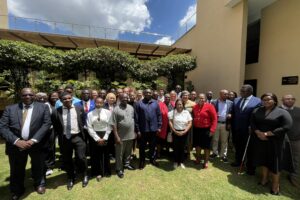
The Government of Bangladesh should withdraw the Foreign Donations Regulation Bill 2015 (FDRB), the ICJ said today.
The provisions of the FDRB are unduly restrictive and inconsistent with Bangladesh’s international legal obligations to respect the right to freedom of association, the ICJ said, and if not withdrawn, the Parliament should reject it.
“The provisions of the Foreign Donations Regulation Bill are clearly designed to restrict and harass human rights defenders in Bangladesh,” Sam Zarifi, ICJ Asia-Pacific director said. “If passed, this law will enable the Bangladeshi executive to control the space for civil society even more than it does now”.
Read the full story here:
Bangladesh-Foreign Donations-News-Web Story-2015-ENG (full text in PDF)

Oct 25, 2015
In a letter to the President of the Socialist Republic, the ICJ today called on Vietnam to immediately halt the execution of 32 year-old Le Van Manh scheduled on 26 October 2015 and to promptly and impartially investigate allegations he was tortured by the police in order to extract a confession.
In 2005, Le Van Manh was charged with the rape and murder of a 13 year-old girl in Thanh Hoa Province.
He confessed to the crimes but later retracted his statement, alleging that he had been severely beaten by the police.
On 25 November 2008, the Supreme People’s Court of Vietnam upheld his convictions and death sentence imposed following a third trial.
He had previously successfully appealed the convictions and sentence imposed following his first two trials arguing errors of fact and violations of his fair trial rights.
“The execution of Le Van Manh would be a denial of the right to life constituting a serious violation of Vietnam’s international legal obligations and must be halted immediately,” said Kingsley Abbott, International Legal Adviser at the ICJ.
“Furthermore, the fact that Le Van Manh’s confession, allegedly obtained by torture, was relied on at trial strongly suggests that the legal process fell far short of international law and standards which, alone, is reason to grant Le Van Manh a permanent reprieve,” he added.
“After halting the execution, Vietnam must carry out a prompt, independent and effective investigation into the allegations of torture. If proven, the perpetrators must be brought to justice and Le Van Manh must be provided remedies and reparation in line with international law and standards,” Abbott further said.
As a State party to both the International Covenant on Civil and Political Rights (ICCPR) and the Convention against Torture (CAT), Vietnam has a duty to protect the right to life; the right to be free from torture and other cruel, inhuman or degrading treatment or punishment; and the right to a fair trial.
Background
Many governments, the United Nations and civil society organizations, including the ICJ, agree that the death penalty constitutes a denial of the right to life and is a form of cruel, inhuman or degrading punishment, and is therefore never justified.
Countries where the death penalty is imposed must ensure, at a minimum, that it is only used in cases of “the most serious crimes” following a trial that meets the highest level of compliance with international law and standards of fairness.
In December 2014, the UN General Assembly adopted a resolution, for the fifth time since 2007, emphasizing that the use of the death penalty undermines human dignity and calling on those countries that maintain the death penalty to establish a moratorium on its use with a view towards its abolition.
Some 117 UN Member States, a wide majority, voted in favor of a worldwide moratorium on executions as a step towards abolition of the death penalty.
The UN Human Rights Committee, the supervisory authority for the ICCPR, has emphasized: “In cases of trials leading to the imposition of the death penalty scrupulous respect of the guarantees of fair trial is particularly important. The imposition of a sentence of death upon conclusion of a trial, in which the provisions of article 14 of the Covenant have not been respected, constitutes a violation of the right to life.”
Article 15 of the CAT places an obligation on States parties to “ensure that any statement which is established to have been made as a result of torture shall not be invoked as evidence in any proceedings, except against a person accused of torture as evidence that the statement was made.”
Contact:
Kingsley Abbott, ICJ International Legal Adviser, (Bangkok), t:+66 944701345, e-mail: kingsley.abbott(a)icj.org
Vietnam-Execution Le Van Manh-Advocacy-open letters-2015-ENG (full text of letter in PDF)

Oct 23, 2015
An opinion piece by Vani Sathisan, ICJ International Legal Adviser in Myanmar.
To say that Facebook and other internet-based social media networks have revolutionized modern day communication would be an understatement.
According to a report by the Human Rights Council’s Special Rapporteur on the promotion and protection of the right to freedom of opinion and expression, the global number of internet users has reached more than two billion.
One million log onto Facebook every month. Twitter claims 500 million users and YouTube is viewed about 4 million times per day.
After ideas expressed online have had an instant “viral” spread, revolutions have unfolded .
And so have the prosecutions.
Judiciaries worldwide have had to struggle with what content is defamatory and what is self-expression.
The US Supreme Court, in Elonis v. United States [2015], considered the case of a defendant who had written, and posted on Facebook, apparently violent rap lyrics, including “I want to kill my wife” while he was undergoing a divorce.
The court had to weigh up whether convicting a man of threatening another person requires proof of subjective intent to threaten or whether it would suffice to show that a “reasonable person” would regard the statement as threatening.
It ruled in favour of the defendant stating that “negligence is not sufficient to support a conviction.” The defendant’s lawyer argued that his client was exercising his First Amendment rights and that governments may not prohibit the expression of an idea simply because certain factions of society find it offensive.
Although freedom of expression is universal and widely accepted in practice, it is not an absolute right and governments may, narrowly and exceptionally impose certain limitations attached to it.
Article 20 of the International Covenant on Civil and Political Rights (ICCPR) bears testament to this by stating that “any advocacy of national, racial or religious hatred that constitutes incitement to discrimination, hostility or violence shall be prohibited by law.”
This is a lot more specific than discriminatory expressions in general and the incitement to “discrimination, hostility or violence” by hate speech is significant for upholding the high threshold it requires.
The International Convention on the Elimination of All Forms of Racial Discrimination, however, goes further and obligates signatories to make “all dissemination of ideas based on racial superiority or hatred” a punishable offense (Article 4(a)).
Myanmar too is struggling with the question of expression that is defamatory, especially in the lead up to its much-anticipated elections. Despite the exponential boom in mobile phone users since SIM cards dropped from $2,000 to $1.50, telecommunications in Myanmar lag behind most developed countries, including its Southeast Asian neighbors.
This has not stopped criminal defamation lawsuits from being filed under the country’s various vague laws on distributing information by electronic technology.
In just under a month, at least two people have been detained without bail under 34(d) of Myanmar’s Electronic Transactions Law and 66(d) of the Telecommunications Law for posting or sharing a post on Facebook, based on complaints lodged by army officials claiming the Myanmar army had been defamed.
If convicted, the accused would be liable for imprisonment of up to five years or a fine or both or imprisonment not exceeding three years or a fine or both, respectively.
The Myanmar’s Electronic Transactions Law is holdover legislation from the former junta, dating back to 2004, signed by General Than Shwe, former junta leader and Chairman of the State Peace and Development Council.
The Deputy Minister for Communications and Information Technology had pledged to repeal parts of the law in 2013, which has been used in the past to imprison activists and political dissidents. That has not happened.
When the run up to the country’s elections has been fraught with severe problems – including inadequate election campaign voter lists, a lack of an independent judiciary and unelected military representatives taking up 25 per cent of the seats in the parliament to preserve a “disciplined democracy”– is it too much to ask prosecutors to exercise their discretion in desisting from moving forward with cases based on weightless Facebook discourse?
Both in terms of justice and effectiveness in law enforcement and fundamental interests of the society, such decisions have far-reaching implications.
Criminal defamation laws that silence free speech online are also incompatible with the right to freedom of opinion and expression and non-compliant with international laws and standards.
The Universal Declaration of Human Rights and the International Covenant of Civil and Political Rights guarantees under Article 19 the right to freedom of expression, which includes the right to impart information.
The UN Human Rights Committee, in expressing its concern at the misuse of defamation laws to criminalize freedom of expression, has clarified that imprisonment is never an appropriate penalty for defamation.
In its General Comment on the issue, the Committee states that, “in circumstances of public debate concerning public figures in the political domain and public institutions, the value placed by the Covenant upon uninhibited expression is particularly high.
Thus the mere fact that forms of expression are considered to be insulting to a public figure is not sufficient to justify the imposition of penalties… all public figures, including those exercising the highest political authority such as heads of state and government, are legitimately subject to criticism and political opposition.”
The United Nations Special Rapporteur on freedom of opinion and expression has also reiterated that justifying any limitation on the freedom of expression on the basis of protecting other rights or reputation of others must not be used to protect the State and its officials from public opinion or criticism.
Other international human rights bodies and an increasing number of governments agree that criminal defamation laws must be abolished.
Criminal penalties are a disproportionate means to protect against reputational harm and pose an impermissibly severe impediment to the exercise of free expression.
The Myanmar government should act to ensure that electoral debates can take place in a constructive and respectful space, and that all people and organizations engaged in the protection and promotion of human rights are able to continue their work safely.
If not, then what Sean Turnell, an expert on Myanmar’s economy reportedly said about the Myanmar government eventually increasing its monitoring of cell networks will almost certainly prove true: Technology’s ability to democratize Myanmar has been “overrated.”
Oct 6, 2015 | News
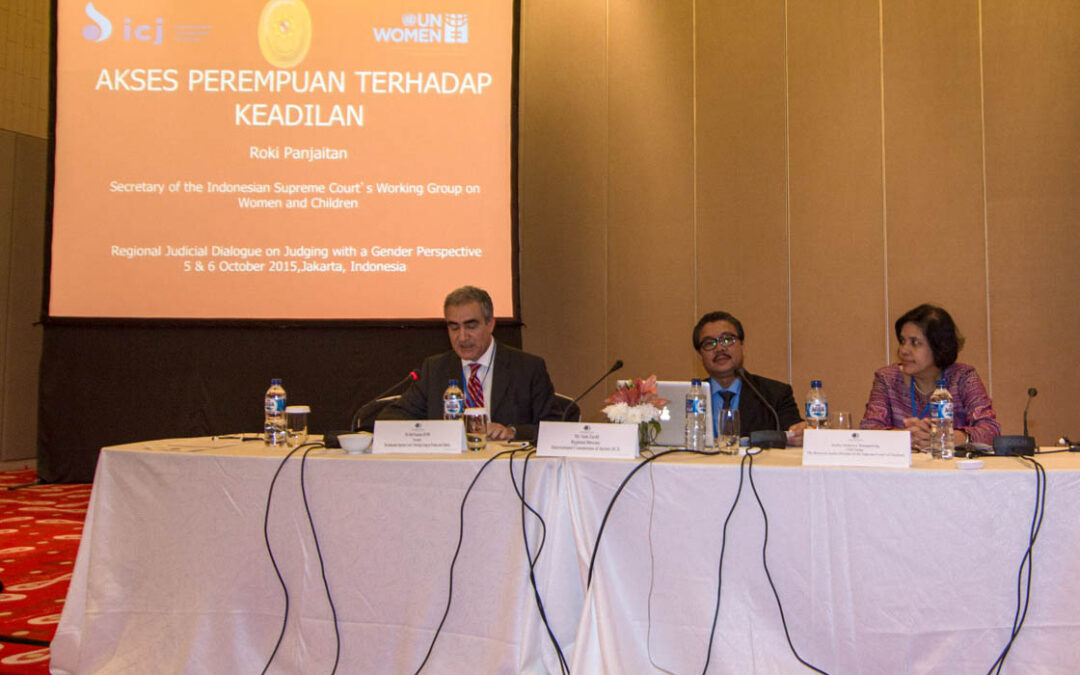
Judges and representatives of judicial training institutions from 9 countries across Southeast Asia gathered in Jakarta, Indonesia, to discuss how judicial decision-making can be further strengthened from a gender perspective.
A two-day event (5-6 October 2015), this judicial dialogue, entitled Regional Judicial Dialogue on Judging with a Gender Perspective, was organized by the ICJ, in collaboration with the Supreme Court of Indonesia and UN Women.
Participants discussed key topics such as initiatives of various courts in Southeast Asia that promote and protect women’s human rights, what are gender stereotypes and how gender stereotyping could be avoided in judicial decisions.
Speakers from the Supreme Court of Mexico were invited to speak about the initiative taken by the judiciary in the country to establish a protocol on judging with a gender perspective.
Senior judges from courts in Southeast Asian countries attended the event: Justice Dr. Takdir Rahmadi of the Supreme Court of Indonesia, Justice Suntariya Muanpawong, Chief Judge of the Research Division of the Supreme Court of Thailand; Justice Teresita De Castro of the Supreme Court of the Philippines, Justice Maria Natercia Gusmao Pereira of the Court of Appeal of Timor Leste; and Ms. Natalia Calero Sanches and Ms. Macarena Saez of the Mexican Supreme Court.
This dialogue is aimed at strengthening the participants’ ability to make decisions based on the rights to equality and freedom from discrimination.
UN Women also launched an online interactive platform that seeks to enhance dialogue among judges, prosecutors, court personnel, judicial training institutions, women’s machineries, scholars and other experts in the region.
The platform called, “Equality for All: community of change makers”, will enable users to access tools such as e-discussion forums, blogs and quick fact sheets that offer tailored learning solutions.
Oct 1, 2015 | News
The ICJ today welcomed the adoption by the UN Human Rights Council of a further resolution on promoting reconciliation, accountability and human rights in Sri Lanka.
The resolution, co-sponsored for the first time by the Government of Sri Lanka (GOSL), is a historic step towards post-war justice, accountability and reconciliation.
The ICJ at the same time called on the GOSL to take genuine and prompt steps to deliver on the commitments and obligations reflected in the resolution, which was adopted by the UN Human Rights Council by consensus.
“Today’s resolution is a significant step towards achieving justice, accountability and reconciliation for the victims of Sri Lanka’s long and bloody civil war,” said Nikhil Narayan, ICJ’s senior legal adviser for South Asia.
“The shift in posture of the Sri Lankan Government in co-sponsoring the resolution marks a further welcome break from the Rajapakse regime. The Government must now demonstrate its political will by immediately launching concrete steps towards a genuine process of truth-seeking, justice and reconciliation,” he added.
The consensus resolution reflects certain key recommendations contained in the Report of the office of the UN High Commissioner for Human Rights (OHCHR) summarizing findings of the OHCHR Investigation on Sri Lanka (OISL), the ICJ notes.
The investigation and report was mandated by an earlier UN resolution on Sri Lanka, adopted in March 2014 over the strong objections of the Rajapakse government.
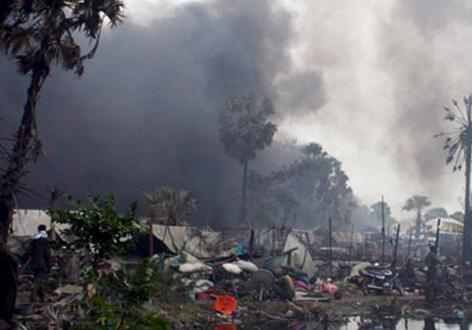
The report documents in vivid detail alleged serious violations and abuses of human rights and humanitarian law amounting to war crimes and crimes against humanity committed by both sides during the armed conflict in Sri Lanka, including extrajudicial killings, torture, enforced disappearances, forced recruitment, including of children, and sexual violence.
One of the most important recommendations of the High Commissioner for Human Rights called for an accountability process through a special judicial mechanism and prosecutor’s office that involves the full participation of international judges, prosecutors, lawyers and investigators.
Responding in part to this call, the resolution affirms the importance of participation of foreign judges, defence lawyers, prosecutors and investigators in an independent and impartial judicial mechanism to hold individuals accountable for human rights and humanitarian law violations, including those documented in the report.
The resolution also mandates further monitoring and reporting back to the Council on implementation of the accountability and other measures.
“The international community, through the UN Human Rights Council, the Office of the High Commissioner for Human Rights and Special Procedures, and other UN member states, must as the High Commissioner himself recommended, remain engaged through continued and sustained monitoring, assistance, support and fully integrated involvement of the international community to ensure full implementation of the resolution,” said Narayan.
Background:
The ICJ has worked with judiciaries, governments, civil society and victims around the world for decades to address impunity and victims’ right to remedy for violations of international human rights and humanitarian law, including in situations of transition.
In Sri Lanka, the ICJ has been documenting and reporting on a gradual erosion of judicial independence, impartiality and integrity under successive governments, and the resulting culture of impunity, for over thirty years.
The ICJ considers the International Criminal Court (ICC) to be the preferred mechanism for individual accountability where national authorities and courts lack the capacity or the willingness to genuinely investigate and prosecute all war crimes and crimes against humanity. In the absence of an ICC process, the ICJ’s extensive experience in Sri Lanka and elsewhere demonstrates that any credible and effective accountability process in Sri Lanka must involve, at a minimum, a majority of international judges, prosecutors and investigators.
The ICJ therefore advocated for and welcomed the resolution’s recognition of the need for international participation.
Since January 2015, when a new president was elected, the GOSL has undertaken a number of important steps to reverse the slide towards authoritarianism and the erosion of the rule of law and the culture of impunity experienced under the Rajapakse government, and restore democratic governance and build confidence towards reconciliation among Sri Lanka’s ethnic minorities, including by restoring the Constitutional Council through the passage of the 19th amendment to the Sri Lankan Constitution, and returning some tracts of military-occupied lands in the North and East.
However, after decades of war and distrust, and a history of promises undelivered, much work remains to be done to deliver justice to victims and their families, and to rebuild trust and confidence among Sri Lanka’s fractured ethnic minorities. Continued and sustained monitoring and engagement by the international community in ensuring the progress of the implementation of this resolution will be essential.
Equally importantly, today’s consensus resolution also reaffirmed the OHCHR’s recommendations on: the mandate and resources of the accountability mechanisms; legislating retroactive recognition of international crimes under national law; justice and security sector reform; repealing the Prevention of Terrorism Act (PTA); strengthening the Witness and Victim Protection Act; accession to the International Convention on the Protection of All Persons from Enforced Disappearances (CED), the Additional Protocols to the Geneva Convention, and the Rome Statute of the International Criminal Court; and continued monitoring of and technical support for implementation through the OHCHR and by the Council.
Contact
Nikhil Narayan, ICJ’s senior legal adviser for South Asia; t: +41 79 730 09 27; e: nikhil.narayan(a)icj.org