Oct 27, 2023 | News
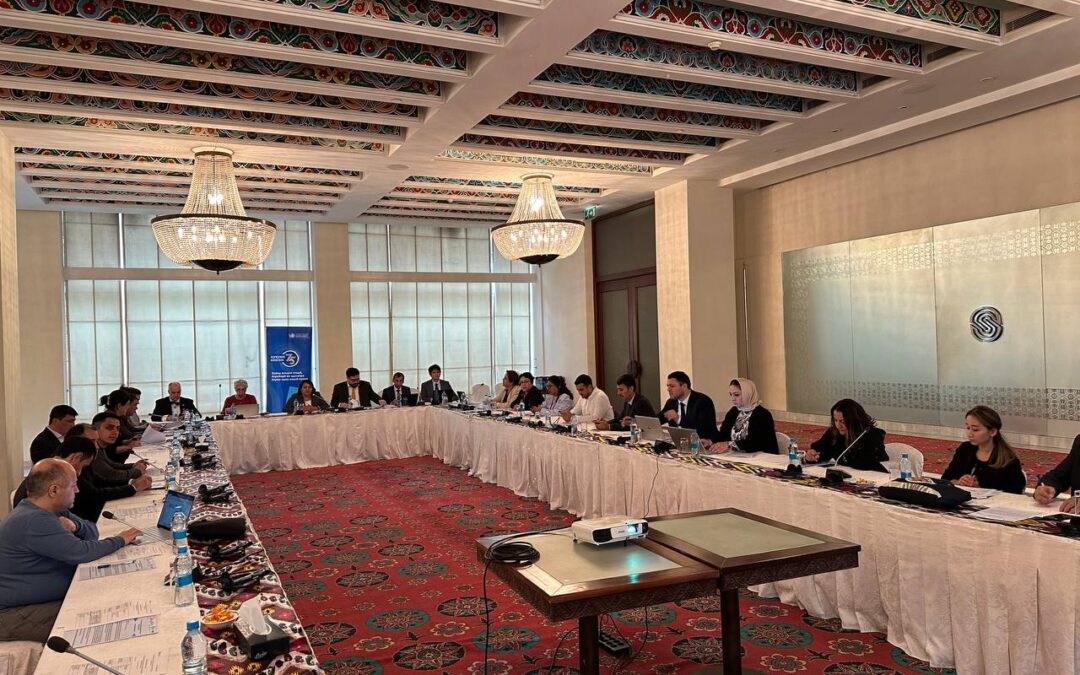
Today, the International Commission of Jurists (ICJ), in collaboration with the Supreme Court of the Republic of Tajikistan the Office of the High Commission of Human Rights (OHCHR) Regional Office for Central Asia (ROCA), and the Organization for Security and Cooperation in Europe (OSCE)in Dushanbe, has convened a round to discuss the application of international law by national courts. The event aimed to enhance the capacity of the judiciary to apply international standards in Tajikistan.
The discussions at the round table were focused on international human rights mechanisms and instruments, the binding nature of international treaties, and the current use of international law in Tajik courts. The participants examined these standards in relation to Tajikistan’s international treaty obligations, with the objective of improving the judiciary’s ability to effectively apply international jurisprudence and principles.
The event provided a platform for participants to discuss the practical implementation of international legal norms in the adjudication process in other national contexts and to share strategies to address the challenges of such integration. The round table also facilitated a critical analysis of the reforms necessary for effective use of international standards in national legal procedures.
The event addressed the broader implications of applying international law, considering its impact on the rule of law and public trust in the justice system. There was a clear consensus on the need to draft recommendations that could guide the judiciary in applying international law.
The round table discussions were notably informed by a recent ICJ report calling for comprehensive judicial reform in Tajikistan. Published in December 2020, the report titled “Neither Check nor Balance: the Judiciary in Tajikistan,” provided an in-depth analysis of the organisation and functioning of the judiciary in Tajikistan and its capacity to administer justice and uphold human rights.
The ICJ report’s conclusion that acquittals in criminal trials are exceedingly rare underscored a systemic failure to ensure judicial independence, thereby highlighting the urgency of the reform. It was recognized that for Tajikistan to fulfil its international legal obligations and to provide effective remedies for human rights violations, reforms must be initiated and practically implemented to safeguard against practices that undermine the independence of the judiciary.
Attachment: Briefing paper on RT for judges on Oct 27 2023 in Dushanbe
Oct 16, 2023 | News
The International Commission of Jurists (ICJ) condemns the arbitrary detention and criminal prosecution of three lawyers who had been defending the prominent opposition figure, Alexei Navalny.
“These criminal proceedings, constituting persecution of lawyers, severely compromise the administration of justice in Russia and undermine the ability of all lawyers to defend their clients’ human rights and uphold the rule of law”, said Temur Shakirov, interim Director of ICJ Europe and Central Asia Programme.
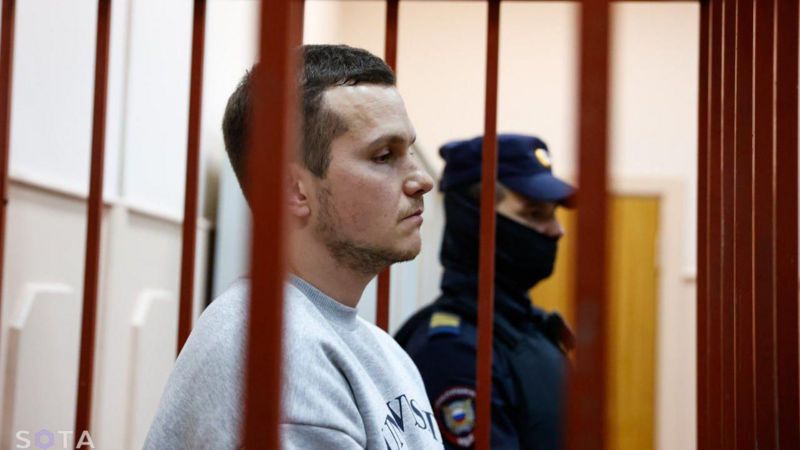
On 13 October 2023, Vadim Kobzev, Alexey Liptser and Igor Sergunin – who had been acting as Navalny’s defence lawyers — were arrested and detained at Basmanny District Court in Moscow on charges of purportedly participating in an “extremist community”, with a potential sentence of up to six years’ imprisonment if convicted. As such, the criminal proceedings against Vadim Kobzev, Alexey Liptser and Igor Sergunin amount to persecution.
The charges are reportedly based on accusations that the three lawyers facilitated Navalny’s communication with the outside world while in detention.
Moreover, another lawyer representing Navalny, Alexander Fedulov, apparently fearing being arrested, was forced to flee the country following the arrest of his three colleagues.
The arrest and detention of the three lawyers and Fedulov’s flight significantly disrupt Navalny’s ability to defend himself through the assistance of qualified, independent legal counsel of choice, and his ability to challenge the criminal convictions and sentences, which led to his detention since 2022 as a result of a series of criminal cases against him widely believed to be politically motivated.
“The detention of Navalny’s lawyers is likely to constitute part of a wider strategy to isolate him even further. Moreover, it sends a chilling message to anyone wishing to defend human rights and political activism”, said Shakirov. “This is contrary to the right of lawyers to practise their profession freely, and it denies Navalny his right to legal representation, a fair trial guarantee protected under international human rights law binding on the Russian Federation”.
The ICJ stresses that the harassment and arbitrary detention of lawyers contravene the Russian Federation’s obligations under international law, including under the International Covenant on Civil and Political Rights and the UN Basic Principles on the Role of Lawyers. They affirm the crucial role of lawyers in upholding the rule of law and protecting human rights. It is crucial to ensure that lawyers can perform their legitimate professional functions without intimidation, hindrance, harassment, or improper interference, as guaranteed under the Basic Principle on the Role of Lawyers.
“The ICJ calls on the Russian Federation: to immediately stop this flagrant violation of the guarantees afforded to lawyers under international human rights law; for an end to these persecutory criminal proceedings; for all charges against Vadim Kobzev, Alexey Liptser and Igor Sergunin to be dropped; and for them to be immediately released”, added Shakirov.
Furthermore, the ICJ urges the Russian authorities to cease the persecution and harassment of lawyers and to take steps to ensure a safe environment where lawyers can operate without fear of reprisal for their work.
Background:
According to the UN Basic Principles on the Role of Lawyers, governments must ensure that lawyers are able to perform all of their professional functions without intimidation, hindrance, harassment or improper interference and must not face sanctions for discharging their duties in accordance with professional standards and ethics (Principle 16). Furthermore, lawyers must not be identified with their clients or their clients’ causes as a result of discharging their functions. (Principle 18).
The UN Basic Principles also specify that lawyers like others have a right to freedom of expression and in particular the right to take part in public discussion of matters concerning the law, the administration of justice and the promotion and protection of human rights” (Principle 23)
The arrest of the three lawyers has prompted a call for a strike within the Russian legal community to demonstrate against the hostile environment within which lawyers in the Russian Federation operate, particularly those defending human rights and representing political activists.
Oct 10, 2023 | News
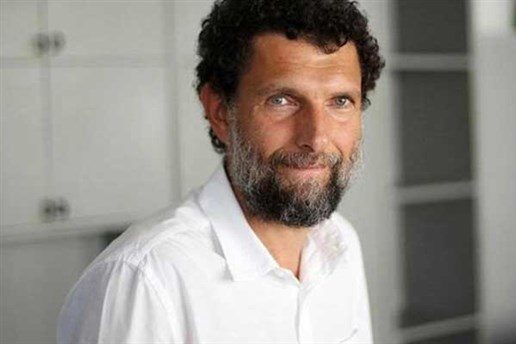
The prosecution of the rights defender and businessman Osman Kavala and four codefendants in connection with mass protests a decade ago has been unfair and essentially a political show trial from the beginning, a group of nine non-governmental organizations including the International Commission of Jurists (ICJ) said today, ahead of an October 12 urgent debate calling for Kavala’s release at the Parliamentary Assembly of the Council of Europe. The five have been punished for the legitimate exercise of their rights to freedom of expression, association and peaceful assembly.
On September 28, 2023, Turkey’s Court of Cassation, its top appeals court, upheld the convictions, notwithstanding that the European Court of Human Rights has previously found no basis for detention or trial, and ordered Kavala’s immediate release.
“By ignoring these judgments and Turkey’s human rights obligations, the Court of Cassation is doubling down on the deep injustice of this case that dramatically demonstrates how far Turkey has deviated from the rule of law,” said Helen Duffy of the Turkey Human Rights Litigation Support Project. “The trial has not only led to grave violations of the rights of Kavala and the others, but it provided a chilling example of how Turkey’s justice system has become a tool of political repression.”
Although President Recep Tayyip Erdogan and Turkish government officials repeatedly state that Turkish courts are independent, the trial of Kavala and his codefendants exposes those claims for the falsehood they are, and demonstrates how in key cases of interest to the president, prosecutors and courts blatantly do his bidding.
Kavala was sentenced to life in prison without parole, convicted of attempting to overthrow the government on false allegations that he organized and financed the 2013 Istanbul Gezi Park protests against a government urban development project. Four codefendants – Çiğdem Mater, Can Atalay, Mine Özerden and Tayfun Kahraman – received 18-year sentences for allegedly aiding Kavala, while the court quashed the 18-year sentences of Mücella Yapıcı, Hakan Altınay and Yiğit Ekmekçi, and ordered Yapıcı and Altınay’s release pending retrial.
“This trial cynically opened six years after the Gezi Park protests with the malevolent intent of casting them as the outcome of a grand conspiracy by one man, Osman Kavala,” said Hugh Williamson, Europe and Central Asia director at Human Rights Watch. “To achieve this the prosecution and the courts blatantly had to ignore all the evidence of spontaneous mass protests in which the vast majority of protesters committed no violence and exercised their lawful rights to freedom of expression and assembly.”
The Court of Cassation’s 78-page verdict simply reiterates the prosecution’s allegations in the February 2019 indictment, though the European Court of Human Rights ruled twice that the indictment offered insufficient evidence to justify Kavala’s detention, prosecution or conviction, and by inference, the other defendants’.
Notably, in a striking rebuke to the European Court of Human Rights, Council of Europe, and Turkey’s human rights obligations, the Court of Cassation makes no reference to the repeated findings against Turkey in this case. In December 2019, the European Court ordered Kavala’s immediate release, and in February 2022, the Committee of Ministers of the Council of Europe, the body responsible for overseeing implementation of European Court judgments, took the almost unprecedented step of triggering infringement proceedings against Turkey for its refusal to comply.
This led to a second European Court of Human Rights judgment condemning Turkey’s failure to carry out the first, and the failure of the Turkish court convicting Kavala and others on April 25, 2022, to recognize the European Court of Human Rights’ judgment. The Court of Cassation decision doubled down on that rejection of the European Court’s role, with no mention of that judgment.
Turkey’s European and international allies, both unilaterally and through intergovernmental organizations, including the Council of Europe, the European Union, and the United Nations, should address this injustice as a matter of urgency. They should treat the case as a priority human rights matter in their mutual relations with Turkey, and push for the swift and full implementation of the European Court’s’ judgments, including for the defendants’ immediate release.
They should firmly condemn the abuse of criminal law against activists, human rights defenders, journalists and others in politically motivated cases. Robust efforts are essential to ensure that Turkey respects and abides by its human rights obligations and rule of law principles, which are currently being flouted with impunity.
In turning a blind eye to the Strasbourg court’s rulings, the Court of Cassation is also ignoring its constitutional obligation to ensure that Turkey adheres to binding decisions of the European Court, which take precedence over rulings in Turkey’s domestic courts.
“In direct contravention of its legal obligations under international law, the Court of Cassation has chosen to maintain convictions despite the European Court of Human Rights judgment ordering Kavala’s immediate release,” said Temur Shakirov, ICJ Europe and Central Asia Director (ad interim). “By failing to adhere to its obligations, the Court of Cassation sets a precedent, eroding confidence in the legal system’s ability to act as an independent and impartial institution, separate from political influence and committed to upholding human rights and the rule of law.”
The Court’s Flawed Reasoning
In its September 29 decision, the Court of Cassation relies on a chronology of events from the February 2019 indictment that the prosecution argues constituted the preparation for the Gezi protests. This included making a short video with a group of actors in 2011 called “Rise up Istanbul,” production of a play in Istanbul about a dictator, which ran from 2012-13, and the 2012 establishment of the civil society platform, Taksim Solidarity, focused on the highly contested plan to develop Taksim Square and Gezi Park. The court fails to show any causality between these lawful activities and any crime or to provide any evidence that these activities showed that Kavala and the other defendants were involved in a conspiracy.
The court decision makes reference to the protests and popular uprisings in various Middle Eastern countries that predated the Gezi protests and came to be known as the Arab Spring, and nonviolent civil disobedience movements such as OTPOR in Serbia a decade earlier, without showing their relevance to the case.
The decision names civil society organizations and alleges they “supported and directed” the Gezi Park protests without providing any credible evidence. Chief among them are the Open Society Foundations, set up by the US financer and philanthropist George Soros, and the affiliated but independent (and now dissolved) philanthropic foundation in Turkey (Açık Toplum Vakfı). Kavala was a founding member of the group, and Altınay served for a period well before the Gezi Park protests as director of the board.
The court repeats a conspiracy theory, informed by antisemitic tropes, from the original indictment that Soros’s organizations aimed to overthrow governments in various countries by encouraging uprisings, and that the Turkish Open Society Foundation and Kavala were involved in this process under the guise of innocent-looking philanthropic activities.
Kavala’s own civil society group, Anadolu Kültür A.Ş., which supports the arts, was also named. The other defendants were linked to Kavala through their participation in that organization: film producer Çiğdem Mater, employed as an advisor, Mine Özerden, a member of the board, and Yiğit Ekmekçi, deputy head of the board. Taksim Solidarity is named as the group in which three defendants – lawyer Can Atalay, city planner Tayfun Kahraman and architect Mücella Yapıcı – participated actively.
The Court of Cassation endorses the indictment’s inclusion of Kavala’s contacts with bodies such as the European Commission, members of the European Parliament, diplomats, diplomatic missions and international human rights groups, as evidence of alleged efforts to influence international opinion against the Turkish government.
A section on the alleged protest financing cites the Open Society Foundations’ funding of the Turkish Open Society and Anadolu Kültür, but it omits that a formal investigation into the funding cited in the indictment (the MASAK report) found no evidence of unaccounted for money transfers. Instead, the court relies on examples drawn from wiretapped conversations, of Kavala once bringing people camped in the park a few bread rolls, talking about obtaining a plastic table for use in the park, and where to buy masks and goggles to protect from police tear gas.
The court decision also allows as admissible evidence a mass of random wiretapped conversations between the defendants and others that were illegally obtained. Far from revealing any criminal activity, the conversations show that the defendants were lawfully engaged in civil society organizations and nonviolent activism, and were exercising their rights to free speech, association, and assembly. Such activities are strictly protected under international law, including treaties to which Turkey is a party such as the European Convention of Human Rights and the International Covenant on Civil and Political Rights, as well as in Turkey’s own laws.
The decision rejects parliamentary immunity from prosecution for one of the defendants, Atalay, a lawyer and activist who won a seat in the May 2023 parliamentary elections on behalf of the Workers’ Party of Turkey. The Court of Cassation decided that he was not protected by parliamentary immunity under article 83 of Turkey’s Constitution in relation to this case confirming its own July 13 decision on the matter, and upheld his conviction. In reaching this conclusion, the Court of Cassation rejects the case law of the Constitutional Court, given under identical conditions, in judgments related to other jailed parliament members, Ömer Faruk Gergerlioğlu and Leyla Güven, which held that they do have immunity and that arresting, prosecuting, and detaining them constitute very serious violations of that immunity.
The nongovernmental organizations who signed the statement are:
- Amnesty International
- ARTICLE 19
- Human Rights Watch
- European Democratic Lawyers (AED)
- European Lawyers for Democracy and Human Rights (ELDH)
- International Commission of Jurists
- International Federation for Human Rights (FIDH)
- PEN International
- Turkey Human Rights Litigation Support Project.

Oct 9, 2023 | Access to justice, Advocacy, Cases, News
Today, the International Commission of Jurists (ICJ), the AIRE Centre (Advice on Individual Rights in Europe), the Dutch Council for Refugees (DCR), and the European Council on Refugees and Exiles (ECRE), submitted a third-party intervention to the European Court of Human Rights in the case S.M.H. v Lithuania, concerning the deprivation of liberty of an asylum seeker.
S.M.H., an Iraqi citizen, who entered Lithuania irregularly and sought asylum, was subsequently arrested and detained in various centres. The applicant claimed that his detention was not justified, lacking both individualised assessment and effective legal assistance.
In its intervention, the ICJ and its partners focus on Article 5.1 and Article 5.4 of the European Convention of Human Rights (ECHR). In particular, the interveners analyse the requirements for lawful deprivation of liberty, the right to have the lawfulness of detention promptly examined by a Court, and the right to have effective legal assistance. The intervention considers both the EU and international law and standards related to deprivation of liberty and the right to an effective remedy against unlawful detention and material conditions of detention.
The key points of the intervention are as follows:
- The interveners submit that under Article 5.1 detention must not be arbitrary, and be prescribed by law both substantively and procedurally. The intervention highlights that detention must be a measure of last resort, it should follow an individualised and exhaustive examination, and it may be imposed only when less strict measures cannot be effectively applied.
- Regarding Article 5.4, the interveners clarify that an effective judicial review of detention prescribed by law and accessible in practice constitutes a safeguard against arbitrary detention. Legal aid and competent legal representation are essential elements in ensuring the accessibility and effectiveness of judicial review of the lawfulness of detention.
- Finally, the interveners stress that lack of access to clear information, lack of access to a lawyer, and lack of access to an effective remedy contravene the guarantees under Articles 3 and 13 ECHR, rendering them ineffective, theoretical, and illusory.
Read the full intervention here.

Oct 6, 2023 | Cases, Uncategorized
The International Commission of Jurists (ICJ), together with the AIRE Centre (Advice on Individual Rights in Europe), the Dutch Council for Refugees and the European Council on Refugees and Exiles (ECRE) submitted today a third party intervention in the Communicated case No. 193/2022, before the UN Committee on the Rights of the Child.
The case concerns immigration detention of an 11-year-old girl from Afghanistan together with her older sister and parents, pending transfer to another EU Member State according to the EU Dublin Regulation.
The interveners focus in their submission on the prohibition of immigration detention of children, including when accompanied by family members, the right to be heard, access to information and legal representation and age assessment in the migration context.
The full intervention can be read here.