Mar 22, 2018 | Articles, Multimédia, Nouvelles
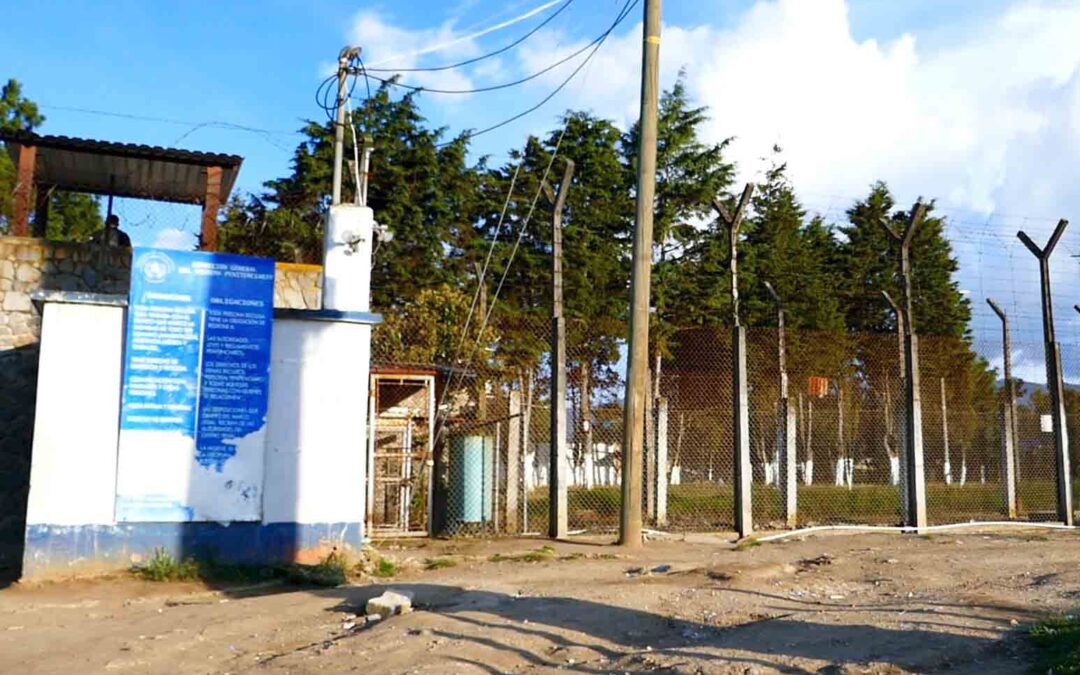
Des leaders communautaires a ont été accusés d’actions criminelles présumées et, dans certains cas, arbitrairement détenus pour avoir chercher à protéger leurs terres et leurs ressources naturelles des impacts négatifs liés à des projets industriels et à leurs infrastructures.
Une telle réponse est destinée à faire taire les voix dissidentes et leurs demandes légitimes de consentement libre, préalable et informé à l’installation de ces projets et infrastructures sur les terres des communautés indigènes.
Cette vidéo comprend des interviews de Ramón Cadena, directeur de la CIJ pour l’Amérique centrale, de deux dirigeants indigènes traditionnels qui ont été victimes de détention arbitraire, et d’une responsable communautaire qui explique l’impact de la détention sur la famille et toute la communauté.
La criminalisation du travail lié aux droits de l’Homme est un phénomène qui conduit à accuser pénalement des dirigeants communautaires simplement parce qu’ils s’opposent à un modèle de développement basé sur les industries extractives ou la privatisation de services sociaux essentiels.
Ce type de développement porte atteinte aux ressources naturelles (eau, sols et environnement) des territoires indigènes.
C’est un phénomène global mais particulièrement marqué au Guatemala.
L’exploitation de ressources naturelles, par le biais de mines à ciel ouvert et des autres opérations extractives industrielles sur les territoires autochtones, est l’une des principales raisons de la répression des protestations sociales et du travail des droits de l’Homme.
Du fait de l’impact environnemental de ce type d’exploitation, les différentes communautés s’y opposent et un certain nombre de dirigeants ont payé de leur vie cette opposition.
Lorsque des membres de leurs familles ont continuer à contester ces projets industriels, ils ont à leur tour été accusés d’infractions pénales.
Au Guatemala, il y a aussi un conflit social intense en raison de la manière dont sont gérés le réseau et l’approvisionnement électriques.
Suite à la privatisation du service d’électricité en 1966, l’Etat guatémaltèque a accordé des concessions à des entreprises nationales et internationales.
Au fil du temps, de nombreux utilisateurs se sont plaints de la piètre qualité et du coût élevé des services fournis par ces entreprises privées.
La Commission nationale de l’électricité n’a pas respecté son devoir de « s’assurer que les obligations des concessionnaires et des entrepreneurs soient remplies et les droits des utilisateurs protégés », ce que de nombreux utilisateurs mécontents ont exigé.
A cause de cette situation, de nombreux consommateurs se sont déclarés être en résistance, citant l’article 45 de la Constitution guatémaltèque stipulant qu’ «il est légitime que la population résiste pour protéger et défendre ses droits et ses garanties inscrites dans la constitution».
Pour avoir agi sur la base de cette protection constitutionnelle de nombreux dirigeants communautaires, des avocats et des défenseurs des droits de l’Homme ont été victimes d’attaques.
La CIJ soutient l’accès à la justice pour les personnes victimes de ces violations des droits de l’Homme.
Elle soutient les avocats qui défendent les victimes de la criminalisation des contestations sociales ; elle observe les procès des cas emblématiques ; elle promeut le dialogue entre les communautés et les autorités étatiques concernées ainsi qu’avec les maires locaux ; et dans certains cas, elle appuie les soumissions devant la Cour constitutionnelle.
Voir la vidéo:
Mar 22, 2018 | Advocacy, Non-legal submissions
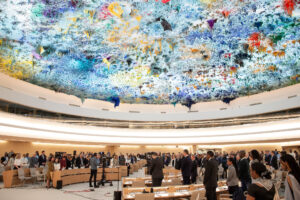
The ICJ today highlighted at the UN the need for further action to address impunity in Sri Lanka and in Colombia.
The statement, delivered in a general debate at the UN Human Rights Council, responded to UN reports on Sri Lanka and Colombia, and read as follows:
Sri Lanka has not made sufficient progress on its commitments and obligations as reflected in Council resolution 30/1. Among the mechanisms contemplated, only the Office on Missing Persons (OMP) is operational. The process for establishing the other mechanisms, and the extent to which their composition will be based on the broad national public consultations carried out in 2016, remains unclear. The ICJ reiterates that, in line with operative paragraph 6 of resolution 30/1, the accountability mechanism cannot be seen as credible without involvement of international judges, prosecutors and investigators.
Furthermore, despite promises to repeal the Prevention of Terrorism Act (PTA), arrests still take place. As the High Commissioner recommended, the PTA should be promptly repealed without waiting for replacement legislation. Any proposed counterterrorism law must comply with international human rights standards.
In Colombia, the ICJ shares OHCHR’s deep concern about the exclusion of non-military State agents and private individuals from the scope of mandatory application of the Integrated System of Justice, Truth, Reparations and Guarantees of Non-repetition (per paragraph 90 of the Report). Furthermore, four months of unjustified delay by the Government in accrediting the new representative of the OHCHR Office, which ended only yesterday, undermined the ability of the Office to provide adequate technical assistance to guarantee victims’ rights in the Integrated System, as provided for by the Peace Agreement.”
[Paragraph 6 of Human Rights Council resolution 30/1 provides that the Council, “Welcomes the recognition by the Government of Sri Lanka that accountability is essential to uphold the rule of law and to build confidence in the people of all communities of Sri Lanka in the justice system, notes with appreciation the proposal of the Government of Sri Lanka to establish a judicial mechanism with a special counsel to investigate allegations of violations and abuses of human rights and violations of international humanitarian law, as applicable; affirms that a credible justice process should include independent judicial and prosecutorial institutions led by individuals known for their integrity and impartiality; and also affirms in this regard the importance of participation in a Sri Lankan judicial mechanism, including the special counsel’s office, of Commonwealth and other foreign judges, defence lawyers and authorized prosecutors and investigators;”]
Mar 22, 2018 | News
The ICJ has been awarded a grant from the Royal Norwegian Embassy in Mexico to continue its work in the area of independence of the judiciary in Guatemala.
This initiative titled “Strengthening the rule of law in Guatemala, Phase II” aims to strengthen domestic compliance with, and implementation of, international standards providing for judicial independence through the training of judges, raising awareness on this topic, as well as providing support to judges at risk.
The ICJ will be working together with the Mayan Association of Lawyers and Notaires of Guatemala as a partner in this action, through a sub grant of 1,622,801 NOK.
Guatemala-Grant Agreement with Norway-2018-ENG (full grant agreement, in PDF)
Mar 20, 2018 | Advocacy, Non-legal submissions
The ICJ today joined other NGOs in condemning and calling for proper investigation of the killing of human rights defender Marielle Franco in Brazil, at the Human Rights Council.
The statement read as follows:
“Protection of human rights defenders is key to the implementation of the Vienna Declaration on Human Rights.
City councilwoman Marielle Franco and Anderson Gomes were brutally killed on 14 March in Rio de Janeiro, Brazil. Her mandate focused on structural racism and police violence suffered by the poor, black and young in favelas, and on the empowering black women and the LGBTI community.
She was appointed as parliamentary rapporteur to oversee the abuses of the highly militarized federal intervention in Rio, decreed by the President, against the will of the community, and under concerns by the High Commissioner.
Many who speak truth to power in Brazil are facing unprecedented violence and stigmatization, as the country ranks at the top in defenders’ deaths. The defenders’ protection program remains underfunded and understaffed.
Marielle’s strength, engagement and sorority serve as a source of inspiration for the work on the promotion and protection of the rights of the most marginalized groups.
We urge Brazil to ensure a prompt, impartial and independent investigation, bringing those responsible to justice, by seriously exploring the hypothesis on an extrajudicial execution, and to provide effective protection to the survivors of this attack.”
The full statement together with a list of the organisations joining it, may be downloaded here: UN-HRC37-JointStatement-GD8-Brazil-2018
Mar 15, 2018 | Noticias
La CIJ preparó una declaración en las Naciones Unidas sobre la situación de los derechos humanos en Guatemala.
Debía hacerse durante la discusión en el Consejo de Derechos Humanos del resultado del Examen Periódico Universal para Guatemala, sin embargo, la Comisión Internacional de Juristas no pudo leer la declaración debido al tiempo limitado para las declaraciones de las ONG. La declaración contiene lo siguiente:
“Honorables miembros del Concejo de Derechos Humanos:
El Estado de Derecho en Guatemala está siendo socavado por las propias autoridades. Tal y como lo ha señalado la Comisión Internacional Contra la Impunidad de Guatemala (CICIG), el Estado se encuentra capturado por el crimen organizado. Desde que el Presidente de la Repuública Jimmy Morales declaró como “persona non grata” al Comisionado de la CICIG Abogado Iván Velásquez en agosto de 2017, los tres poderes del Estado de Guatemala tienen un objetivo comuún: recuperar el terreno perdido, por las acciones contundentes que la CICIG ha implementado contra la impunidad y la corrupción.
Preocupa sobre manera que el Organismo Legislativo esté tratando de aprobar una legislacion regresiva en materia de derechos humanos. En lo que respecta al Poder Judicial, la CICIG ha impulsado un proceso de depuración por la vía judicial y aquellos jueces que promueven más impunidad, se resisten a ser investigados protegiéndose en la figura del antejuicio.
En este contexto, se está llevando a cabo el proceso de elección del próximo Fiscal General. El Presidente de la República tendrá que elegir de una lista de seis candidatos. Urge que el Consejo de Derechos Humanos inste al Presidente de la República a elegir a una persona honesta y que esté comprometida con el respeto de los derechos humanos. La CIJ lamenta que algunos candidatos o candidatas participen para consolidar “el pacto de corruptos” en marcha.
Finalmente, es necesario que el Consejo de Derechos Humanos demande a los tres Poderes del Estado, apoyar decididamente los actos que el Comisionado Iván Velásquez lleva a cabo en Guatemala y el trabajo de las Instituciones Nacionales de Derechos Humanos, así como respetar y atender la gestión positiva que viene realizando el Procurador de los Derechos Humanos Abogado Jordán Rodas.”