Dec 21, 2023 | News
On 18 December 2023, the International Commission of Jurists (ICJ) filed a submission to the Human Rights Committee (the Committee) on Tunisia’s implementation of the Committee’s 2020 concluding observations regarding the Constitutional Court and the use of counter-terrorism provisions in the context of the Committee’s follow-up procedure.
“Since July 2021, President Kais Said has systematically eroded all checks on his authority, including by curtailing the powers of the Constitutional Court under the 2022 Constitution and by instigating arbitrary prosecutions against those suspected of opposing his rule , including judges, journalists, human rights defenders, and political opponents,” said Said Benarbia, ICJ MENA director. “The Tunisian authorities must abide by their obligations under international law, immediately reinstate a democratic constitutional order, and end the use of the criminal process and counter-terrorism measures to crackdown on dissent and free speech.”
In April 2022, pursuant to the Committees’ request to the State party to provide follow-up information on the implementation of its recommendations regarding the Constitutional Court, the state of emergency and counter-terrorism, and freedom of peaceful assembly and excessive use of force by the State’s agents, Tunisia submitted further information regarding its obligations under the International Covenant on Civil and Political Rights (ICCPR) as they pertain to the above-mentioned concerns. During the Committee’s 140th session between 4 and 28 March 2024, this information, and Tunisia’s implementation of the Committee’s recommendations on the same, will be reviewed.
The ICJ’s submission to the Committee highlights a number of ongoing human rights concerns with respect to the country’s implementation of and compliance with the provisions of ICCPR, which are not adequately addressed in the State’s submission of further information, including:
- Article 2(3). By failing to establish a Constitutional Court, and by severely limiting the independence and powers of the Constitutional Court under the new Constitution – should one ever be established – Tunisia has failed to provide recourse to resolve disputes about the constitutionality of the exceptional decrees promulgated by the President under the state of exception, including by removing the power of the legislature to challenge the constitutionality of such decrees in the new Constitution;
.
- Article 4(1) and (3). By failing to specify the nature of the public emergency that purportedly necessitated the suspension of the Constitution in July 2021 per article 80 of the 2014 Constitution on state of exception, and the corollary interference with ICCPR rights, and by failing to notify the derogation to these rights, Tunisia has failed to meet its obligations to prove and ensure that the exceptional measures adopted by the President were “strictly required by the exigencies of the situation”;
.
- Article 9(1). By arbitrarily detaining perceived political opponents, lawyers or judges under counter-terrorism provisions without reliable evidence, Tunisia is unlawfully interfering with their right to liberty;
.
- Article 19 (1) and (3). By arbitrarily investigating and prosecuting members of the judiciary, political opponents and lawyers under counter-terrorism provisions, Tunisia is unlawfully interfering with their right to express their opinions both in their professional and personal capacity; and
.
- Article 14(1). Through interference in the appointment, career, disciplining and dismissal of judges, prosecutors and High Judicial Council members, the President has undermined the independence and impartiality of tribunals presiding over criminal investigations and prosecutions, including with respect to counter-terrorism proceedings against perceived political opponents and members of the judiciary.
Contact
Said Benarbia, Director, ICJ Middle East and North Africa Programme, t: +41-22-979-3800; e: said.benarbia(a)icj.org
Dec 18, 2023 | Attacks on Justice, Publications
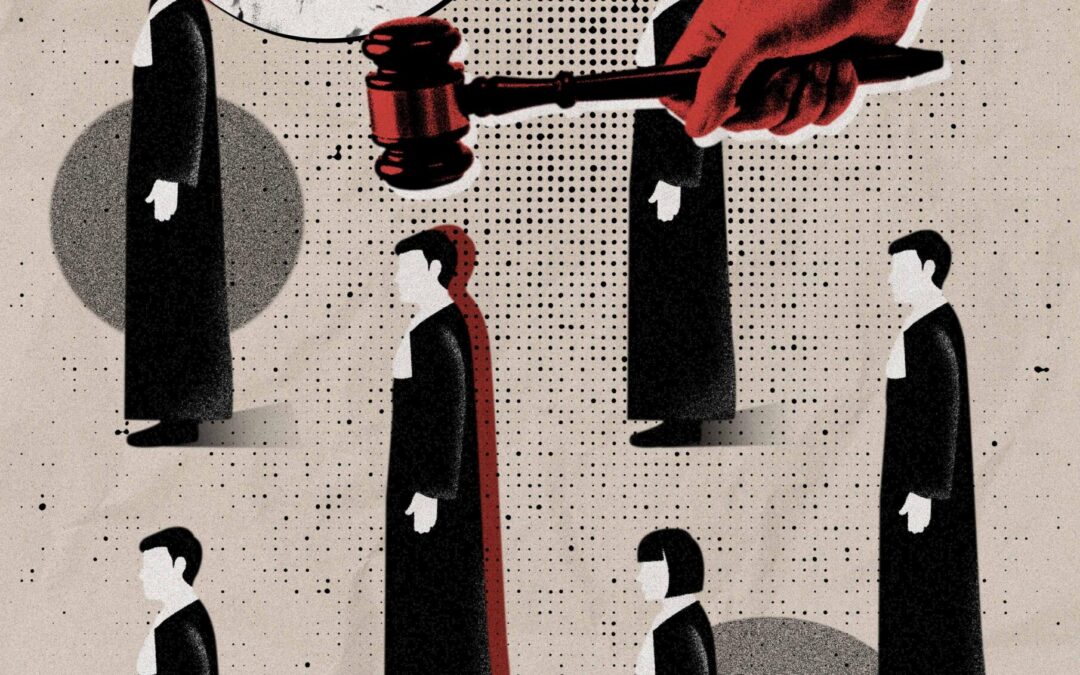
In a briefing paper published today, the ICJ called on the Tunisian authorities to immediately end their attacks on independent judges and prosecutors, drop any criminal charges against them, and reinstate all those arbitrarily dismissed.
التقرير بالغة العربية
On 1 June 2022, President Kais Saied granted himself, via decree, absolute power to fire judges and prosecutors summarily, and [on the same day] promptly dismissed 57 of them. The President had earlier pledged to “cleanse” the judiciary on spurious accusations of widespread political bias and corruption.
The ICJ analysis of the cases of 18 dismissed judges and prosecutors, as well of another judge subjected to disciplinary and criminal proceedings, establishes a pattern of arbitrary disciplinary and criminal processes effectively aimed at purging the judiciary of those who asserted their independence and challenged the dismantling of the institutional independence of the judiciary.
“The ongoing arbitrary criminal prosecutions against independent judges and prosecutors for the legitimate exercise of their professional functions or of their right to freedom of expression is an affront to the rule of law and judicial independence in Tunisia,” said Said Benarbia, ICJ MENA director. “The authorities must immediately end such prosecutions and reinstate all judges and prosecutors who have been dismissed without legitimate grounds or due process”
In the aftermath of his speech on 25 July 2021 announcing exceptional measures, the President promised to “cleanse” and “purify” the judiciary, which he accused of complicity with political parties in power before July 2021, as well as of inefficiency, corruption and political bias. He also targeted the High Judicial Council and its members, limiting certain of their financial benefits. Since then, the President has followed up on his rhetoric with successive decisions and measures aimed directly at dismantling the judiciary’s institutional independence.
The ICJ’s analysis examines the process of arbitrarily dismissing and prosecuting judges and prosecutors in Tunisia since the adoption of these measures in light of the country’s obligations under international human rights law.
The ICJ’s analysis is primarily based on: (i) a review of 20 criminal cases opened by the authorities against 18 dismissed magistrates and of the case of Anas Hmedi, the President of the Association of Tunisian Magistrates (AMT), which is directly linked to his support of the dismissed judges and proseuctors; (ii) 15 interviews with judges, prosecutors and their lawyers; (iii) an analysis of the First President of the Administrative Court’s decisions to suspend the dismissal of 49 magistrates and to dismiss the request for suspension of seven others; and (iv) an analysis of decisions and reports by the General Inspection Service, the High Judicial Council and the Temporary High Judicial Council.
The ICJ considers that the conduct of the dismissed judges and prosecutors, on the basis of which they have apparently been subject to criminal proceedings, did not amount to recognizably criminal offences under general principles of criminal law and international human rights law and standards.
On the contrary, the ICJ’s analysis of these cases establishes that these judges and prosecutors were arbitrarily dismissed and then subject to criminal proceedings in relation to serious offences solely for three types of conduct, none of which is a legitimate basis for criminal prosecution:
- for the exercise of their prosecutorial and judicial functions in compliance with the law and ethical standards, and
- for the exercise of human rights protected by international human rights law, including the rights to freedom of expression and freedom of association
- for private conduct, unrelated to their performance of their duties, which, in any event, was not criminal in nature.
Contact
Said Benarbia, Director, ICJ Middle East and North Africa Programme, t: +41-22-979-3800; e: said.benarbia(a)icj.org
Download:
Download ICJ briefing on Attacks on Judges and Prosecutors in Tunisia in English: Here
Download ICJ briefing on Attacks on Judges and Prosecutors in Tunisia in Arabic: Here
Dec 11, 2023 | Advocacy, News
On the occasion of the 16 Days of Activism against Gender-Based Violence, from 25 November to 10 December, the 25th anniversary of the Declaration on Human Rights Defenders on 9 December, and the 75th anniversary of the Universal Declaration of Human Rights, on 10 December, the International Commission of Jurists (ICJ) condemns gender-based violence against women human rights defenders (HRDs) in Libya and calls for an immediate end to such violence. In recent years, the authorities in the West and the East of Libya have consistently attacked prominent women HRDs and let non-State actors threaten, assault and kill them with impunity.
.هذا البيان الصحفي متوفر باللغة العربية أيضاً
The situation of women human rights defenders in Libya
In the years that have followed the 2011 uprising and the ouster of Muammar Gadhafi, women HRDs in Libya have been killed and subjected to enforced disappearances. For example, in June 2014 five armed men killed Salwa Bugaighis, a woman HRD and lawyer advocating for women’s human rights, in her home in Benghazi, eastern Libya. In July 2019, Siham Sergiwa, a woman HRD and member of the House of Representatives (HoR) – the 2014 elected legislative body based in the East of the country – was abducted and there is reasonable grounds to believe that she was subjected to an enforced disappearance by men believed to be affiliated with the Libyan National Army (LNA), a group of militias led by Khalifa Haftar, a top military officer under Gadhafi who was officially appointed Field Marshall of the LNA by the HoR in 2015. Her abduction occurred after she criticized the April 2019 offensive by the LNA on Tripoli and called for a ceasefire. Her fate and whereabouts remain unknown to this day. In November 2020, Hanan Al Barassi, a lawyer, political activist and woman HRD critical of the LNA, was shot dead by a group of armed men in Benghazi’s city centre, in broad daylight. No one has yet been held accountable for these violations or for the killing of other women HRDs, including Fariha El Berkawi and Intissar Al Hasairi, in 2014.
In April 2021, the Committee on the Elimination of All Forms of Discrimination against Women (CEDAW) issued its decision relating to the first communication against Libya under the Optional Protocol to the Convention on the Elimination of All Forms of Discrimination against Women. The case concerned Magdulein Abaida, a woman human rights defender who, in 2012, was abducted three times by members of the Martyrs of 17 February Brigade, a militia affiliated with the Ministry of Interior, beaten, called a “whore” and a “bitch”, and threatened with death. A man identified as a Ministry of Defence official questioned her. After her release, she received death threats online.
The CEDAW found that Libya had breached the Convention on the Elimination of All Forms of Discrimination against Women, finding that the gender-specific abuse inflicted on Magdulein Abaida had occurred with the consent or acquiescence of public officials and, therefore, amounted to torture. In addition, the Committed highlighted that Magdulein Abaida had been abducted during a women’s rights workshop, and that, immediately after being tortured, she had been interrogated about her women’s rights organization, and that the Deputy Interior Minister had criticized her organization’s “chanting for women’s freedom”.
The Committee recommended to the Libyan authorities to carry out a prompt, thorough and independent investigation into Magdulein Abaida’s discrimination, arrest, detention and torture and to provide her with appropriate reparation. It also made the following general recommendations: (1) to “adopt comprehensive anti-discrimination legislation”, (2) to “put in place measures to ensure a safe and favorable environment for women’s human rights defenders”, and (3) to “recognize publicly the specific place and role of women HRDs and their legitimacy in the public debate”. The Libyan authorities have not responded to or implemented CEDAW’s recommendations.
In its June 2022 report, the UN Independent Fact-Finding Mission on Libya (FFM) – which investigated violations and abuses of international human rights law and international humanitarian law since the beginning of 2016 until March 2023 – documented the case of an unnamed woman HRD who was summoned by the eastern Internal Security Agency (ISA) in 2020. The ISA interrogated her about the human rights organization she established, its activities, including on women’s rights, and funding. During her questioning, she was insulted, called “damaged”, beaten, was forced to remove her shirt, burnt with a metal rod and sexually harassed. In 2023, the UN Support Mission in Libya documented further intimidation and assaults against women HRDs.
In the same June 2022 report, the FFM also found that “tactics used to terrify and silence activists” included online threats of sexual violence, in particular against women HRDs. It noted that, in December 2021, Meta, Facebook’s parent company, said it removed pages “purporting to be run by female public figures to make inflammatory statements on their behalf”. The FFM considered that, in the polarized context of Libya, the publication of provocative political statement could “endanger the lives” of the impersonated woman HRDs, as they could become the target of further online and offline violence. In 2021, the NGO Lawyers for Justice in Libya found that online violence against women “is overwhelmingly directed against […] women human rights defenders […] with the aim of silencing their voices and, increasingly, spreading misinformation”.
The failure of the Libyan authorities to effectively investigate crimes of gender-based violence against women HRDs has occurred in a context in which complete impunity for human rights violations and abuses prevails. Such a climate, in turn, has enabled even further violence against women HRDs, and women and girls more generally, forcing them out of public life. According to a study referred to by the UN Special Rapporteur on violence against women and girls, its causes and consequences in her report following her official visit to Libya, 60 per cent of consulted women declared that they had been deterred from participating in the public sphere because of the attacks against women.
Ill-equipped legal framework
As noted by the UN Special Rapporteur on the situation of HRDs in her 2023 report on women HRDs in conflict, post-conflict and crisis-affected settings, to ensure that women HRDs can safely do their work, concrete measures need to be put in place to prevent attacks against them. However, the Libyan legal framework is ill-equipped to address gender-based violence against women and girls. The Benghazi and Tripoli specialized courts – which were established in 2020 to hear criminal cases arising from violence against women and children – have so far only been dealing with civil cases relating to family law, rather than trying crimes of gender-based violence committed against women.
The General National Congress, the first post-revolution legislative body, and its successor, the HoR, discussed in 2013 and 2016-2017 two draft laws on combating violence against women, but they were never adopted into law. In 2020, a committee of experts supported by the western Government of National Unity’s Minister for Women’s Affairs started preparing a third draft. The draft has recently been submitted for consideration to the HoR by 20 members of parliament.
Recommendations
Considering the plight of women HRDs, the ICJ calls on the Libyan authorities to:
- Adopt and implement the draft law on combatting violence against women, and amend the Libyan Penal Code, in accordance with international human rights law and standards with respect to violence against women;
- Protect women HRDs from harassment, intimidation and acts of violence, both online and offline;
- Investigate and prosecute the crimes, including online violence, committed against women and women HRDs, including with respect to the cases of Fariha El Berkawi, Hanan Al Barassi, Intissar Al Hasairi, Salwa Bugaighis and Siham Sergiwa, and hold perpetrators to account;
- Equip the specialized courts on violence against women and children with resources and funding to ensure the fulfillment of their mandate to prosecute criminal offences of gender-based violence committed against women and children;
- Protect and promote the human rights of women and women HRDs, and promote as legitimate and encourage their participation in political and public life, including elections; and
- Publicly condemn any acts of gender-based violence against women HRDs.
Contact
Said Benarbia, Director, ICJ Middle East and North Africa Programme, said.benarbia(a)icj.org
Katherine Iliopoulos, Legal Adviser, ICJ Middle East and North Africa Programme, katherine.iliopoulos@icj.org
Mohamed Hanafy, Legal Researcher, ICJ Middle East and North Africa Programme; mh(a)icj.org
Juliette Rémond Tiedrez, Legal Researcher, ICJ Middle East and North Africa Programme, juliette.remond-tiedrez(a)icj.org
Nov 22, 2023 | Advocacy, Joint Statement
In light of credible allegations of ongoing violations of international humanitarian law arising from the protracted armed conflict in Israel and the Occupied Palestinian Territory, in particular in the Gaza Strip, the International Commission of Jurists (ICJ), Amnesty International (AI), and Human Rights Watch (HRW) support the call by a number of High Contracting Parties to the 1949 Geneva Conventions addressed to Switzerland, in its capacity as the depository of the four Geneva Conventions, to convene an urgent Conference of High Contracting Parties to the Geneva Convention Relative to the Protection of Civilian Persons in Time of War of 12 August 1949 (“the Fourth Geneva Convention”).
This call is based on Common Article 1 to the four Geneva Conventions, which states that “The High Contracting Parties undertake to respect and to ensure respect for the present Convention in all circumstances”. Underscoring the continued relevance of this body of law, the ICJ, AI, and HRW recall operative paragraph 1 of the UN Security Council Resolution 2712 on the situation in the Middle East, including the Palestinian question, of 15 November 2023 demanding “that all parties comply with their obligations under international law, including international humanitarian law, notably with regard to the protection of civilians, especially children.” In the same vein, our organisations recall operative paragraph 2 of the UN General Assembly, entitled Protection of civilians and upholding legal and humanitarian obligations, of 26 October 2023 demanding “that all parties immediately and fully comply with their obligations under international law, including international humanitarian law and international human rights law, particularly in regard to the protection of civilians and civilian objects, as well as the protection of humanitarian personnel, persons hors de combat, and humanitarian facilities and assets”.
The ICJ, AI, and HRW call on all High Contracting Parties to uphold the fundamental principle of international law that treaties must be executed in good faith, and fulfil their obligations under Common Article 1 “to ensure respect” for the Fourth Geneva Convention by participating in the Conference and acting collectively to prevent further violations of international humanitarian law in the Occupied Palestinian Territory and Israel.
The ICJ, AI, and HRW consider that in the circumstances currently prevailing in Israel and the Occupied Palestinian Territory, including, in particular, the Gaza Strip, ensuring respect for international humanitarian law requires, at a minimum, a suspension of arms transfers to the parties to the conflict; ensuring accountability for serious violations of international humanitarian law; supporting and cooperating with the Independent International Commission of Inquiry on the Occupied Palestinian Territory, including East Jerusalem, and Israel, and with the International Criminal Court’s ongoing Palestine investigation; and supporting other pathways to accountability including through the principle of universal jurisdiction.
Contact:
Said Benarbia, Director, ICJ Middle East and North Africa Programme, email: said.benarbia@icj.org
Katherine Iliopoulos, Legal Adviser, ICJ Middle East and North Africa Programme, email: katherine.iliopoulos@icj.org
Nov 17, 2023
Photo by Amir Shiri on Unsplash
LEGAL BRIEFER: States’ Duty to Prevent Genocide under the 1948 Genocide Convention
This legal briefer focuses on States’ duty to prevent genocide under international law. However, the International Commission of Jurists (ICJ) notes that there are credible allegations of other serious crimes under international law having been committed in the course of the ongoing hostilities in Israel and the Occupied Palestinian Territory, including the Gaza Strip.
Given the scale and severity of Israel’s ongoing attacks on Gaza, reports that Israel has now killed over 11,000 civilians, including over 4,000 children, in the Gaza Strip since 7 October 2023 and recent warnings, including by a group of independent United Nations human rights experts on 16 November that, “grave violations committed by Israel against Palestinians in the aftermath of 7 October, particularly in Gaza, point to a genocide in the making”, the ICJ urges States to fulfil their international legal obligations, including in particular under the Convention on the Prevention and Punishment of the Crime of Genocide of 1948 (hereafter the Genocide Convention), and take immediate action to prevent acts of genocide in Gaza.
Acts of Genocide
Article II of the Genocide Convention defines the crime of genocide outlining its two main elements:
(1) specific underlying acts, namely, the material elements of the crime; and
(2) specific intent, namely, the mental state required of the person committing the material elements of the crime.
The Genocide Convention and the Rome Statute of the International Criminal Court (ICC) outline the following five specific underlying acts, any one of which may be constitutive of the crime of genocide:
- Killing members of a national, ethnical, racial or religious group;
- Causing serious bodily or mental harm to members of the group;
- Deliberately inflicting on the group conditions of life calculated to bring about its physical destruction in whole or in part;
- Imposing measures intended to prevent births within the group; and
- Forcibly transferring children of the group to another group.
The ICC Elements of Crimes define the term “conditions of life” as including but not limited to “deliberate deprivation of resources indispensable for survival, such as food or medical services, or systematic expulsion from homes.”
The ICJ considers that the complete blockade of Gaza – coupled with depriving civilians of water, food, medicine, electricity and fuel – may constitute the specific underlying act of “deliberately inflicting on the group conditions of life calculated to bring about its physical destruction”, as per the genocide definition set out above.
Some of the underlying acts of the crime of genocide may also simultaneously constitute the material elements of certain war crimes or crimes against humanity.
Specific Intent
The distinguishing feature of genocide is that the perpetrator commits the specific underlying acts of the offence with the specific intent to destroy, in whole or in part, a national, ethnical, racial or religious group, as such.
The Palestinian people constitute a national group for the purposes of the Genocide Convention. The Palestinians of the Gaza Strip constitute a substantial proportion of the Palestinian nation.
The ICJ is concerned that certain statements by senior officials and politicians in Israel disclose evidence of what may be characterised as intent to destroy Palestinians of the Gaza Strip.
For example, on 9 October, the Israeli Defence Minister Yoav Gallant said, “I have ordered a complete siege on the Gaza Strip. There will be no electricity, no food, no fuel, everything is closed. We are fighting human animals and we act accordingly.” On 10 October, the head of the Israeli Army’s Coordinator of Government Activities in the Territories (COGAT), Maj. Gen. Ghassan Alian, addressed a message directly to Gaza residents: “Human animals must be treated as such. There will be no electricity and no water, there will only be destruction. You wanted hell, you will get hell”. On 13 October, the Israeli Defence Minister said: “Gaza won’t return to what it was before. We will eliminate everything.”
The ICJ is concerned that such statements by officials responsible for Israel’s ongoing military offensive in Gaza, with their expressed emphasis on siege on the Gaza Strip, on depriving the population of essential needs, on the total destruction and elimination of everything and everyone in the Gaza Strip and on evacuation – taken together with well-documented patterns of reported crimes under international law in Gaza, such as indiscriminate bombardment of densely populated areas, including airstrikes resulting in extensive civilian casualties, attacks on medical units, transports and personnel, refugee camps, evacuation routes, humanitarian corridors and other vital civilian infrastructure, collective punishment and the forced transfer of over one million Palestinians from northern Gaza to the south – disclose evidence sufficient to trigger the duty of each State to take reasonable action to seek to prevent acts of genocide in Gaza.
The Duty to Prevent
Notwithstanding individual criminal liability for acts of genocides outlined above, under international law, States have a duty to prevent acts of genocide.
It is not necessary for a definitive determination that genocide is taking place. As the International Court of Justice (“the Court”) held in Bosnia v Serbia, a “State’s obligation to prevent, and the corresponding duty to act, arise at the instant that the State learns of, or should normally have learned of, the existence of a serious risk that genocide will be committed.” The ICJ considers, based on the above, that such threshold has been reached in Gaza, triggering States’ duty under international law to take measures to prevent acts of genocide.
The totality of destruction by Israeli forces against Palestinians in Gaza, as documented in numerous open sources, should guide an assessment by the international community and individual States as to whether genocide is underway or whether there exists a serious risk of genocide, triggering the corresponding duty to prevent it. States’ legal obligation to prevent genocide is not a passive obligation, but rather, according to the Court in Bosnia v Serbia, “implies that each State party must assess whether a genocide or a serious risk of genocide exists”.
When the Court issued its order for provisional measures in The Gambia v. Myanmar in January 2020, it held that there was no requirement of demonstrating violations of obligations under the Genocide Convention, but rather that “the acts complained of … are capable of falling within the provisions of the Genocide Convention”.
The Genocide Convention imposes a minimum legal obligation on States to each take reasonable action to contribute toward preventing genocide, a duty that extends extraterritorially and applies regardless of whether any one State’s actions alone are sufficient to prevent genocide. The Court in Bosnia v. Serbia held that States with strong political links to the State concerned have a greater duty to use their influence in this regard, as the duty to prevent varies from State to State depending on its:
“capacity to influence effectively the action of persons likely to commit, or already committing, genocide. This capacity itself depends, among other things, on the geographical distance of the State concerned from the scene of the events, and on the strength of the political links, as well as links of all other kinds, between the authorities of that State and the main actors in the events”.
The Court also held that, “if the State has available to it means likely to have a deterrent effect on those suspected of preparing genocide, or reasonably suspected of harbouring specific intent, it is under a duty to make such use of these means as the circumstances permit”. Third State responsibility may be incurred if a State manifestly fails to take all measures that are within its power to prevent acts of genocide, and that might contribute to preventing such acts.
Recommendations
In light of the above, the ICJ calls upon States who have a position of influence with the Government of Israel – particularly the United States – to take all reasonable measures within their power to prevent genocide in Gaza, including by calling for a ceasefire, taking steps to ensure the lifting of the siege and preventing the displacement of Palestinians outside the Gaza Strip, and to discontinue any military assistance, including arms sales, that would enable or facilitate genocide, and other crimes under International law.
The ICJ urges other States to immediately act under article VIII of the Genocide Convention, by calling on the competent organs of the United Nations, including the UN Security Council, and particularly the UN General Assembly, to take urgent action under the UN Charter appropriate for the prevention and suppression of any acts of genocide in Gaza, including calling for an immediate ceasefire.
The ICJ also calls on UN Independent International Commission of Inquiry on the Occupied Palestinian Territory, including East Jerusalem, and Israel, and the Office of the Prosecutor of the ICC, to rapidly expand their investigations in relation to the situation in Palestine to include genocide.
Contact:
Said Benarbia, Director, ICJ Middle East and North Africa Programme, email: said.benarbia@icj.org
Katherine Iliopoulos, Legal Adviser, ICJ Middle East and North Africa Programme, email: katherine.iliopoulos@icj.org