
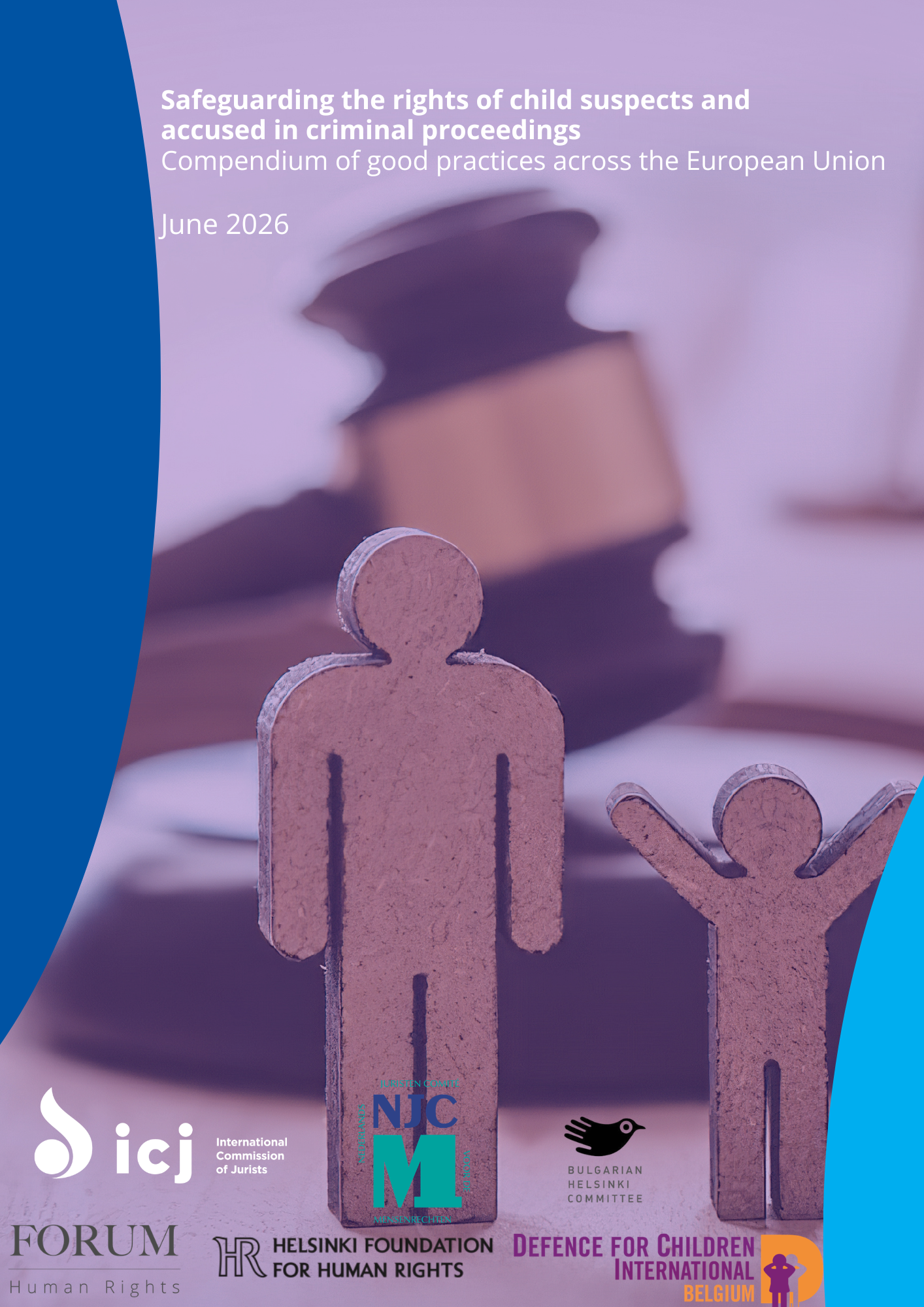
Children who come into contact with the criminal justice system as suspects or accused persons continue to face serious gaps in the protection of their rights, despite international and EU law and standards. A new publication Safeguarding the rights of child suspects and accused in criminal proceedings: Compendium of Good practices by the International Commission of Jurists (ICJ) examines these challenges in six countries — Belgium, Bulgaria, the Czech Republic, the Netherlands, Poland and Slovakia, identifying both persistent shortcomings and promising practices.
The report shows that while legal frameworks are in place, their implementation remains inconsistent and often ineffective in practice. These gaps are linked to limited resources, insufficient specialized training, and structural inequalities that continue to affect children’s access to justice.
The Compendium focuses in particular on key aspects of children’s rights in criminal proceedings, including the right to a lawyer, the right to information, safeguards related to deprivation of liberty, discrimination and inequality, and the situation of children below the age of criminal responsibility. Across these areas, findings reveal a gap between legal guarantees and everyday practice.
“Many children who come in contact with criminal proceedings are too often left without timely access to a lawyer, are not provided with information in a way they can understand, and do not receive adequate assessment or support tailored to their needs. Yet this can change, and concrete practices already exist, from early access to a specialist lawyer to genuine alternatives to detention, that any State can put in place to make children’s rights real,” said ICJ Senior Legal Adviser Karolína Babická.
Systemic inequalities persist. Children from disadvantaged backgrounds, minorities and children with disabilities are more likely to face barriers to participation and unequal treatment. In addition, deprivation of liberty is not consistently applied as a measure of last resort, with insufficient recourse to alternatives. Children below the age of criminal responsibility are particularly vulnerable, as they may be subjected to restrictive measures without the full procedural safeguards guaranteed in criminal proceedings.
At the same time, the Compendium identifies a range of practices across the six countries that demonstrate how these challenges can be addressed. These examples show that with targeted efforts, including child-friendly communication, early access to legal assistance, and improved coordination between professionals, justice systems can better respond to the needs and rights of children.
By bringing together legal standards and practical experience, the Compendium provides guidance for policymakers and justice professionals seeking to strengthen child-friendly justice systems and ensure that children are treated as rights-holders with effective access to justice.
Further resources
Full report
The Compendium is also available in the following languages:
Bulgarian | Czech | Dutch | French | Polish | Slovak
Baseline studies
The Compendium builds on national baseline studies examining children’s procedural rights in Belgium, Bulgaria, the Czech Republic, the Netherlands, Poland and Slovakia under Directive (EU) 2016/800.
Access the baseline studies and the summary here
Child-friendly FAQs for children and families
As part of the project, child-friendly FAQs were developed to support children and families in understanding their rights in criminal proceedings.
The model is available in English as a Word version and as a child-friendly formatted version.
Country-specific versions are also available:
Belgium (French / Dutch) | Bulgaria | The Czech Republic (Leaflet and Brochure) | The Netherlands (Flyer and Poster) | Poland | Slovakia (Leaflet and Brochure)
Background
The Access to Justice for Children Accused and Suspect in Criminal Proceedings (ACCESS) project aims to foster EU-wide effective and non-discriminatory access to justice for children in criminal proceedings, and respect for children’s procedural rights amongst legal and other professionals. The project is implemented by the ICJ in partnership with NJCM – the Dutch section of the International Commission of Jurists, Forum for Human Rights in Czechia and Slovakia, Helsinki Foundation for Human Rights in Poland, Bulgarian Helsinki Committee, and Defence for Children International – Belgium.
The Compendium is the product of exchanges and discussions carried out throughout the ACCESS project. It draws in particular on a Transnational Exchange Roundtable held in Brussels in March 2025, as well as a series of follow-up online workshops tailored to different professional groups, including lawyers, judges, prosecutors and law enforcement personnel, and social workers and probation officers.
These exchanges, involving professionals from the six countries, provided a platform to share experiences and explore key challenges, with a view to strengthening the protection of children suspected or accused in criminal proceedings.

Contact
Karolína Babická, Senior Legal Adviser: karolina.babicka@icj.org
Viktoryia Konashava, Legal Researcher: viktoryia.konashava@icj.org