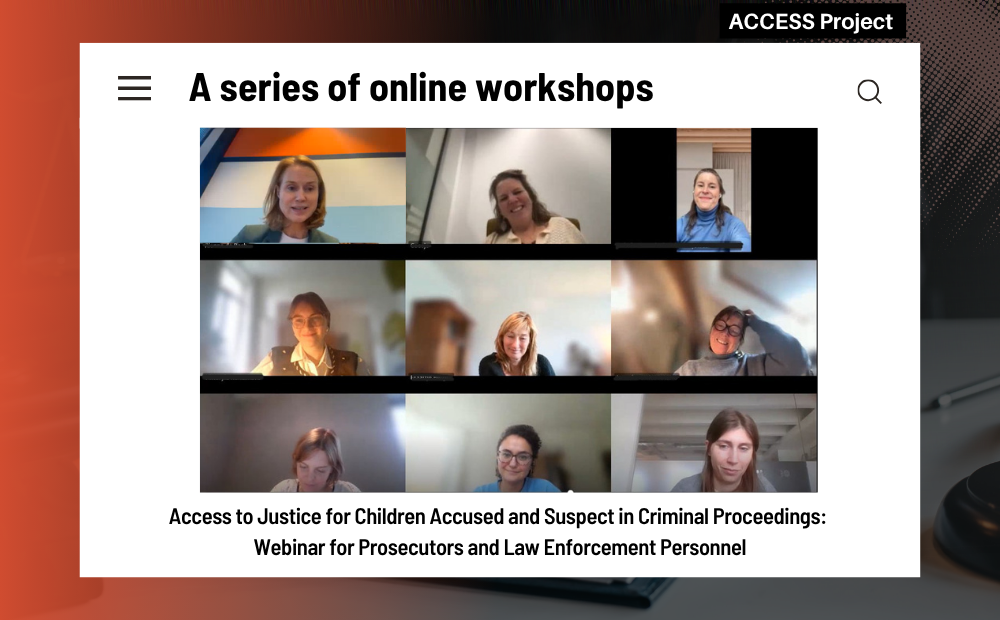
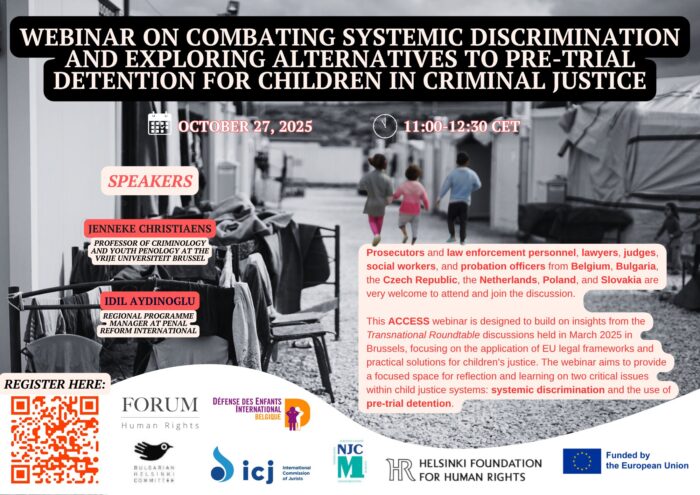
On 27 October 2025, the International Commission of Jurists held a webinar for prosecutors and law enforcement personnel, focusing on combating systemic discrimination and expanding alternatives to pre-trial detention for children in criminal justice systems.
The event brought together experts and practitioners to discuss how inequality is embedded within existing systems and how a child-centred, rights-based approach can drive meaningful reform. Participants highlighted that children in conflict with the law are often treated as individual offenders rather than as young people affected by broader social and economic inequalities such as poverty, exclusion, and limited access to education.
“The juvenile justice process remains highly selective, with children from minority, migrant, and low-income backgrounds disproportionately represented,” said Professor Jenneke Christiaens, Professor of Criminology and Youth Penology at the Vrije Universiteit Brussel.
While risk assessment tools are designed to enhance objectivity and consistency in judicial decision-making, they can unintentionally reinforce existing biases. Their application, therefore, requires careful review on a case-by-case basis. In some jurisdictions, including in the Netherlands, this may call for a broader political discussion on whether such tools should be retained or reformed.
Applying a children’s rights lens was recognised as essential for addressing structural inequities. Professionals working with young people should prioritise children’s rights in their daily practice and remain aware of how institutional norms and procedures may perpetuate discrimination.
Regarding pre-trial detention, it was highlighted that under the UN Convention on the Rights of the Child and the EU Directive 2016/800, detention must be used only as a measure of last resort and for the shortest possible time. Alternatives such as community supervision, curfews, school attendance, and structured programmes were identified as more constructive than placement in police cells or detention facilities.
Participants also observed that certain conditions, such as bail payments or electronic monitoring, may exclude specific groups, particularly Roma children or those from low-income households, who lack the financial means or stable housing required to comply. Ensuring flexibility and creativity in the application of these measures is therefore essential to uphold inclusion and fairness.
Discussions concluded that once children enter detention, their life prospects often deteriorate, underscoring the urgent need to prioritise prevention, reintegration, and non-custodial approaches. A justice system guided by children’s rights, fairness, and care, rather than control and punishment, is essential to ensure that every child has the opportunity to build a stable and dignified future.
Background
On 22 April 2025, the ICJ launched a series of online workshops for lawyers, judges, prosecutors and law enforcement personnel, social workers and probation officers, on access to justice for children suspected or accused in criminal proceedings. These workshops were organized within the framework of the ACCESS project and as a follow-up on the Transnational Exchange Roundtable held in March 2025 in Brussels. The aim was to explore specific issues in greater depth and strengthen legal assistance for children in conflict with the law.
The ACCESS project aims to foster EU-wide effective and non-discriminatory access to justice for children in criminal proceedings, and respect for children’s procedural rights amongst legal and other professionals. The project is implemented by the ICJ in partnership with NJCM – the Dutch section of the International Commission of Jurists, Forum for Human Rights in Czechia and Slovakia, Helsinki Foundation for Human Rights in Poland, Bulgarian Helsinki Committee, Defence for Children International – Belgium.
Contact
Karolína Babická, ICJ Senior Legal Advisor, karolina.babicka@icj.org
Viktoryia Konashava, ICJ Legal Researcher, viktoryia.konashava@icj.org
The full webinar is available here: