
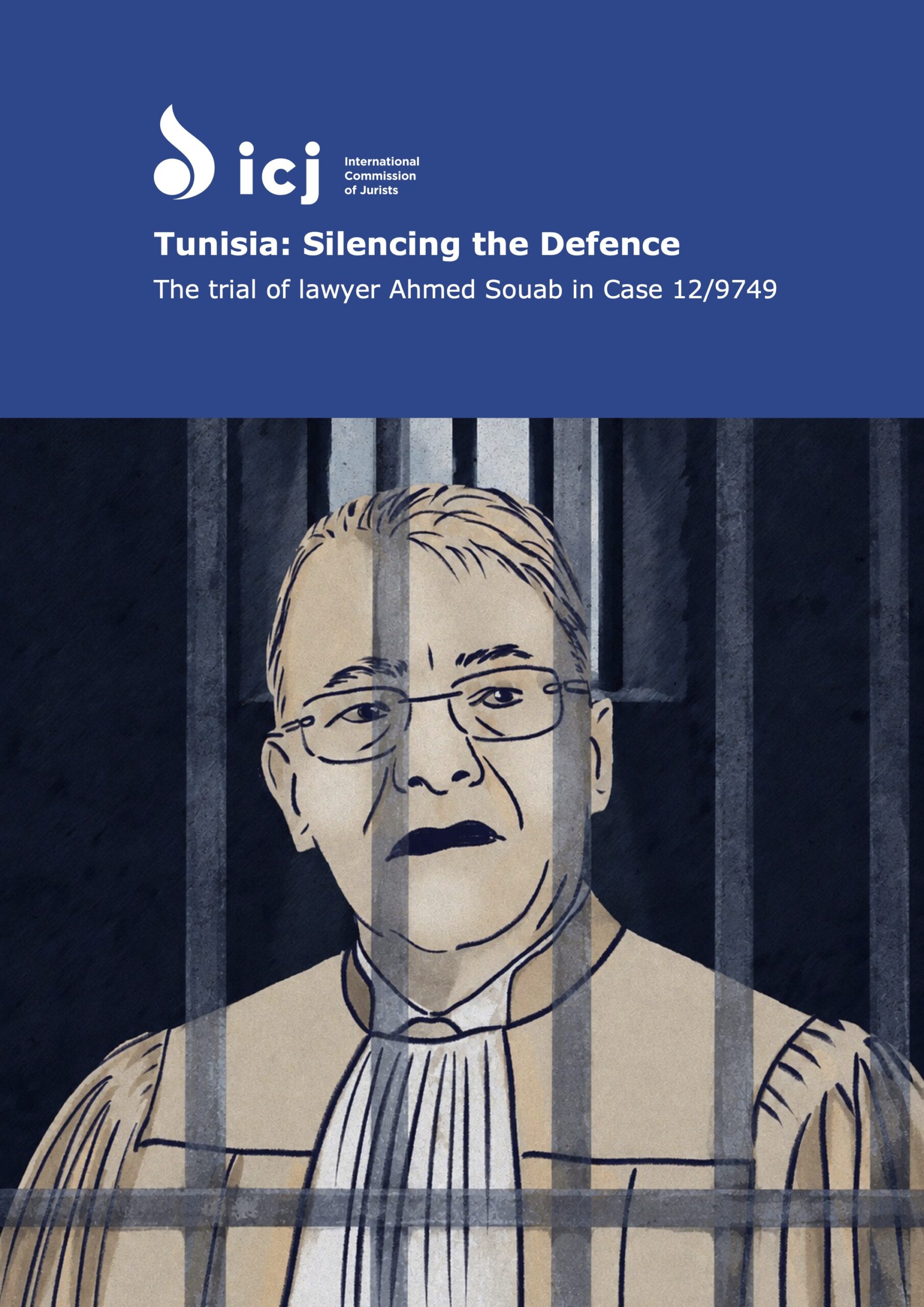
In a legal briefing published today, the International Commission of Jurists (ICJ) documents and analyses the Tunisian authorities’ resort to arbitrary criminal proceedings against Ahmed Souab for statements he legitimately made as a defence lawyer in one of Tunisia’s sham political trials commonly referred to as the “Conspiracy Case”.
The human rights organization calls on the authorities to quash Ahmed Souab’s conviction and ensure his access to an effective remedy for the human rights violations he endured as a result of his politicized, persecutory and arbitrary prosecution, trial, conviction and imprisonment in Case 12/9749.
“The Tunisian authorities’ weaponization of the criminal justice system against Ahmed Souab in retaliation for his calling out the executive’s interference in judicial affairs is emblematic of the serious risks now facing all lawyers daring to act independently and vocally defending their clients in Tunisia”, said Saïd Benarbia, ICJ Middle East and North Africa Programme Director. “The Tunisian authorities must immediately end their attacks on the independence of the legal profession and the judiciary.”
Ahmed Souab is a prominent Tunisian lawyer, a former administrative judge and the 2025 recipient of the Ebru Timtik Award in recognition of his outstanding commitment and sacrifice to defend the right to a fair trial.
On 18 April 2025, following the final trial hearing in the “Conspiracy Case”, Ahmed Souab publicly denounced the pressure the Ministry of Justice had exerted on the trial judge in that case. In his speech, Ahmed Souab also made reference to “many other cases” in which the executive had threatened judges with reprisals if they failed to convict defendants, emphasizing his point by making a gesture with his hand to simulate “a knife to the throat” when referring to the existence of those other cases. Pro-government social media accounts then circulated a video excerpt of Ahmed Souab’s speech, taking his metaphorical hand gesture out of context to falsely portray it as a physical threat against the trial judge. As a result, the Tunisian authorities initiated criminal proceedings against him in Case 12/9749.
Following Ahmed Souab’s arrest on 21 April 2025, an investigating judge at the “Counter-Terrorism” Judicial Pole charged him with multiple offences under the “Counter-Terrorism” Law, the Penal Code, the Decree-Law 2022-54 on Cybercrime and the Telecommunications Code, and remanded him to pre-trial detention.
Eventually, on 31 October 2025, notwithstanding the manifest lack of evidence for the serious offences with which he had been charged, the Tunis Court of First Instance’s Criminal Chamber convicted Ahmed Souab of two offences under the “Counter-Terrorism” Law and sentenced him to a total of five years’ imprisonment, with a “complementary penalty” of three years of post-release administrative supervision.
On 23 February 2026, the Tunis Court of Appeal’s Criminal Chamber upheld the guilty verdict but reduced Ahmed Souab’s original sentence to a total of 10 months’ imprisonment and a two-year suspended prison sentence, quashed the complementary penalty, and ordered his release on the basis of time served since his arrest in April 2025.
In today’s legal briefing, the ICJ concludes that the criminal proceedings against Ahmed Souab were based on spurious charges in a politically motivated and persecutory prosecution intended to punish him for his work as a defence lawyer, including in the “Conspiracy Case”, and for speaking out against the executive’s interference in the judiciary, as well as to make an example of him and dissuade other lawyers from taking a stand. The legal briefing further finds that the criminal proceedings against Ahmed Souab were marred by a litany of fair trial rights violations, including the right to communicate with counsel and to legal assistance and representation, to defend himself and be present at his trial, and to a fair hearing before an independent and impartial tribunal, and that the arrest, detention, prosecution, trial, conviction and sentencing of Ahmed Souab violated his rights to freedom of expression and to liberty, while also unlawfully obstructing his professional duties as a defence lawyer. The briefing concludes with a series of recommendations to the Tunisian authorities, including for legislative reforms.
Background
Since President Kaïs Saïed’s power grab of 25 July 2021 and the executive’s subsequent subordination of the judiciary, the Tunisian authorities have instigated arbitrary criminal prosecutions against lawyers who have represented opposition figures or who, in the course of their legal work, have expressed profound concern at the authorities’ dismantling of judicial independence and weakening of human rights protections in Tunisia. These attacks have formed a part of the Tunisian authorities’ wider crackdown on political dissent and pluralism, which in recent years has culminated in the arbitrary prosecution of political opponents, judges, journalists, human rights defenders and civil society actors, often as a result of their peaceful exercise of their human rights, including the right to freedom of expression.
Dalila Msaddek, Samir Dilou, Islem Hamza, Abdelazziz Essid, Ayachi Hammami, Ghazi Chaouachi, Najib Chebbi and Lazher Akremi, who, like Ahmed Souab, were all lawyers in the “Conspiracy Case”, have been subjected to arbitrary prosecution, including in connection with the fulfilment of their professional obligations in that case, with UN Special Procedures mandate-holders warning that the measures taken against them interfered directly with the independence of the legal profession.
Download
The legal briefing can be downloaded in English or Arabic.
Contact
Saïd Benarbia, Director, ICJ Middle East and North Africa Programme; t: +41 22 979 3800, e: said.benarbia@icj.org
Nour Al Hajj, Regional Communications & Advocacy Officer, ICJ Middle East and North Africa Programme; e: nour.alhajj@icj.org