
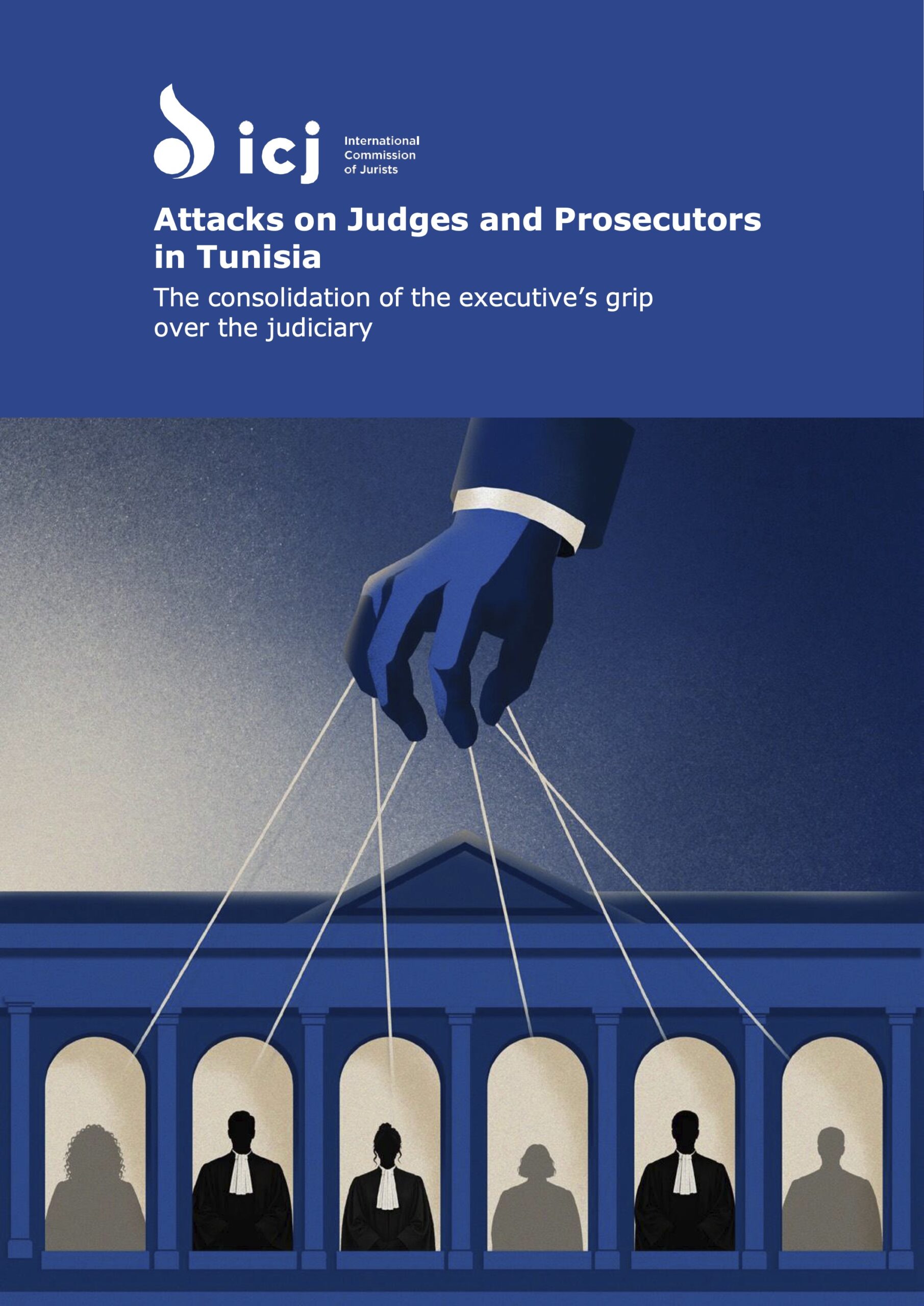
Geneva – In a new briefing, the International Commission of Jurists (ICJ) documents and analyses the Tunisian executive’s intensifying attacks on judicial independence, particularly its full control over and direct interference in the careers of judges and prosecutors, without legal process.
The ICJ calls on the authorities to guarantee judicial independence, including by re-establishing an independent High Judicial Council (HJC) with sole responsibility for the selection, appointment, assignment, transfer, promotion and disciplining of judges and prosecutors.
“Without even a mere semblance of due process, the Ministry of Justice appoints, transfers, promotes, punishes and dismisses judges and prosecutors at will,” said Saïd Benarbia, ICJ Middle East and North Africa Programme Director. “The Tunisian authorities must end their nearly five-year-long assault on judicial independence and interference in judicial affairs: they ought to facilitate a return to the constitutional order and ensure full respect for the rule of law and the principle of the separation of powers.”
In 2022, the Tunisian President, Kaïs Saïed, dissolved the HJC, and replaced it with a Temporary High Judicial Council (THJC), whose membership the President heavily influenced. The THJC comprises three councils, namely, the Temporary Judiciary Council (TJC), the Temporary Administrative Council (TAC) and the Temporary Financial Council (TFC). Since then, the President has deliberately failed to appoint several senior judges and prosecutors who are ex-officio THJC members, preventing, in turn, both the TJC and TFC from being able to function for lack of quorum since October 2023 and October 2024, respectively. Although the TFC re-acquired quorum in June this year and proposed a rotation of judges, which the executive implemented on 30 September 2026, the TJC remains inquorate and, as a result, remains unable to administer the appointment, assignment, promotion and transfer of judges and prosecutors, as well as ruling on their suspension and dismissal.
In continuing to obstruct the TJC’s operations, the President removed the final, albeit very limited, means through which members of the judiciary could influence decisions concerning judicial affairs, ever tightening the executive’s grip on the judiciary.
In turn, the Ministry of Justice has informally assumed responsibility for the appointment, assignment, transfer, promotion, suspension and de facto dismissal of judges and prosecutors outside of any legal process, with judges and prosecutors subjected to punitive measures without being provided with any reasons, let alone accorded due process.
The publication of a Ministry of Justice’s decree, on 26 August 2026, indicating the promotion of 157 judges and prosecutors, does not remedy the situation generated by the use of informal measures over thousands of other judges and prosecutors outside of any judicial rotation since 2023. Through these means, the Tunisian executive has unwarrantedly assumed control over the composition of Tunisia’s courts and even the assignment of individual judges and/or prosecutors to specific cases, with dire consequences for the fair administration of justice and human rights in Tunisia, such as the increased use of arbitrary and unfair criminal proceedings to silence political opponents, lawyers, activists, journalists and civil society actors.
In its legal briefing, the ICJ concludes that the executive’s control over the appointment, assignment, promotion, transfer, suspension and de facto dismissal of judges and prosecutors violates Tunisia’s obligations under international law to guarantee judicial independence and the rule of law, as well as the rights of individual judges and prosecutors to a fair hearing, and to freedom of expression and association. The briefing sets out a series of recommendations to the Tunisian authorities, such as the adoption of a new statute for judges and prosecutors that meets international standards, including with respect to security of tenure, freedoms of association and expression, and fair trial rights in disciplinary proceedings.
Download
The full briefing can be downloaded in English.
Contact
Saïd Benarbia, Director, ICJ Middle East and North Africa Programme; t: +41 22 979 3800, e: said.benarbia@icj.org
Nour Al Hajj, Regional Communications & Advocacy Officer, ICJ Middle East and North Africa Programme; e: nour.alhajj@icj.org