Nov 19, 2016 | Advocacy
Ten years after the Comprehensive Peace Accord (CPA) ended Nepal’s bloody civil war, Nepali authorities must renew their commitment to ensure truth, justice and reparation for victims of the conflict who are still waiting for redress, the ICJ said today.
The CPA, signed by the Government of Nepal and the country’s major political parties, including the then Communist Party of Nepal (Maoist) on 21 November 2006, called for a credible transitional justice process that would ensure victims’ rights to truth, justice, reparation and effective remedy in accordance with Nepal’s international human rights obligations.
“The hope and promise to conflict victims towards fulfillment of their rights to truth, justice and reparation that came with the signing of the CPA and the end of the conflict ten years ago have yet to be realized,” said Sam Zarifi, ICJ Asia director.
“Over the last ten years, various governments from all the different parties have blocked or hindered the transitional justice process, ignoring rulings by the Supreme Court that demanded compliance with international law and standards,” he added.
The full statement can be downloaded here:
nepal-statement-cpa-anniversary-advocacy-2016-eng (full text in PDF)
Nov 18, 2016 | Agendas, Events, News
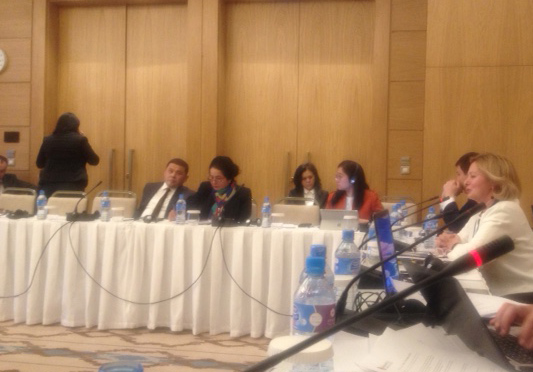
Today, the ICJ holds a round table discussion in Tashkent, Uzbekistan on “Comparative Perspectives on Judicial Ethics”.
The event takes place as part of the Central Asian Forum Expert Forum organized by the Organisation for Cooperation and Security in Europe (OSCE) in Tashkent this year.
International standards, and national standards of judicial ethics in Uzbekistan in other countries will be discussed at the event.
Participants will discuss questions of judicial independence, impartiality and accountability and disciplinary mechanisms.
Speakers at the event include Justice Ketil Lund (photo), an ICJ Commissioner and a former judge of the Supreme Court of Norway, Justice Tatiana Andreyeva, professor of law and a former Judge of the High Arbitration Court of the Russian Federation, as well as a representative of the Uzbekistan judiciary.
Legal practitioners and experts from across the Central Asian region will attend the event.
uzbekistan-side-event-tashkent-events-agenda-2016-rus (Agenda in Russian, PDF)
Oct 25, 2016 | Events
The ICJ convenes today a roundtable at the United Nations gathering several stakeholders to discuss on a possible future treaty on business and human rights.
Tuesday 25 October, 2016
13:00 to 15:00 hrs
Room XXVII- Palais des Nations
The second session of the Open Ended Intergovernmental Working Group to elaborate a legally binding instrument on Transnational Corporations and other business enterprises in relation to human rights, offers the opportunity to significantly advance the process of establishing an effective treaty that assist in preventing and addressing business related human rights abuses. Advancing the process will require stakeholders to reach a common platform of understanding on some core concepts and foundational elements before textual details can be elaborated and negotiated.
The objective of the roundtable is to assist in this process by creating a space for various stakeholders to address issues of importance for the treaty process from diverse points of view with the goal of enhancing mutual understanding among stakeholders of concepts and element that can serve as the basis for possible agreement for the future. This panel has a multistakeholder nature with a view to create a space of dialogue and understanding among the most important actors of the process.
Moderator:
Mr Ian Seiderman, Legal and Policy Director, International Commission of Jurists
Speakers:
Mr Ariel Meyerstein- United States Council of International Business, representing the International Organization of Employers
Mrs Makbule Sahan, Legal Advisor, International Trade Union Confederation
Prof Douglas Cassel, School of Law, University of Notre Dame, Indiana, United States
Prof Surya Deva, member of the UN Working Group on Business and Human Rights
Mr Humberto Cantú Rivera, Researcher at University of Panthéon-Assas, Paris II
Mrs Debbie Stothard, Secretary-General, International Federation of Human Rights (FIDH)
icj-side-event-2nd-session-flyer (download the flyer)

Oct 20, 2016 | Advocacy, Analysis briefs, News
In a paper published today, the ICJ recommends a series of substantive elements that it considers as key to an effective treaty on business and human rights.
The ICJ is publishing this paper as the second session of the open ended intergovernmental working group on transnational corporations and other business enterprises with respect to human rights (OEIWG) will be held next week (24-28 October).
On 26 June 2014, the United Nations Human Rights Council (HRC) adopted Resolution 26/9 establishing an “open ended intergovernmental working group on transnational corporations and other business enterprises with respect to human rights” (OEIWG) with the mandate to “elaborate an international legally binding instrument to regulate, in international human rights law, the activities of transnational corporations and other business enterprises”.
The first session of the OEIWG took place from 6 to 10 July 2015.
The ICJ supports the objective of establishing an international legally binding instrument on transnational corporations and other business enterprises, with a focus on business accountability and access to effective remedies for human rights abuses by business enterprises.
There is a substantial international protection gap to be filled in this respect, on which the ICJ has previously commented extensively.
It is with a view to closing this gap and ensuring that international human rights law can optimally fulfil its protective function that the ICJ is engaging in the present treaty process.
The key elements in the ICJ paper are a contribution to the ongoing discussions about the future instrument, without being exhaustive as to such elements.
The ICJ has already published a paper focused on issues of scope of businesses to be addressed in the treaty, in particular the meaning or “transnational corporations (TNCs) and other business enterprises” a question which remains unresolved and is contentious in the OEIWG discussions.
The present paper will focus on the possible content of the prospective treaty.
universal-oewg-session-2-icj-submission-advocacy-analysis-brief-2016-eng (full text in PDF)
Oct 11, 2016 | News
Thailand should immediately end the use of Article 44 of the Interim Constitution which gives the Head of the military junta sweeping, unchecked powers contrary to the rule of law and human rights, said the ICJ today.
Despite widespread international condemnation of Article 44, its use has increased every year since the Interim Constitution was promulgated on 22 July 2014 following the coup d’état of 22 May 2014.
The Head of the National Council for Peace and Order (NCPO), Prayut Chan-o-cha, has issued at least 107 Orders under Article 44 (available in the public domain): at least one in 2014; 44 in 2015; and 62 in 2016 to date – with 37 Orders being issued since June 2016 alone.
“The Head of the NCPO’s increasing willingness to use extraordinary powers to make ad hoc, arbitrary changes to existing laws and regulations without judicial oversight should be alarming to everyone, including the business sector,” said Wilder Tayler, Secretary General of the ICJ.
“Article 44 places law making power in the hands of one man, while Articles 47 and 48 of the Interim Constitution block judicial review or access to remedies and reparation. This is entirely inconsistent with the three fundamental pillars of the rule of law, equality, accountability and predictability, and should be revoked immediately,” he added.
The Article 44 orders range from those restricting the civil rights of all people in Thailand to those aimed at seemingly minor and ordinary bureaucratic processes.
To date, Article 44 has been used to introduce a raft of revisions into existing Thai law without observing proper process or practice, including providing for the acquisition of land for the establishment of Special Economic Zones bypassing the usual environmental and social checks and balances provided for in domestic legislation; granting military officers sweeping powers of investigation, arrest and detention; and prohibiting the gathering of five or more persons for political purposes.
“It is long past time for Thailand to revoke Article 44 and all others laws, orders and announcements issued since the military coup that are inconsistent with the rule of law and human rights,” Tayler said.
“The justifications the military presented for such measures were never valid or credible, and certainly not so after more than two years of direct military rule.”
All Orders issued under Article 44 – and all other NCPO Orders and Announcements – will continue to remain in force under the draft Constitution that was accepted at a public referendum on 7 August 2016, and may only be repealed or amended by an Act.
Last week, Deputy Prime Minister Wissanu Krea-ngam announced that the NCPO was considering converting many of the hundreds of orders issued by the NCPO into legislation, including those issued under Article 44.
thailand-art-44-ncpo-news-press-releases-2016-eng (full text with background, in PDF)
thailand-head-of-ncpo-orders-advocacy-2016-eng (full list of all publicly available Head of NCPO Orders, in PDF)
thailand-art-44-ncpo-news-press-releases-2016-tha (full text in Thai, PDF)