Nov 22, 2017 | News
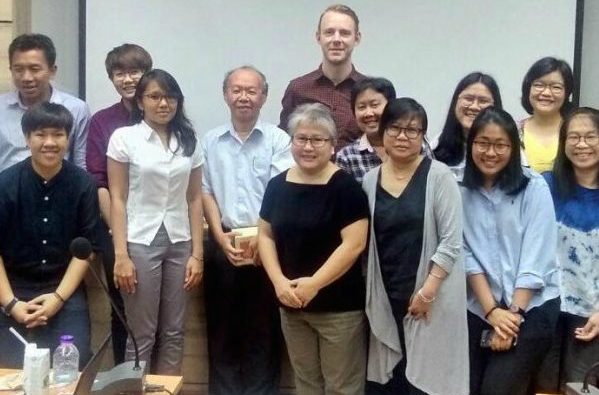
On 22 November, the ICJ, in collaboration with the Legal Research and Development Center under Chiang Mai University’s Faculty of Law, held a roundtable discussion on “Human Rights Litigation concerning the Special Economic Zones in Myanmar and Thailand”.
The objective of the discussion, held on campus at Chiang Mai University, was to identify legal issues and to share experiences regarding strategic litigation and advocacy strategies concerning human rights violations associated with the development of Special Economic Zones (SEZs) in Thailand and Myanmar.
In recent years, both the Thai and Myanmar governments have been trying to attract foreign direct investment into their countries by demarcating specific areas where special regulations concerning, inter alia, public administration, the environment, land or labour rights might be applied.
Proponents of SEZs tend to link their development with jobs and economic growth, however, there is generally limited publicly available information about their economic or public purpose rationale.
The development of SEZs, which requires a lot of land, can undermine the protection of human rights and the rule of law by creating governance structures and permitting processes less stringent than that required under national and international law.
Participants at the discussion included postgraduate students and lecturers from Chiang Mai University’s Faculty of Law, lawyers and representatives from Thai civil society organisations.
The ICJ shared with participants its report analysing the legal framework of SEZs in Myanmar and human rights concerns arising from a case study of Kyauk Phyu SEZ, ‘Special Economic Zones in Myanmar and the State Duty to Protect Human Rights’, during the discussion.
The speakers at the discussion were:
· Sean Bain, ICJ International Legal Advisor, Myanmar
· Sumitchai Hattasan, Director, Center for Protection and Revival of Local Community Rights
· Supaporn Malailoy, EEC Watch, Human Rights and Environmental Lawyer

Nov 1, 2017 | News
The ICJ welcomes the Pattani Provincial Prosecutor’s decision to end the criminal prosecution of three prominent human rights defenders who raised allegations of torture in Thailand’s restive deep South: Ms Pornpen Khongkachonkiet, Mr Somchai Homlaor, and Ms Anchana Heemmina.
On 24 October 2017, the Region 9 Senior Expert Public Prosecutor, on behalf of the Pattani Provincial Prosecutor, informed the Superintendent of the Muang District Pattani Police Station of the decision to end the prosecution of the three defenders for criminal defamation and violation of the Computer Crime Act.
The ICJ has previously expressed concern that the prosecutions were unwarranted and abusive and were aimed at chilling the exercise of critical human rights work in Thailand.
“While we welcome the decision to end these prosecutions, they have already caused a tremendous amount of damage to complainants of serious human rights violations like torture and ill-treatment, civil society, and the local community in the deep South that must now be repaired,” said Kingsley Abbott, the ICJ’s Senior International Legal Adviser for Southeast Asia.
“An important first step would be to pass legislation which criminalizes torture and ill-treatment and provides meaningful protections for those who wish to come forward with allegations of violations,” he added.
On 28 February 2017, the UN Office of the High Commissioner for Human Rights announced that it had been informed that the Thai National Legislative Assembly (NLA) would not enact legislation then under consideration criminalizing torture and enforced disappearance, the Draft Prevention and Suppression of Torture and Enforced Disappearance Act (Draft Act).
The following day, an NLA official speaking to BBC Thai confirmed that the Draft Act would be “returned [to the Thai Cabinet] for more consultations… with Interior officials, police authorities, the national security sector, military authorities and prosecutors.”
The Draft Act remains with the Thai Cabinet.
“It is long past time for Thailand to make good on its repeated commitments on the international stage to pass this essential piece of legislation in accordance with its international human rights obligations,” added Abbott.
Contact
Kingsley Abbott, Senior International Legal Adviser, ICJ Asia Pacific Regional Office, t: +66 94 470 1345, e: kingsley.abbott(a)icj.org
Background
On 10 February 2016, three Thai organizations, the Cross Cultural Foundation (CrCF), Duay Jai Group (Hearty Support Group), and the Patani Human Rights Organization (HAP), issued a report that documented 54 cases of alleged torture and ill-treatment by the Thai security forces in the deep South since 2004.
In response, the Internal Security Operations Command (ISOC) Region 4 (Forward Command) – created to resolve the situation in the deep South – made complaints of criminal defamation against the three co-editors, Pornpen Khongkachonkiet (Director of the CrCF), Somchai Homlaor (Senior legal advisor to CrCF and Hearty Support Group), and Anchana Heemmina (founder and Director of the Hearty Support Group).
On 26 July 2016, the Thai police charged the three defenders with criminal defamation by means of publication under Article 326 and 328 of the Penal Code, and importing false information to a computer system under Article 14 (1) of the Computer-Related Crime Act B.E. 2550 (2007).
On 7 March 2017, the ISOC 4 Forward Command announced its intention to drop the complaints at a press conference in Bangkok.
Thailand is a State party to the International Covenant on Civil and Political Rights (ICCPR), the Convention against Torture and other Cruel, Inhuman or Degrading Treatment or Punishment (CAT) and has signed, but not yet ratified, the International Convention for the Protection of All Persons from Enforced Disappearance (ICPPED).
Further reading on these criminal proceedings
Thailand: ICJ welcomes dropping of complaints against human rights defenders but calls for investigation into torture
Thailand: stop use of defamation charges against human rights defenders seeking accountability for torture
Thailand: immediately withdraw criminal complaints against human rights defenders
Further reading on the Draft Prevention and Suppression of Torture and Enforced Disappearance Act
Thailand: ICJ commemorates international day in support of victims of enforced disappearances
Thailand: pass legislation criminalizing enforced disappearance, torture without further delay
Thailand-News-Pressreleases-humanrightsdefenders-2017-THAI (full press release in Thai, pdf)

Sep 12, 2017 | News, Publications, Reports, Thematic reports
The Venezuelan Supreme Court has ceased to act as an independent court upholding the rule of law, but has become an arm of an authoritarian executive, the ICJ said in a new report released today.
The ICJ report The Supreme Court of Justice: an instrument of executive power says that through a series of rulings issued since December 2015, the Venezuelan Supreme Court has progressively dismantled the rule of law, undermined human rights and failed to faithfully apply key elements of the country’s Constitution.
In rulings on 27 and 28 March 2017 (Sentencias 155 and 156), the Supreme Court of Justice (SCJ) delivered a blow to the rule of law, effectively claiming legislative powers for itself, depriving the National Assembly of its Constitutional powers and granting sweeping arbitrary powers to the executive, the ICJ notes.
“These decisions amount to a coup d’état against the Constitutional order and have ushered in a new reign of arbitrary rule,” said Sam Zarifi, the ICJ Secretary General.
The report analyses SCJ jurisprudence issued since December 2015 in the light of international law and standards, rule of law principles and the Venezuelan Constitution, and in relation to the Constitutional functions and faculties of the legislative power, parliamentary oversight, states of emergency and the amnesty.
It finds that:
- The SCJ has been decisively co-opted by the Venezuelan executive;
- The Court’s members are mainly from the United Socialist Party of Venezuela (Partido Socialista Unido de Venezuela) and/or ex-Government officials; and
- It has become a political instrument increasingly used against the political and social opposition.
The report also says the Court has interpreted the Constitution in an arbitrary manner, omitting to analyse key Constitutional standards while granting a supra-Constitutional status to standards of lesser rank.
It has abrogated due process and judicial review and so stripped the National Assembly of its Constitutionally mandated functions with regard to legislative matters, parliamentary oversight, regulation and internal administration in order to benefit the government politically, the ICJ adds.
“The rulings have not been issued with impartiality on the basis of facts and in accordance with law, as required under rule of standards,” Zarifi said.
“They are in flagrant violation of the Venezuelan Constitution. The SCJ has issued its decisions based on political considerations and ideological and party loyalties to the executive power,” he added.
The report also outlines key recommendations on the administration of justice which various UN and Inter-American procedures and bodies have made to Venezuela going back a number of years.
None of these recommendations appear to have been taken into account by the Venezuelan authorities. These include reparations ordered by the Inter-American Court of Human Rights, which are binding on Venezuela as a matter of law.
“The Venezuelan authorities are in breach of its international obligation to cooperate in good faith with international human rights bodies and procedures,” Zarifi said.
Finally, the report concludes that the SCJ has undermined the rule of law by violating the principle of the separation of powers and infringing upon the Constitutional functions and autonomy of the legislative power.
As a consequence of its decisions based on the political interests of the executive power, the SCJ has lost the essential attributes of an authentic judicial power, such as independence, impartiality, autonomy and legitimacy.
“The SCJ has assumed the role of giving an appearance of judicial legitimacy to the arbitrary political actions of the executive thus abandoning the exercise of its Constitutional function as the guarantor of the rule of law, human rights and fundamental freedoms,” Zarifi added.
Contact:
Sam Zarifi, ICJ Secretary General, t +41 79 726 44 15 ; e sam.zarifi@icj.org
Federico Andreu-Guzman, ICJ South America Representative, t +57 311 481 8094 ; e federico.andreu@icj.org
Download the report:
Venezuela-Suprem Court-Publications-Reports-Thematic reports-2017-ENG (in PDF)
Further readings:
Venezuela: rule of law and impunity crisis deepens
Venezuela: dismissal of Attorney General a further blow to the rule of law and accountability
Venezuela: Human rights and Rule of Law in deep crisis
Strengthening the Rule of Law in Venezuela
Sep 3, 2017 | News
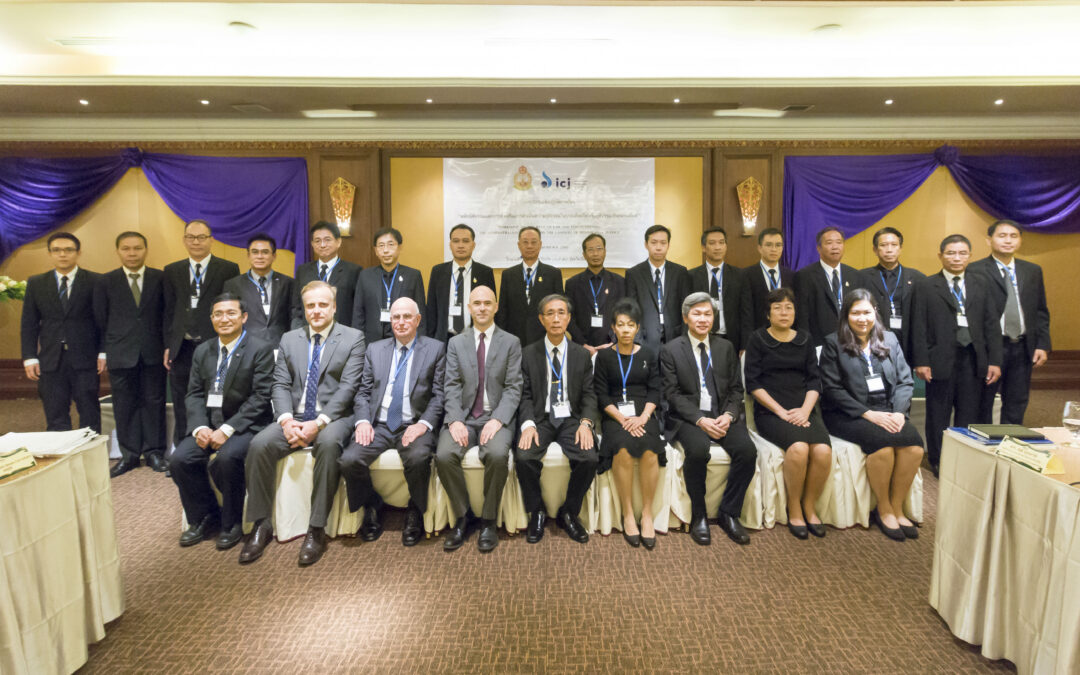
On 2 and 3 September, the ICJ held a workshop on “the Rule of Law and Strengthening the Administration of Justice in the Context of Restorative Justice” for members of the Thai judiciary.
The workshop was held in Chiang Mai.
Twenty-two judges attended the workshop, with an observer from the Thailand Institute of Justice (TIJ).
The objective of the workshop was to discuss how to best apply international standards of restorative justice within Thailand’s justice system.
Restorative justice is based on the fundamental principle that criminal behavior not only violates the law, but also injures victims and the community.
A restorative process is any process in which the victim and the offender and, where appropriate, any other individuals or community members affected by a crime participate together actively in the resolution of matters arising from the crime, with the help of a facilitator.
Frederick Rawski, Regional Director of ICJ Asia and the Pacific, recognized in his opening statement that implementation of restorative justice, including constructive non-custodial sentencing and measures, could assist in combating the problem of overcrowding in detention facilities in the North of Thailand, particularly with respect to drug-dependent offenders.
The workshop made reference to the United Nations Declaration of Basic Principles on the Use of Restorative Justice Programmes in Criminal Matters, which was adopted by the United Nations Economic and Social Council in 2002.
Speakers at the Workshop included Chief Justice Somnuk Panich from Office of the Chief Justice Region V, who formally opened the workshop, Judge Dr. Dol Bunnag, Presiding Judge of Intellectual Property and International Trade Court, who summarized the landscape of restorative justice in Thailand, and Judge Sir David James Carruthers from New Zealand, an international expert on restorative justice in New Zealand.
ICJ’s Senior International Legal Adviser Kingsley Abbott moderated the two-day workshop.
The ICJ ended the workshop with a statement reiterating its commitment towards working with Thailand’s judiciary to strengthen the rule of law and administration of justice in Thailand.

Apr 20, 2017 | News
Nepali authorities should immediately take effective steps to enforce the landmark Kavre district court murder verdict for the 2004 torture and killing of teenage Maina Sunuwar, the ICJ, Amnesty International, and Human Rights Watch said today.
On 16 April 2017, the Kavre district court sentenced three army officers to life imprisonment for the murder of Maina Sunuwar, a 15-year-old girl (photo) who was tortured in army custody and died as a result in February 2004.
Maina’s killing took place during the decade-long armed conflict between the Maoists and government forces that ended in 2006.
A court martial in 2005 found that Maina had died in army custody, convicted the three officers of torture and murder, but only sentenced the three perpetrators to six months’ imprisonment for minor offences, and promptly released them on grounds that they had already served the six months while confined to army barracks during the period of investigation.
“These convictions are an important development in Nepal’s slow-paced justice system’s ability to deal with grave conflict-era human rights abuses,” said Sam Zarifi, the ICJ’s Secretary General.
“What we need now is for the government to demonstrate its commitment to the rule of law and enforce them,” he added.
The trial before the Kavre district court took place in the absence of any of the four accused, despite repeated court summonses, including an arrest warrant, to notify them of the charges and compel them to appear in court.
The three accused army officers who were convicted of Maina Sunuwar’s murder, Bobi Khatri, Amit Pun and Sunil Adhikari, are no longer in the army and are believed to have fled abroad after the court martial proceedings.
The fourth accused, who was acquitted, Major Niranjan Basnet, is still in the army and was repatriated to Nepal from a UN peacekeeping assignment in Chad in 2009 due to the indictment against him.
Maina Sunuwar’s case has become emblematic of the shortcomings in Nepal’s justice system that have repeatedly frustrated efforts of Nepali conflict victims to secure justice for wartime abuses.
Maina Sunuwar’s mother first filed a report with the police in November 2005.
Since then, there have been numerous procedural and political hurdles, and a lack of cooperation by the military as it sought to protect its own.
An arrest warrant issued in 2008 was never enforced by Nepali authorities, with the police telling the court they were unable to trace them.
“Maina Sunuwar’s case was a true test case for the Nepal criminal justice system, but the government has a habit of simply ignoring court orders,” said Brad Adams, Asia director of Human Rights Watch. “This is the first sign of hope for victims after more than ten years since the end of the conflict—and now we need to see all those convicted of murder behind bars.”
The human rights organizations expressed concern that the government might refuse to seek to take measures to enforce the Kavre court’s verdict given its prior record on this and thousands of other conflict-era cases.
In a disturbing example, the police have yet to implement a 13 April 2017 Supreme Court order to arrest Bal Krishna Dhungel, a Maoist politician convicted of a 1998 murder.
Dhungel has yet to serve out his life sentence handed down by the courts.
The court gave the police a week to execute its order and present Dhungel before it.
“The Kavre district court has done its job, reaffirming the independence of the judiciary from political and military pressure, and holding perpetrators of serious crimes committed during the conflict to account,” said Biraj Patnaik, Amnesty International South Asia Regional Office Director. “Now the authorities must do their job by breaking with the practice of successive past governments that ignore and undermine the courts’ decisions. We expect the government to promptly implement this week’s ruling.”
Contact
Nikhil Narayan, ICJ’s South Asia Senior International Legal Adviser, e: Nikhil.narayan@icj.org
Sam Zarifi, ICJ’s Secretery General, e: sam.zarifi@icj.org