May 25, 2017 | News
The Philippine government must ensure that human rights are protected and respected in Mindanao, in light of the yesterday’s declaration of martial law and suspension of the writ of habeas corpus, the ICJ said today.
The ICJ reminds the Philippine government that it remains responsible for upholding its international human rights legal obligations, notwithstanding the imposition of martial law.
The ICJ also calls upon the Congress and, if engaged, the Supreme Court, to exercise their oversight authority to ensure that the declaration is necessary and lawful, and that the activities conducted under martial law respect human rights.
“The suspension of the writ of habeas corpus, which is vital for protecting the right to liberty and preventing torture, ill-treatment and enforced disappearance, must be lifted immediately,” said Frederick Rawski, ICJ’s Regional Director for Asia and the Pacific.
Rawski added, “The provision of the Philippine Constitution providing for the possibility of suspension of the writ of habeas corpus is in contravention of international law, and denying the right to challenge the lawfulness of a detention is incompatible with recognized principles of the rule of law.”
President Rodrigo Duterte declared martial law on the evening of 23 May 2017, covering the island of Mindanao, after Maute, an armed group that had pledged allegiance to the Islamic State of Iraq and the Levant (ISIL), reportedly laid siege on Marawi City. The next day, 24 May 2017, President Duterte suspended the writ of habeas corpus.
The ICJ recalls that the right to challenge the lawfulness of one’s detention through habeas corpus or similar procedures must always be available, even under states of exception like martial law.
The ICJ calls on the Philippine government to establish a clear timetable for an end to martial law, and to ensure in the interim that human rights are fully protected.
Background
Under Article VII, Section 18 of the 1987 Philippine Constitution, the President may declare martial law or suspend the privilege of the writ of habeas corpus in case of invasion or rebellion and only “when the public safety requires it.” However, Article VII, Section 18 of the 1987 Constitution limits a declaration of martial law to 60 days, and imposes other important limitations – including that the President of the Philippines must submit a report to Congress within 48 hours, which may then revoke the suspension or declaration.
Any citizen may petition the Supreme Court to review the sufficiency of the factual basis of the proclamation of martial law, or the suspension of the writ of habeas corpus. Finally, this provision of the Constitution also provides that in the case of a suspension of the writ of habeas corpus, any arrested or detained person must be judicially charged within three days, or be released.
Contact
Emerlynne Gil, ICJ’s Senior International Legal Adviser for Southeast Asia, email: emerlynne.gil(a)icj.org tel: +66 840923575.
Mar 14, 2017 | News
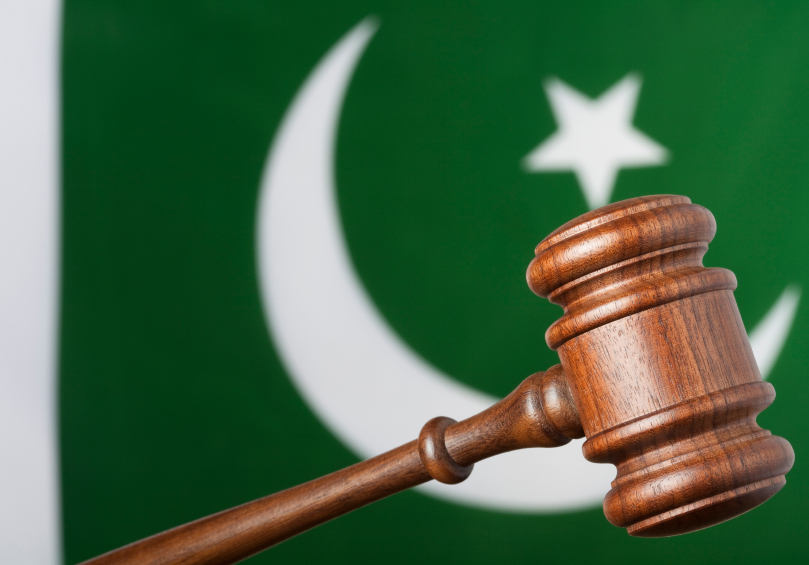
The ICJ urged the Pakistan government to withdraw its proposal to reinstate and widen the scope of military trials for civilians.
“Bringing back military courts is an attempt to deflect attention from the real issue: the Government’s failure to enact reforms to strengthen the criminal justice system during the two years the 2015-2017 military courts were in operation,” said Sam Zarifi, ICJ’s Asia Director.
Bills to amend the Constitution of Pakistan and the Army Act, 1952, to extend the jurisdiction of military courts to try a wide variety of terrorism-related offences, were introduced before the National Assembly (lower house of parliament) on Friday, 10 March.
The “terrorism-related” offences include, among others: abducting any person for ransom; raising arms of waging war against Pakistan; causing any person injury of death; using or designing vehicles for terrorist attacks; creating terror or insecurity in Pakistan; and attempting, aiding or abetting any of these acts.
The new amendments are also applicable in all cases where the accused commit “grave and violent acts against the State”. The mandatory requirement to belong to a group that uses “the name of religion or sect”, as introduced by the 21st Amendment and corresponding amendments to the Army Act introduced in 2015, is no longer applicable.
“The expansion of military courts’ jurisdiction over all ‘grave and violent acts against the State’ creates the possibility that these courts could be used against a wide variety of people, including those who are legitimately exercising their rights to speech, association, and assembly,” added Zarifi.
According to the preambles of the bills, an “extraordinary situation” and a “grave and unprecedented threat to the integrity of Pakistan” still exist in the country, and military courts are being revived because they “yielded positive results in combatting terrorism” in the two years they were in operation.
“The military courts have not had any positive results in combating terrorism, given the country’s ongoing problem with acts of terrorism and armed insurgents,” said Zarifi. “Instead, military trials of civilians have further eroded the rule of law and weakened the government’s legitimacy in providing justice and defending the rights of people in Pakistan.”
Background
Military courts constituted under the 21st Amendment convicted 274 people in the two years during which they were in operation, from 7 January 2015 to 6 January 2017. Of those 274 convictions, 161 people were sentenced to death and 113 people were given prison sentences. At least 17 people given death sentences have been executed by hanging. The enabling legislation for these courts lapsed on 6 January 2017 pursuant to a two-year sunset clause.
The ICJ recalled that the use of military courts to try civilians is inconsistent with international standards.
The ICJ has documented serious fair trials violations in the operation of military courts including: denial of the right to counsel of choice; failure to disclose the charges against the accused; denial of a public hearing; failure to give convicts copies of a judgment with evidence and reasons for the verdict; and a very high number of convictions based on “confessions” without adequate safeguards against torture and ill treatment.
Contacts
Sam Zarifi, ICJ Asia Pacific Regional Director (Bangkok), t: +66 807819002; e: sam.zarifi(a)icj.org
Reema Omer, ICJ International Legal Adviser for Pakistan (London), t: +447889565691; e: reema.omer(a)icj.org
Mar 9, 2017 | News
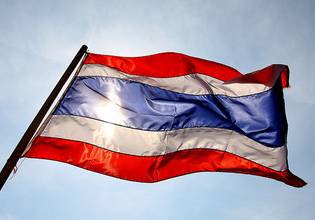
Amnesty International and the ICJ regret the decision of Thailand’s National Legislative Assembly (NLA) to further delay the passage of essential legislation criminalizing torture and enforced disappearances.
Our organizations call on the Thai government to cease its stalling measures and instead prioritize the amendment of the Draft Prevention and Suppression of Torture and Enforced Disappearance Act (Draft Act) in order to bring it into line with international law. The government should then ensure its passage into law without undue delay.
On 28 February, the Office of the High Commissioner for Human Rights announced that it had been informed that the NLA would not enact the Draft Act. The following day, an NLA official speaking to BBC Thai confirmed that the draft would be “returned [to the Thai Cabinet] for more consultations… with Interior officials, police authorities, the national security sector, military authorities and prosecutors.”
The Draft Act is the result of years of effort by government authorities, including by Ministry of Justice officials who consulted with our organizations and took account of many of our recommendations in elaborating it. The draft was approved by Thailand’s Cabinet in May 2016.
The recent decision by the NLA has indefinitely delayed the enactment of this important piece of legislation, which would represent a significant step towards preventing torture and enforced disappearances in Thailand.
The slow-tracking of this law in the face of all the commitments Thailand has made over the years right up to last year is extremely disappointing, especially for the victims of torture and enforced disappearances who have struggled to obtain justice in the absence of a clear legal framework.
The most recent version of the Draft Act addresses many existing gaps in Thailand’s current legal framework and could support Thailand’s compliance with its obligations under international human rights law. However, further amendments are needed to address significant shortcomings in the Draft Act.
In particular, the Draft Act omits key elements from the definitions of torture and enforced disappearances, does not criminalize acts of cruel, inhuman or degrading treatment, and fails to define enforced disappearance as a continuing crime. Additionally, the Draft Act does not extend criminal liability beyond the direct commission of the act and fails to unequivocally bar the use as evidence in court proceedings of statements obtained by torture.
Thailand should make it a top priority to address these and other concerns and to enact the law as soon as possible. The urgent need to amend and enact the Draft Act is underscored by recent reports alleging the use of torture and other ill-treatment by state security forces and the continued failure to hold accountable perpetrators of torture, other ill-treatment and enforced disappearances.
Our organizations remain committed to providing any necessary assistance to the Thai government in amending the Draft Act or otherwise acting to prevent torture and enforced disappearances in Thailand.
Background
Thailand is a state party to the International Covenant on Civil and Political Rights (ICCPR), the Convention against Torture and other Cruel, Inhuman or Degrading Treatment or Punishment (CAT), and has signed, but not ratified, the International Convention for the Protection of All Persons from Enforced Disappearance (ICPPED).
The expert UN bodies overseeing the implementation of these treaties have consistently called upon states parties to criminalise torture and enforced disappearance as specific crimes.
On 13 and 14 March 2017, the UN Human Rights Committee will review Thailand’s compliance with the ICCPR.
In Thailand’s 15 November 2016 reply to the Committee’s List of Issues,[1] it noted that it was in the process of passing the Draft Law which would “provide clear definition and set up specific offence on torture to be in line with the terms set forth under CAT” and “serve as an implementing legislation for ICPPED.”
It also noted that the Draft Act “aims to strengthen the prevention, suppression, and prosecution mechanism and to ensure remedy for victims as well as address the problem of misuse, and abuses of power by government authorities with regard to torture and enforced disappearances.”
It concluded by noting that “[o]n 24 May 2016, the Cabinet approved the draft Act in principle. The draft has been reviewed by the Council of State and is currently waiting to be submitted to the legislative branch for consideration.”
[1] Human Rights Committee, “Replies of Thailand to the List of Issues,” U.N. Doc. CCPR/C/THA/Q/2/Add.1, para 51.
Thailand-Joint Statement-Torture Legislation-News-2017-ENG (Press release in PDF)
Contact
Kingsley Abbott, Senior International Legal Adviser for Southeast Asia, Tel: +66 94 470 1345, E-mail: Kingsley.abbott(a)icj.org

Dec 5, 2016 | News
A joint statement calls on members of the House of Representatives of the Philippines to stop further attempts to reintroduce the death penalty and to block any legislation that subverts human rights.
On 29 November 2016, the Sub-Committee on Judicial Reforms of the House Committee of Justice approved a bill restoring the death penalty in the Philippines by railroading the proceedings in the committee and ignoring important questions from other lawmakers questioning the need for the legislation or its urgent passage.
The full statement can be downloaded here:
philippines-joint-statement-death-penalty-news-web-story-2016-eng (PDF)

Nov 29, 2016 | News
The Philippines House of Representatives must immediately cease efforts to rush through legislation restoring the death penalty, the International Commission of Jurists (ICJ) said today.
On 29 November 2016, the Sub-Committee on Judicial Reform, which is chaired by Congressman Marcelino “Ching” Veloso, hastened the passage of a bill restoring the death penalty in the Philippines.
According to reports received by the ICJ, ex-officio members of the Sub-Committee on Judicial Reform railroaded the proceedings and ignored important questions from other lawmakers questioning the need for the legislation or its urgent passage. The Sub-Committee did not present any report, as is the normal practice, on the discussions and information presented in the previous hearings.
“Filipino lawmakers seem intent on embracing the barbaric practice of executions purely as a political measure, without any understanding or even proper discussion of the death penalty’s impact or what their actions would mean to the international obligations of the Philippines,” said Emerlynne Gil, ICJ’s Senior International Legal Adviser for Southeast Asia.
A representative of the ICJ spoke at the hearing of the Sub-Committee on 22 November 2016, and brought to the lawmakers’ attention the country’s obligations under the 2nd Optional Protocol to the International Covenant on Civil and Political Rights (ICCPR) and the general prohibition on reintroduction of capital punishment once abolished, which commit the country not to execute anyone within its jurisdiction.
“There are already thousands of alleged cases of extrajudicial killings in the country. This bill, if it becomes law, will unquestionably usher the Philippines into a dark period where respect for the right to life is comprehensively degraded,” Gil emphasized.
The ICJ has previously written to President Rodrigo Duterte underscoring that the evidence shows that death penalty is not effective at deterring crime at a greater rate than alternative forms of punishment. Investing in improved detection and investigation techniques and capacity, and improving the effectiveness and efficiency of the justice system, is more likely to achieve real results in reducing crime.
The ICJ categorically opposes the death penalty and considers its use to be a violation of the right to life and freedom from cruel, inhuman, or degrading punishment.
The UN General Assembly has repeatedly adopted resolutions by overwhelming majorities, calling on all retentionist States to impose a moratorium with a view to abolition.
Contact:
Ms. Emerlynne Gil, ICJ’s Senior International Legal Adviser
Telephone: +66 840923575
Email: emerlynne.gil(a)icj.org