Mar 28, 2016 | News
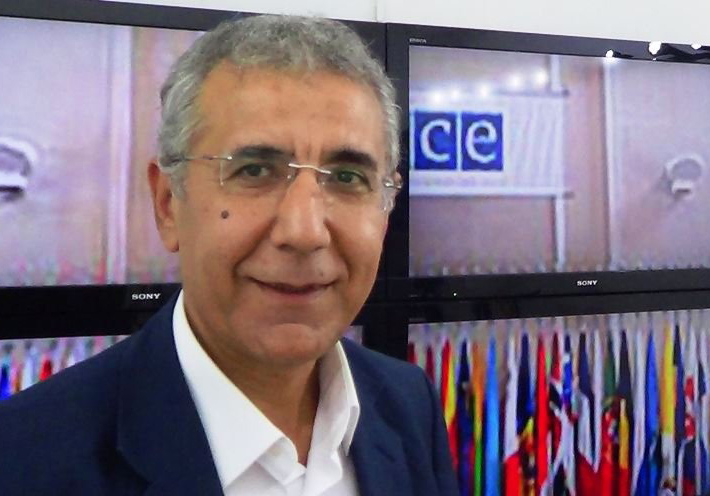
The ICJ welcomes the release of human rights lawyer Intigam Aliyev today after the Supreme Court reduced and suspended his sentence and ordered his immediate release.
Intigam Aliyev, a prominent human rights lawyer and the head of the NGO Legal Education Society, had been convicted on 22 April 2015 of tax avoidance, illegal entrepreneurship and abuse of power and sentenced to seven and a half years of imprisonment by a Baku Court.
A number of credible human rights organizations and international observers who have closely followed the case have stated that they consider the charges he was tried on to have been politically motivated, and that the real reason for his prosecution and conviction was repression by the Government of critical voices in civil society.
In a closed hearing, the Supreme Court reduced his sentence to five years of imprisonment and suspended its execution, after a request to this effect was made by Azerbaijan’s Prosecutor General, Zakir Garalov.
This unusual initiative follows the rejection, on 24 February, by the same Supreme Court of Intigam Aliyev’s complaint against his sentence.
“While the release of Intigam Aliyev is a positive step, the ICJ remains concerned that this decision appears to leave the underlying conviction in place despite credible reports that the charges were politically motivated,” said Massimo Frigo, ICJ Legal Adviser.
“If, as these allegations would suggest, Intigam Aliyev was targeted for his work as a lawyer, this would clearly violate international standards on the independence of lawyers”, said Temur Shakirov, another ICJ Legal Adviser.
Contact
Temur Shakirov, Legal Adviser, Europe Programme, temur.shakirov(a)icj.org
Massimo Frigo, Legal Adviser, Europe Programme, masimo.frigo(a)icj.org

Feb 19, 2016 | News
The ongoing incommunicado detention of human rights defenders Nguyễn Văn Đài and Lê Thu Hà must end, said today seven human rights groups, including the ICJ. It violates their right to freedom from torture and other cruel, inhuman or degrading treatment or punishment.
All charges against Nguyễn Văn Đài and Lê Thu Hà, should be withdrawn and they should be immediately and unconditionally released, the organizations added.
An incommunicado detention is one in which a detainee is held without access to the outside world, particularly to family, lawyers, courts and independent doctors. The practice of incommunicado detention violates key rights of persons deprived of liberty and facilitates torture and other ill-treatment. Prolonged periods of incommunicado detention can themselves constitute a violation of the prohibition on torture and other ill-treatment.
Nguyễn Văn Đài and Lê Thu Hà were arrested on 16 December 2015 and charged under Article 88 of the Penal Code, ‘Conducting propaganda against the state’. All efforts by family and legal counsel to visit the pair since their arrests have been denied.
Vietnam-Release prisoners-News-webstory-2016-ENG (full story, in PDF)

Nov 11, 2015 | News
While welcoming the Maldives government’s revocation of the emergency yesterday, the arbitrary manner in which the emergency was first imposed and then suddenly revoked within the span of a week reflects a deeper erosion of the rule of law in the country, the ICJ said today.
On 10 November, a week after declaring a 30-day state of emergency, the Maldives lifted the emergency reportedly because authorities had arrested several people in connection with an alleged plot to “use dangerous weapons and explosives”, thereby neutralizing the purported national security threat cited as the grounds for the emergency.
Maldivian authorities have not provided any information as to who or how many individuals were arrested or the nature of the charges.
“The imposition of a state of emergency is not a political tool to be used willy-nilly as a matter of convenience to suspend human rights protections and suppress political opposition,” said Nikhil Narayan, ICJ’s South Asia Senior Legal Adviser.
“A state of emergency that suspends constitutional rights is not to be declared lightly,” he added. “It has serious implications for human rights and the rule of law in the country, and must only be invoked in the most extreme situations and in accordance with international law.”
International law expressly permits derogations of certain human rights only in times of public emergency which threatens ‘the life of the nation’.
“Declaring a 30-day emergency and then suddenly lifting it a week later only reinforces the serious concerns previously raised as to the legitimacy of the emergency in the first place, and speaks to the larger rule of law crisis in the country,” Narayan said.
The emergency decree issued by the Maldives government last week suspended several constitutional rights, including the right to freedom of peaceful assembly, and reduced the constitutionally mandated period for the vice president to respond to impeachment charges from 14 to 7 days.
The opposition Maldivian Democratic Party (MDP) had planned a public anti-government demonstration for 6 November, two days prior to which the emergency was declared.
Meanwhile, the vice president was removed from his post the day after the emergency decree, 5 November, in a swift and seemingly arbitrary impeachment hearing.
“The circumstances surrounding events in the Maldives this past week clearly suggest that the government was using the emergency as a ploy to prevent the planned opposition rally and to eliminate the vice president as a political threat,” said Narayan.
The emergency also granted sweeping powers of search, arrest and detention without warrant to the police, who reportedly raided several buildings and arrested an unknown number of individuals under its emergency powers over the past week.
“The Maldives government cannot flout international law by invoking emergency powers as a means to deny the due process rights of the vice president and others arrested or detained for alleged crimes,” added Narayan. “The government must ensure that the individuals arrested during the emergency are afforded their full fair trial and due process rights in accordance with international law.”
Additional Information:
The ICJ previously raised concerns that the alleged grounds for the emergency did not appear to establish a threat to the life of the as required by the high threshold set by international law, and could not in any event justify the complete suspension of constitutional rights.
In August 2015, following a joint fact-finding mission to the Maldives, the ICJ and South Asians for Human Rights (SAHR) documented the breakdown of the rule of law and human rights in the Maldives in a 35-page report, Justice Adrift: Rule of Law and the Political Crisis in the Maldives.
Contact:
Nikhil Narayan, ICJ Senior Legal Adviser for South Asia, t: +977 9813187821 ; e: nikhil.narayan(a)icj.org
Jun 8, 2015 | News
While the constitution of Pakistan’s first National Commission for Human Rights is welcome, the Commission risks being toothless unless its powers are extended to investigate human rights violations allegedly committed by the security agencies, the ICJ warned today.
The ICJ was informed that members of the National Commission for Human Rights were notified on 20 May 2015, three years after the National Commission for Human Rights Act was passed in June 2012.
“The establishment of a national human rights commission is a much-needed step for the promotion and protection of human rights in Pakistan,” said Sam Zarifi, ICJ’s Asia Director. “But for the new Commission to be able to assist the people of Pakistan, who face tremendous violations of their rights in terms of civil, political, social, economic, and cultural rights, it must be able to address the conduct of the country’s powerful military and security agencies.”
Under the National Commission for Human Rights Act, the Commission’s powers include investigating human rights violations, suo motu or on petition; visiting detention centers to ascertain the legality of the detention of detainees and ensure detainees are treated according to law; reviewing and suggesting amendments to Pakistan’s constitutional and legal framework on human rights; making recommendations for the effective implementation of international human rights treaties; and developing a national plan of action for the promotion and protection of human rights.
The law provides that while inquiring into complaints under the Act, the Commission shall have all powers of a civil court, including summoning and ensuring attendance of witnesses, receiving evidence on affidavits; and discovery and production of documents.
However, the Commission’s mandate is very limited where the armed forces or security agencies are accused of committing human rights violations, the ICJ says.
The law specifically states that “the functions of the Commission do not include inquiring into the act or practice of the intelligence agencies”.
Where the armed forces are accused of human rights violations, the Commission is only authorized to seek a report from the Government and make recommendations.
“The Commission’s restricted mandate over the armed forces, and especially the intelligence agencies, is of grave concern given that Pakistan’s military and intelligence services are accused of perpetrating gross human rights violations, including enforced disappearances, extrajudicial killings, and torture and ill-treatment,” Zarifi said. “A human rights commission that does not have jurisdiction over abuses by these actors risks being toothless and ineffective – and worst, a cover for continuing government inaction in response to these violations.”
“With these exceptions in place, it seems questionable that the Commission will get accreditation by the International Coordinating Committee of NHRIs, which is a requirement for a National Human Rights Institution to be recognized internationally,” he added. “The Pakistani government should ensure that the Commission complies with international standards so it can help protect and promote the rights of all people in Pakistan.”
Additional Information:
Justice (r) Ali Nawaz Chohan was appointed as the Chairperson of the Commission. Other members include one representative from each province; one representative each from the Islamabad Capital Territory and the Federally Administered Tribal Areas; the Chairperson of the National Commission on the Status of Women; and a member belonging from a religious minority community.
The UN Principles relating to the Status of National Institutions (Paris Principles) provide the minimum standards required by national human rights institutions to be considered credible and effective, and get accreditation by the International Coordinating Committee of NHRIs. Section 3 (a) (ii) of the Paris Principles states that a NHRI should have the power to hear a matter without higher referral over “any situation of violation of human rights which it decides to take up”.
Section 4 of the National Commission on Human Rights Act, 2012, provides the following procedure for appointment of members of the Commission: the Federal Government invites nominations for commissioners through public notice; the Prime Minister and Leader of the Opposition scrutinize the nominations; and the Prime Minister and Leader of the Opposition forward three names for each member of the commission to a parliamentary committee for confirmation. The law provides that the parliamentary committee would comprise of two members of the National Assembly (lower house) and two members of the Senate (upper house) –with two members each from the government and two from the opposition.
Contact:
Sam Zarifi, ICJ Asia Pacific Regional Director (Bangkok), t: +66 807819002; e: sam.zarifi(a)icj.org
Reema Omer, ICJ International Legal Adviser for South Asia (London), t: +44 7889565691; e: reema.omer(a)icj.org

May 24, 2015 | News
The ICJ signed a joint statement together with 35 other national and international NGOs calling for the immediate release of Vietnamese blogger Tran Huynh Duy Thuc.
Tran Huynh Duy Thuc was arrested on 24 May 2009 for “promoting anti-government propaganda” after posting a blog calling for political reform and respect for human rights.
On 20 January 2010, following a one day trial with three co-defendants, he was sentenced to 16 years imprisonment followed by five years house arrest.
On 29 August 2012, the United Nations Working Group on Arbitrary Detention found that Tran Huynh Duy Thuc and his three co-defendants’ detention violated the right to freedom of opinion and expression guaranteed by Article 19 of the International Covenant on Civil and Political Rights (ICCPR), to which Vietnam is a State Party, as well as the right to liberty and security of person (Article 9) and the right to freedom of association (Article 21).
The Working Group concluded by requesting Vietnam to release Tran Huynh Duy Thuc and provide him with compensation in accordance with Article 9(5) of the ICCPR.
Vietnam-Statement on blogger Duy Thuc-News-webstory-2015-ENG (full text of statement in PDF)