Apr 30, 2015 | News
The ICJ welcomes yesterday’s adoption, by the UN Working Group on Arbitrary Detention, of the Working Group’s “Basic Principles and Guidelines on Remedies and Procedures on the Right of Anyone Deprived of His or Her Liberty by Arrest or Detention to Bring Proceedings Before Court”.
Under its resolution 20/16 (2012), the UN Human Rights Council requested the Working Group to prepare draft basic principles and guidelines on habeas corpus. The Working Group set out a first draft set of principles and guidelines ahead of its global consultation on the subject in September 2014. From 2 to 5 February 2015, the Working Group met to continue its elaboration of the Basic Principles and Guidelines, resulting in the adoption of a second draft. The Working Group adopted its final iteration of the document at the conclusion of its session on 29 April 2015. The Basic Principles and Guidelines will be presented to the Human Rights Council during the Council’s 30th regular session, to be held from 14 September to 2 October 2015.
The ICJ welcomes the Basic Principles and Guidelines as a means of assisting States to enhance, in law and in practice, respect for the right to habeas corpus. It especially welcomes certain aspects of the document, including:
- Paragraph 68, in which applicable qualifications are set out to any derogating measures to accommodate constraints on the application of some procedural elements of the right to habeas corpus;
- Principle 6 and Guideline 4 which reaffirm that habeas corpus petitions must be heard by courts that bear all characteristics of competence, independence and impartiality (paras 27, 70 and 72(a)), that competence includes the power to order immediate release if detention is fund to be arbitrary or unlawful (para 27), that immediate implementation of such orders is required (para 71(c)) and that courts must give reasoned and particularized decisions (para 71(d));
- Guideline 7, in which it is provided that individuals are entitled to take proceedings multiple times (paras 81 and 82), that expediency is required, including in cases of subsequent challenges, and especially in cases alleging, among other things, torture or ill-treatment (para 83) and that authorities remain obliged to ensure regular review of the continuing need for detention (para 84);
- Principle 9 and Guideline 8 concerning legal representation and legal aid;
- The clarifications in Principle 10 and Guideline that persons able to bring proceedings include counsel, family members or other interested parties, whether or not they have proof of the consent of the detainee (paras 34 and 92) and that no restrictions may be imposed on a detainee’s ability to contact such persons (para 35);
- The express recognition in Guideline 12 that information obtained by torture or other forms of ill-treatment may not be used in evidence;
- Guideline 13 concerning disclosure and limitations applicable to any non-disclosure of information on security or other grounds;
- Guideline 14, reflecting authorities’ obligation to justify the need and proportionality of detention;
- Principle 15 and Guideline 16 (on remedies), reflecting the overarching right to remedies and reparation (paras 43), the need for authorities to give immediate effect to an order for release (para 44) and the right to compensation, restitution, rehabilitation, satisfaction and guarantees of non-repetition (paras 109-112); and
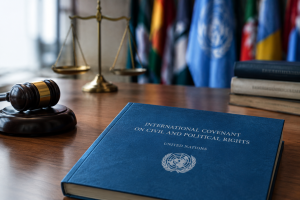
- Principle 16 concerning the application of Article 9(4) of the International Covenant on Civil and Political Rights (ICCPR) alongside international humanitarian law (paras 45 and 47), the application of Article 9(4) to civilians in an international armed conflict (para 47), the application of habeas principles to prisoners of war (para 48), and the question of administrative detention or internment in the context of a non-international armed conflict (para 49).
The ICJ has engaged in all stages of the Working Group’s elaboration and consultations. It made written submissions in November 2013, April 2014 and March 2015. Its staff, Matt Pollard and Alex Conte, gave panel presentations at the September 2014 global consultation.

Apr 7, 2015 | News
The Malaysian government must cease efforts to strengthen the country’s draconian Sedition Act 1948, which has been used with increasing frequency and severity to suppress and punish criticism of the government, said the ICJ today.
An amendment to Malaysia’s Sedition Act tabled at parliament today would make sedition a non-bailable offence, aggravating the Sedition Act’s incompatibility with international human rights standards.
“The Sedition Act has been used against the government’s political opposition much more frequently than in previous years,” said Emerlynne Gil, ICJ’s International Legal Advisor for Southeast Asia. “Since January 2015, ICJ has recorded at least 36 academicians, lawyers, politicians, students, and activists have been investigated, arrested, or charged under the Sedition Act.”
According to the ICJ, this is a significant spike when compared to the total number of reported sedition cases recorded by Malaysian civil society in previous years: 2010 (5 cases); 2011 (3 cases); 2012 (7 cases); 2013 (19 cases); 2014 (42 cases).
“Instead of repealing or restricting the Sedition Act, the new amendment actually makes it worse by limiting the ability of courts to grant bail to people accused under the Sedition Act,” Gil added.
The amendment specifically states that if the Public Prosecutor certifies in writing that it would not be “in the public interest” to grant bail to the person charged with sedition, the person shall therefore not be released on bail, a matter otherwise normally determined by the courts in each case.
Denying bail based on a mere certificate by the Public Prosecutor removes any requirement that the court be presented with evidence to remand a person in custody and it may also preclude effective inquiry by the court into the lawfulness of the arrest and detention.
“The proposed amendment removes the court’s discretion to determine whether to grant bail or not when presented with a certification from the Public Prosecutor,” Gil said. “It appears therefore that the court has no power to require evidence or even articulation of the reasons to evaluate whether it is reasonable and necessary to remand the person charged with the offence in custody.”
Under international law, the right to seek provisional release before final conviction, for instance through posting bail, is closely linked to the right not to be subjected to arbitrary detention.
Under international standards, a detention that complies with national law can nevertheless be considered arbitrary based on elements of inappropriateness, injustice, and lack of predictability.
In principle, anyone arrested on criminal allegations should have the right to seek release pending trial, including through bail proceedings before a court of law.
National laws should only allow bail to be denied where the facts of the individual case give rise to some specific reasonable ground for continued detention, such as preventing flight, or interference with evidence, or the commission of further violent offences.
Further, where the charges are incompatible with human rights – for instance when it is based entirely on protected freedom of expression – then there can be no basis whatsoever for pre-trial detention. Thus, any detention under the Sedition Act, a vague and ambiguously defined law, would be an arbitrary deprivation of liberty.
Finally, the ICJ recognizes that there have been instances when those arrested under the Sedition Act have allegedly committed acts that are recognizably criminal in character.
In these instances, other criminal laws in Malaysia could provide a proper basis for any investigation and detention.
Contact:
Emerlynne Gil, ICJ’s International Legal Advisor for Southeast Asia: emerlynne.gil@icj.org or +66840923575.
NOTE:
The figures above and the information contained in the chart and graph below are based on ICJ’s documentation in 2015 in comparison with the documentation of reported sedition cases for the past five years done by one of Malaysia’s leading organizations, Suara Rakyat Malaysia (SUARAM).
Malaysia-Graph Sedition Cases 2010to2015-Advocacy-2015-ENG (full graph in PDF)
Malasia-Sedition table 2015-Advocacy-2015-ENG (full ICJ table in PDF)
Malaysia-SUARAM document Overview – Sedition cases 2010to2014-Advocacy-2015-ENG (full SUARAM table, in PDF)

Mar 31, 2015 | News
The present form of the recently tabled draft Prevention of Terrorism Act, also known as POTA, violates international standards and seeks to reintroduce detention without trial, said the ICJ.
The Malaysian government claims that the draft POTA, which was tabled yesterday in Parliament for its first reading, together with 7 other amendments, is aimed at curbing terrorist threats in the country.
“The draft law, as it is now, is susceptible to abuse,” said Emerlynne Gil, ICJ’s International Legal Adviser for Southeast Asia. “It is very disturbing that the POTA has very similar elements that were in the problematic and now repealed 1960 Internal Security Act that was previously used to silence government opposition and curtail freedom of expression in the 1980s.”
For example, the ICJ notes with concern that the draft law allows a “board” that is not a court to order and extend detention for up to four years.
Only one of the members of the board is required to have any legal training at all.
Detention orders issued by the “board” cannot be challenged in any court, except on procedural issues.
The ICJ urges members of Parliament in Malaysia to amend the existing draft law so that it will not reintroduce draconian preventive detention measures, as in the repealed Internal Security Act.
The Parliament of Malaysia should either reject the draft law or amend its provisions to respect human rights.
CONTACT:
Emerlynne Gil, ICJ International Legal Adviser, e: emerlynne.gil(a)icj.org or m: +668 4092 3575

Mar 26, 2015 | News
The conviction of the Maldives’ former president, Mohamed Nasheed, on terrorism charges after a grossly unfair trial marks a significant deterioration of the independence and impartiality of the country’s judiciary, said the ICJ.
On 13 March, Mr. Nasheed (photo) was sentenced to 13 years in prison for the dismissal and alleged unlawful detention of the Chief Judge of the Criminal Court, Mr. Abdullah Mohamed, in 2012, when Mr. Nasheed was president.
He was convicted of an “act…of kidnapping or abduction of person(s) or of taking hostage(s)” under Section 2(b) of the Prevention of Terrorism Act 1990.
“The Maldivian judiciary’s independence has been compromised for years by serious pressure from the government, and this grossly unfair conviction highlights the numerous problems with the politicization of the judiciary in the country,” said Sam Zarifi, the ICJ’s Regional Director for Asia and the Pacific. “It is crucial for Maldivian authorities to allow Mr. Nasheed to appeal his case effectively, with transparency and monitoring by Maldivian and international observers.”
The case’s pre-trial phase and trial were marked by gross violations of international standards of fair trial, including Article 14 of the International Covenant on Civil and Political Rights, to which the Maldives acceded in 2006.
Two of the judges on the three-judge bench testified as witnesses against Mr. Nasheed in the 2012 investigation; these statements were submitted as evidence in the present trial.
Mr. Nasheed’s defense team was not allowed to be present on his behalf during the first proceeding, nor was he given the opportunity to seek bail.
The defense team was repeatedly denied full access to prosecution evidence and witnesses or to regularly consult with Mr. Nasheed during the course of the trial.
When Mr. Nasheed’s defense team recused itself in protest of the lack of fairness, the court proceeded with the trial without legal representation present for Mr. Nasheed rather than granting him the opportunity to obtain new counsel. The defense was also denied the opportunity to call its own witnesses.
Mr. Nasheed now has the right to appeal the conviction, but his right to appeal has been infringed by the unprecedented amendment of the statutory period for appeal from 90 days to 10 days, via Supreme Court circular six weeks prior to the trial.
In addition, the court has still not released to Mr. Nasheed’s defense team the full court record required to prepare and present an effective appeal within this accelerated timeframe.
The ICJ has previously documented the politicization of the judiciary and the polarized political climate in the Maldives, calling attention to a justice system characterized by vested interests and political allegiances rooted in the country’s authoritarian past (See Maldives: Securing an Independent Judiciary in a Time of Transition (February 2011)).
“Recent events reflect a justice system that still remains deeply politicized along the same lines of entrenched political loyalties that pre-date the transition period,” Zarifi said. “The Maldivian judiciary must allow a proper appeal in this case if it is to establish itself as a separate and equal branch of the government dedicated to supporting the rule of law.”
The ICJ urged Maldivian authorities to ensure Mr. Nasheed’s defense team full access and adequate opportunity to prepare an effective appeal, and to ensure that the appeal proceeding is conducted fairly and transparently, with full access to media and domestic and international observers, in compliance with fair trial and due process standards under both Maldivian and international law.
The Maldives must also take effective measures to ensure that such violations do not reoccur in this or future cases.
Background information can be downloaded here:
Maldives-Background Brief Nasheed Trial-Advocacy-Anylysis brief-2015-ENG (full text in PDF)

Dec 13, 2014 | News
The ICJ condemned decision of the People’s Supreme Court on 12 December 2014 affirming the unfair convictions of human rights defenders Bui Thi Minh Hang, Nguyen Van Minh and Nguyen Thi Thuy Quynh respectively to three, two-and-a half and two years imprisonment.