Aug 31, 2020 | Advocacy, News
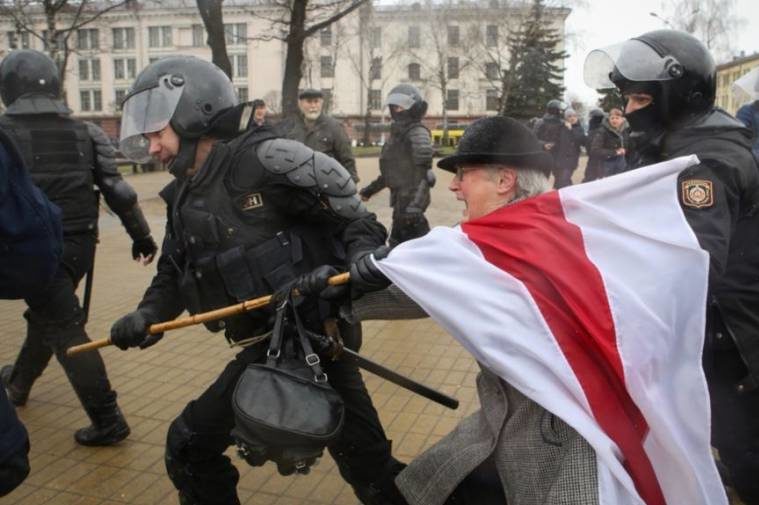
Today, the ICJ called on Belarus to comply with its international human rights law obligations in its response to the protests taking place in the aftermath of the presidential elections and in the treatment of those detained.
This includes immediately releasing persons arbitrarily detained, providing prompt access to lawyers for those still detained, accounting for the fate and whereabouts of missing protestors and promptly and effectively investigating torture and other ill-treatment.
The widespread arbitrary arrests of peaceful protesters, and credible allegations of torture and ill-treatment and enforced disappearances of detainees, are particularly alarming in light of obstacles faced by detainees in accessing lawyers, the ICJ said.
The ICJ recalls that under international human rights law, all persons have the right to peaceful assembly, and any restriction of this right must be provided in law be strictly necessary and proportionate to a specified legitimate purpose. The mass arrest of protesters does not appear to meet these requirements.
Belarus has obligations, including under treaties to which it is party, to respect the right to liberty and refrain from arbitrary arrests or other unwarranted interferences with the freedom of assembly, or freedom of expression, of protesters, protected under international law.
Law enforcement authorities must respect the right to life and the prohibition on torture or other ill-treatment at all times. Allegations of arbitrary killing, enforced disappearances and torture and other ill-treatment must be promptly, thoroughly and independently investigated, and those responsible brought to justice.
Effective remedies must be provided to victims of such serious human rights violations.
The ICJ is concerned about reports of the widespread denial of access to a lawyer and further obstacles that lawyers face while carrying out their professional duties in the current context in Belarus.
Reportedly, lawyers are not provided with access to the case file or further information necessary for the provision of effective legal assistance to their clients. This is of particular concern in light of multiple reports of torture or other ill-treatment of those detained following the election.
The ICJ stresses that the right of access to qualified legal representation is crucial for the protection of the human rights of those arrested in connection with the current political upheaval in Belarus.
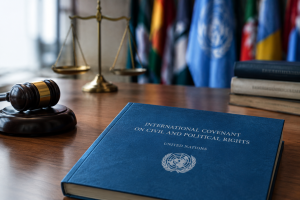
The right of access to a lawyer is recognized as an essential element of the right to a fair trial and the right to liberty, protected under the International Covenant on Civil and Political Rights, to which Belarus is a party.
The UN Basic Principles on the Role of Lawyers provide that governments should ensure that lawyers are able to perform all of their professional functions without intimidation, hindrance, harassment or improper interference and should be able to consult with their clients freely and have access to appropriate information, files and documents in their possession or control in sufficient time to provide effective legal assistance to their clients.
It is essential that lawyers and other human rights defenders can carry out protection of human rights of their clients especially in times of emergency.
The ICJ also calls on the Belarus Republic Bar Association to bolster its efforts in protecting its members who provide legal representation in cases related to the ongoing protests.
Background:
The Republic of Belarus ratified the International Covenant on Civil and Political Rights in 1973
Following the presidential elections of 9 August 2020 in Belarus, widespread protests across Belarus took place following the discredited result, which were recognized as neither free nor by the European Union and other observers. Following the initial dispersal of these protests by the authorities, more than 6000 people were arrested and detained, many arbitrarily. There is credible evidence that many of those arrested or detained have been subjected to torture or other ill-treatment and that decisions regarding their arrest and detention have been made by courts temporarily established in detention centres.
While estimates of numbers differ, the whereabouts of at least tens of those who took part in the protest have not been established to date. One of the missing persons, Nikita Krivtsov, was recently found dead in a forest near Minsk.
The reports that defence lawyers were denied access to those arrested include high-profile cases, such as the case of the former presidential candidate Victor Babaryka whose lawyer was not allowed to see his client in the detention centre for more than a week.
According to the Belarusian Republican Bar Association, lawyers face problems with meeting their clients held in the detention centres and access to the case files and further information necessary to carry out their professional duties.

Jun 9, 2020 | News
As of 9 June, at least ten prominent lawyers have been arrested and criminally charged in Zimbabwe.
Among them, Advocate Thabani Mpofu (photo), Advocate Choice Damiso, Mr Tapiwa Makanza and Mr Joshua Chirambwe have been arrested and charged with the crime of defeating or obstructing the course of justice.
These lawyers are alleged to have falsified information in the papers filed in a legal matter in which they were representing a citizen, who was challenging the legality of President Mnangagwa’s decision to appoint Mr Kumbirai Hodzi as the Prosecutor General.
Mr Dumisani Dube was arrested on similar charges but his charges arise from a different case.
Mr Patrick Tererai was charged with disorderly conduct after he demanded access to his client who had been detained at a police station.
The ICJ notes that the criminal charges laid against all the six lawyers are linked to the performance of their duties as legal practitioners.
The ICJ reminds the Government of Zimbabwe of its domestic and international obligations pertaining to the right to fair trial and protection of the independence of lawyers, as underscored in the United Nations Basic Principles on the Role of Lawyers and the African Commission on Human and Peoples’ Rights Principles and Guidelines on the Right to a Fair Trial and Legal Assistance in Africa
These elaborate standards relevant to the right to a fair trial including under article 14 of the International Covenant on Civil and Political Rights (ICCPR) and article 7 of the African Charter on Human and Peoples’ Rights.
Of particular significance is Principle 16 of the UN Basic Principles which states that “Governments shall ensure that lawyers are able to perform all of their professional functions without intimidation, hindrance, harassment or improper interference;…. and [lawyers] shall not suffer, or be threatened with, prosecution or administrative, economic or other sanctions for any action taken in accordance with recognized professional duties, standards and ethics.”
In addition, Principle 20 provides that “Lawyers shall enjoy civil and penal immunity for relevant statements made in good faith in written or oral pleadings or in their professional appearances before a court, tribunal or other legal or administrative authority.” Similar provisions are included in Part I of the African Principles and Guidelines.
A lawyer would not generally be immune from criminal proceedings where allegations of perjury or intentionally providing false information to a court were well-founded.
In relation to this recent group of cases, the Law Society of Zimbabwe has expressed the concern that the arrests appear calculated to hinder the members of the profession from undertaking their professional duties.
In this context, the ICJ calls upon the Government of Zimbabwe to ensure that the right to fair trial for these lawyers is fully respected and that the criminal charges brought against these lawyers are not abused to subvert the independence of the legal profession.
“The arrest of ten lawyers within one week on criminal allegations arising from the performance of their duties as legal practitioners is a cause of concern. The state must ensure that these cases are handled fairly and that the criminal justice system is not abused to harass and intimidate lawyers who represent clients who are perceived as political opposition to the sitting government,” said ICJ Africa Director Arnold Tsunga.
Of late, Advocate Thabani Mpofu has represented opposition leader Mr Nelson Chamisa in a series of cases. These include the presidential election petition and the cases in which Mr Chamisa’s rise to the leadership of the opposition party has been challenged.
Contact
Arnold Tsunga, Director of the ICJ Africa Regional Programme, t: +263 77 728 3248, e: arnold.tsunga(a)icj.org

Jun 2, 2020 | News
The ICJ has called on the Russian authorities to institute a prompt, independent and thorough investigation into the recent use of physical force against lawyers Natalia Magova, Diana Sipinova and Liudmila Kochesokova and detention of Diana Sipinova by officers of the Ministry of Interior in the Kabardino-Balkaria Republic.
Those responsible should be held accountable, the ICJ stressed.
According to the lawyers and as corroborated by video recordings available online, they arrived in the Department of the Ministry of Interior in the Kabardino-Balkaria Republic to represent their client Ratmir Jilokov, another lawyer who was detained on 20 May 2020, also following alleged violence against him by the police.
Despite the lawyers’ requests to have access to their client, they were not allowed to meet him. Instead, they were removed from the building of the Department of the Ministry of Interior with the use of physical force by several officers, which resulted in an altercation.
Moreover, Diana Sipinova was detained in the building of the Department for several hours. Both she and Ratmir Jilokov were later released.
“The use of physical force against the lawyers to prevent their meeting their client was clearly contrary to international human rights law and standards, including those on the role of lawyers,” said Temur Shakirov, Senior Legal Adviser of the ICJ Europe and Central Asia Programme.
The ICJ also raised concerns at the criminal proceedings against lawyer Diana Sipinova, following the incident of 21 May 2020, and Ratmir Jilokov, who was detained on 20 May 2020 apparently in connection with having tried to defend a client’s premises from what he considered to be an unlawful search by the authorities.
Both are accused of having used violence against police officers.
Reportedly, the criminal proceedings against Diana Sipinova and Ratmir Jilokov were instituted following their complaints of being subjected to physical attack by the officers of the Ministry of Interior of the Kabardino-Balkaria Republic.
The ICJ highlights that as provided by the UN Principles on the Role of Lawyers, States must ensure that lawyers are able to perform all of their professional functions without intimidation, hindrance, harassment or improper interference and that they do not suffer, or be threatened with prosecution for any action taken in accordance with recognized professional duties, standards and ethics.
International human rights law further guarantees the right of a person deprived of liberty to meet with his or her lawyer.
The authorities should take effective measures to prevent such acts against lawyers in the future, and to ensure that lawyers are not prevented from representing their clients in accordance with law, the ICJ said.
The ICJ furthermore calls on the authorities to terminate the criminal investigations against the lawyers in connection with their attempts to meet with and defend their clients’ interests, and for any other action they have taken in relation to the representation of their clients that was in accordance with their professional duties, standards and ethics.
Background information:
Natalia Magova, Diana Sipinova and Liudmila Kochesokova are lawyers based in Kabardino-Balkaria Republic in the North Caucasus part of the Russian Federation.
According to the official website of the Investigative Department of the Investigative Committee of Kabardino-Balkaria, Diana Sipinova and Ratmir Jikolov are charged with the criminal offence provided for by Article 318.1 (use of violence which does not endanger life or health against the public officials in connection with the performance of their duties) of the Criminal Code of the Russian Federation.
In particular, Diana Sipinova is charged with having used violence against officers of the department of the Ministry of Interior of Kabardino-Balkaria Republic when she requested access to her client on 21 May 2020. Ratmir Jilokov is charged with having used violence against the police officers who arrived in the office of his client to conduct a search on 20 May 2020.
On 30 May 2020, the first instance court imposed the preventive measure for Diana Sipinova of prohibition of certain activities for two months.
Lawyer Ratmir Jilokov, who was detained on 20 May and released on 21 May 2020, claims that the officers who arrived in his client’s office for a search failed to provide him with any legal grounds or the document authorising the search, and that he was subjected to violence when he had challenged the unlawfulness of the officers’ actions. The first instance court imposed the preventive measure of prohibition of certain activities for two months in respect of him.
The Federal Chamber of Lawyers of Russian Federation expressed their support to the lawyers and criticized the interference with their professional functions and actively participated in the defence of the lawyers.
The ICJ has previously raised concerns at violence and intimidation against Russian lawyers.
Mar 30, 2020 | News
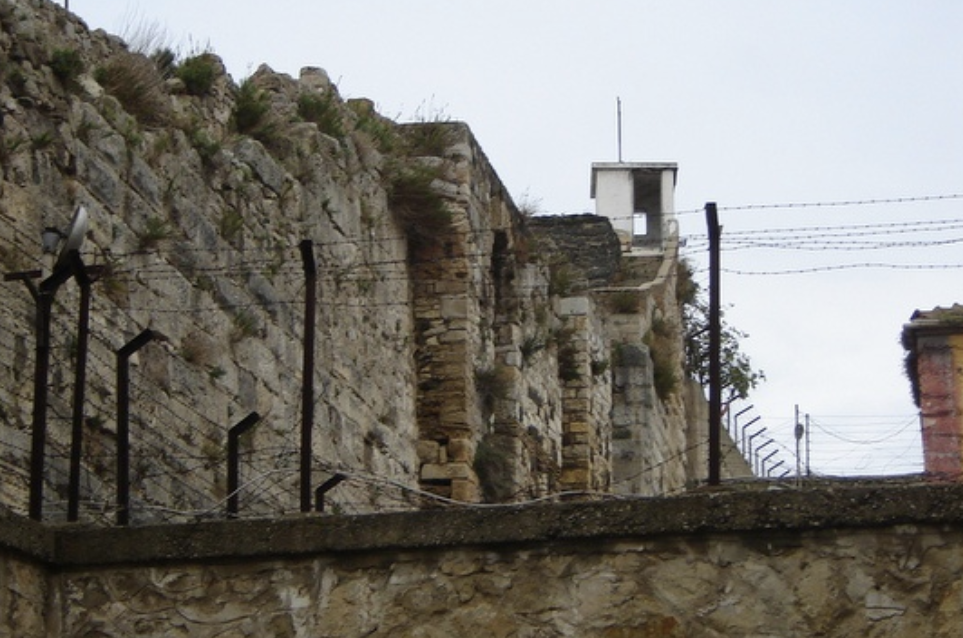
The ICJ is calling on the Turkish Parliament to extend the planned provision of alternatives to detention in response to the COVID-19 crisis to all those imprisoned for non-violent crimes who do not pose a current threat to members of the public, regardless of the nature of the offences for which they have been charged.
In particular, alternatives to detention should apply to all those detainees who are particularly at risk at losing their life or suffering severe health effects from COVID-19.
Measures to protect the right to life, the right to health and other human rights must apply equally and without discrimination in line with Turkey’s international legal obligations.
The government have announced the tabling of a draft law to reduce the prison population that has been under discussion in recent months. The process has been accelerated with the purported aim of addressing the serious health risk that an outbreak of COVID-19 contagion would pose to the prison population. However, the draft law has not been adapted to address the health crisis and contains several shortcomings.
The new measures would grant alternatives to detention, including house arrest or early parole to an estimated one-third of the prison population.
This welcome move is however limited by the exclusion of those convicted or under trial for terrorism offences or offences against the State.
“In Turkey, terrorism offences and offences against the State have long been abused to arrest, try and jail human rights defenders, lawyers, judges and political opponents,” said Massimo Frigo, Senior Legal Adviser for the ICJ Europe and Central Asia Programme. “The rights to life and health of these groups are now at particular risk.”
The ICJ considers that it is also essential that all detainees who are members of a group whose life or health may be at risk because of COVID-19 have either access to alternatives to detention, if they do not pose a current threat to public safety, or, otherwise, to detention conditions that may preserve them as far as possible from such risk.
“The State has a non-derogable obligation to protect the right to life of all its prison population, without discrimination of any sort,” Massimo Frigo added.
Feb 19, 2020 | News
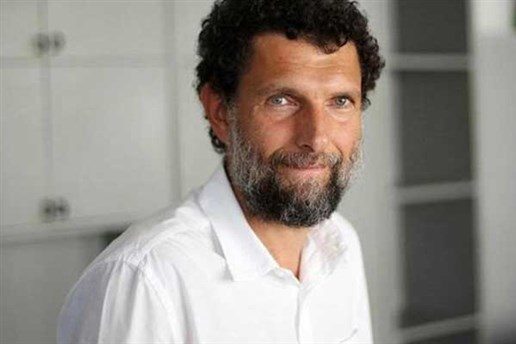
The ICJ and IBAHRI condemn yesterday’s re-arrest of Turkish human rights defender Osman Kavala, immediately following his acquittal on charges connected to the Gezi Park demonstrations that began in May 2013.
Osman Kavala was arrested on his release from prison yesterday evening, on suspicion of “attempting to disrupt the constitutional order” connected to the failed coup attempt of 2016.
“For Osman Kavala to be acquitted yesterday, on charges for which there was never credible evidence against him, only to be immediately re-arrested on another highly improbable charge, suggests a criminal justice system that is operating to suppress independent civil society rather than uphold due process and the rule of law,” said Róisín Pillay, Director of the ICJ’s Europe and Central Asia Programme.
Osman Kavala has been held in pre-trial detention since October 2017. The European Court of Human Rights recently ordered that Turkey must act to secure his immediate release, and found that his detention violated his right to liberty (Article 5.1 ECHR) and his right to speedy judicial review of detention (Article 5.4 ECHR), and pursued an improper purpose (Article 18 ECHR).
“It is disgraceful that the Turkish authorities seek to evade compliance with their obligation under the European Convention on Human Rights to end the arbitrary detention of Osman Kavala, by releasing and re-arresting him. We call for these new charges to be dropped and for Osman Kavala to be immediately released,” said Baroness Helena Kennedy QC, IBAHRI Director.
Background
Mr Kavala has been in detention since 18 October 2017 pending trial on charges connected to the Gezi Park protests. The Gezi Park protests began in May 2013 as an effort by a group of environmentalists to save a park in central Istanbul from being rezoned, but soon grew into nationwide demonstrations. Police quelled the protest in Taksim Square with the use of tear gas and water cannons.
Mr Kavala’s trial, along with 15 other defendants, took place before Istanbul 30th Assize Court. The IBAHRI and the ICJ jointly sent international observers to attend all hearings of the trial.
Contact :
Róisín Pillay, Director for Europe and Central Asia Proramme, t: +32 2 734 84 46; e: roisin.pillay(a)icj.org