Dec 6, 2013 | News
The ICJ and Amnesty International expressed concern over the trial of Mohamed Belbouri before the criminal court of Oran in Algeria. The next hearing of the trial is held on Monday 9 December.
Belbouri, aged 29, stands as the sole accused in the murder of Professor Ahmed Kerroumi, an Algerian political activist. Kerroumi was killed in April 2011, shortly after meeting with the UN Special Rapporteur on freedom of expression, Frank La Rue, in Algeria.
The ICJ and Amnesty International call on the Algerian authorities to ensure the right of Kerroumi’s family members to know the truth about his killing and to criminally hold the perpetrator(s) to account in line with international fair trial standards.
The two organizations are concerned that the Belbouri trial has failed to meet these standards, including the right of the accused to be presumed innocent and to defence.
The two organizations are further concerned by allegations that acts of torture and other ill-treatment were inflicted on Belbouri during his interrogation in police facilities between 12 and 17 May 2011, apparently aiming to make him “confess” to the killing of Kerroumi.
Belbouri says he was beaten on the head, face, stomach and feet, electrocuted, made to sit on his knees for hours with a chair on his head, and threatened that his relatives would be ill-treated if he did not “confess”.
“Algerian authorities must respect and ensure the right of Belbouri to a fair hearing before an independent and impartial tribunal and in full compliance with international fair trial standards,” said Wilder Tayler, ICJ Secretary General.
“The authorities must also ensure that all reports of torture and other ill-treatment of Belbouri are thoroughly and impartially investigated, and that any statement alleged to have been obtained as a result of torture or other ill-treatment is not admitted as evidence by the court,” Tayler added.
Lawyers representing the accused and the family of Professor Kerroumi have both said that the trial was marred by irregularities.
These include the court’s refusal to allow the defence to call and cross-examine witnesses, including the forensic expert who performed the autopsy on Ahmed Kerroumi’s body, and to challenge and test evidence put forward by the prosecution.
“Justice would not be served by sentencing – possibly to death – a man who has claimed his innocence all along when they are so many doubts about the seriousness of the investigation,” said Philip Luther, Middle East and North Africa Director at Amnesty International.
Contact:
Said Benarbia, ICJ Senior Legal Adviser of the Middle East and North Africa Programme, tel: 41 22 979 38 1, e-mail: said.benarbia(a)icj.org

Nov 29, 2013 | Advocacy, Non-legal submissions
The ICJ’s Director of the International Law and Protection Programmes, Alex Conte, today delivered the keynote address at the launch of the OSCE manual on Human Rights in Counter-Terrorism Investigations.
Responding to the challenges faced by some OSCE participating States in operationalizing human rights when conducting counter-terrorism investigations, the OSCE Office for Democratic Institutions and Human Rights (ODIHR) and the OSCE Secretariat’s Transnational Threats Department / Strategic Police Matters Unit jointly developed a manual on Human Rights in Counter-Terrorism Investigations. The manual adopts an operational approach to different phases of counter-terrorism investigations and linking them to relevant human rights standards.
The keynote address focussed on the link between human rights protection and effective counter-terrorism practices; and on how human rights are themselves useful tools to successfully prevent and counter terrorism. It identified five law, policy and practical reasons that human rights compliance is required and/or contributes to the prevention and countering of terrorism:
- Human rights compliance while countering terrorism is an international obligation, recalling that States’ right and duty to combat terrorism is part of international and regional human rights law stemming from the duty of States to protect individuals under their jurisdiction from interference with their enjoyment of human rights, including the rights to life and security;
- Human rights compliance at the investigative stage of counter-terrorism cases means that there will be an exponentially greater chance that the precious resources dedicated to terrorist investigations will result in the admissibility of evidence;
- Human rights compliance at the investigative and pre-trial stages of counter-terrorism cases (considering the impact of prolonged detention without trial or without charge) gives rise to a greater prospect of achieving a sound conviction;
- Bringing perpetrators of terrorist acts to justice through effective (i.e. human rights-compliant) investigation and prosecution contributes to the realisation for victims of terrorism of their rights to truth and reparation; and
- Human rights compliance not only assists the short-term objectives of effective counter-terrorism investigations and prosecutions, but is also the essential basis for a sustainable, long-term approach to the countering of terrorism by avoiding further conditions conducive to the spread of terrorism.
ICJ-OSCE-ManualOnHumanRightsInCounterTerrorismInvestigations-LaunchEvent-KeynoteAddress-NonlegalSubmission-2013 (download keynote address in PDF)
OSCE_HRCT_Manual (download manual on Human Rights in Counter-Terrorism Investigations in PDF)
Nov 5, 2013 | News
The ICJ condemns Bangladesh’s imposition of the death penalty in contravention of the global trend towards abolition of capital punishment.
It signifies a weakening of the rule of law and respect for human rights standards in the country.
On 5 November 2013, a special court sentenced 152 persons to death, most of them former officers of the Bangladesh Rifles (BDR), for participating in the 2009 mutiny in which 74 people were killed.
Two days earlier, the International Crimes Tribunal (ICT) had convicted Chowdhury Mueen Uddin and Ashrafuzzaman Khan in absentia for abduction and murder during Bangladesh’s liberation war in 1971 and sentenced them to death.
The ICT, set up by the Government of Bangladesh in 2010 to prosecute persons accused of committing genocide, crimes against humanity, war crimes and other serious crimes during the 1971 war, has so far convicted nine accused. Seven have been given death sentences.
“The numbers of death sentences issued by special courts in Bangladesh is alarming,” said Ben Schonveld, ICJ’s South Asia Director. “There seems little interest in seeking justice; this looks more like revenge.”
“Those responsible for committing atrocities during the Bangladeshi war of liberation and the 2009 mutiny must be prosecuted and brought to justice,” he added. “But the death penalty is a perversion of justice, even more so when imposed after trials that violate due process.”
The ICJ considers the death penalty to constitute a violation of the right to life and the right not to be subjected to cruel, inhuman or degrading punishment. The United Nations General Assembly has repeatedly called on all States to establish a moratorium on the death penalty with a view to abolition.
Under international law and standards, including the International Covenant on Civil and Political Rights, Bangladesh is required to scrupulously and strictly to observe all relevant fair trial guarantees.
This includes the right to effective legal assistance at all stages of the proceedings including the appeal.
The International Crimes Tribunal as well the Special Court set up by Bangladesh to try those accused of committing atrocities in the 2009 mutiny do not meet international standards and Bangladesh’s legal obligations concerning the right to a fair trial.
The 846 suspects tried by the special court in Dhaka for the 2009 mutiny had limited access to lawyers; did not have sufficient knowledge of the charges and evidence against them; and at least 47 suspects died while in custody, allegedly after being subjected to torture.
There are also serious procedural flaws at all stages in the ICT.
Pre-trial release has been routinely and arbitrarily denied; witnesses have been abducted and intimidated; and there have been credible allegations of collusion between the Government, prosecutors and judges.
The ICJ calls on Bangladesh to join the great majority of States around the world in rejecting the death penalty.
To that end, Bangladesh should impose a moratorium on the practice and take steps towards its abolition, as prescribed by repeated United Nations General Assembly Resolutions.
In addition, Bangladeshi authorities must order a retrial of all persons accused of participating in the 2009 mutiny and ensure that their fresh trials meet international law standards on fair trial.
Bangladesh-Death penalty statement-news-web story-2013 (full text in pdf)
Oct 4, 2013 | News
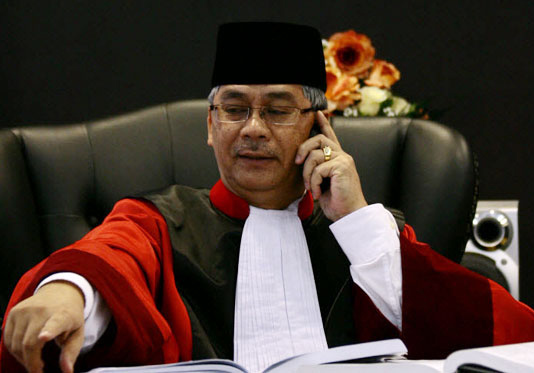
The ICJ is calling on the Indonesian authorities to ensure that the proceedings against Justice Akil Mochtar fully comply with international law and standards on fair trial and the independence and impartiality of the judiciary.
Justice Mochtar, Chief Justice of Indonesia’s Constitutional Court (photo), is accused of taking a bribe to issue a favourable verdict in an election dispute.
Justice Mochtar was arrested on 2 October 2013 and remains in custody. According to a spokesperson for the Corruption Eradication Commission, he is alleged to have received a bribe, through several intermediaries, from Hambit Binti, a district chief whose re-election was contested.
The Constitutional Court has sole jurisdiction over disputes contesting the conduct or results of elections.
The ICJ calls for a prompt, thorough and impartial investigation of these serious allegations.
The impartiality of the judiciary is an essential condition for respect for the rule of law, and is undermined when judicial decisions are made on the basis of financial inducements rather than solely according to evidence and the law.
Integrity is vital to the proper discharge of judicial office, and any judge must ensure that his or her conduct is above reproach, maintaining and enhancing the confidence of the public in the impartiality of both the individual judge and the judiciary as a whole.
According to the Beijing Statement of Principles on Independence of the Judiciary in the LAWASIA Region, signed by 32 judicial heads of Asia Pacific States, including the Chief Justice of Indonesia, “Judges shall uphold the integrity and independence of the judiciary by avoiding impropriety and the appearance of impropriety in all their activities.”
At the same time, the ICJ stresses that any eventual criminal or disciplinary proceedings, should those be warranted, must respect the independence of the judiciary and Justice Mochtar’s right to a fair trial.
Judges charged with a criminal offence, like all other persons, have the right to a fair trial by a competent, independent and impartial tribunal established by law.
The right to a fair trial in criminal cases as recognized in Indonesia and under international law and standards, including Article 14(3) of the International Covenant on Civil and Political Rights, comprises a series of procedural and substantive safeguards that must be respected during the pre-trial and trial phases.
Contact
Sam Zarifi, ICJ Asia-Pacific Regional Director, Bangkok, tel. no. +66 8078 19002 or sam.zarifi(a)icj.org
Laurens Hueting, ICJ Associate Legal Adviser (International Law and Protection Programme), Geneva, tel. no. +41 22 979 3848 or laurens.hueting(a)icj.org

Oct 4, 2013 | News, Publications, Reports, Trial observation reports
In a report published today, the ICJ details a catalogue of violations of fair trial rights and other serious human rights violations committed against those detained in the context of the UAE 94 trial.
The report, Mass convictions following an unfair trial: The UAE 94 case, comes amidst a crackdown on individuals calling for peaceful political reform, who continue to be arrested, detained, prosecuted and convicted for the lawful exercise of their rights to freedom of expression, association and assembly.
The UAE authorities must end this crackdown and ensure the immediate and unconditional release of those convicted in the UAE 94 trial, the ICJ says.
“The UAE 94 trial has been marred with a litany of violations of fair trial rights. The convictions of 69 individuals following this trial must be quashed and those imprisoned must be immediately and unconditionally released”, said Said Benarbia, senior legal adviser of the ICJ Middle East and North Africa Programme.
Those convicted on 2 July 2013 were found guilty of “establishing, founding and administering an organization, with the aim of challenging the basic principles upon which the government of the State is based, taking control of the government and establishing a secret structure for the organization”.
Fifty-six of them were sentenced to ten years’ imprisonment, five of them to seven years’ imprisonment and eight others, who were tried in absentia, to fifteen years’ imprisonment. The remaining 25 accused were acquitted.
The ICJ notes that, since 31 July 2013, many of the prisoners convicted in the UAE 94 case have begun a hunger strike to protest against the conditions of their detention.
They have reportedly been subjected to various forms of ill-treatment, including beatings by prison guards and light depravation.
The authorities have failed to investigate the many human rights abuses alleged to have been committed against those detained in the context of the UAE 94 case, the ICJ says.
Instead, the UAE authorities have continued their crackdown on political activists and government critics, including those that have publicly spoken out in support of the UAE 94 or against the conditions of detention of those imprisoned.
“Rather than live up to the commitment made by the UAE to the Human Rights Council to “place human rights at the top of its priorities”, the UAE authorities have embarked on a sustained campaign to suppress any form of peaceful dissent and all calls for political reform,” Benarbia added. “They must comply with their obligations under international law and bring an end to this cycle of arbitrary arrest, detention, prosecution and unfair trials against of all those that dare to speak out.”
Key findings of the report:
- Most of the detainees were not informed of the reasons for their arrest and promptly notified of the charges against them.
- They were denied their right to prompt access to a lawyer, including during interrogation and were not brought before a judge or a judicial authority within 48 hours of their arrest.
- Most of the detainees were held in incommunicado detention and in secret and unofficial detention centres.
- They were also held in prolonged solitary confinement, which in some cases lasted more than 236 days.
- Most of the detainees were reportedly subjected to torture or other ill treatment by the authorities, including severe beatings, pulling out detainees’ hair, sleep deprivation, exposure to extreme light during the day and night, death threats and other threats and verbal abuse, as well as prolonged incommunicado detention and solitary confinement.
- The Court failed to investigate or order the investigation of such allegations.
- To the contrary, statements and “confessions” alleged to have been obtained as a result of torture or other ill-treatment were admitted as evidence by the court.
Contact :
Said Benarbia, ICJ Senior Legal Adviser of the Middle East and North Africa Programme, tel: 41 22 979 38 17, e-mail: said.benarbia(a)icj.org
UAE-Violations at UAE 94 Trial-Publications-Reports-2013 (full text in pdf)

![Smoke rises after an Israeli air strike on the village of Taybeh in southern Lebanon [Source: Al Jazeera]](https://www.icj.org/wp-content/uploads/2026/03/Screenshot-2026-03-20-at-15.56.24-300x200.png)