Nov 6, 2013 | News
The ICJ is calling on the Bangladeshi authorities to immediately and unconditionally release Nasiruddin Elan, Director of the human rights group Odhikar.
Odhikar is an affiliate organization of the ICJ.
On 6 November 2013, a Dhaka cyber crimes tribunal rejected Nasiruddin Elan’s bail application and ordered his detention in Dhaka Central Jail.
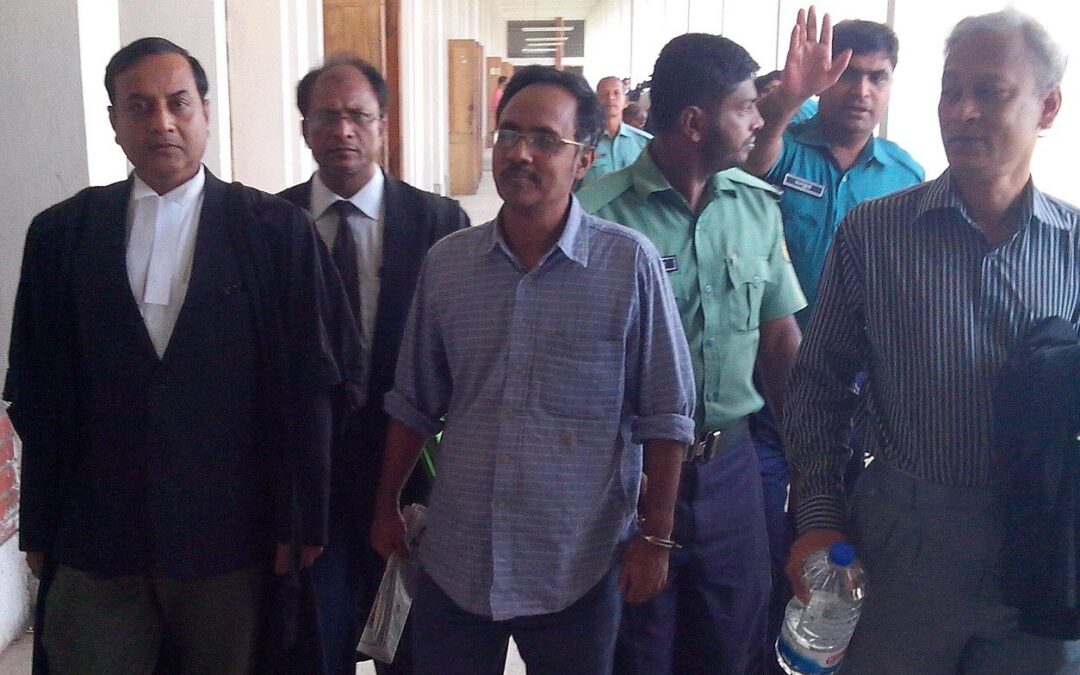
Nasiruddin Elan (in the middle on the picture) has been accused of distorting information, presenting false evidence and manipulating photographs of a Government crackdown on a rally by Hefazat-e-Islam, an Islamist political organization, in May this year.
The action reportedly resulted in multiple deaths and injuries. Odhikar had reported that 61 protestors were killed by the Rapid Action Battalion (RAB) and the police. The Government contests the number of casualties.
“What we are seeing is a continuing unlawful attack on Odhikar and voices critical of the Government,” said Ben Schonveld, ICJ’s South Asia Director. “Nasiruddin Elan is being arbitrarily detained for the lawful exercise of the right to freedom of expression and his legitimate work as a human rights defender.”
“The Government should immediately drop its opposition to Nasiruddin Elan’s bail application,” he added. “We are concerned that he will be one of the many detainees who faces torture and ill-treatment during detention, as documented by Odhikar and other human rights organizations.”
Bangladesh-Elan arrest statement-news-web story-2013 (full text in pdf)

Oct 4, 2013 | News, Publications, Reports, Trial observation reports
In a report published today, the ICJ details a catalogue of violations of fair trial rights and other serious human rights violations committed against those detained in the context of the UAE 94 trial.
The report, Mass convictions following an unfair trial: The UAE 94 case, comes amidst a crackdown on individuals calling for peaceful political reform, who continue to be arrested, detained, prosecuted and convicted for the lawful exercise of their rights to freedom of expression, association and assembly.
The UAE authorities must end this crackdown and ensure the immediate and unconditional release of those convicted in the UAE 94 trial, the ICJ says.
“The UAE 94 trial has been marred with a litany of violations of fair trial rights. The convictions of 69 individuals following this trial must be quashed and those imprisoned must be immediately and unconditionally released”, said Said Benarbia, senior legal adviser of the ICJ Middle East and North Africa Programme.
Those convicted on 2 July 2013 were found guilty of “establishing, founding and administering an organization, with the aim of challenging the basic principles upon which the government of the State is based, taking control of the government and establishing a secret structure for the organization”.
Fifty-six of them were sentenced to ten years’ imprisonment, five of them to seven years’ imprisonment and eight others, who were tried in absentia, to fifteen years’ imprisonment. The remaining 25 accused were acquitted.
The ICJ notes that, since 31 July 2013, many of the prisoners convicted in the UAE 94 case have begun a hunger strike to protest against the conditions of their detention.
They have reportedly been subjected to various forms of ill-treatment, including beatings by prison guards and light depravation.
The authorities have failed to investigate the many human rights abuses alleged to have been committed against those detained in the context of the UAE 94 case, the ICJ says.
Instead, the UAE authorities have continued their crackdown on political activists and government critics, including those that have publicly spoken out in support of the UAE 94 or against the conditions of detention of those imprisoned.
“Rather than live up to the commitment made by the UAE to the Human Rights Council to “place human rights at the top of its priorities”, the UAE authorities have embarked on a sustained campaign to suppress any form of peaceful dissent and all calls for political reform,” Benarbia added. “They must comply with their obligations under international law and bring an end to this cycle of arbitrary arrest, detention, prosecution and unfair trials against of all those that dare to speak out.”
Key findings of the report:
- Most of the detainees were not informed of the reasons for their arrest and promptly notified of the charges against them.
- They were denied their right to prompt access to a lawyer, including during interrogation and were not brought before a judge or a judicial authority within 48 hours of their arrest.
- Most of the detainees were held in incommunicado detention and in secret and unofficial detention centres.
- They were also held in prolonged solitary confinement, which in some cases lasted more than 236 days.
- Most of the detainees were reportedly subjected to torture or other ill treatment by the authorities, including severe beatings, pulling out detainees’ hair, sleep deprivation, exposure to extreme light during the day and night, death threats and other threats and verbal abuse, as well as prolonged incommunicado detention and solitary confinement.
- The Court failed to investigate or order the investigation of such allegations.
- To the contrary, statements and “confessions” alleged to have been obtained as a result of torture or other ill-treatment were admitted as evidence by the court.
Contact :
Said Benarbia, ICJ Senior Legal Adviser of the Middle East and North Africa Programme, tel: 41 22 979 38 17, e-mail: said.benarbia(a)icj.org
UAE-Violations at UAE 94 Trial-Publications-Reports-2013 (full text in pdf)

Oct 2, 2013 | News
The ICJ welcomes the endorsement today by the Parliamentary Assembly of the Council of Europe of the Tshwane Principles on National Security and the Right to Information.
The ICJ was one of a number of civil society groups and government representatives who contributed to the development of the Principles.
Headline stories such as the Bradley Manning, Edward Snowden, and David Miranda cases, and the large number of other similar cases and situations around the world that do not necessarily receive the same media attention, demonstrate the timeliness and relevance of the Principles.
The ICJ hopes that the precedent set by the PACE will now be followed by other inter-governmental organisations at the global and regional levels, recognizing and endorsing the Principles.
Links to the resolution and recommendation by the PACE:
http://assembly.coe.int/nw/xml/XRef/Xref-DocDetails-EN.asp?fileid=20190&lang=EN
http://assembly.coe.int/nw/xml/XRef/Xref-DocDetails-EN.asp?fileid=20194&lang=EN
Global-Tshwane Principles on right to information-position paper-2013 (full text in pdf)

Sep 25, 2013 | News
The ICJ continues to be disappointed over the continued arbitrary detention and refusal of bail of Secretary of human rights organization, Odhikar, and Supreme Court Advocate Adilur Rahman Khan.
The ICJ urged the Bangladeshi authorities to drop their opposition to Adilur Rahman Khan’s bail application.
On 25 September 2013, a cyber crimes tribunal in Dhaka refused Adilur Rahman Khan’s bail application. He had earlier been denied bail on 11 August 2013 and 9 September 2013.
“Adilur Rahman Khan is being arbitrarily detained for his lawful exercise of the right to freedom of expression and his legitimate work as a human rights defender,” said Ben Schonveld, ICJ’s South Asia Director. “What we are seeing is a Government crackdown on voices of dissent.”
Under international law, all persons are presumed innocent until proven guilty.
Under Article 9 of the International Covenant on Civil and Political Rights (ICCPR), to which Bangladesh is a party, there is a presumption of pre-trial release.
A person can only be denied pre-trial release where it is reasonable and necessary in all of the circumstances to prevent absconding, interference with evidence or recidivism.
“The Government cannot show that Adilur Rahman Khan poses a flight risk,” Schonveld added. “In fact, he faces a serious threat of torture and ill-treatment during detention, as documented by Odhikar and other human rights organizations.”
The ICJ reiterates its call on Bangladesh to immediately and unconditionally drop all charges against Adilur Rahman Khan and Nasiruddin Elan, ensure Adilur Rahman Khan is treated in accordance with international law in custody, and cease its harassment of Odhikar.
Contact
Ben Schonveld, ICJ South Asia Director (Kathmandu), t: +977 14432651; email: ben.schonveld(a)icj.org

Sep 11, 2013 | News
The ICJ expressed its disappointment over the continued arbitrary detention and refusal of bail of Secretary of human rights organization, Odhikar, and Supreme Court Advocate Adilur Rahman Khan.
The ICJ urged the Bangladeshi authorities to drop their opposition to Adilur Rahman Khan’s bail application.
On 9 September 2013, a Magistrates Court in Dhaka refused Adilur Rahman Khan’s bail application for the second time. He had earlier been denied bail on 11 August 2013.
“Adilur Rahman Khan is being arbitrarily detained for his lawful exercise of the right to freedom of expression and his legitimate work as a human rights defender,” said Ben Schonveld, ICJ’s South Asia Director. “What we are seeing is a Government crackdown on voices of dissent.”
Under international law, all persons are presumed innocent until proven guilty.
Under Article 9 of the International Covenant on Civil and Political Rights (ICCPR), to which Bangladesh is a party, there is a presumption of pre-trial release.
A person can only be denied pre-trial release where it is reasonable and necessary in all of the circumstances to prevent absconding, interference with evidence or recidivism.
“The Government cannot show that Adilur Rahman Khan poses a flight risk,” Schonveld added. “In fact, he faces a serious threat of torture and ill-treatment during detention, as documented by Odhikar and other human rights organizations.”
The ICJ reiterates its call on Bangladesh to immediately and unconditionally drop all charges against Adilur Rahman Khan and Nasiruddin Elan, ensure Adilur Rahman Khan is treated in accordance with international law in custody, and cease its harassment of Odhikar.
Contact
Ben Schonveld, ICJ South Asia Director (Kathmandu), t: +977 14432651; email: ben.schonveld(a)icj.org
Additional information
Adilur Rahman Khan was arrested his home on 10 August 2013 without an arrest warrant.
On August 11, a Magistrate’s Court refused his bail application and remanded him for five days of custodial interrogation.
On August 12, the High Court Division of the Supreme Court stayed the remand order and directed that Adilur Rahman be sent back to jail, where he could be interrogated ‘at the gate of the jail.’
On 4 September 2013, the Detective Branch of Police filed a charge sheet against Adilur Rahman Khan and Odhikar’s Director, Nasiruddin Elan, under Section 57 of the International Communication and Technology Act 2006.
They were accused of distorting information, presenting false evidence and manipulating photographs regarding a police operation on a Hefazat-e Islam rally in May this year.
Odhikar had reported that 61 people were killed in the police crackdown on the rally. The government contested the number of casualties.
Adilur Rahman Khan and Nasiruddin Elan will be formally charged on 12 September 2013.
LATEST UPDATE: Letter to Prime Minister Sheikh Hasina Wazed on the Continued Detention of Adilur Rahman Khan
Bangladesh- Letter Adilur Rahman Khan-Advocacy-Open letter-2013 (full text in pdf)