Sep 2, 2013 | News
The ICJ today called on the Bangladesh authorities to immediately withdraw the contempt of court notice issued against the international human rights organization Human Rights Watch.
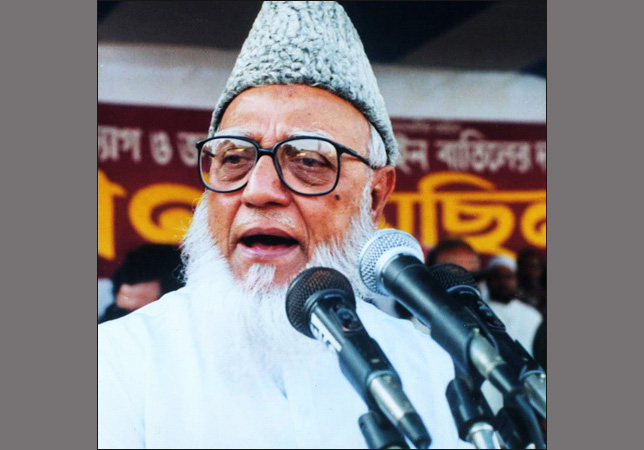
The charges are in response to well documented concerns by Human Rights Watch that the trial of Ghulam Azam (photo), former head of the Islamist group Jamaat-e-Islami Azam’s trial was “deeply flawed” and failed to meet international fair trial standards.
“Silencing voices that highlight the shortcomings of the International Crimes Tribunal impede rather than advance the enormously important task of ensuring that those responsible for committing atrocities during Bangladesh’s war of liberation are brought to justice in a process that complies with international law and standards”, said Alex Conte, Director of the ICJ’s International Law and Protection Programmes.
On 2 September 2013, the International Crimes Tribunal (ICT) in Bangladesh issued a show cause notice asking Human Rights Watch to explain why contempt of court proceedings should not be initiated against it for its allegedly ‘biased’, ‘scandalous’ and ‘inaccurate’ statements about the ICT. Human Rights Watch has to respond within three weeks, or possibly face trial and conviction in absentia.
“Assessing the conduct of administration of justice in judicial proceedings, including where it entails criticism of judicial performance is an important means of ensuring accountability,” said Conte. “Judges and prosecutors should defend the right to freedom of expression, not use their discretionary powers to muzzle criticism”.
Contact:
Alex Conte, Director, International Law & Protection Programmes, t: +41 79 957 2733; email: alex.conte(a)icj.org
Additional information:
The Bangalore Principles on Judicial Conduct clarify that “since judicial independence does not render a judge free from public accountability, and legitimate public criticism of judicial performance is a means of ensuring accountability subject to law, a judge should generally avoid the use of the criminal law and contempt proceedings to restrict such criticism of the courts”.
The Commonwealth (Latimer House) Principles on the Accountability of and the Relationship Between the Three Branches of Government also stress that “criminal law and contempt proceedings should not be used to restrict legitimate criticism of the performance of judicial functions”.
The UN Declaration on Human Rights Defenders underscores that “everyone has the right, individually and in association with others, to promote and to strive for the protection and realization of human rights and fundamental freedoms at the national and international levels”.
The Declaration also highlights that human rights defenders have the right to “freely to publish, impart or disseminate to others views, information and knowledge on all human rights and fundamental freedoms” and to hold opinions and draw public attention to the observance of human rights.

Aug 23, 2013 | News
The ICJ is calling on the Bangladesh authorities to immediately withdraw contempt of court charges against Human Rights Watch.
“Bangladesh must not impose contempt of court charges to restrict the important work carried out by human rights defenders, including international human rights groups,” said Alex Conte, Director of the ICJ’s International Law and Protection Programmes. “The contempt charges are inconsistent with Bangladesh’s obligations as a party to the International Covenant on Civil and Political Rights to respect freedom of expression.”
On 20 August 2013, prosecutors for the International Crimes Tribunal (ICT) in Bangladesh charged Human Rights Watch with contempt of court for allegedly “scandalizing the judiciary” after the group had expressed concern that the trial of Ghulam Azam, former head of the Islamist group Jamaat-e-Islami Azam’s trial was “deeply flawed” and did not meet international fair trial standards.
The group stated, based on credible media reports, that “judges improperly conducted an investigation on behalf of the prosecution” and that there was “collusion and bias among prosecutors and judges”.
“It is paramount that those responsible for committing atrocities – notably unlawful killings and the widespread and systematic use of rape as a form of torture – during Bangladesh’s war of liberation in 1971, should be prosecuted before competent, independent and impartial courts in proceedings that meet international fair trial standards,” Conte added. “Muzzling voices that highlight the deficiencies of the ICT and prosecutions before it distract from that enormously important task.”
The ICJ, as well as several Bangladeshi and international observers, have expressed similar concerns that the International Crimes Tribunal does not adhere to international standards of a fair trial.
“The charges against Human Rights Watch are an abuse of prosecutorial discretion to attack a highly respected human rights group for pointing out serious and well-documented problems with the Bangladeshi International Crimes Tribunal. Attacking the messenger does not address nor resolve the very real concerns about the operations of the ICT,” said Conte.
Under international norms, judges and the judicial process are not immune from public criticism. The Bangalore Principles on Judicial Conduct clarify that “since judicial independence does not render a judge free from public accountability, and legitimate public criticism of judicial performance is a means of ensuring accountability subject to law, a judge should generally avoid the use of the criminal law and contempt proceedings to restrict such criticism of the courts”.
Similarly, the Commonwealth (Latimer House) Principles on the Accountability of and the Relationship Between the Three Branches of Government also stress that “criminal law and contempt proceedings should not be used to restrict legitimate criticism of the performance of judicial functions”.
The charges against Human Rights Watch were preceded by the arrest on 10 August 2013, of Adilur Rahman, Secretary of the human rights group Odhikar for allegedly “distorting information” on a police operation on a Hefazat-e Islam rally in May this year. Odhikar reported that 61 people had been killed in the police crackdown on the rally. The Government disputed the number of casualties.
“We are deeply concerned that the contempt of court charges against Human Rights Watch and the charges against Adilur Rahman, are expressly intended to silence dissent and discourage individuals and organizations from raising legitimate concerns about human rights violations and the rapid deterioration of the rule of law in Bangladesh,” Conte further said. “Rather than charging them with contempt, the authorities should investigate the allegations of rights violations made by Human Rights Watch and Adilur Rahman”.
The UN Declaration on Human Rights Defenders underscores that “everyone has the right, individually and in association with others, to promote and to strive for the protection and realization of human rights and fundamental freedoms at the national and international levels”.
The Declaration also highlights that human rights defenders have the right to “freely to publish, impart or disseminate to others views, information and knowledge on all human rights and fundamental freedoms” and to hold opinions and draw public attention to the observance of human rights.
“We urge the Bangladesh authorities to immediately drop the charges against Human Rights Watch and Adilur Rahman, which are being used to restrict the legitimate exercise of the right to freedom of expression, and allow human rights defenders to freely carry out their work,” said Conte.
Contact:
Alex Conte, Director, International Law & Protection Programmes (Geneva), t: +41 79 957 2733; email: alex.conte(a)icj.org

Aug 12, 2013 | News
The ICJ is calling for the immediate release of Adilur Rahman Khan, a prominent Supreme Court lawyer and human rights defender in Bangladesh.
Mr Khan is the Secretary of Odhikar, a Bangladeshi human rights organization that has documented human rights violations allegedly carried out by Bangladeshi security forces.
Plainclothes police officers arrested Mr Khan from his home on 10 August 2013 without an arrest warrant.
“Adilur Rahman Khan is being charged for the lawful exercise of the right to freedom of expression, so Bangladeshi authorities must immediately and unconditionally drop all charges against him and release him,” said Ben Schonveld, ICJ’s South Asia director. “Until the charges are dropped, he must be released on bail.”
Adilur Rahman Khan was charged on 11 August under section 57 of the Information and Communication Technology Act, 2006, for distorting information regarding a police operation on a Hefazat-e Islam rally in May this year.
Odhikar reported that 61 people had been killed in the police crackdown on the rally. The government denied any casualties.
He was not allowed to speak with his family or his lawyers until August 11, when a Magistrate’s Court refused bail and remanded him for a further five days of custodial interrogation.
On August 12, the High Court Division of the Supreme Court stayed the remand order, directing that Mr. Khan be sent back to jail, where he could be interrogated ‘at the gate of the prison.’
“Adilur Rahman Khan’s arrest is illustrative of a deeply worrying government strategy to muzzle and discredit the work of human rights defenders and distract attention from human rights violations,” added Schonveld. “The High Court’s stay of the remand order is a positive development. However, the Bangladesh government must uphold its obligations under domestic and international law to guarantee freedom of expression and allow human rights defenders to carry out their work.”
Article 19 of the International Covenant on Civil and Political Rights (ICCPR), to which Bangladesh is a party, guarantees ‘freedom to seek, receive and impart information and ideas of all kinds, regardless of frontiers, either orally, in writing or in print, in the form of art, or through any other media of his choice.’
The UN Basic Principles on the Role of Lawyers provide that lawyers must be allowed to carry out their work ‘without intimidation, hindrance, harassment or improper interference.’
Further, lawyers shall, in particular, have the right to take part in public discussions of matters concerning the law, administration of justice and the promotion and protection of human rights.
In addition, the UN Declaration on Human Rights Defenders clarifies that States must create an enabling environment for human rights defenders and take all necessary measures to protect human rights defenders ‘against any violence, threats, retaliation, de facto or de jure adverse discrimination, pressure or any other arbitrary action as a consequence of his or her legitimate exercise of his or her rights.’
CONTACT:
Ben Schonveld, ICJ South Asia Director (Kathmandu), t: +977 14432651; email: ben.schonveld(a)icj.org
Sam Zarifi, ICJ Asia-Pacific Director, (Bangkok), t: +66 807819002; email: sam.zarifi(a)icj.org

Aug 5, 2013 | News
La CIJ condena acciones de intimidación en contra del Relator de las Naciones Unidas sobre Libertad de Expresión y del Instituto Centroamericano de Estudios para la Democracia Social (DEMOS).
Jun 12, 2013 | News
The Tshwane Principles on National Security and the Right to Information seek to protect the right to information and to ensure public access to information held by governments, without jeopardizing legitimate efforts to protect people from security threats.