Jul 2, 2015 | News
The Royal Thai Government must immediately end its harassment and intimidation of human rights lawyer, Sirikan Charoensiri, the ICJ said today.
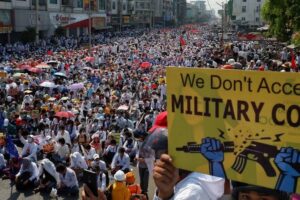
Sirikan Charoensiri (photo), a lawyer with Thai Lawyers for Human Rights (TLHR), has been providing legal aid to 14 students who were arrested on 26 June 2015 after carrying out peaceful protests calling for democracy and an end to military rule.
Since then, the Royal Thai Police have threatened Sirikan Charoensiri with legal action, publically announced they are considering charging her with a crime, and visited her home and questioned her family.
“The government must immediately end its harassment and intimidation of human rights lawyer Sirikan Charoensiri,” said Matt Pollard, Head of the ICJ’s Centre for the Independence of Judges and Lawyers in Geneva. “The case against her clients clearly violates Thailand’s obligations under international law, and cannot be a valid basis for the police to take any action against her for defending their rights.”
On 30 June 2015, the ICJ met in Geneva with staff members of the United Nations Special Rapporteurs on the Independence of Judges and Lawyers, and on the Situation of Human Rights Defenders, in order to bring Sirikan Charoensiri’s case to their attention.
“The ICJ has been repeatedly warning of Thailand’s steady slide away from open democracy and the rule of law,” added Pollard. “These actions of the police, targeting peacefully protesting students with prosecution in a military court, and then targeting the lawyer who comes to their defence, underscores the urgent need to restore respect for human rights in Thailand.”
Contact:
Matt Pollard, Senior Legal Adviser, ICJ’s Centre for the Independence of Judges and Lawyers, t: +41 22 979 38 12, e: matt.pollard(a)icj.org
Background
The 14 students were arrested during the evening of 26 June 2015 and were brought to a police station in Bangkok and then to the Bangkok Military Court for a hearing on pre-trial detention, which proceeded until midnight.
The students have been charged with violating order 3/2015 of the National Council for Peace and Order (which prohibits the public assembly of more than five people for political purposes) and a ‘sedition’-type offence under section 116 of Thai Criminal Code, which carries a maximum sentence of seven years imprisonment.
Upon hearing of the students’ arrest, Sirikan Charoensiri and three other lawyers drove in her car to the Bangkok Military Court in order to provide legal aid to the students.
Following the hearing and during the early morning of 27 June 2015, the police asked Sirikan Charoensiri for her permission to search her car for the student’s phones, without a warrant. She refused to consent to the warrantless search. As a result, the Police impounded her car, which contained the lawyers’ case files and personal computers, and five phones belonging to the students.
At 12:45pm, Sirikan Charoensiri went to the police station to file a complaint of malfeasance regarding the seizure of her car. The police refused to accept the complaint and in the meantime another police team searched her car with a warrant. Five phones belonging to the students were seized as evidence.
At 18:00pm, Sirikan Charoensiri again attempted to file a complaint at the police station for malfeasance. A senior investigator told her that the police had power to search her car and suggested that if she filed a complaint, it would not finish there and that the police would consider countering with some form of legal action against her. The police finally accepted the complaint at 11:00pm.
On 28 June 2015, a senior police officer told the media that they had found “important evidence” in Sirikan Charoensiri’s car and are considering whether to charge her with a crime.
On 29 June 2015, the police visited Sirikan Charoensiri’s family home and asked her parents to identify her in photos and questioned them about her background.
The International Covenant on Civil and Political Rights (ICCPR), to which Thailand is a State Party, guarantees the right to peaceful assembly; the right to freedom of expression; the prohibition of arbitrary arrest or detention and the right to a fair and public hearing by a competent, independent and impartial tribunal established by law (including the right of prompt access to a lawyer and precluding jurisdiction of military courts over civilians in circumstances such as these); and the prohibition of arbitrary or unlawful interference with privacy, family, home and correspondence (which includes arbitrary searches or seizures).
The UN Declaration on Human Rights Defenders affirms the right of everyone peacefully to oppose human rights violations. It prohibits retaliation, threats and other harassment against anyone who takes peaceful action against human rights violations, both within and beyond the exercise of their professional duties. It protects the right of persons to file formal complaints about alleged violations of rights. The UN Basic Principles on the Role of Lawyers provide that governments are to ensure that lawyers are able to perform their professional functions without intimidation, hindrance, harassment or improper interference.
Sirikan Charoensiri formerly served as a National Legal Consultant with the ICJ.
Thailand-Sirikan case-News-press releases-2015-THA (full text in PDF, Thai version)
Jun 30, 2015 | News
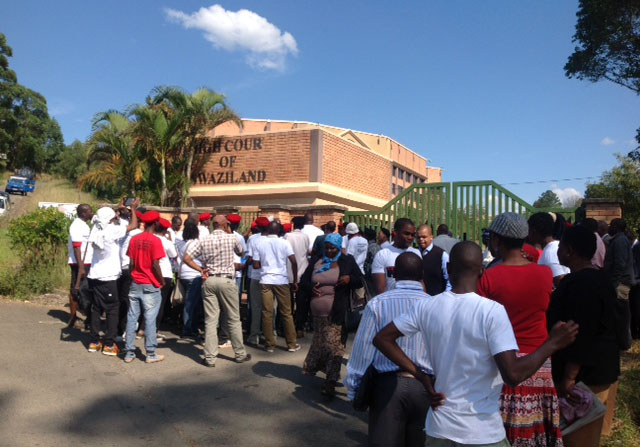
The ICJ welcomes the decision of the Supreme Court of Swaziland to uphold the appeal of imprisoned human rights defenders Thulani Maseko and Bheki Makhubu and ordering their immediate release.
“The decision marks a victory for the rule of law in Swaziland,” said ICJ Secretary-General Wilder Tayler. “We hope that this is but the first of many steps to come in restoring the integrity of the courts and reinforcing the respect for the rule of law that has undergone so much erosion in recent years.”
The ICJ considers that while the release of the two men is a necessary step for justice for the two men, alone it is not enough.
The government of Swaziland should ensure adequate reparation for their wrongful imprisonment.
More broadly, it must engage in legal and structural reforms necessary to ensure the fair and effective administration of justice, the independence of the judiciary and respect for human rights in the country.
Thulani Maseko and Bheki Makhubu were arrested on 17 March 2014 under contempt of court charges for having written articles criticizing the manner in which the then Chief Justice (CJ), Michael Ramodibedi, had handled the case of another defendant, Bhantshana Gwebu.
Mr. Gwebu had been arraigned before the CJ without legal representation, charge sheet or being informed of his rights to apply for bail.
The trial of Thulani Maseko and Bheki Makhubu was riddled with violations of basic due and fair trial principles, as affirmed by the UN Working Group on Arbitrary Detention (WGAD), which ruled on a complaint in Thulani Maseko’s case.
Background
The trial of Thulani Maseko and Bheki Makhubu resulted in their conviction and a two-year prison sentence It was improperly conducted before a presiding judge, Mpendulo Simelane, who was a potential witness and had a direct interest in the case.
They had been in custody since their arrest, save for a three-day release in June 2014, and were due for final release on the 17 July 2015.
The ICJ has previously issued a number of statements after conviction by the High Court, underscoring that the prosecution and trial Court’s judgment had constituted a breach of Swaziland’s obligations to respect the rights to freedom of expression and fair trial.
The UN WGAD opinion issued on 22 April 2015 held that the deprivation of liberty of the accused was arbitrary and in contravention of the Universal Declaration of Human Rights and Swaziland’s obligations under the International Covenant on Civil and Political Rights (ICCPR).
The WGAD also emphasized that Swaziland should release the accused and facilitate the enforceable right to compensation in accordance with article 9 of the ICCPR.
In the appeal hearing yesterday, the Crown conceded most of the legal arguments by defence counsel and in particular that Judge Simelane ought to have recused himself from presiding over the case.
The Supreme Court’s written judgment is expected to be issued at the end of the session of its sitting.
Read also:
Swaziland: ICJ condemns the harsh prison term imposed on Thulani Maseko and Bheki Makhubu
Swaziland: ICJ condemns the conviction of celebrated human rights lawyer and prominent journalist on charges of contempt of court
Swaziland: ICJ concerned at detention of human rights lawyer and journalist
American Bar Association’s statement
Contact:
Arnold Tsunga, Director, ICJ Africa Regional Programme, t +27 716 405 926 or +41 76 239 90 32 e: arnold.tsunga(a)icj.org
Matt Pollard, Senior Legal Adviser, ICJ’s Centre for the Independence of Judges and Lawyers, t: +41 22 979 38 12, e: matt.pollard(a)icj.org
May 15, 2015 | News
Concluding a five-day mission today, an International Fact-Finding team of the ICJ observed that there are serious structural deficiencies in Swaziland’s justice system that need to be addressed systematically and in a structured way to ensure the country meet core rule of law principles.
The mission was conducted in collaboration with the Africa Judges and Jurists Forum, Judges for Judges (the Netherlands) and the Commonwealth Magistrates’ and Judges’ Association, with the aim to assess the state of independence of the judiciary and administration of justice in the country.
“Current developments are merely the symptoms of a systemic crisis,” said Mission leader retired Judge Chinhengo of Zimbabwe.
“There is a need for officials from all branches of government to adhere to the rule of law. The effect of denied justice and in Swaziland has made many victims. Its effect on the community has been devastating, as it has served to undermine respect for human rights and trust in the judiciary to act as a check on the other branches of the State,” he added.
The decision to convene the International Fact-Finding Mission coincided with highly troubling recent events, including the arrest of Judges Simelane and Annandale, Registrar Nhlabatsi and former Minister of Justice Shongwe, and the continuing stand-off between suspended Chief Justice Ramodibedi and governmental authorities.
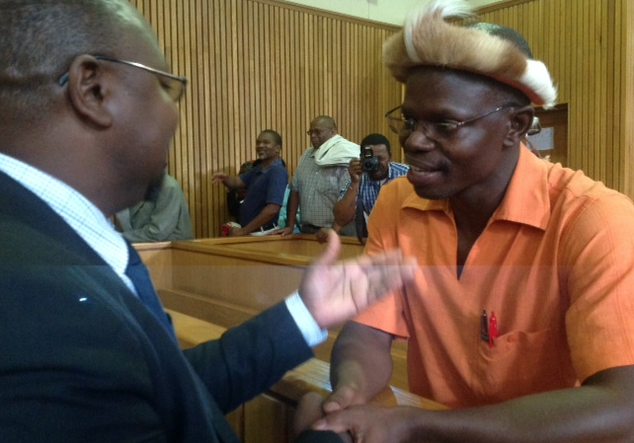
The Mission was also deeply concerned by the emblematic cases of the unfair dismissal of Judge Thomas Masuku in 2011 as well as the unfair trial and subsequent arbitrary detention of journalist Bheki Makhubu and lawyer Thulani Maseko (photo, on the right) in 2014.
The mission noted these developments were the culmination of a longstanding and deep-rooted systemic challenge that has to be adressed.
During its visit, from 11 to 15 May, the Mission met with key stakeholders in the administration of justice in Swaziland, including the Prime Minister and the acting Attorney General, the acting Chief Justice, the suspended Chief Justice and other members of the judiciary, and representatives of the Law Society and leading civil society actors.
The International Fact-Finding Mission will release a report with its observations and recommendations to the Swaziland authorities and the international community, providing concrete advice on strengthening the rule of law in the Kingdom.
Contact:
Arnold Tsunga, Director, ICJ Africa Regional Programme, t: +27 11 024 8268 or +27 73 131 8411: e: arnold.tsunga(a)icj.org,
Apr 24, 2015 | News
The ICJ today called on the Egyptian authorities to ensure a prompt, impartial and effective investigation into the deaths of two lawyers, Imam Afifi and Karim Hamdi, who recently died while in police custody in Mataria police station.
The ICJ is deeply concerned that the deaths of Imam Afifi and Karim Hamdi while in police custody are part of a widespread and sustained campaign targeting hundreds of lawyers since 2013, including those defending political opponents of the regime and human rights activists, as well as lawyers exercising their rights to freedom of assembly and expression.
“The Egyptian authorities must effectively investigate and prosecute all those responsible for the alleged torture and death of Imam Afifi and Karim Hamdi while in police custody and must hold accountable any person responsible for wrongful conduct ,” said Said Benarbia, Director of the ICJ MENA Programme.
“The authorities must bring an end to their ongoing campaign of harassing and persecuting lawyers, including arbitrary arrests and prosecutions, for simply discharging their professional duties or for speaking out against human rights violations,” he added.
Under international standards, lawyers should be able to carry out their professional duties free from hindrance, intimidation, harassment or interference, says the ICJ.
They should not be identified with their clients or their clients’ causes or subject to arbitrary arrest and prosecutions as a result of the discharge of their functions.
Background:
On 10 April, Imam Afifi, a 63-year old lawyer, was assaulted and arrested in the Mataria neighborhood where a demonstration was taking place against the government.
He was detained in Mataria police station where he was allegedly subjected to torture, including a severe beating to his head.
On 11 April, he was transferred from the police station to Mataria hospital.
A medical report from the same day, to which the ICJ had access, indicates that Imam Afifi was admitted to the hospital with a massive trauma to the head. He died in hospital on 22 April.
On 22 February, another lawyer, Karim Hamdi, was arrested and questioned on suspicion of belonging to the Muslim Brotherhood, membership of which has been outlawed, and participating in an unauthorized demonstration against the government.
While in police custody in Mataria police station, he was reportedly severely beaten on his neck, chest and abdomen. He died two days later after being transferred to hospital.
Following a complaint by the Bar Association to the prosecutor’s office, two members of the National Security Agency were charged with torturing and murdering Karim Hamdi.
Additional information:
According to information available to the ICJ, attacks against lawyers since 2013 include the following:
On 23 April 2015, six lawyers were summoned for interrogation in relation to their participation in a demonstration on 9 March to protest against the death of Mr Karim Hamdi.
The lawyers also challenged the prosecutor’s decision to prohibit anyone from reporting on the investigation into Mr Hamdi’s case.
On 23 March 2015, human rights lawyer, Azza Soliman, was charged with breaching public order and security under the 2013 Demonstration Law after voluntarily providing testimony against police involved in the killing of Social People’s Alliance party activist, Shaimaa El Sabbagh, on 24 January 2015.
The Qasr El Nile Prosecution Office in Cairo subsequently changed her status from witness to defendant.
On 9 February 2015, a human rights lawyer, Ms Mahienour El Massry, was sentenced to two years imprisonment after she attended the El-Ramel police station in Alexandria, in March 2013, in order to defend demonstrators.
The charges against her included “insulting government employees in the performance of their duties”, “insulting representatives of the authorities” and “attempting to break into a police station”.
Three lawyers, Basma Zahran, Mahmoud Bilal and Oussama Al Mahdi, were referred for investigation, on 3 September 2014, for “disrupting and causing trouble” during trial proceedings for insisting that their client, the human rights activist Ahmed Douma, seated in a sound-proof glass cage, should be heard.
On 5 July 2013, Abdel Men’em Abdel Maqsoud was arrested while attempting to attend the interrogation of his clients, deputy Secretary General of the Muslim Brotherhood, Rachad Bayoumi, and Mohamed Saad Al Katanah.
He was detained before being released on bail on 2 September 2014.
Contact:
Alice Goodenough, Legal Adviser of the ICJ Middle East and North Africa Programme, t: 44 7815 570 834, e: alice.goodenough(a)icj.org
Nader Diab, Associate Legal Adviser of the ICJ Middle East and North Africa Programme, t: 41 229 793 804, e: nader.diab(a)icj.org
Egypt-Deaths of lawyers-News-Press release-2015-ARA (full text of Arabic version in PDF)
Apr 14, 2015 | News
The ICJ is deeply concerned over the decision of the High Judicial Council and the President of the Cairo Court of Appeal to investigate two judges with a view to referring them to the disciplinary Council.
Media reports have indicated that Assem Abdel Jabar, deputy president of the Cassation Court, and Hicham Raouf, a judge in Cairo’s Appeal Court, are being investigated over their individual participation, together with other leading lawyers and legal experts, in a workshop organized by an Egyptian organization, United Group, to discuss and propose new legislation on the prevention of torture.
According to information available to the ICJ, the two judges have so far not been formally notified of any charges against them and have received no information about the allegations on which they are based.
The actions against these judges continue a pattern of intimidation and attempted silencing of judges who are seen by authorities as not aligning themselves with government objectives.
The apparent investigation is only the latest in a string of cases where judges have been subject to arbitrary disciplinary proceedings for legitimately exercising their rights to freedom of expression and assembly.
On 14 March 2015, the Disciplinary Council forced 31 judges into retirement for signing a statement, on 24 July 2013, which criticized the “attack on the constitutional legitimacy and the ouster of the legitimate president that was elected”.
The disciplinary proceedings against these judges were marred with violations of due process rights.
The judges were not adequately informed of the date and location of the hearings, defence witnesses were not called and requests by the judges that the hearings be public were disregarded.
On 4 April 2015, a disciplinary hearing took place against Zakaria Abdelaziz, former president of Egypt’s Judges Club and one of the leading advocates for judicial independence in Egypt.
The charges alleged “involvement in politics” and “breaking into the State Security Building during a demonstration on 5 March 2011”.
According to information available to the ICJ, the case files were not made available to Zakaria Abdeaziz until the first hearing despite repeated requests to obtain them.
Under international human rights law and standards, judges are guaranteed the right to freedom of belief, association, assembly and expression, including by commenting on matters of public concern and matters pertaining to the rule of law and human rights situation in a country.
“Instead of subjecting judges to arbitrary proceedings for lawfully exercising their rights, the Egyptian authorities should stop its sustained campaign to muzzle judges who are seen as not friendly to the authorities,“ said Said Benarbia, Director of the ICJ MENA programme. “The Egyptian authorities must reinstate all judges who were removed from office solely for exercising their rights to freedom of expression and assembly and drop all charges against those currently subject to disciplinary proceedings for charges stemming from the exercise of these rights.”
Contact:
Alice Goodenough, Legal Adviser of the ICJ Middle East and North Africa Programme, t: +44 7815 570 834, e-mail: alice.goodenough(a)icj.org
Nader Diab, Associate Legal Adviser of the ICJ Middle East and North Africa Programme, t: +41 229 793 804, e-mail: nader.diab(a)icj.org
Egypt-Judges harassed-News-web story-2015-ARA (full text in PDF)