Colombia: public authorities must refrain from interference with judicial proceedings in case against former President Uribe

Colombia: public authorities must refrain from interference with judicial proceedings in case against former President Uribe

Today the ICJ called on the public authorities to refrain from comments or actions that could undermine the integrity of the judicial process and the independence of the judiciary.

On August 4, the Instruction Special Chamber of the Criminal Chamber of the Supreme Court of Justice ordered the pretrial detention, substituted for house arrest, of the former President Álvaro Uribe Velez, relating to allegations of bribery of witnesses and procedural fraud.

In recent days, a number of politicians have made highly inappropriate and inflammatory statements, including some suggesting that judges are making their decisions based on ideological or political biases rather than based on the Constitution and the law.

Colombian president Ivan Duque said in remarks broadcast on television on the 4 of August: “it hurts as a Colombian that many of those who have lacerated the country with barbarism defend themselves at liberty or are even guaranteed to never go to prison, and that an exemplary public servant who has held the highest dignity of the State is not allowed to defend himself in freedom with the presumption of innocence. I am and will always be a believer in the innocence and in the honor of him who, with his example, have earned a place in the history of Colombia.” (unofficial translation).

The ICJ stresses that it is inappropriate for a head-of-State or other executive official to intervene in this manner in a case that is under active judicial proceedings. The UN Basic Principles on the Independence of the Judiciary make clear that “it is the duty of all governmental and other institutions to respect and observe the independence of the judiciary” and this includes refraining from any “improper influences, inducements, pressures, threats or interferences, direct or indirect.”

In reaction to Senator Uribe’s arrest, the political party “Centro Democrático”, of which both President Duque and former President Uribe are members, released a press statement saying that they were planning to propose a National Constituent Assembly with the purpose of “depoliticizing justice”. Also, former President Uribe mentioned on 16 of August that he hoped his political party would initiate a reform of the justice system through a “referendum” to end the “politicization” of the Court.

The ICJ considers that any actions concerning reforms of the justice sector must be based on the standards and best practices that reinforce the independence of the judiciary and the prompt, timely and fair administration of justice, and not on a political reaction based on a single active case.

Lastly, United States Vice President Mike Pence has also made inappropriate remarks related to the Colombian justice system, tweeting on August 14 that he joined the voices that called Colombian authorities to let Alvaro Uribe “defend himself as a free man”.

Contact

Carolina Villadiego Burbano, ICJ Latin America legal and policy adviser, e: carolina.villadiego(a)icj.org

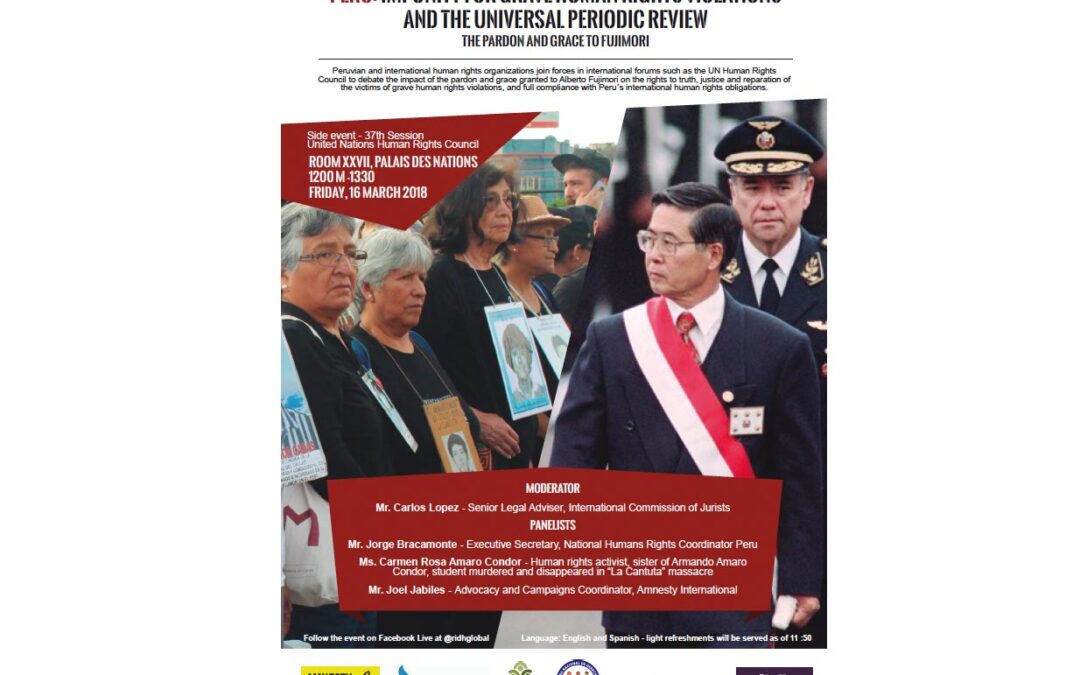
Side event to the HRC: Peru, the pardon and grace to Fujimori

Side event to the HRC: Peru, the pardon and grace to Fujimori

This side event to the 37th Session of the United Nations Human Rights Council takes place on Friday, 16 March 2018, from 12.00 to 13.30, Room XXVII, Palais des Nations, Geneva. It is co-sponsored by the ICJ.

Peruvian and international human rights organizations join forces in international forums such as the UN Human Rights Council to debate the impact of the pardon and grace granted to Alberto Fujimori on the rights to truth, justice and reparation of the victims of grave human rights violations, and full compliance with Peru´s international human rights obligations.

Moderator

  • Mr. Carlos Lopez – Senior Legal Adviser, International Commission of Jurists

Panelists

  • Mr. Jorge Bracamonte – Executive Secretary, National Humans Rights Coordinator Peru
  • Ms. Carmen Rosa Amaro Condor – Human rights activist, sister of Armando Amaro
    Condor, student murdered and disappeared in “La Cantuta” massacre
  • Mr. Joel Jabiles – Advocacy and Campaigns Coordinator, Amnesty International

Follow the event on Facebook Live at @ridhglobal

Language: English and Spanish – light refreshments will be served as of 11 :50

Kenya: stop attacks on the judiciary in the wake of elections

Kenya: stop attacks on the judiciary in the wake of elections

The ICJ notes that a number of threats and intimidating statements aimed at members of the judiciary, including the Supreme Court, were made during the election campaign period in Kenya.

Now that the elections ordered by the Supreme Court after nullification of the initial elections in Kenya have been concluded, it is important for Kenyan authorities to reaffirm commitment to separation of powers and guarantee the security of judges and the independence of the judiciary in the country, the ICJ says.

On Monday, 30 October 2017, the Indepedent Electoral Boundaries Commission (IEBC) in Kenya declared President Uhuru Kenyatta as the winner of the October 26 repeat polls.

President Uhuru Kenyatta is widely reported to have been heavily critical of the Supreme Court for annulling the 8 August 2017 presidential election on a “technicality”.

It is also reported that he promised to “fix” the bench if re-elected.

The President is also reported to have said he would deal with Chief Justice Maraga, but did not however define the form of action he would take.

Similar sentiments have been attributed to Deputy President William Ruto. It’s unclear at this stage whether these statements should be dismissed as political rhetoric on the campaign trail or warrant further consideration.

However such utterances and threats on the judiciary by senior government officials may be inferred as an attempt to intimidate or unduly influence the bench.

“These threats coming from the highest authorities hinder the ability of the courts to perform their duties, which are indispensable for the rule of law and fair administration of justice in the country,” said Arnold Tsunga, ICJ’s Africa Regional Programme Director.

“Judges must be able to exercise their duties freely, independently and impartially, or else the rule of law in the country will be eroded, and with it, effective protection of the human rights of the Kenyan people,” he added.

The ICJ recalls that the UN Basic Principles on the Independence of the Judiciary provide that judges must be able to perform their professional duties “without any restrictions, improper influences, inducements, pressures, threats or interferences, direct or indirect, from any quarter or for any reason” and that governments have a responsibility to secure this guarantee.

Article 26 of the African Charter on Human and Peoples Rights also imposes an obligation on Kenya to establish an independent judiciary.

Contact

Arnold Tsunga, Director of ICJ’s Africa Regional Programme, t: +27716405926, e: arnold.tsunga(a)icj.org

Translate »