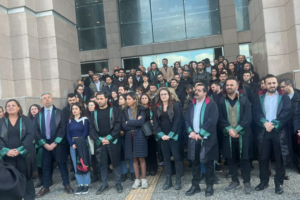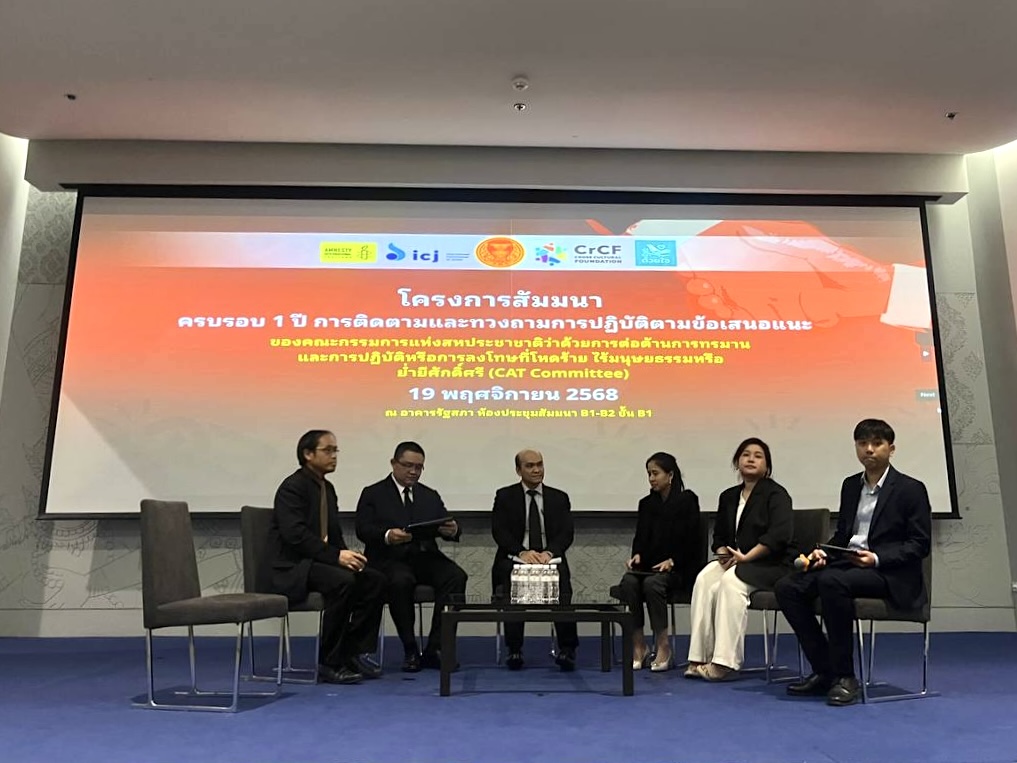
On 19 November, the International Commission of Jurists (ICJ) co-hosted an event at the Thai Parliament to address the situation of torture and enforced disappearances, which included representatives from the government, civil society and victims.
The event was entitled “Countdown to One Year: Follow-up to the Recommendations of the Committee against Torture and the Next Steps for the Thai Parliament in Protecting Victims of Torture and Enforced Disappearance”.
While speakers noted some progress over the past year, such as a decrease in reported allegations of torture and other ill-treatment and enforced disappearances, the country was still falling far short in meeting its obligations to prevent, stop and provide accountability and redress for acts of torture, ill-treatment and enforced disappearance.
The UN Committee against Torture (CAT) had to Thailand prioritized recommendations in its Concluding Observations of 9 December 2024. Thailand was required to report back to CAT by 22 November 2025 on its progress in: amending domestic law so that torture and enforced disappearance are not subject to statutes of limitations that would prevent accountability for many violations; ensuring adequate resourcing of Thailand’s National Committee on the Prevention and Suppression of Torture and Enforced Disappearance; and ending the unlawful use of administrative detention and the poor conditions in immigration detention facilities.
A representative from the Ministry of Justice informed participants that the Ministry had convened a meeting with relevant agencies to discuss the prioritized recommendations and had prepared a draft response, which would be forwarded to the Ministry of Foreign Affairs once finalized. However, the Ministry’s representative also asserted that the government currently had no plans to amend laws to remove statutes of limitations for torture and enforced disappearance, and that the National Committee was considered to have adequate resources. To date, Thailand has not yet submitted its required replies to CAT.
Panelists raised serious concerns about the slow implementation of the Prevention and Suppression of Torture and Enforced Disappearance Act B.E. 2565 (2022). Only two cases had reached the courts in the past two years, with many others still pending investigation. Speakers also highlighted the lack of transparent statistics on case progress and condemned the absence of meaningful steps to amend the statute of limitations provisions; overcrowding and poor hygiene in immigration detention facilities, and the inability of most immigration detainees to effectively challenge their detention both at the outset and throughout the detention period.
A second panel at the event addressed “Progress and the Way Forward in Advancing Legislative Compliance with CAT Recommendations” and featured contributions from members of parliament and other stakeholders on the legislative reforms needed to implement the prioritized recommendations and improve the effectiveness of the Anti-Torture Act.
Noting the lack of tangible progress from the government, speakers discussed potential amendments to expand exceptions to statutes of limitations in certain circumstances, through a draft bill already being prepared by the Parliamentary Subcommittee and political parties, as well as revisions to the Anti-Torture Act to address persistent shortcomings in investigations and access to justice.
The ICJ underscores that under international standards, statutes of limitations should not be available for serious crimes under international law, such as torture and enforced disappearance.
Background
The event was organized in collaboration with Amnesty International Thailand, the Cross-Cultural Foundation (CrCF), the Duayjai Association for Humanitarian Affairs, and the Thai Parliament’s Standing Committee on Legal Affairs, Justice, and Human Rights.
It brought together some 30 participants, including victims and their families; representatives from the Office of the Attorney General, the Royal Thai Police and its Immigration Bureau, the Ministry of Justice, and the Ministry of Foreign Affairs; several members of parliament, and representatives from civil society organizations and UN agencies.
Thailand submitted its Second Periodic Report on the implementation of the Convention against Torture and Other Cruel, Inhuman or Degrading Treatment or Punishment (UNCAT) to the CAT, which reviewed the report during its 81st session on 5–6 November 2024 in Geneva, Switzerland. The resulting Concluding Observations, dated 9 December 2024, acknowledged certain progress but identified significant gaps to be addressed for Thailand to meet its obligations under UNCAT.
This was Thailand’s first review since adopting the Anti-Torture Act, which domesticates the UNCAT’s treaty obligations. It also marked ten years since Thailand’s initial review in 2014, following its ratification of UNCAT in 2007.
The CAT has requested that Thailand submit its third periodic report by 22 November 2028, and provide information on follow-up to the prioritized recommendations by 22 November 2025.
Speakers on the first panel included Bawon Bunlop from the Office of the Attorney General’s Center for Prevention and Suppression of Torture and Enforced Disappearance; Chattraporn Ditsasriphon from the Ministry of Justice’s Rights and Liberties Protection Department; Jira Monsiri from the Human Rights and Development Foundation; Pol Col Surasak Surinkaew from the Royal Thai Police’s Immigration Bureau; Preda Nakpew from the Cross-Cultural Foundation; and Sanhawan Srisod from the International Commission of Jurists.
Speakers on the second panel included Adilan Ali Isha, Dr. Sriyada Palimaphan, Ratklao Suwannakhiri, and Romadon Panjor, who are parliamentarians and/or representatives of political parties.
Further Reading
Contact
Sanhawan Srisod, Senior Legal Adviser, Legal and Policy Office, e: sanhawan.srisod@icj.org