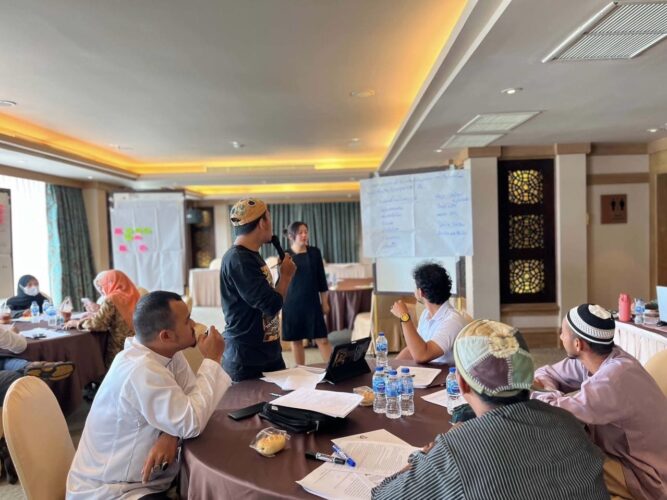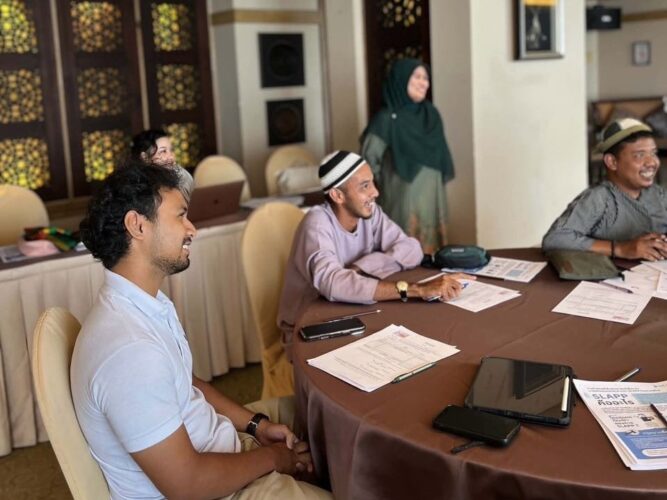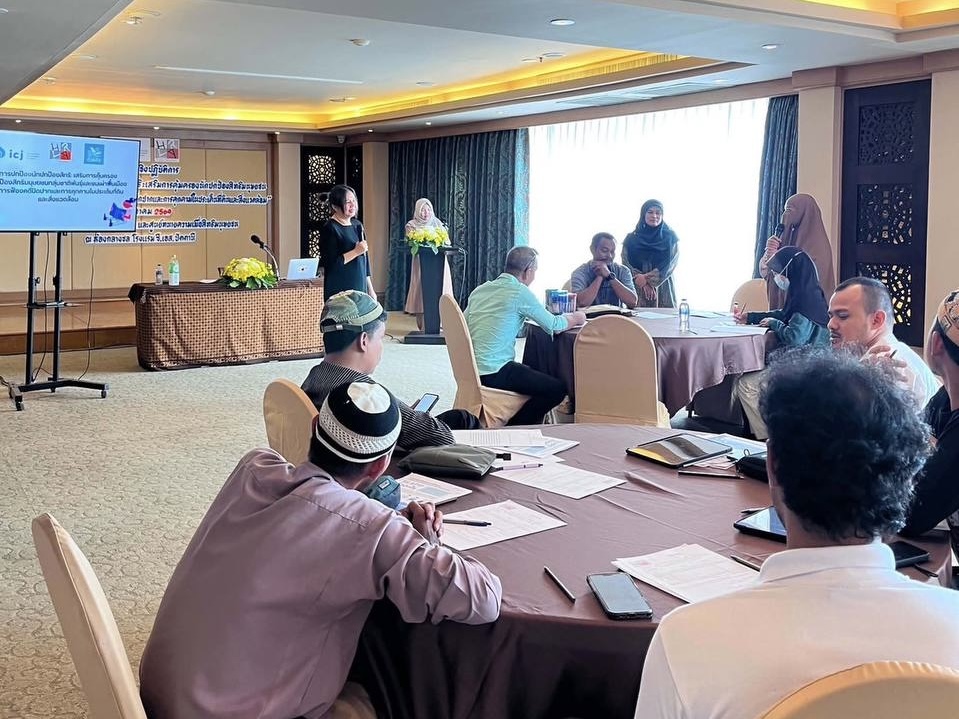
On 6 May 2026, the International Commission of Jurists (ICJ), together with the Duay Jai Foundation for Humanitarian Affairs (Duayjai) and the Human Rights Lawyers Association (HRLA), convened a workshop in Pattani Province with 23 human rights defenders (HRDs) from Thailand’s southern border provinces (SBPs). The workshop discussed challenges faced by HRDs in the region, including barriers to safe and effective human rights work, and the growing abuse of judicial processes through Strategic Lawsuits Against Public Participation (SLAPPs)—as a tool to silence defenders. It also discussed the draft Act on the Prevention of Strategic Lawsuits Against Public Participation. Participants analysed in groups whether the draft adequately responds to their concerns and supports their work.
Threats, Harassment, and Intimidation
Participants working across areas concerning environment, land, culture, and other human rights indicated, based on first-hand accounts, that physical, digital, and psychological harassment persisted in connection with their work or in the exercise of their rights to freedom of expression and assembly.
Participants described a recurring pattern of intimidation. Several reported physical surveillance and repeated visits at homes and offices by security forces outside working hours, with some residences surrounded by multiple vehicles and armoured personnel during night-time searches. Others described being arbitrarily stopped at security checkpoints and subjected to body searches. Workplace harassment was also documented, with authorities approaching employers to enquire about defenders’ activities. Participants further noted threats from local officials who are themselves the target of scrutiny by HRDs, including threats to prosecute defenders under the security laws in force in the SBPs.
Threats through digital means were also reported, including targeted online disinformation campaigns (“Information Operations”), by which HRDs are characterized as “insurgents” and, in the case of women HRDs, deploying sexist language. Participants also reported drones observed over their neighbourhoods at night and CCTV cameras installed opposite their residences.
Abuse of Judicial Processes
Participants discussed the accelerating use of SLAPPs to silence HRDs in the region. Duayjai has recorded at least 13 SLAPP cases involving 39 individuals and a media company between 2014 and 2024, with nine cases involving 32 individuals occurring between 2021 and 2024 alone. Laws used include Section 116 of the Criminal Code (sedition), protest-related offences under regulations imposed by the Emergency Decree, and the Computer Crimes Act.
Participants spoke of a pronounced chilling effect on freedom of expression, peaceful assembly, and association—causing defenders to scale back advocacy, fracturing community solidarity, and discouraging journalists from covering human rights issues in the region.
Saovanee Kaewjullakarn, ICJ Associate Legal Adviser, described deficiencies in Thailand’s existing anti-SLAPP legal framework. In discussing the Ministry of Justice’s draft Act on the Prevention of Strategic Lawsuits Against Public Participation, participants raised concern over the condition allowing prosecutors and judges to dismiss SLAPP cases, including where the “public interest” in dismissal outweighs the “public interest” in proceeding. This formulation is ambiguous and, if not clearly defined, risks being used to suppress rather than protect HRDs’ work.
This workshop is the first in a series of regional consultations to be held by the ICJ and its partners across Thailand. The ICJ will document threats, intimidation, reprisals, and SLAPPs faced by HRDs—with particular focus on those from ethnic, ethno-religious, and indigenous communities—and conduct knowledge-sharing sessions to ensure HRDs’ concerns are reflected in ongoing legislative processes, including the current SLAPP law reform effort.
Background
The SBPs—commonly referred to as the Deep South—encompass Pattani, Yala, and Narathiwat provinces, as well as four districts of Songkhla. The region is predominantly populated by ethnically Malay Muslims and operates under a more restrictive legal framework than the rest of Thailand, with Martial Law in force since 2004 and the Emergency Decree since 2005.
Thailand’s existing anti-SLAPP provisions—Sections 161/1 and 165/2 of the Criminal Procedure Code (2019) — have proven inadequate, applying only to private criminal complaints and failing to define what constitutes filing “not in good faith.” A recent amendment to the Organic Act on Anti-Corruption similarly falls short, applying solely to cases before the National Anti-Corruption Commission (NACC). The Ministry of Justice’s draft Anti-SLAPP Act remains stalled, with no public progress announced since its public hearing in April 2025.
Further reading
Dictating the Internet: Curtailing Free Expression and Information Online in Thailand
Thailand: New law protecting SLAPPs marks progress but much more is needed
Contacts
Sanhawan Srisod, Senior Legal Adviser, Legal and Policy Office, e: sanhawan.srisod@icj.org
Saovanee Kaewjullakarn, Associate Legal Adviser, ICJ Asia and the Pacific Programme, e: saovanee.kaewjullakarn@icj.org