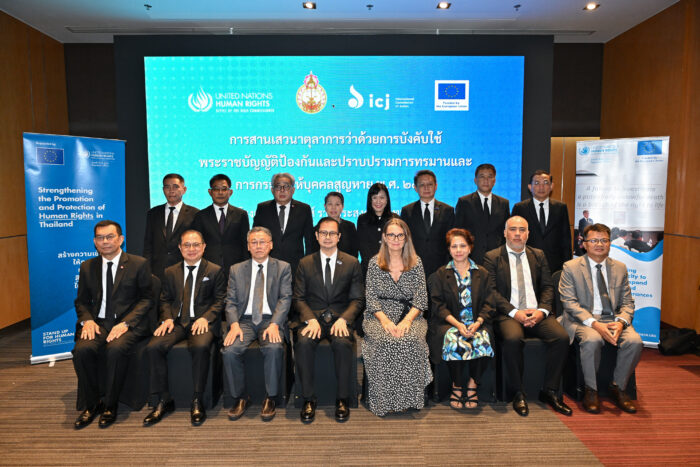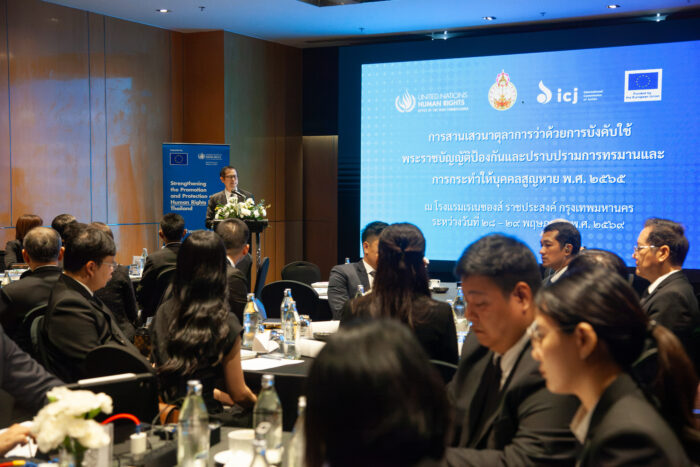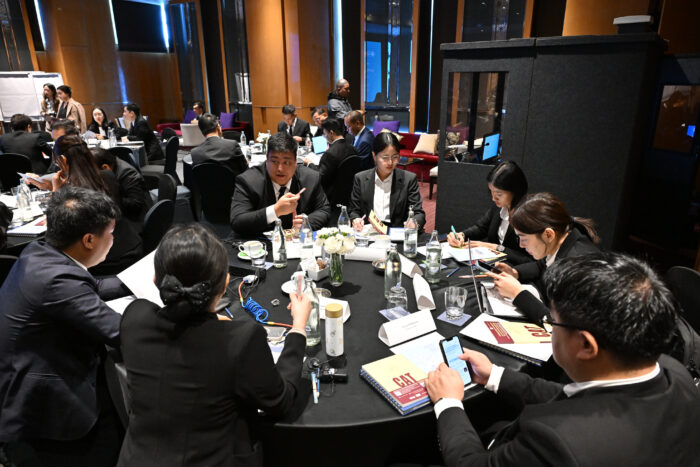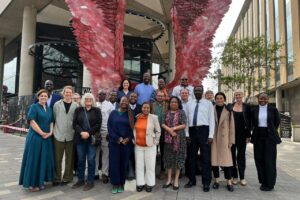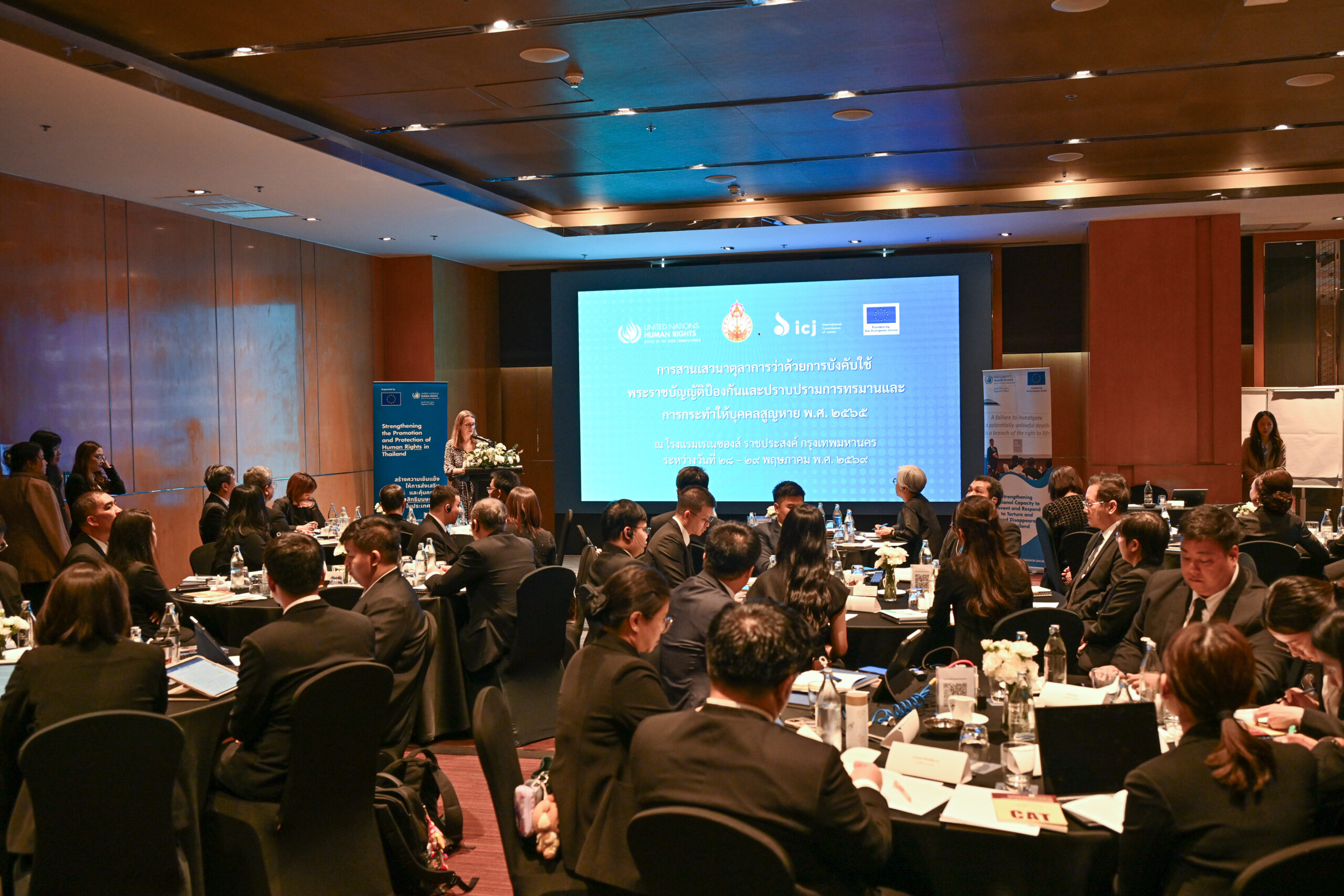
On 28-29 May, fifty-four judges from Bangkok and Regions 1, 2 and 7 (spanning the central, eastern and western regions of Thailand) took part in the first of a series of five planned regional judicial dialogues on the implementation of Thailand’s Prevention and Suppression of Torture and Enforced Disappearance Act B.E. 2565 (2022) (the Act).
The dialogue was jointly organized by the Office of the Court of Justice, the International Commission of Jurists (ICJ) and the Office of the UN High Commissioner for Human Rights (OHCHR), with support from the European Union Delegation to Thailand.
Cases under the Act have begun to be adjudicated, some three years after the Act entered into force. The Act is intended to incorporate into Thai law the provisions of the Convention against Torture and the International Convention for the Protection of All Persons from Enforced Disappearance. This early stage of adjudication is critical, as the first wave of judicial decisions stands to shape how the law is understood and applied nationwide in the coming years.
The workshop participants considered the law’s jurisdictional architecture and the evidentiary and procedural tools available to courts, such as mandatory audio-visual recording of arrests. Participants discussed how “detention” should be defined and construed under the Act, and how the law’s retrospective application to enforced disappearance committed prior its enactment should be understood.
Participants also discussed how the importance of taking into account jurisprudence and commentary from relevant UN treaty bodies and independent experts (special procedures) of the UN Human Rights Council. Speakers encouraged wider use of the Istanbul Protocol, the leading set of international standards concerning the investigation and documentation of torture and ill-treatment, which has so far rarely been applied in Thai proceedings.
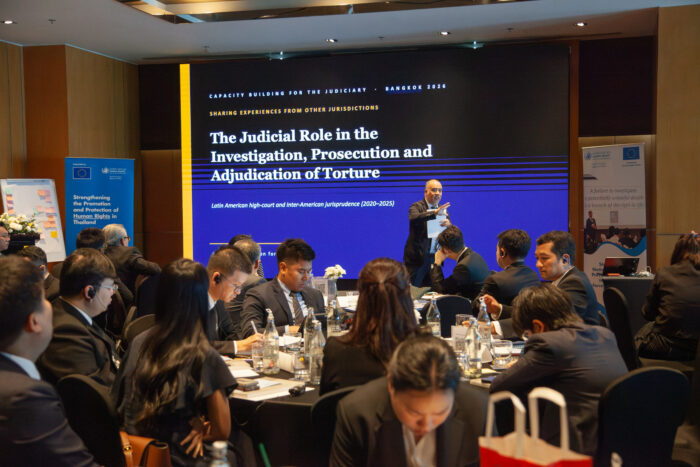
The Dialogue also drew on the experience of Omar Gomez Trejo, former Special Prosecutor in Mexico, who set out five judicial functions he described as central to preventing and redressing torture and enforced disappearance: rigorous judicial control of detention from the moment a person is first brought before a court; a firm exclusionary rule for statements obtained through torture, ill-treatment or coercion, with the burden resting on the state to prove an inculpatory statement was voluntary; the application of habeas corpus that compels the physical production of the detained person and permits unannounced inspection of detention facilities; the power of courts to set aside domestic laws, such as amnesty provisions, that are non-compliant with international law; and a continuing duty to investigate, protect victims and witnesses, and ensure integral reparations.
Participants worked through how the exclusionary rule and habeas corpus protections operate under Thai law, how courts should sequence proceedings where a “confession” is alleged to have been obtained through torture or ill-treatment, and how the continuing nature of enforced disappearance affects the running of limitation periods.
Closing the dialogue, the Court of Justice also announced it is preparing practitioner guidelines for judges on applying the Act.
The dialogue is the first in a series that will include events in northern, northeastern and southern Thailand later in 2026, reflecting an effort by the judiciary to embed implementation of the Act in line with international law and standards across Thailand.
Background
Since entering into force in 2023, the Act has generated growing numbers of complaints but comparatively few that reach court. As of May 2026, 195 complaints had been lodged with various authorities, of which only 13 had proceeded to trial, while 83 cases were closed or a decision was made not to prosecute.
When combined with petitions directly submitted to court seeking the exercise of the court’s protective powers to prevent crimes under the Act, a total of 53 cases had reached the courts.
Presenters at the dialogue included:
- Audrey Rochelemagne, EU Delegation to Thailand
- Dip Magar, OHCHR Regional Office for Southeast Asia
- Mandira Sharma, ICJ Regional Director for Asia and the Pacific
- Narong Jaiharn, Chair, Subcommittee on Law under the Anti-Torture and Enforced Disappearance Act
- Omar Gomez Trejo, former Special Prosecutor, Mexico
- Sanhawan Srisod, ICJ Senior Legal Adviser, ICJ
- Thanarat Thangthong, Chief Justice of the Central Criminal Court for Corruption and Misconduct Cases
- Thiratai Charoenwong, Secretary-General of the Office of the Judiciary
Further reading
Contacts
Sanhawan Srisod, Senior Legal Adviser, Legal and Policy Office, e: sanhawan.srisod@icj.org
Saovanee Kaewjullakarn, Associate Legal Adviser, ICJ Asia and the Pacific Programme, e: saovanee.kaewjullakarn@icj.org