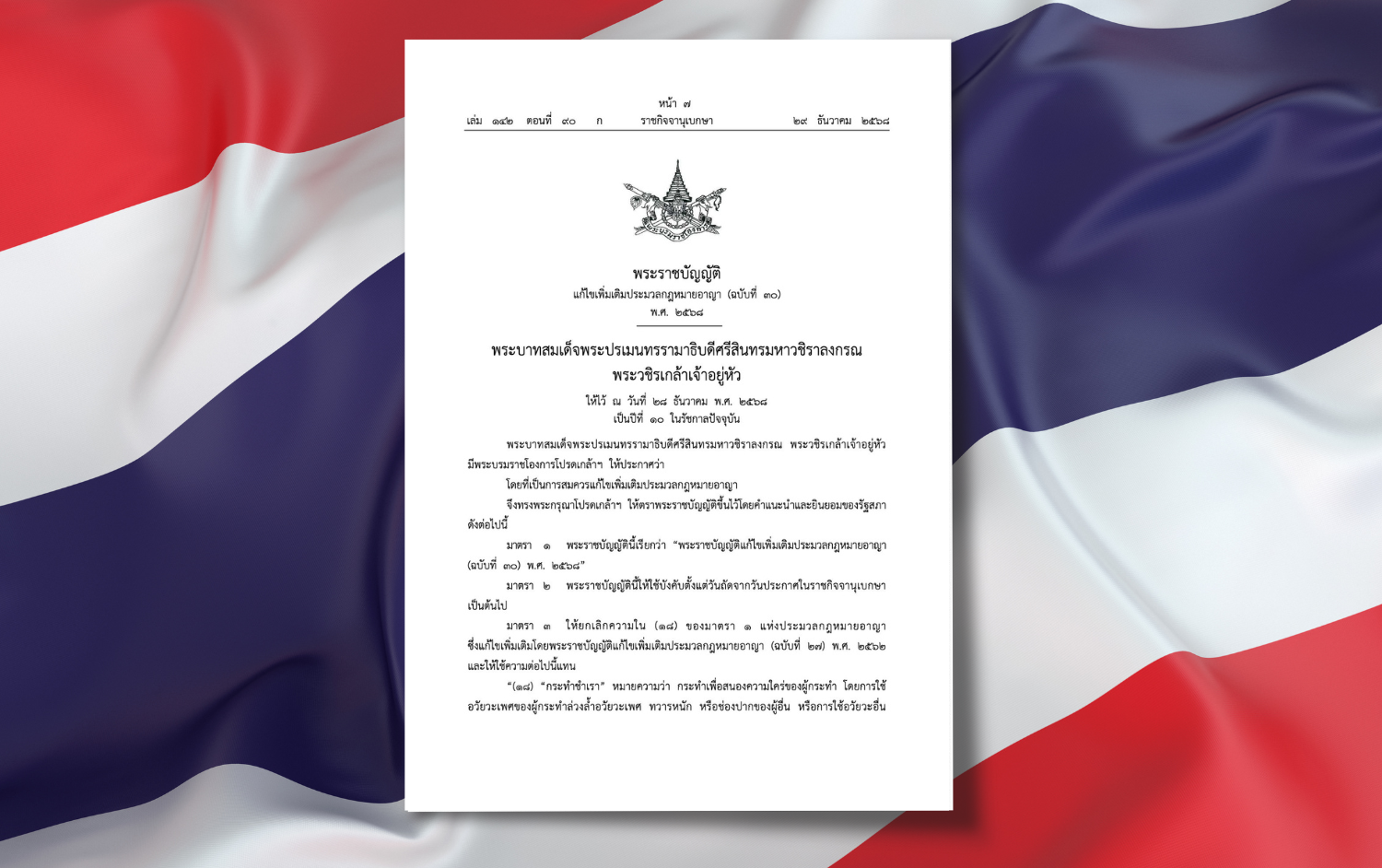
The International Commission of Jurists (ICJ) today welcomes the 30 December 2025 entry into force of the amendment to Thailand’s Criminal Code (No. 30) B.E. 2568 (2025) criminalizing sexual harassment—an abusive conduct that had long remained in legal limbo in the country. At the same time, the ICJ stresses that further reforms are required to ensure effective and human rights-compliant protection for survivors of sexual harassment, to strengthen awareness-raising to support effective enforcement and to prevent an overly broad application of the law.
“The long-awaited amendment to the Criminal Code addresses gaps that survivors of sexual harassment and civil society organizations have long highlighted—particularly the absence of a specific legal provision and definition addressing sexual harassment and technology-facilitated gender-based violence (TFGBV),” said Sanhawan Srisod, Senior Legal Adviser at the ICJ.
“This reform also reflects some of ICJ’s most recent recommendations, including, in our baseline study launched in November last year.”
Under the amended Criminal Code, “sexual harassment” is defined as “any act committed by physical means, words, sounds, gestures, communication, watching, stalking, or by any other means—including acts carried out through computer systems, telecommunications devices, or other electronic devices—capable of conveying meaning to another person, that has a sexual connotation and is likely to cause that person distress, annoyance, embarrassment, humiliation, fear, or a sense of sexual insecurity.”
Upon conviction, an offender may be liable to imprisonment up to one year, a fine not exceeding 20,000 THB (approximately USD 637), or both, unless aggravating circumstances are present. Aggravating circumstances leading to increased penalties under the amended Criminal Code include continuous or repeated acts; acts committed in public, before the public, or through computer systems accessible to the public; acts committed against children under 15 years of age regardless of consent; and acts involving abuse of power or authority, such as those committed by commanders, employers, or other persons exercising power over survivors.
While the amendment marks important progress, the ICJ underscores that its application must be consistent with international human rights law and standards.
“Under international human rights law and standards, while some conduct may justify civil or disciplinary penalties, not all acts of sexual harassment necessarily warrant criminal sanctions, such as imprisonment—particularly where the conduct does not amount to a violation of a survivor’s physical, sexual, or psychological integrity or where it is isolated,” Sanhawan said.
“We therefore urge Thai justice sector actors to ensure that the law is applied in compliance with international law and standards, with sanctions that are commensurate with the gravity of the offence, and that do not unduly restrict human rights, including the right to freedom of expression.”
In addition, the ICJ underscores that other existing legal provisions, which provide a basis for criminalization, still need to be amended to prevent their overly broad application, which has frequently targeted individuals solely for their involvement in consensual sexual activities raising serious freedom of expression and other human rights concerns. For example, certain legal provisions concerned with the production, possession and dissemination of so-called “obscene materials” should be amended to limit their application to non-consensual conduct only and to cases involving child pornography.
Certain laws and practices also create additional barriers for sexual harassment and TFGBV survivors and should be repealed or substantially amended, including laws criminalizing sex work and restrictive immigration regulations, which deter survivors from reporting sexual harassment and seeking justice.
The ICJ further calls on the authorities to conduct awareness-raising initiatives and to develop and promote clear guidelines to ensure that law enforcement officers are knowledgeable about all forms of sexual harassment, both offline and online.
Background
The amendment also grants the courts the power to issue provisional protection measures in sexual harassment cases, including orders to prevent the publication or dissemination of harmful content. This new power responds to a longstanding demand by civil society organizations, including the ICJ, and survivors, as such provisional protection measures were previously limited largely to domestic violence cases.
In November 2025, the ICJ launched a baseline study titled Access to Justice for Sexual and Gender-Based Violence in Thailand. The study analyzed Thailand’s legal and policy framework on sexual and gender-based violence and assessed the country’s compliance with its international human rights law obligations.
The report found, among other things, that Thailand lacked a comprehensive legal framework addressing sexual harassment and TFGBV, with existing protections scattered across civil service, labour, and criminal laws. Legal definitions were narrow and inconsistent, penalties were often minor, and there was insufficient guidance for justice sector actors on what constituted “sexual harassment”.
The report also found that broadly framed “obscenity” and computer-crime offences had been applied in ways that unduly restricted consensual sexual expression, raising freedom of expression concerns.
The production, possession, import, export, or dissemination of adult content deemed “obscene” is criminalized under Section 287 of the Criminal Code and Section 14(4) of the Computer-Related Crimes Act B.E. 2550 (2007).
Further reading
Baseline Study on Access to Justice for Sexual and Gender-Based Violence (SGBV) in Thailand
Download
The presser is also available for download in English and Thai.
Contact
Sanhawan Srisod, Senior Legal Adviser, Legal and Policy Office, e: sanhawan.srisod@icj.org
Saovanee Kaewjullakarn, Associate Legal Adviser, ICJ Asia and the Pacific Programme, e: saovanee.kaewjullakarn@icj.org