Sep 11, 2018 | Advocacy, Non-legal submissions
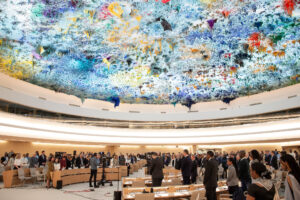
The ICJ today addressed the new UN High Commissioner for Human Rights, Michelle Bachelet, highlighting the role of her office in countering global threats to the rule of law and human rights.
The statement was made at the UN Human Rights Council, during general debate on the High Commissioner’s oral update. It read as follows:
“Madam High Commissioner,
The International Commission of Jurists (ICJ) warmly welcomes you to your new mandate – a mandate that the ICJ has, since 1964, fought to create and support.
A multitude of issues and situations urgently call for your attention. However, a dark cloud looms over them all, and casts its shadow across the globe, including in this chamber. From different directions, various political actors driven by authoritarian ideologies and impulses, thirst for power and fraudulent populisms, grow in strength and are joining forces to mount a concerted attack on the rule of law.
They openly scorn the stated aims of the UN Charter, including “faith in fundamental human rights” and the maintenance of “justice and respect for … international law.” They seek to undermine, defame, and destroy global, regional and national institutions built over decades as bulwarks to protect human rights and human dignity. They thrive on silence or passivity by global leaders and populations, as they assault independent judiciaries, media, and civil society.
Madam High Commissioner, you can make a unique impact by speaking forcefully and publicly in defense of human rights and the rule of law, in defense of victims, and against governments and individuals who demonstrate their hostility or indifference to these aims. The ICJ stands ready to support you and your office in the challenges that lie ahead.
Thank you.”
Sep 5, 2018 | Events, News
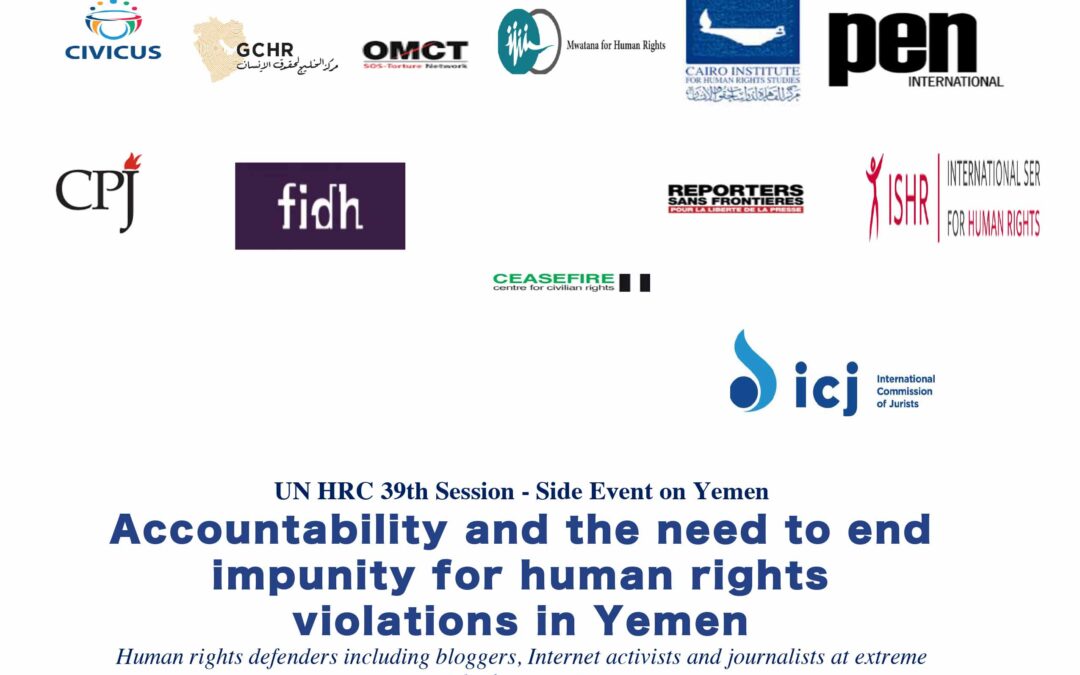
The ICJ will participate in the side event “Accountability and the need to end impunity for human rights violations in Yemen,” organized by the CIVICUS, FIDH, CIHRS in cooperation with Mwatana for Human Rights and the Gulf Centre for Human Rights (GCHR).
This side event at the Human Rights Council will take place on Monday, 10 September 2018 from 12:00 – 13:00 in room XXIV of the Palais des Nations.
The issue of human rights defenders including bloggers, Internet activists, and journalists who are at extreme risk of persecution will be discussed.
Speakers:
- Radhya Al-Mutawakel, Co-founder and Chairperson of Mwatana for Human Rights
- Khalid Ibrahim, Executive Director, Gulf Centre for Human Rights (GCHR)
- Vito Todeschini, Associate Legal Adviser, International Commission of Jurists (ICJ)
- Miriam Puttick, Head of MENA Programmes, Ceasefire for Civilians Rights
Moderator:
Antoine Madelin, International Advocacy Director, International Federation for Human Rights (FIDH)
Yemen-Side event at HRC-News-events-2018-ENG (download the flyer)
Jul 6, 2018 | Advocacy, News, Non-legal submissions
The ICJ today joined other NGOs in highlighting key outcomes of the 38th ordinary session of the UN Human Rights Council.
The statement, delivered by International Service for Human Rights (ISHR) at the end of the session, read as follows (text in italics was not read aloud due to the limited time available):
“Our organisations welcome the adoption of the resolutions on civil society space, peaceful protest, on violence against women and girls and on discrimination against women and girls and the Council’s rejection of attempts to impede progress on protecting civic space, peaceful protest and the rights to sexual and reproductive health.
On civil society space, the resolution recognizes the essential contribution that civil society makes to international and regional organisations and provides guidance to States and organisations on improving their engagement with civil society. On peaceful protest, it sets out in greater detail how international law and standards protect rights related to protests.
On violence against women and on discrimination against women, we consider that ensuring sexual and reproductive health and rights are vital in efforts to combat violence and discrimination against women, online and offline, as well as to ensure targeted and specific remedies to victims. We appreciate that the work of women human rights defenders towards this is recognised.
We consider the adoption of the resolution on the contribution of the Council to the prevention of human rights violations as an important opportunity to advance substantive consideration on strengthening the Council’s ability to deliver on its prevention mandate.
Following challenging negotiations, we welcome the adoption by consensus of the resolution on human rights and the Internet, reaffirming that the same rights that people have offline must also be protected online, and calling on States to tackle digital divides between and within countries, emphasising the importance of tools for anonymity and encryption for the enjoyment of human rights online, in particular for journalists, and condemning once more all measures that prevent or disrupt access to information online.
We welcome continued Council attention to Eritrea‘s abysmal human rights record. This year’s resolution, while streamlined, extends expert monitoring of, and reporting on, the country and outlines a way forward for both engagement and human rights reform. We urge Eritrea to engage in long-overdue meaningful cooperation.
We welcome the renewal of the mandate of the Special Rapporteur on Belarus under item 4 with an increased vote – as it is still the only independent international mechanism to effectively monitor human rights violations in Belarus – while remaining concerned over a narrative to shift the mandate to item 10 in the absence of any systemic change in Belarus.
We welcome the consensus resolution on the DRC, putting in place continued monitoring and follow up on the expert’s recommendations on the Kasais. However, given violations and abuses throughout several regions in the country, occurring against the backdrop of an ongoing political crisis, delayed elections, and the brutal quashing of dissent, we urge the Council to promptly move towards putting in place a country-wide mechanism that can respond to events on the ground as they emerge.
We welcome the strong resolution on Syria, which condemns violations and abuses by all parties, and appropriately addresses concerns raised by the COI about the use of chemical weapons, sexual and gender-based violence, and the need to address situations of detainees and disappearances. The Council cannot stay silent in the face of continued atrocities as the conflict continues unabated into its seventh year.
We welcome the joint statements delivered this session on Cambodia, the Philippines, and Venezuela. We urge Council members and observers to work towards increased collective action to urgently address the dire human rights situations in these countries.
On the Philippines, we emphasise that the Council should establish an independent international investigation into extrajudicial killings in the ‘war on drugs’ and mandate the OHCHR to report on the human rights situation and on moves toward authoritarianism.
The joint statement on Cambodia represents a glimmer of hope after the Council’s failure to take meaningful action against clear sabotage of democratic space ahead of elections. Close scrutiny of the human rights situation before, during and after the elections is paramount and the Council must take immediate action on current and future human rights violations in this regard.
We welcome the joint statement delivered by Luxembourg calling on the HRC President to provide oral updates on cases of alleged intimidation or reprisal, including actions taken, at the start of the Item 5 general debate of each Council session and also provide States concerned with the opportunity to respond.
Finally, the new Council member to replace the United States of America should demonstrate a principled commitment to human rights, to multilateralism and to addressing country situations of concern by applying objective criteria.
Signatories:
- Asian Forum for Human Rights and Development (FORUM-ASIA)
- The Association for Progressive Communications
- The Center for Reproductive Rights (CRR)
- CIVICUS: World Alliance for Citizen Participation
- DefendDefenders (the East and Horn of Africa Human Rights Defenders Project)
- Human Rights House Foundation (HRHF)
- International Commission of Jurists (ICJ)
- The International Lesbian, Gay, Bisexual, Trans and Intersex Association (ILGA)
- International Service for Human Rights (ISHR)
Jul 5, 2018 | Advocacy, Non-legal submissions
The ICJ today joined other NGOs in urging open discussion and debate about countries at the UN Human Rights Council in Geneva, including in discussions of cooperation, despite attempts by some States to interrupt and suppress debate.
The statement was delivered in a General Debate on items 2 and 10 of the Council, by Asian Forum for Human Rights and Development (FORUM-ASIA) on behalf of the group of NGOs. It read as follows:
“Thank you, Mr. President. While we appreciate the importance of technical cooperation, we wish to stress that a debate on technical cooperation will be incomplete if it does not address non-cooperation and country situations that have worsened despite technical cooperation. We are alarmed by efforts to restrict discussion on such situations by some states under Agenda Item 10, including for instance by (the Bolivarian Republic of) Venezuela earlier today.
While we recognise that all delegations including NGOs are required to speak on the topic under discussion, we are deeply concerned when NGOs making relevant statements are interrupted and not given a chance to explain the relevance of their statement, and in some cases are even prevented from finishing the statement. This has happened even when an NGO is speaking specifically on concerns addressed by UN reports listed for discussion in the relevant debate. Statements on Cambodia during the March session of the Council are recent examples.
The concept of international cooperation should never be invoked to shut down any criticism of human rights situations in individual countries. Cooperation cannot succeed without accountability. To be effective, debates on technical assistance and capacity building must be open to frank discussion of the true gravity, character and extent of on-going violations in the country in question, as well as the impact or lack of impact of any assistance already undertaken.
Thank You”
Asian Forum for Human Rights and Development (FORUM-ASIA)
Cairo Institute for Human Rights Studies
Conectas Direitos Humanos
Freedom House
Human Rights House Foundation
Human Rights Watch
International Commission of Jurists
International Humanist and Ethical Union (IHEU)
International Service for Human Rights (ISHR)

Jul 5, 2018 | Advocacy, Non-legal submissions
The ICJ and other NGOs today highlighted the need for the next UN High Commissioner for Human Rights to continue to maintain a strong voice and independent voice for human rights.
The statement was delivered by International Service for Human Rights (ISHR), on behalf of a number of NGOs, during a general debate at the UN Human Rights Council in Geneva. It read as follows:
“Thank you Mr. President,
We want to highlight key features for the next High Commissioner – the world’s premier human rights defender – whose mandate includes providing technical assistance and capacity building to States, as well as standing up for universal human rights and those who defend them.
The work of the next High Commissioner, and of human rights defenders more broadly, is essential to justice, fairness and dignity for all. Defenders contribute to sustainable and inclusive development. They combat corruption and the misuse of power. They promote good government, transparency and accountability. They seek to ensure that no-one gets left behind.
Despite this, around the world, defenders face mounting attacks and criminalisation for standing up to power, privilege, prejudice and profit. Their work has never been more important, nor more imperiled.
Mr President, it is in this context we say that the next UN High Commissioner needs to be a dedicated human rights defender. They need to be committed to working with and for human rights defenders; consulting and partnering with them, supporting their causes, and speaking out and protecting them when they are threatened or attacked.
The next High Commissioner needs to build strategic alliances with States, civil society, academics and business enterprises with a shared interest in human rights and the rule of law. They need to be fiercely independent, but also collaborative and capable of building influential partnerships and coalitions.
With the promotion, protection and realisation of human rights being linked to the attainment of peace, security and sustainable development, the next High Commissioner needs to be strongly supported by the UN Secretary-General and key UN agencies. Mr President, while the High Commissioner may be the UN’s premier human rights defender, it is time for the entire organisation to put human rights defenders up front.”
International Service for Human Rights
Cairo Institute for Human Rights Studies
Human Rights House Foundation
The International Lesbian, Gay, Bisexual, Trans and Intersex Association (ILGA)
CIVICUS
Peace Brigades International Switzerland
International Federation for Human Rights Leagues (FIDH)
Conectas Direitos Humanos
Asian Forum for Human Rights and Development (FORUM-ASIA)
West African Human Rights Networks
International Commission of Jurists (ICJ)