Jun 25, 2018 | Advocacy, Non-legal submissions
The statement on behalf of four groups was delivered in the context of the General Debate on Item 3 during the 38th Session of the UN Human Rights Council.
The groups called all States to take up the opportunity to strengthen a multilateral approach the issue of business and human rights by joining the intergovernmental process to establish a legally binding instrument in this field.
The statement is as follows:
The current intergovernmental process to establish a legally binding instrument in the field of business and human rights offers States the opportunity to work through international cooperation and multilateral engagement to effectively address the human rights impact of business activities.
We thus urge all States –including those that have been so far reluctant to engage- to actively participate in this process.
Only constructive dialogue among all States and other stakeholders, especially the affected communities, can lead to sustainable solutions to the existing normative and protection gaps.
This 38th session of the Human Rights Council marks the 10th anniversary of its adoption of the Framework Report “Protect, Respect and Remedy”.
As we celebrate the contribution of this Framework, which led to the creation of the Guiding Principles on Business and Human Rights, we must emphasize the need to increase the international community’s response.
In the past ten years, although important work has been done in some areas and by some countries, little systemic positive change has been felt on the ground, where many individuals, especially indigenous and peasant workers and communities, continue to endure the violation of their rights without recourse to real remedy avenues.
The creation of an international legally binding framework for States to maximize action and cooperation regarding rights abuses in the context of business operations remains a compelling necessity of our times.
I thank you.
Full statement in English (PDF): Universal-HRC38-BHR-treaty-Advocacy-non-legal-submission-June-2018-ENG
Jun 25, 2018 | Advocacy, Non-legal submissions
The ICJ today spoke at the UN on the role of judicial councils, judicial independence in Turkey and Poland, and on business and human rights in Peru.
The statement was made at the UN Human Rights Council during the interactive dialogue with the Special Rapporteur on Independence of Judges and Lawyers and the Working Group on Business and Human Rights.
The statement on judicial councils and independence was made jointly with the Commonwealth Magistrates’ and Judges’ Association. The whole statement read as follows:
“Mr President,
The International Commission of Jurists (ICJ) and Commonwealth Magistrates’ and Judges’ Association (CMJA) welcome the report of the Special Rapporteur on the Independence of Judges and Lawyers (A/HRC/38/38) on the role of judicial councils and similar bodies.
Based on many decades of relevant experience around the world, we urge that:
All countries should consider establishing an independent judicial council. Reliance on constitutional customs, cultures, and traditions alone often proves insufficient if a crisis arises.
To guarantee independence, a majority of members should be judges elected by their peers. Any other members must also be independent. The Head of State, executive or legislative officials, or political candidates, should not be members. Proactive measures should address under-representation of women or persons from minority or marginalized groups.
Such bodies should be responsible for all decisions relating to the selection, appointment, promotion, transfer, discipline, suspension and removal of judges.
As an example of concern, in Turkey following constitutional reform in 2017 no member of the Council of Judges and Prosecutors is elected by their peers, contributing to a lack of institutional independence of the judiciary. We also share the concerns for lawyers in Turkey already expressed by The Law Society and other colleagues today.
On the report on the visit to Poland (A/HRC/38/38/Add.1), we concur that reforms in the name of efficiency and accountability have undermined the independence of the Constitutional Tribunal, the Supreme Court and the National Council of the Judiciary, and effectively placed the entire judiciary under “control of the executive and legislative branches” (para 74). Mr Special Rapporteur, how can other States assist in securing full implementation of your recommendations on Poland?
The findings of the Working Group on Business and Human Rights report on its mission to Peru (A/HRC/38/48/Add.2) are of great concern, that “large number of human rights defenders and local leaders” were reportedly killed, attacked or threatened for defending the environment and land rights, legitimate social protest is criminalized, and wide use of states of exception and the armed forces have lead to serious abuses. The ICJ urges Peru to implement the recommendations and asks the Working Group what it will do to follow up?
Thank you.”
Jun 22, 2018 | Events, News
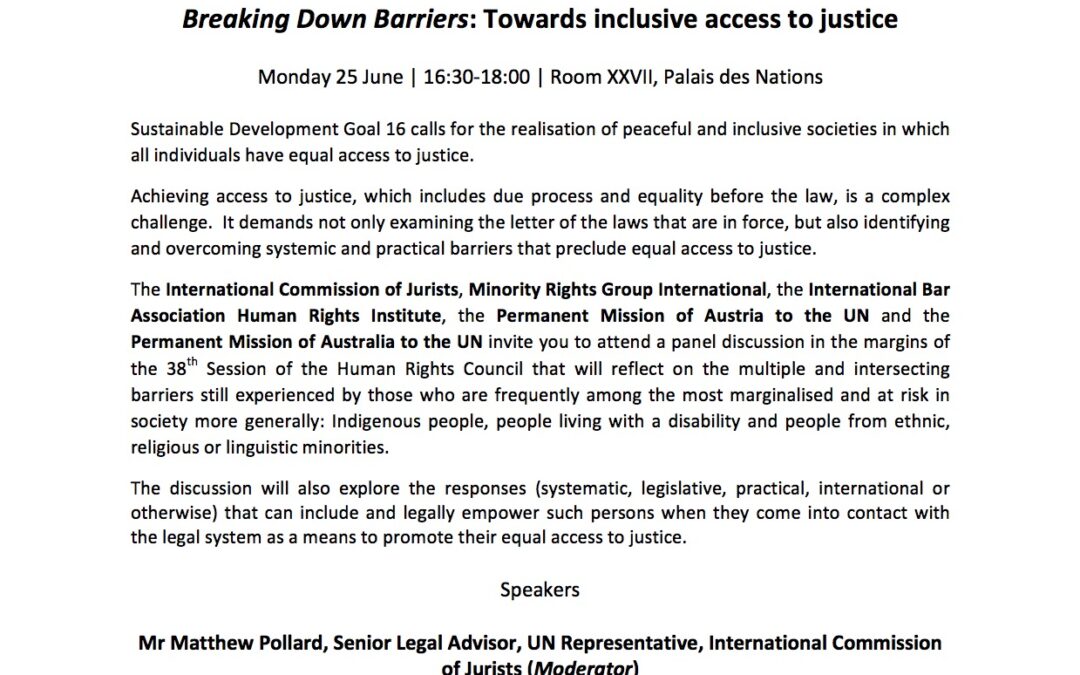
This side event to the UN Human Rights Council session addresses equal and effective access to justice for indigenous people, people living with a disability and people from ethnic, religious or linguistic minorities.
Monday 25 June | 16:30-18:00 | Room XXVII, Palais des Nations
Sustainable Development Goal 16 calls for the realisation of peaceful and inclusive societies in which all individuals have equal access to justice.
Achieving access to justice, which includes due process and equality before the law, is a complex challenge. It demands not only examining the letter of the laws that are in force, but also identifying and overcoming systemic and practical barriers that preclude equal access to justice.
The International Commission of Jurists, Minority Rights Group International, the International Bar Association Human Rights Institute, the Permanent Mission of Austria to the UN and the Permanent Mission of Australia to the UN invite you to attend a panel discussion in the margins of the 38th Session of the Human Rights Council that will reflect on the multiple and intersecting barriers still experienced by those who are frequently among the most marginalised and at risk in society more generally: Indigenous people, people living with a disability and people from ethnic, religious or linguistic minorities.
The discussion will also explore the responses (systematic, legislative, practical, international or otherwise) that can include and legally empower such persons when they come into contact with the legal system as a means to promote their equal access to justice.
Speakers:
Mr Matthew Pollard, Senior Legal Advisor, UN Representative, International Commission of Jurists (Moderator)
Dr June Oscar AO, Australia’s Aboriginal and Torres Strait Islander Social Justice Commissioner, Australian Human Rights Commission
Mr Glenn Payot, UN Representative, Minority Rights Group International
Ms Victoria Lee, Programme Manager, Human Rights and Disability Team, Office of the High Commissioner for Human Rights
For more information contact un(a)icj.org
Jun 22, 2018 | Advocacy, Non-legal submissions
The ICJ today issued a statement on online violence against women and girls.
The statement was issued on the occasion of an interactive dialogue at the UN Human Rights Council, with the UN Working Group on discrimination against women. The ICJ was unable to read the statement due to the limited time provided for NGO statements. The statement is as follows:
“International Commission of Jurists (ICJ) welcomes the Report of the Special Rapporteur focusing on online violence against women and girls.
This is timely considering the noted rise in incidents of women being attacked online for expressing their opinions. In many countries, women political dissenters and women human rights defenders, who express their views through social media, face backlash from the subjects of their criticisms and their supporters. They are persecuted and are threatened with sexual and physical violence. Many of the attacks against them clearly embody harmful gender stereotypes.
The ICJ notes that these harmful stereotypes exist in many countries around the world and they hinder women from accessing justice. Unfortunately, technology and social media play a role in spreading and proliferating these harmful gender stereotypes.
The ICJ continues to assist in strengthening the capacities of formal justice actors such as judges to help women access justice and to eliminate gender stereotypes. In 2016, the ICJ engaged with judges from the Philippines, Thailand, Timor Leste, and Indonesia when they developed and adopted the Bangkok General Guidance for Judges in Applying a Gender Perspective.
The ICJ joins the Special Rapporteur’s recommendation for States to provide training for all justice actors, including judges, to ensure their ability to bring perpetrators of cases of online and ICT-facilitated violence to justice. The ICJ offers the General Guidance as a tool for justice actors to consider evidence in these cases without resorting to gender stereotypes and to decide cases based on the principle of equality under international human rights standards.
The ICJ shall persist in its work to enable women to access justice and to eliminate gender-based violence and discrimination.”
Jun 21, 2018 | Events, News
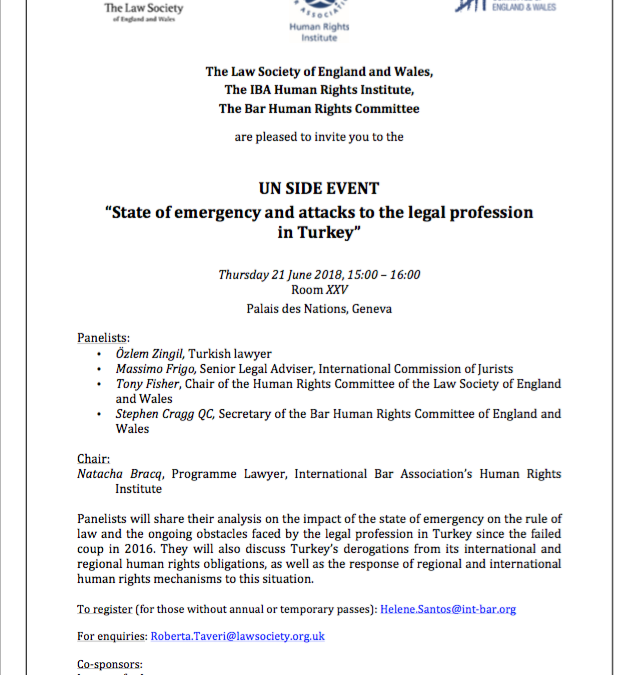
The ICJ will participate today in the side event “State of emergency and attacks on the legal profession in Turkey” organized by IBAHRI, the Law Society, and the Bar Human Rights Committee of England and Wales.
This side event at the Human Rights Council takes place on Thursday, 21 June, 15:00-16:00, room XXV of the Palais des Nations.
It is co-sponsored by Lawyers for Lawyers, Union Internationale des Avocats, Lawyers’ Rights Watch Canada.
In this side event, panelists will share their analysis on the impact of the state of emergency on the rule of law and the ongoing obstacles faced by the legal profession in Turkey since the failed coup in 2016.
They will also discuss Turkey’s derogations from its international and regional human rights obligations, as well as the response of regional and international human rights mechanisms to this situation.
Panelists:
- Özlem Zingil, Turkish lawyer;
- Massimo Frigo, International Commission of Jurists;
- Tony Fisher, Chair of the Human Rights Committee of the Law Society of England and Wales;
- Stephen Cragg QC, Secretary of the Bar Human Rights Committee of England and Wales;
- Natacha Bracq, Programme Lawyer, International Bar Association’s Human Rights Institute.
Geneva-SideEvent-StateofEmergencyLawyersTurkey-IBAHRI&others-June2018-ENG (download the flyer)