Jun 9, 2017 | Advocacy, Non-legal submissions
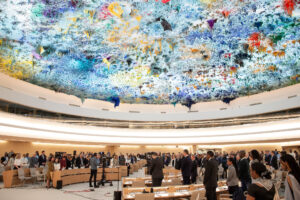
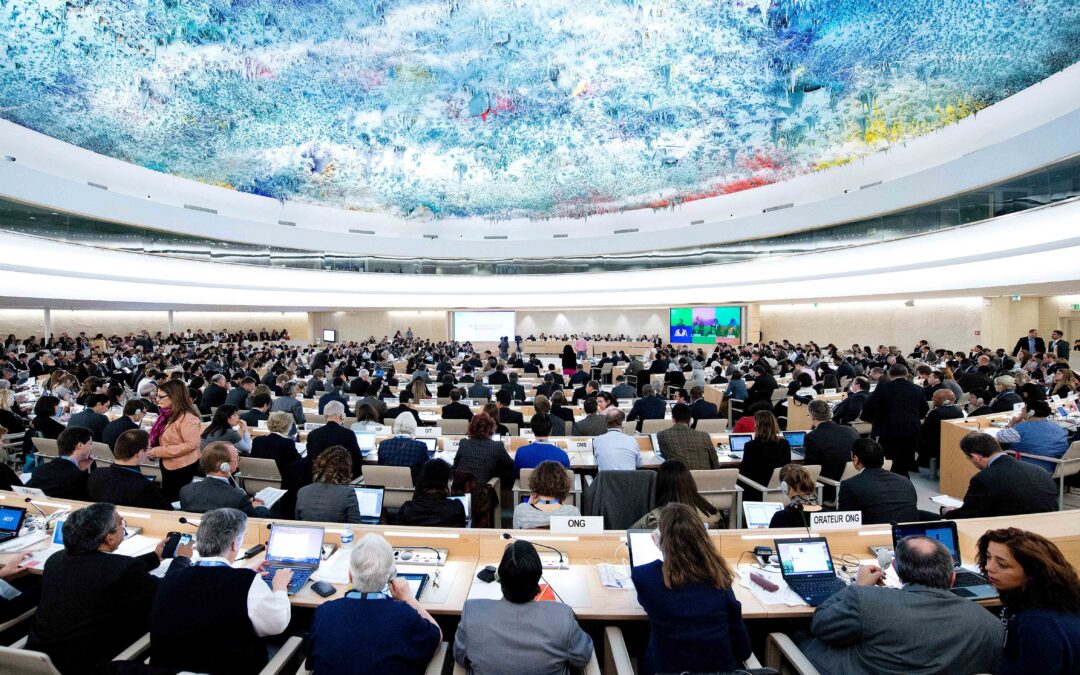
The ICJ today delivered an oral statement at the UN Human Rights Council, addressing global responses to corporate impunity, and addresing the role of judges and lawyers in relation to refugees and migrants.
The statement came in a clustered interactive dialogue with the UN Working Group on Business and Human Rights and the Special Rapporteur on the Human Rights of Migrants. These independent experts appointed by the Council were presenting their respective annual reports to the Council.
The ICJ stated as follows:
The ICJ welcomes the Study of the Working Group on Business and Human Rights, on cross-border cooperation between States with respect to law enforcement in relevant cases (A/HRC/35/33). The ICJ concurs with the Working Group’s concern for the “lack of political will by States to address business-related human rights abuses through the lens of criminal law” (para. 4) and the near-total lack of investigations and prosecutions against companies regarding human rights abuses and international crimes (para. 87).
The ICJ also concurs that a global approach is needed to address corporate impunity and supports the Working Group’s recommendations for adoption of legal frameworks imposing liability on legal entities (para. 93), creation of specialized investigative and prosecutorial units in cross-border human rights cases, and joint investigations. The ICJ would like to ask how the Working Group will support States to put these recommendations into practice?
The ICJ also welcomes the proposal of the Special Rapporteur on the Human Rights of Migrants for a 2035 agenda for facilitating human mobility. We particularly support the goal of effective access to justice for all migrants, and the targets and indicators on access to lawyers and courts for this goal, and in relation to returns and detention.
The ICJ has published a set of Principles on the Role of Judges and Lawyers in Relation to Refugees and Migrants, developed in consultation with leading practitioners and experts from around the world. We encourage States and other actors to take account of the detailed guidance in the ICJ Principles, including during the process for adoption of the Global Compacts foreseen by the New York Declaration for Refugees and Migrants, and in considering the Special Rapporteur’s proposal. We would like to ask the Special Rapporteur how States can better recognise and enable the role of judges and lawyers in relation to migrants?
The Chair of the Working Group on Business and Human Rights, in his concluding remarks, recognised the statement of the ICJ, and answered that the Working Group plans to follow up its report with a continuing conversation about its recommendations, and will reach out to stakeholders for further consultation on what more the WG can do in this regard.
The Special Rapporteur on Human Rights of Migrants also recognised the statement of the ICJ, and in his reponse emphasised that access to justice for migrants is key, including competent well-resourced lawyers, access to meaningful recourse, better funding for National Human Rights Institutions and ombudspersons, and providing in administrative law procedural safeguards that are commensurate to the risks that migrants face when such decisions are applied to them.
Jun 7, 2017 | Events, News
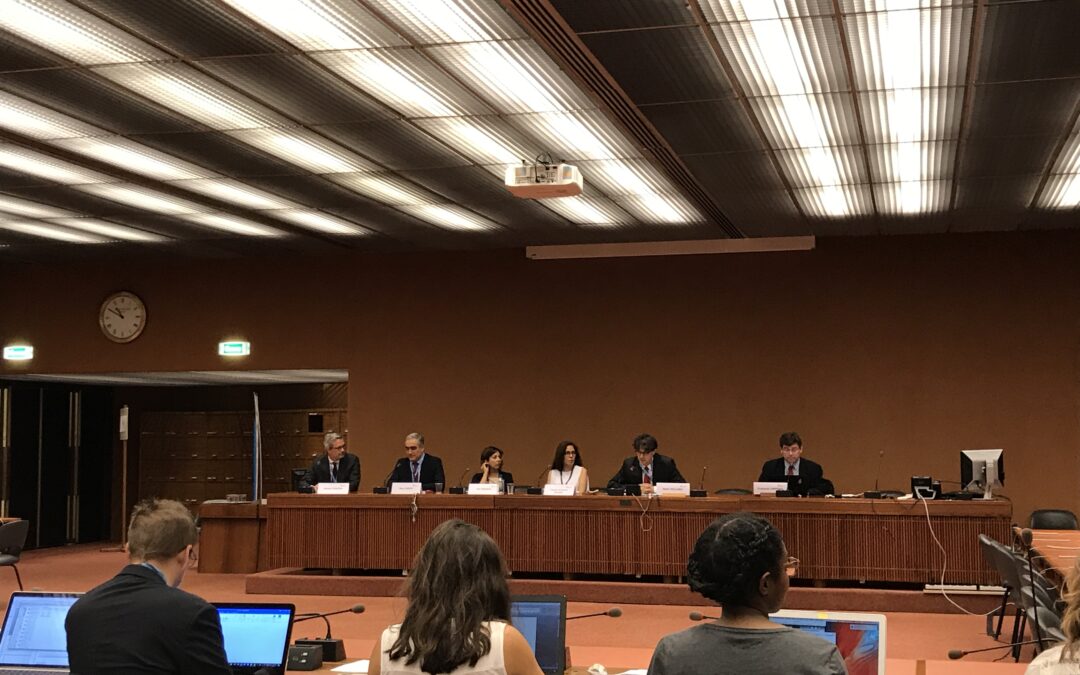
The ICJ organised a panel discussion on 8 June 2017, on the role of judges and lawyers in relation to refugees and migrants, at a side event to the 35th session of the UN Human Rights Council in Geneva.
The Panel was held on the occasion of the publication of ICJ Principles and Commentary on the topic, developed in consultation with judges, lawyers and other expert practitioners from around the world.
The event took place on Thursday, 8 June 2017, from 10:30 to 11:30, in Room XXI of the Palais des Nations, Geneva.
Welcome remarks were delivered by:
- Saman Zia-Zarifi, Secretary General of the ICJ.
- Olivier Coutau, Délégué à la Genève internationale, Republic and Canton of Geneva
Panelists included:
- François Crépeau, UN Special Rapporteur on the human rights of migrants.
- Carole Simone Dahan, Senior Legal Advisor on Judicial Engagement, UNHCR.
- Pia Oberoi, Advisor on Migration and Human Rights, OHCHR.
The discussion was moderated by Matt Pollard, ICJ Senior Legal Adviser.
At the event, each of the panelists emphasised the importance of access to independence courts and lawyers for securing the rights of refugees and migrants, and highlighted the importance and utlity of the ICJ Principles in this regard.
More background on the ICJ Principles and Commentary is available by clicking here.
For more information, email un(a)icj.org
A flyer for the event may be downloaded in PDF format here: Refugees-Migrants-ICJ-Event-HRC35-June2017
The consultations, development and publication of the ICJ Principles were made possible with the financial support of the Republic and Canton of Geneva, for which the ICJ is grateful.
May 16, 2017 | News
Non-governmental organisations interested in participating in UN human rights mechanisms have until 1 June 2017 to submit an application for consideration during 2017.
The International Commission of Jurists, which itself has had consultative status with the UN since 1957, has been requested by the United Nations to disseminate the following information about the upcoming deadline for other interested NGOs to obtain UN consultative status:
1 June 2017 is the last day for Non-Governmental Organizations to apply for consultative status with the Economic and Social Council (ECOSOC), in order to have an opportunity to take part in UN deliberations. ECOSOC consultative status is governed by ECOSOC resolution 1996/31, which outlines the eligibility requirements for consultative status, rights and obligations of NGOs in consultative status, procedures for the withdrawal or suspension of consultative status, the role and functions of the ECOSOC Committee on NGOs, and the responsibilities of the UN Secretariat in supporting the consultative relationship. Consultative status is granted by ECOSOC upon recommendation of the ECOSOC Committee on NGOs, which is composed by Member States.
Who is eligible for applying?
Consultative relationships may be established with international, regional, sub regional and national non-governmental, non-profit public or voluntary organizations. NGOs affiliated to an international organization already in status may be admitted provided that they can demonstrate that their programme of work has direct relevance to the aims and purposes of the United Nations.
To be eligible for consultative status, an NGO must have been in existence (officially registered with the appropriate government authorities as an NGO/non-profit) for at least two years, must have an established headquarters, a democratically adopted constitution, authority to speak for its members, a representative structure, appropriate mechanisms of accountability and democratic and transparent decision-making processes. The basic resources of the organization must be derived in the main part from contributions of the national affiliates or other components or from individual members.
What are the benefits?
NGOs that are accredited with ECOSOC can participate in a number of events, including, but not limited to regular sessions of ECOSOC, its functional commissions and its other subsidiary bodies. NGOs may:
- Attend official meetings;
- Submit written statements prior to sessions;
- Make oral statements;
- Meet official government delegations and other NGO representatives;
- Organize and attend parallel events that take place during the session;
- Participate in debates, interactive dialogues, panel discussions and informal meetings.
Organizations established by governments or intergovernmental agreements are not considered NGOs.
Information about how to apply is available here: http://csonet.org/index.php?page=view&nr=377&type=230&menu=14
Please note that ICJ is not itself involved or in a position to assist with applications for UN consultative status and all queries should be directed to the UN.
May 10, 2017 | Advocacy, News, Non-legal submissions
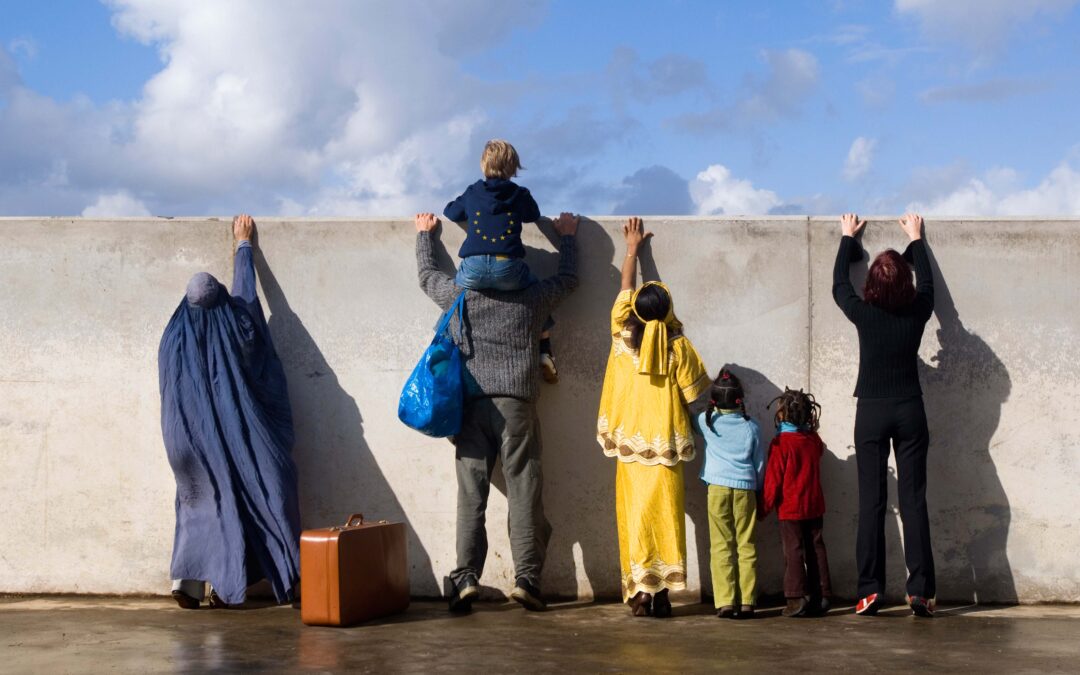
The ICJ emphasised the role of judges and lawyers in protecting human rights of migrants, during consultations at the UN in Geneva, as part of the preparatory process for a Global Compact on migration.
The informal consultation was convened by the UN General Assembly and held in Geneva on 8-9 May 2017. With a focus on human rights of migrants, it was the first thematic consultation to be held in connection with ongoing efforts by States to agree a UN global compact for safe, orderly and regular migration.
In addition to a written submission, the ICJ made statements during the main discussion, and as part of the concluding discussions.
The initial statement highlighted the recently published Principles on the Role of Judges and Lawyers in relation to Refugees and Migrants, developed by the ICJ in consultation with a wide range of relevant experts.
The concluding statement emphasised that effective protection of human rights, including of migrants, requires equal and effective access to impartial courts and independent lawyers, and urged States to ensure that the need for legal and practical guarantees for such access is reflected in the Global Compact eventually to be adopted. Indeed, the ICJ noted, access of individuals to a means of their enforcement is a key element distinguishing durable “rights” from, for instance, welcome but not necessarily permanent generosity.
For more information about the Principles on the Role of Judges and Lawyers in relation to Refugees and Migrants, click here.
Mar 13, 2017 | Events, News
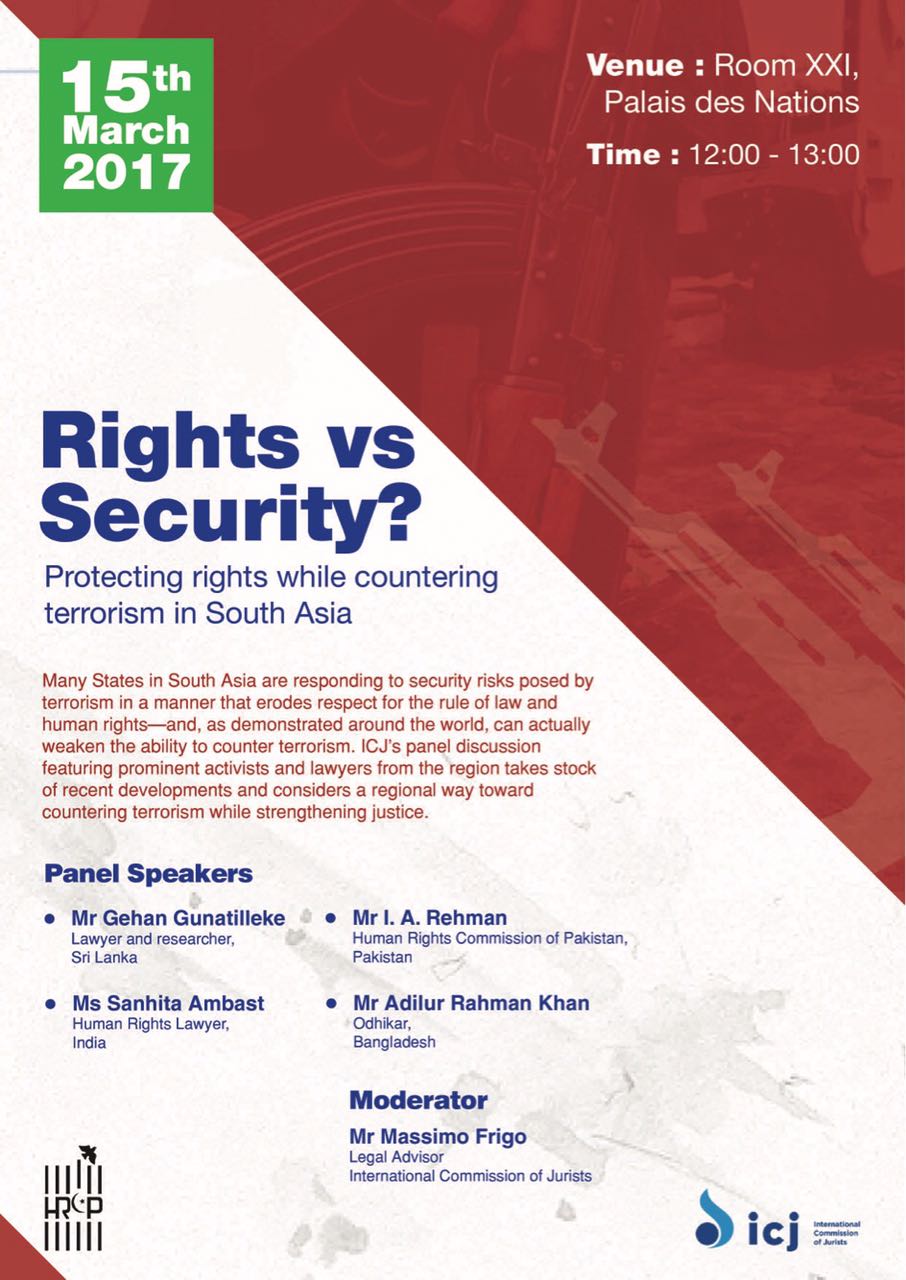
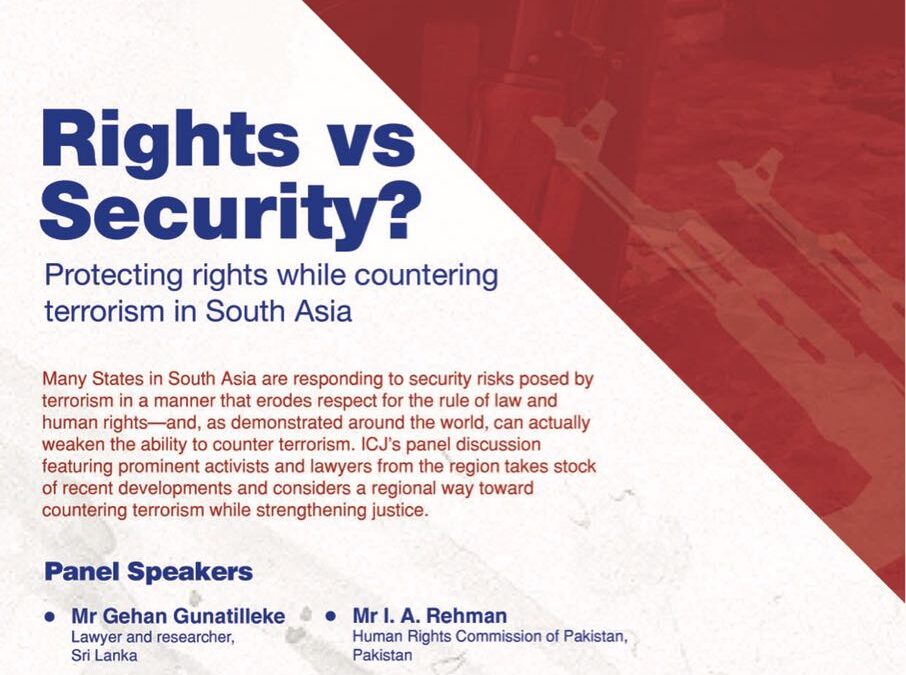
The ICJ and the Human Rights Commission of Pakistan are convening a side event at the UN Human Rights Council, entitled “Rights vs Security? Protecting human rights while countering terrorism in South Asia”.
The event takes place 15 March 2017, 12:00-13:00, Palais des Nations, Room XXI
Many States in South Asia are responding to security risks posed by terrorism in a manner that erodes respect for the rule of law and human rights—and, as demonstrated around the world, can actually weaken the ability to counter terrorism. ICJ’s panel discussion featuring prominent activists and lawyers from the region takes stock of recent developments and considers a regional way toward countering terrorism while strengthening justice.
Panelists:
Mr I. A. Rehman: Human Rights Commission of Pakistan (Pakistan)
Mr Adilur Rahman Khan: Odhikar (Bangladesh)
Mr Gehan Gunatilleke: Lawyer and researcher (Sri Lanka)
Ms Sanhita Ambast: Human rights lawyer (India)
Moderator:
Mr Massimo Frigo: International Commission of Jurists
A flyer may be downloaded here.