Mar 13, 2017 | Advocacy, Non-legal submissions
The ICJ today delivered a joint NGO oral statement to the UN Human Rights Council on the need in Myanmar for an international Commission of Inquiry and for an independent and self-governing legal profession.
In the statement, the International Commission of Jurists, joined by the International Bar Association’s Human Rights Institute and Lawyers’ Rights Watch Canada, welcomed the report of the Special Rapporteur on the situation for human rights in Myanmar, and her recommendation for a Commission of Inquiry to investigate persecution of Rohingya and other minorities in Rakhine State.
Since 9 October 2016, Myanmar’s security forces have reportedly targeted Rohingya during “clearance operations” which have no basis in law. Attacks against women, men, and children allegedly have involved extrajudicial killings; enforced disappearances; torture and other ill-treatment including rape and other sexual violence; hundreds of arbitrary arrests and detentions; forced displacement; and looting and destruction of homes, food and other property.
To date, authorities in Myanmar appear to have been unwilling or unable to investigate abuses or hold perpetrators accountable. Several national investigation commissions have lacked impartiality and independence. National judicial and law enforcement authorities lack capacity and independence to address this situation. Accordingly, we urge Council to adopt a resolution at this session establishing an international, independent Commission of Inquiry to assess facts, identify causes and perpetrators, and issue recommendations including remedies for victims.
The recent killing of lawyer U Ko Ni, who strongly advocated against religious discrimination and for inter-communal peace, must be subject to a prompt, impartial and effective investigation capable of identifying all those responsible and holding them accountable in a fair trial. It also underscores the urgent need for an independent and self-governing legal profession in Myanmar, enabled to uphold human rights and the rule of law without fear.
The statement may be downloaded in PDF format here: HRC34-OralStatement-Myanmar-2017
Mar 12, 2017 | Events, News
A side event to the UN Human Rights Council, Tuesday 14 March, 16.00 – 17.00, Palais des Nations room XXI.
TORTURE AND ENFORCED DISAPPEARANCE IN THAILAND
THE STATE RESPONSE
Tuesday 14 March/16.00-17.00
room XXI
Panelists:
Angkhana Neelapaijit, National Human Rights Commissioner and family victim of enforced disappearance
Yuval Ginbar, Amnesty International legal advisor
Moderated by Matt Pollard, ICJ Senior Legal advisor
The event follows the Human Rights Committee’s examination of Thailand’s second periodic report on its implementation of the International Covenant on Civil and Political Rights on 13 and 14 March 2017.
The event will focus on the measures Thailand has taken to implement its international human rights obligations with respect to the prohibition of enforced disappearance, torture and ill-treatment – with a particular focus on the draft Prevention and Suppression of Torture and Enforced Disappearance Act (Draft Law).
Background
Eighty-two cases of enforced or involuntary disappearance in Thailand were reported to the Working Group on Enforced or Involuntary Disappearances between 1980 and 2016. Civil society has also issued several reports containing allegations of torture by security forces, particularly in the restive deep South. These allegations were made against a culture of impunity which pervades Thailand.
In October 2016, after 11 years and three months of investigation, the Department of Special Investigation (‘DSI’) declared the emblematic enforced disappearance case of Somchai Neelapaijit closed, saying no culprits had been found. In January 2017, the DSI further announced it would not investigate the apparent enforced disappearance of Pholachi “Billy” Rakchongcharoen, a Karen minority human rights defender. These cases underscore the difficulties victims face in obtaining justice under the current legal framework in Thailand.
For several years, Thailand has pledged its commitment to ratifying the International Convention on Enforced Disappearance (ICCPED) and passing domestic legislation criminalizing torture and enforced disappearance. In May 2016, the Cabinet approved a Draft Law, which was subsequently transmitted to Thailand’s legislature, the National Legislative Assembly (NLA). However, last month, the NLA announced it would send the Draft Law back to the Cabinet for further consultation, effectively ending the possibility of it being enacted in the foreseeable future.
For further information on recent developments concerning this piece of legislation, please see: https://www.icj.org/thailand-prioritize-the-amendment-and-passage-of-legislation-on-torture-and-enforced-disappearances/.
A flyer for the event may be downloaded here.

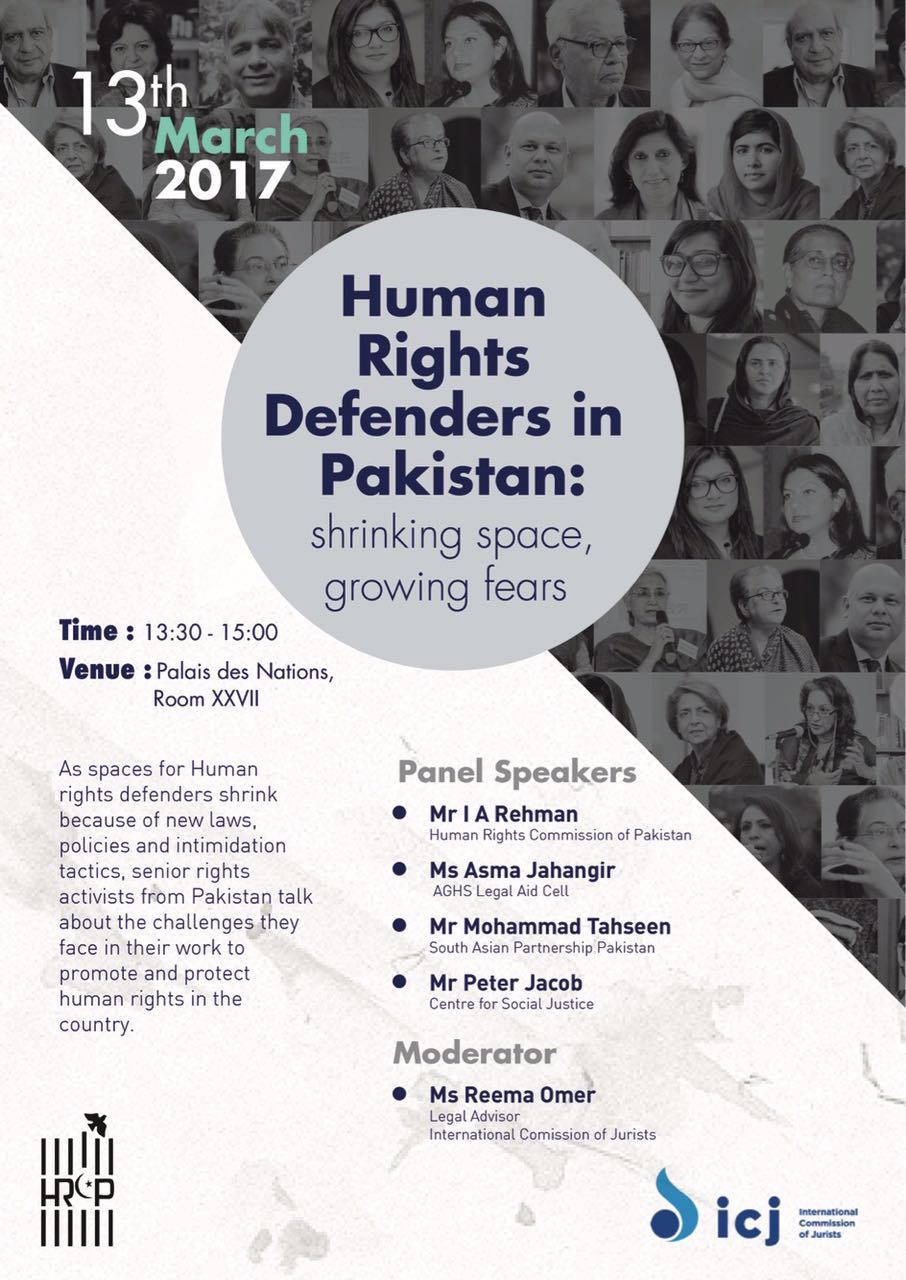
Mar 12, 2017 | Events, News
A side event at the UN Human Rights Council, 13 March 2017.
13 March, 13:30-15:00
Palais des Nations, Room XXVII
As spaces for human rights defenders shrink because of new laws, policies and intimidation tactics, senior rights activists from Pakistan talk about the challenges they face in their work to promote and protect human rights in the country.
Panelists:
Mr I. A. Rehman: Human Rights Commission of Pakistan
Ms Asma Jahangir: AGHS Legal Aid Cell
Mr Mohammad Tahseen: South Asia Partnership Pakistan
Mr Peter Jacob: Center for Social Justice
Moderator:
Ms Reema Omer: International Commission of Jurists
Flyer available here.
Mar 12, 2017 | Advocacy, Non-legal submissions
The ICJ has made an oral statement to the UN Human Rights Council on a range of measures needed to ensure truth, justice, reparations and non-repetition of past violations, in Nepal.
The statement read as follows:
TRUTH, JUSTICE, REPARATION, AND GUARANTEES OF NON-RECURRENCE IN NEPAL
10 March 2017
Mr. President
Without effective measures to ensure truth, justice, reparation and guarantees of non-recurrence, countries in situations of transition or post-conflict fail victims and put future reconciliation, peace and stability at risk. One example is Nepal.
Nepal’s Truth and Reconciliation Commission and Commission of Investigation on Disappeared Persons have not been effective. Changes are needed to bring their legal frameworks and operations in line with international standards and Supreme Court jurisprudence. These bodies require adequate resources. Trust-building measures including consultation processes must address the perspectives and needs of victims and for victims to feel ownership over the transitional justice process in Nepal.
Nepal must ensure prompt, independent and impartial investigation and prosecutions for serious human rights violations, including those committed during the armed conflict.
It must ensure justice and reparation for victims, including as provided for in the UN Basic Principles and Guidelines on the Right to a Remedy and Reparation.
It must criminalize serious crimes under international law in a manner that is consistent with international law, to help prevent such violations ever occurring again.
Nepal should also issue a standing invitation to all thematic special procedures of the Council.
Thank you, Mr. President.
Mar 12, 2017 | Advocacy, Non-legal submissions
The ICJ made an oral statement to the Human Rights Council, on the role of judges and lawyers in relation to large movements of migrants and refugees.The statement, made in an Enhanced Interactive dialogue on human rights and large movements of migrants, was as follows:
THE ROLE OF JUDGES AND LAWYERS IN RELATION TO LARGE MOVEMENTS OF REFUGEES AND MIGRANTS
10 March 2017
Mr. President,
The International Commission of Jurists (ICJ) welcomes the Principles and Guidelines included in the High Commissioner’s report and conference room paper. The ICJ appreciates their emphasis on equal and effective access to justice for migrants, and the recognition that this requires legal assistance that is competent, independent, confidential, and, when needed, without charge, as well as due process guarantees. We welcome the clear affirmation of the essential role of judges and lawyers in upholding and protecting the human rights of migrants and the rule of law.
To complement these and other relevant standards, the International Commission of Jurists is developing a set of Principles and recommendations specifically focussed on the role of judges and lawyers in relation to large movements of refugees and migrants. The ICJ principles and recommendations are based on global consultations with senior judges, lawyers, UN agencies, regional human rights mechanisms, and other relevant legal experts.
The ICJ Principles and recommendations address the role of judges and lawyers in status determination procedures, in relation to detention and removal, the right to an effective remedy, the importance of ensuring independence and impartiality of judicial decision-makers, equality before the law, and the relationship between national judiciaries and international law.
In addition to a consultation we convened yesterday at a parallel event, we welcome further feedback on the draft ICJ Principles from all stakeholders, before we launch the final version at the June session of the Human Rights Council.
Thank you.
Download the draft Principles here: https://www.icj.org/refugeesmigrantsconsultation/
Please send written feedback to un(a)icj.org, until 14 April 2017.